In the shadow of ongoing tensions with Iran, threats to the Strait of Hormuz, and high-stakes negotiations, President Donald Trump’s administration is actively pushing to expand the Abraham Accords. Recent statements tie potential deals with Tehran directly to broader normalization between Israel and additional Arab and Muslim-majority countries — including key Gulf states. The strategy appears aimed at building a stronger regional coalition that economically and strategically integrates more nations, potentially marginalizing the hardline influence of Iran’s Islamic Revolutionary Guard Corps (IRGC) and its proxy networks. But can these accords truly help “keep the IRGC in line,” especially amid disputes over energy chokepoints like the Strait of Hormuz?
A Quick Summary of the Abraham Accords Today
The Abraham Accords, brokered by the first Trump administration, represent a paradigm shift in Middle East diplomacy. Unlike previous peace efforts that linked normalization to resolution of the Israeli-Palestinian conflict, these agreements prioritized direct bilateral normalization between Israel and Arab states based on shared interests — particularly countering Iranian influence — while opening doors to economic, technological, security, and cultural cooperation.
Current signatories and status (as of May 2026):
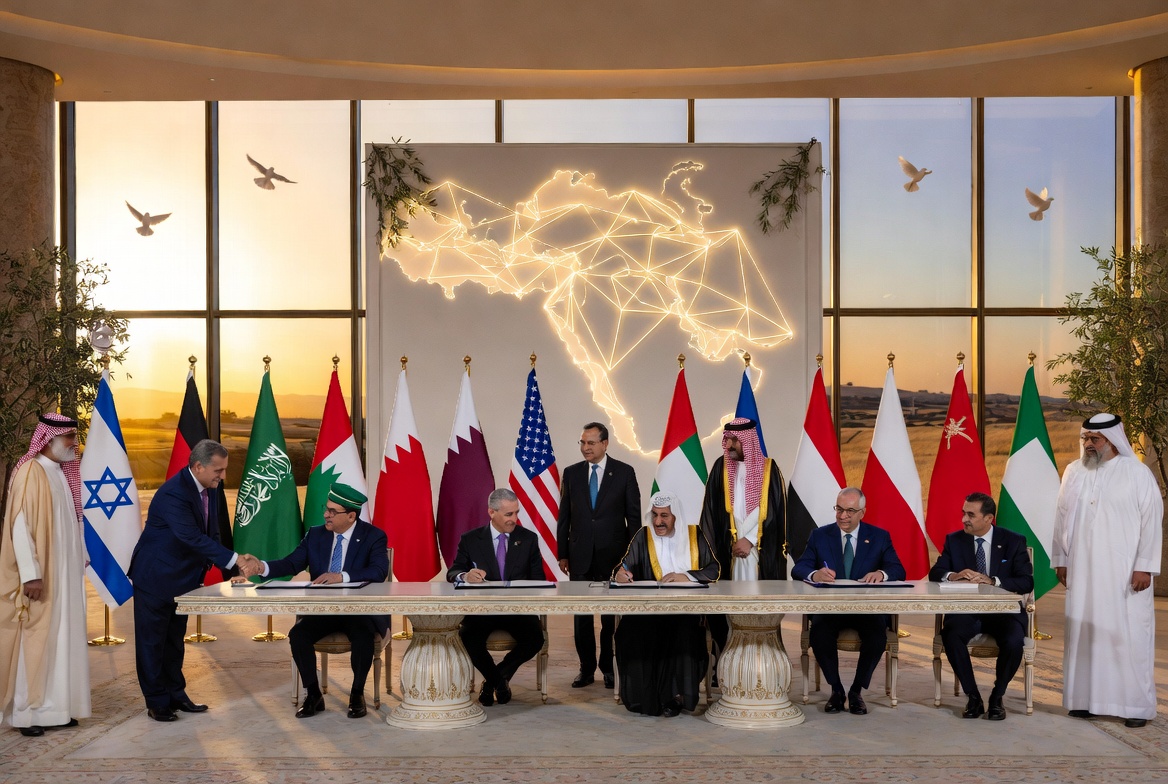
Original core (2020): Israel, the United Arab Emirates (UAE), and Bahrain (signed September 15, 2020, in Washington, D.C.). Morocco joined in December 2020.
Sudan: Agreed in principle, but full ratification stalled due to internal instability.
Recent expansions: Kazakhstan formally joined in late 2025/early 2026 (first Central Asian addition). Somaliland pledged to join following Israel’s recognition of its independence in December 2025.
Ongoing push: The second Trump administration is actively courting Saudi Arabia, Syria, Lebanon, and others. Trump has repeatedly stated he expects major expansion soon, with Saudi Arabia as the potential catalyst (“when Saudi Arabia goes in, everybody goes in”).
The accords have proven resilient. Despite the Gaza war and related tensions, no signatory has fully severed ties with Israel, though some relations cooled temporarily (e.g., Bahrain recalled its ambassador symbolically). Trade, investment, tourism, technology, and defense cooperation between Israel and the UAE, Bahrain, and Morocco have grown significantly.
Key language and principles (from the Abraham Accords Declaration and bilateral agreements):
The foundational declaration emphasizes:“Maintaining and strengthening peace in the Middle East and around the world based on mutual understanding and coexistence, as well as respect for human dignity and freedom, including religious freedom.”
Promoting “interfaith and intercultural dialogue to advance a culture of peace among the three Abrahamic religions and all humanity.”
Addressing challenges “through cooperation and dialogue” and developing “friendly relations among States” for lasting peace.
Seeking “tolerance and respect for every person… no matter their race, faith or ethnicity.”
Supporting “science, art, medicine, and commerce” to bring nations closer.
Seeking to “end radicalization and conflict to provide all children a better future.”
Pursuing a “vision of peace, security, and prosperity in the Middle East and around the world.”
Bilateral agreements commit parties to full diplomatic relations (including embassies), direct flights, and cooperation across investment, tourism, security, telecommunications, technology, energy, healthcare, culture, environment, and more. They recall prior peace treaties (Egypt, Jordan) and express commitment to advancing comprehensive Middle East peace.
These documents are available on the U.S. State Department site.
How the Accords Help Ensure Peace in the Middle East
The accords created a new “normalization-first” model that bypassed traditional roadblocks. By fostering economic interdependence and practical cooperation, they raise the cost of conflict for participants. Joint ventures in tech, energy, water, and defense create stakeholders invested in stability.
Strategically, they align Sunni Arab states and Israel against shared threats — most notably Iran’s regional ambitions and its network of proxies (Houthis, Hezbollah, etc.). This has enabled intelligence sharing, security coordination, and a de facto “Abraham Accords ecosystem” that complicates Iranian adventurism.
The framework has survived major tests (including post-Oct. 7, 2023, pressures) without collapse, demonstrating durability. Expanded cooperation also supports interfaith efforts and counters radicalization narratives. Economically, it has unlocked billions in trade and investment, with potential for far more if Saudi Arabia and others join fully.
Critics note limitations: Public opinion in many Arab countries remains skeptical (often tied to the Palestinian issue), and Saudi Arabia continues to condition full normalization on progress toward a Palestinian state. Still, the accords have shifted the regional paradigm toward pragmatism over ideology.
Trump Administration Statements: Expanding the Accords to Counter Iran and Integrate the Gulf
President Trump has long championed the accords as a signature achievement and has made expansion a priority in his second term. He has pushed for Saudi Arabia as the linchpin and floated broader inclusion.
In a striking development as of May 25, 2026, Trump explicitly linked Iran negotiations to Abraham Accords expansion. In a Truth Social post, he stated that negotiations with Iran are “proceeding nicely” and declared:
“I am mandatorily requesting that all Countries immediately sign the Abraham Accords, and that, if Iran signs its Agreement with me, as President of the United States of America, it would be an Honor to have them also be part of this unparalleled World Coalition.”
He referenced a Saturday call with leaders of Saudi Arabia, Qatar, the UAE, Bahrain, and others (including Pakistan, Turkey, Egypt, and Jordan), telling them it should be “mandatory” for these countries to sign the accords “at a minimum, simultaneously” as part of resolving the broader puzzle with Iran. Trump suggested that once a deal with Iran is reached, these nations (and potentially Iran itself) could join or strengthen the coalition.
This aligns with earlier comments where Trump expressed hope for rapid expansion and even mused about Iran one day participating. The approach seems designed to use momentum from any Iran de-escalation (or deal covering hostilities, the Strait of Hormuz, and nuclear issues) to lock in a wider pro-stability, Israel-normalizing bloc across the Gulf and beyond. This could help “keep Gulf countries in line” by tying them into a U.S.-brokered framework of economic integration and implicit security alignment, reducing space for Iranian influence or adventurism.
The Strait of Hormuz, Iran, and Participation in the Accords
The Strait of Hormuz remains a critical flashpoint. Iran has floated or discussed tolls/fees for passage (in talks with Oman) and has made threats or taken actions affecting shipping amid broader tensions. Roughly 20% of global oil and LNG transits through this chokepoint. International pushback (including from the U.S. and China) against unilateral tolls or militarization is strong, as it violates norms of free navigation.
Any Iran deal under discussion likely includes expectations around reopening secure passage without coercive tolls. If Iran does not move quickly to allow free passage without tolls in the coming days, it would signal that hardline elements (particularly within the IRGC) retain significant sway and are unwilling to fully de-escalate. This would make Iranian participation in anything resembling the Abraham Accords framework even more remote in the near term — Trump’s hypothetical aside. Ideologically, the IRGC and Iranian leadership have long opposed Israel’s existence; normalization would require a fundamental shift.
However, Iranian intransigence over the strait and related issues would strengthen the case for accelerating the expansion of the Accords among Gulf and other states. A broader coalition of normalized countries could better coordinate to deter threats to energy infrastructure and shipping, enhance collective security, and economically isolate or pressure Iranian adventurism. In short, refusal to stabilize the strait would highlight why integrating more regional players into the Accords ecosystem serves U.S., Israeli, and Gulf energy security interests.
Bottom Line: A Powerful Tool, But Not a Magic Wand
The Abraham Accords are not a direct lever to “control” the IRGC — that would require sustained military, economic, and diplomatic pressure. However, by building a widening circle of economically intertwined, Israel-normalized states, they create a structural counterweight. They raise the costs of Iranian disruption (especially to energy flows), foster pragmatic cooperation over radical ideologies, and give the U.S. additional diplomatic tools.
Trump’s current push — explicitly tying Gulf and other nations’ participation to Iran diplomacy while floating even broader inclusion — represents an ambitious bid to reshape the region. Success depends on delivering tangible economic/security benefits, navigating Saudi conditions on Palestine, and managing Iranian responses.
Personally, I still do not see an end to the IRGC’s violence without the Venezuelan-style controls placed on Iran’s Oil and Gas exports. In my opinion, the Abraham Accords are fantastic for long-term peace, but they would not be able to control the IRGC. They only understand violence and brute control. As evidenced by their killing of 40 to 50 thousand of their own citizens. We see higher oil prices, but this crisis may allow a financial crisis for the Newly appointed Fed Chair to push for lower rates right before the 3 to 9 trillion that is due to be refinanced at the Fed at lower interest rates. That is pure speculation, but it does seem convenient.
For global energy markets, a more integrated and stable Middle East under an expanded Accords framework would be a significant positive, reducing risks around the Strait of Hormuz and supporting reliable supply chains. In the short run, we see volatile price swings in paper oil trades that eventually catch up to physical delivery prices.
The coming weeks and months will test whether this vision advances or stalls.
Appendix: Sources and Links
- Official Abraham Accords Declaration and texts: U.S. Department of State — https://www.state.gov/the-abraham-accords (includes PDFs of declaration and bilateral agreements).
- Current status and expansions: Wikipedia summary (well-sourced) and Britannica overview.
- Trump’s May 25, 2026, statements linking Accords to Iran deal: Reuters, CNBC, Times of Israel, CNN, and Washington Post reporting on Truth Social post and calls with regional leaders.
- Strait of Hormuz context and tolls discussions: New York Times, Jerusalem Post, and related reporting (May 2026).
- Broader analysis: Middle East Institute, Atlantic Council, and Hudson Institute pieces on Accords resilience and expansion potential.
- Additional context: Axios reporting on Trump’s calls with Arab/Muslim leaders.
For the latest developments, monitor official White House/Truth Social statements and credible energy/geopolitical outlets. Energy News Beat will continue tracking how these diplomatic moves intersect with global oil and gas security.