

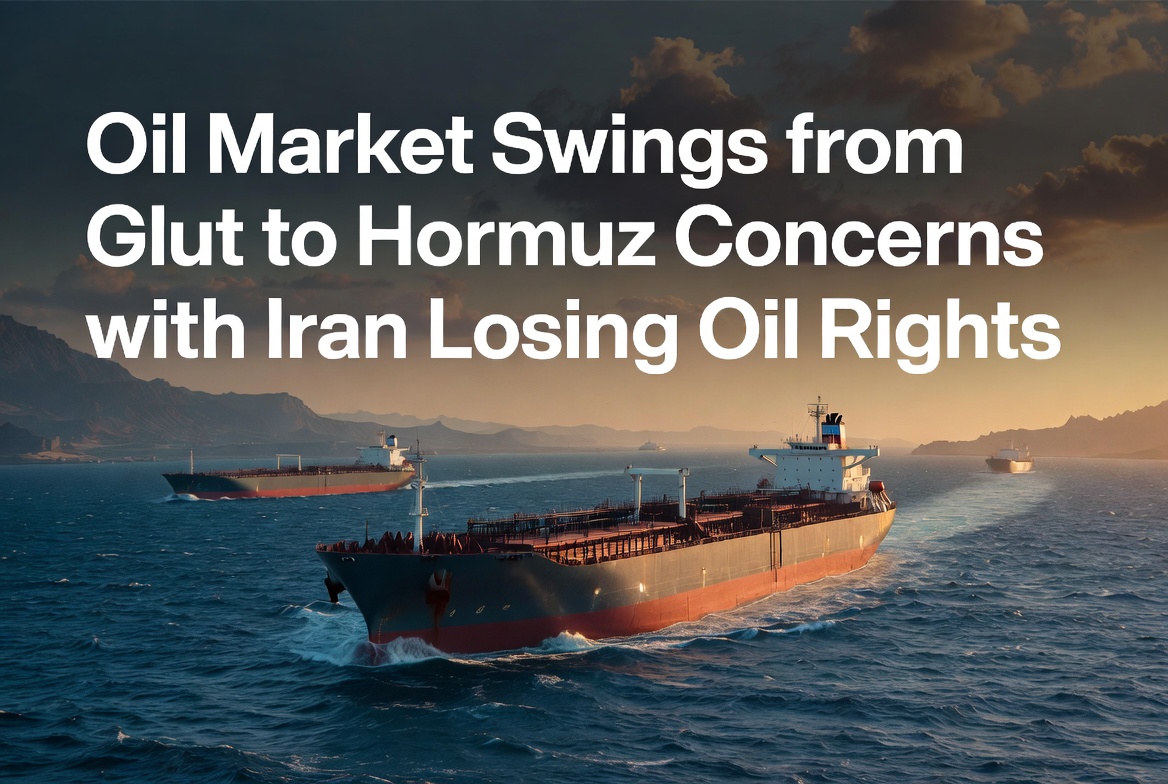
The global oil market is experiencing sharp volatility, shifting rapidly from fears of an impending glut to renewed geopolitical risks centered on the Strait of Hormuz. This comes amid escalating U.S.-Iran tensions, highlighted by Washington’s revocation of a key license allowing Iranian oil sales and Tehran’s persistent efforts to impose fees or tolls on shipping through the critical chokepoint.
From Glut Fears to Hormuz Toll Concerns
Just days ago, analysts warned of a potential supply glut as tanker traffic from the Persian Gulf surged. OPEC+ production rose significantly, the U.S. hit new output records near 14 million barrels per day (bpd), and the UAE exported at all-time highs while refilling depleted global inventories after earlier disruptions.
JP Morgan analyst Natasha Kaneva noted that “the surge in oil supply is about to collide with a market that, at least for now, simply does not need it.”
However, attention has quickly pivoted to the Strait of Hormuz. European buyers and some Gulf officials are preparing for the possibility that Iran (potentially with Oman) could impose transit tolls or service fees, which could be factored into oil pricing. International maritime law generally prohibits tolls on international straits used for navigation, and the U.S. and major players have rejected the idea outright.
A mid-June U.S.-Iran Memorandum of Understanding (MOU) included a 60-day window for fee-free transits, but that period and related concessions are now under severe strain.
U.S. Revokes Iran’s Oil Sales License
In a major development on July 7, 2026, the U.S. Treasury Department revoked the general license (General License X, issued June 22) that had authorized the production, delivery, and sale of Iranian crude oil, petrochemicals, and petroleum products through August 21, 2026.
The move was explicitly tied to Iran’s “wholly unacceptable” actions in the Strait of Hormuz, including recent attacks on tankers not following Iranian-preferred routes or paying fees. A wind-down period runs until July 17 for transactions already underway. Oil prices jumped more than 5% on the news.
This revocation effectively strips Iran of a core economic concession tied to the fragile MOU, marking a significant blow to Tehran’s oil export “rights” under the interim framework. The MOU was performance-based, and Iran’s Hormuz moves crossed a red line for Washington.
Iran’s Oil Exports to China: Shadow Fleet Resilience Amid Sharp Declines
Iran’s oil lifeline remains overwhelmingly dependent on China, which has long absorbed 80-90% of its seaborne exports through a sophisticated “shadow fleet” of aging tankers, ship-to-ship transfers, and sanctions-evasion tactics (opaque ownership, deactivated transponders, yuan settlements, etc.).
In 2025, Iran exported roughly 1.4 million bpd to China via the shadow fleet, generating around $31 billion in revenue (about 45% of Iran’s government budget at the time).
Early 2026 saw averages around 1.1–1.4 million bpd to China before disruptions.
However, U.S. naval enforcement and a de facto blockade caused a dramatic collapse in May 2026:
Exports fell over 90% to record lows (UANI tracked ~65,000 bpd total; Kpler/Vortexa reported ~209,000–260,000 bpd crude/condensate — the lowest in at least six years). No crude oil successfully exited the blockade line.
China’s imports of Iranian crude dropped to around 1.1 million bpd in May.
Exports began resuming in mid-June after the MOU (e.g., TankerTrackers reported significant loadings, including supertankers carrying millions of barrels), but volumes remain volatile and far below pre-disruption peaks.
Exact counts of individual tankers “purchased” or loaded with Iranian oil are not publicly tallied in aggregate (the shadow fleet involves hundreds of vessels with frequent ship-to-ship transfers), but tracking firms monitor dozens of loadings monthly when flows are normal. China continues as the dominant buyer of discounted Iranian crude despite risks.
Hormuz Tolls/Fees: Attempts at Collection vs. Limited Success and Threats
Iran has established the Persian Gulf Strait Authority and implemented a de facto “toll booth” system run by the IRGC. Vessels must submit documentation, obtain clearance, and sometimes follow escorted corridors. Iran frames these as “service fees,” “navigational fees,” or “insurance fees” rather than outright tolls (to navigate international law concerns), with reported charges up to $2 million per vessel in some claims.
Iran claims hundreds of ships (e.g., reports of 300 sign-ups) have applied for “safe passage.”
Some vessels — reportedly including smaller operators and payments settled in yuan — have paid fees. Earlier reports mentioned Iran banking initial revenues.
However, major global shipping companies largely refuse to pay, citing illegality under international law for an international strait. The U.S. (including statements from officials like Marco Rubio) has been unequivocal: no tolls or fees are permitted.
The MOU provided a 60-day fee-free window, but Iran has signaled it intends to charge after that period, offering “special treatment” to friendly nations like China.
Iran appears partially incapable of widespread, effective toll collection due to legal barriers, resistance from major players, potential U.S./allied naval presence, and the practical difficulties of enforcing fees in international waters without broad compliance. Yet Tehran continues to threaten or carry out actions against non-compliant shipping (as referenced in the recent tanker attacks that triggered the U.S. license revocation).
This creates ongoing risk premiums in oil pricing despite the glut narrative.
Iran’s Financial System Strains: Sanctions, Disruptions, and Shadow Networks
Iran’s conventional financial system is under severe pressure from long-standing sanctions, recent conflict impacts, and internal issues:
Banking disruptions (failed card/POS transactions, transfer issues) have been widely reported.
Bank collapses/mergers (e.g., Bank Noor and Ayandeh into Bank Melli) and broader economic strain (rial devaluation, budget deficits, protests) have occurred.
The regime relies heavily on shadow banking networks, barter, yuan payments, and cryptocurrency for oil revenues and procurement to evade sanctions.
While these illicit channels have allowed oil sales (especially to China) to continue, they are inefficient, costly, and vulnerable to further U.S. designations. Iran is not fully “incapable” of handling oil-related finances through parallel systems, but its mainstream financial infrastructure is dysfunctional for normal international transactions. This limits its ability to cleanly collect and repatriate any Hormuz fees at scale.
Outlook
The revocation of Iran’s oil sales license represents a major setback for Tehran, stripping away a key concession and pressuring its economy further while it attempts to monetize control over the Strait of Hormuz. The market is now pricing in higher geopolitical risk, even as underlying supply dynamics lean toward potential oversupply.
Uncertainty remains high: Will enforcement tighten further? Will Iran escalate Hormuz actions? How will China respond to any special treatment offers? Oil traders are watching closely as the 60-day MOU window and wind-down periods play out.
- Mario Nawfal X post (July 7, 2026): https://x.com/MarioNawfal/status/2074570630633328734
- OilPrice.com article (July 7, 2026): https://oilprice.com/Energy/Crude-Oil/Oil-Market-Swings-From-Glut-Fears-to-Hormuz-Toll-Concerns.html
- Reuters on U.S. revocation of Iran oil license (July 7, 2026): https://www.reuters.com/business/energy/us-revoking-license-that-authorized-iranian-oil-sales-official-says-2026-07-07/
- WSJ on Iran shadow fleet and China exports (May 2026 data): https://www.wsj.com/world/middle-east/iranian-oil-shadow-fleet-black-market-3dc7fb6c
- UANI May 2026 Iran Tanker Tracker: https://www.unitedagainstnucleariran.com/blog/may-2026-iran-tanker-tracker
- Reuters on May 2026 export lows: https://www.reuters.com/business/energy/iranian-oil-exports-fall-lowest-level-six-years-data-shows-2026-06-04/
- Various reports on Hormuz fees/tolls (NYT, Al Jazeera, DW, etc., May–June 2026): See references in tool results for specific links on toll attempts and legal issues.
- Additional context from TankerTrackers, Kpler, Vortexa, and U.S. Treasury/OFAC statements (via multiple 2026 reports).
This article is based on the latest available reporting as of July 7, 2026. Markets and geopolitics can shift rapidly.