A Major Win for U.S. Consumers in California and the West Coast
April 20, 2026 — In a significant boost for energy reliability and supply security across the Western United States, Phillips 66 (NYSE: PSX) and Kinder Morgan, Inc. (NYSE: KMI) today announced they are advancing the Western Gateway Pipeline Project. The move follows a highly successful second open season that secured strong long-term shipper commitments, paving the way for the project to proceed subject to final transportation service agreements, joint venture agreements, and board approvals.
This infrastructure initiative directly addresses growing refined products needs in Arizona, California, and Nevada at a time when California’s in-state refining capacity is shrinking due to regulatory pressures and refinery closures. By creating a new domestic supply corridor, the project promises greater energy independence for the West Coast, reduced reliance on costly overseas imports, and more stable fuel supplies for consumers—potentially helping to ease price volatility at the pump.
Project Details and Pipeline Path
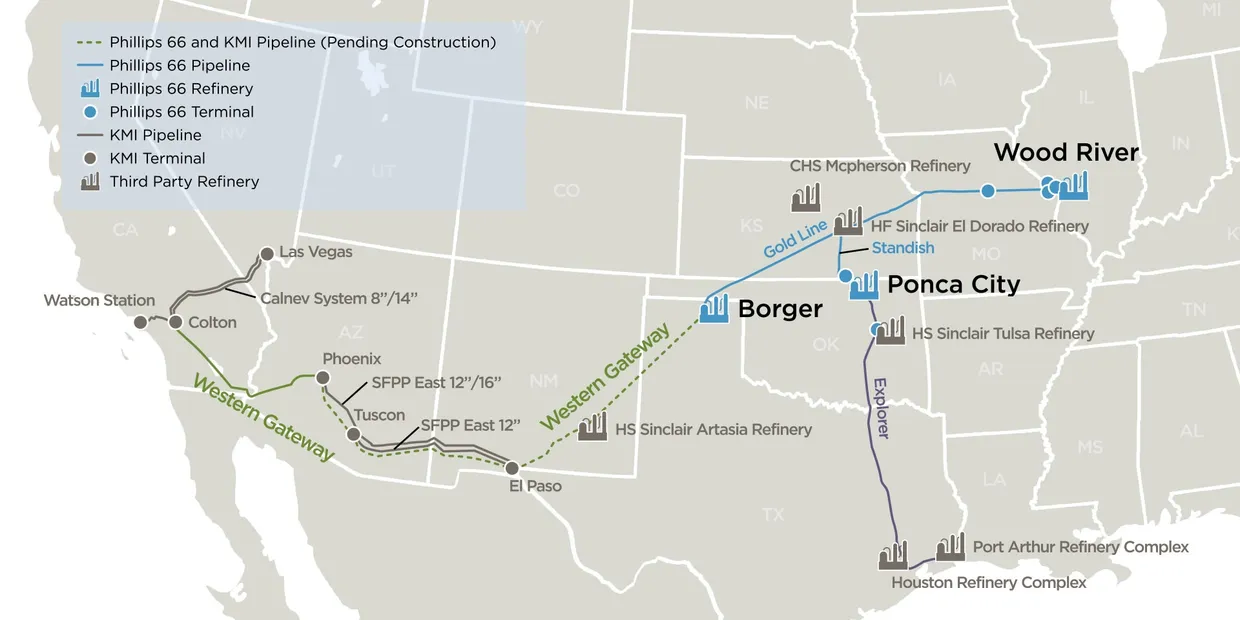
The Western Gateway Pipeline is an approximately 1,300-mile refined products system designed as a partnership between Phillips 66 and Kinder Morgan. Key components include:
New-build pipeline: A line from Borger, Texas, to Phoenix, Arizona (with Phillips 66 responsible for construction and operation from Borger to El Paso).
Reversals of existing infrastructure: Kinder Morgan’s SFPP pipeline segment from Colton, California, to Phoenix will be reversed to enable east-to-west flows into California. Phillips 66’s Gold Pipeline (currently flowing from Borger to St. Louis) will also be reversed to deliver refined products from Midwest refineries (including Illinois) and expanded Gulf Coast sources (Houston and Port Arthur/Beaumont areas) into Borger to feed the system.
Connectivity: From Phoenix, the product will flow into California markets, with additional optionality to Las Vegas, Nevada, via Kinder Morgan’s existing CALNEV Pipeline.
The system is strategically co-located within existing pipeline corridors from El Paso, minimizing new environmental footprint. It is engineered for safety with 24/7 monitoring, aerial/ground inspections, and in-line tools, leveraging the operators’ extensive experience (Phillips 66 operates over 53,000 miles of U.S. pipelines; Kinder Morgan operates over 79,000 miles).
Capacity is targeted at up to 200,000 barrels per day (bpd) of Midcontinent refined products into Arizona—replacing roughly 125,000 bpd that Phoenix currently receives from California via the SFPP system. This shift will free up equivalent volumes to stay in California, directly increasing in-state supply availability.
The targeted in-service date is mid-2029.
A Win for California Consumer
California drivers and businesses stand to benefit significantly. The state is on track to lose 17–20% of its refining capacity by mid-2026, exacerbating reliance on expensive waterborne imports from Asia and other distant sources. Gasoline imports into the West Coast have already hit record levels, exposing consumers to higher costs and supply disruptions from weather, tanker delays, or global events.
The Western Gateway Pipeline introduces the first direct pipeline link for refined products (gasoline, diesel, and jet fuel) into California from outside the state. This enhances supply flexibility, provides backup during refinery outages or maintenance, and reduces dependence on imports. Analysts note it could help stabilize or lower fuel prices by tapping advantaged Midcontinent and Gulf Coast supplies while keeping more California-refined product in-state. For everyday consumers, this means fewer price spikes, greater reliability for commuting and commerce, and a hedge against the very supply strains caused by recent refinery closures like Phillips 66’s Los Angeles facility and the impending Valero Benicia shutdown.
Arizona and Nevada markets will also see improved access, with Las Vegas gaining new direct pipeline optionality from Texas for the first time.
Benefits for Investors
For Phillips 66 and Kinder Morgan shareholders, the project represents a compelling growth opportunity backed by firm long-term shipper commitments. The joint venture leverages existing assets for efficient capital deployment, creating new revenue streams from transportation tariffs while addressing proven market demand. CEO quotes underscore the momentum:Phillips 66 Chairman and CEO Mark Lashier: “Customer response during the open season underscores the importance of Western Gateway in addressing long‑term refined products logistics needs in the region. Strong market interest validates the role this project can play in improving supply flexibility and reliability for West Coast markets.”
Kinder Morgan CEO Kim Dang: “We’re pleased to be able to use our existing assets to leverage growth opportunities for the Arizona and California markets. By utilizing existing pipeline assets across multiple states along the route, we’re uniquely well-positioned to support a refined products transportation solution.”
This pragmatic infrastructure play strengthens both companies’ positions in a region facing structural supply shifts, offering investors exposure to resilient, long-term cash flows in essential energy logistics.
Can Gavin Newsom or Climate Activists Stop It?
The project’s structure makes it resilient to state-level interference. Because it relies primarily on reversals of existing California pipelines (with terminal adjustments mainly at Colton) and new construction outside the state, minimal new permitting is required within California itself. The bulk of the route and approvals fall under federal and interstate jurisdiction, with co-location in established corridors further reducing regulatory hurdles.
While Governor Newsom and climate advocates have aggressively opposed fossil fuel infrastructure—through lawsuits against offshore projects like Sable, refinery regulations, cap-and-trade, and setback rules that have accelerated closures—this pipeline addresses the very supply shortages those policies have created. Past California lawsuits have targeted new coastal or in-state builds, but Western Gateway’s design (interstate flows using mostly pre-existing assets) positions it as a tougher target. Environmental groups may attempt legal challenges on emissions or permitting grounds, but success appears limited given the project’s focus on reliability and domestic supply chains.
Industry observers view it as a pragmatic solution that California consumers desperately need.
Looking Ahead
The Western Gateway Pipeline exemplifies how targeted midstream investment can deliver real-world energy security. By connecting abundant domestic refining capacity to high-demand Western markets, Phillips 66 and Kinder Morgan are delivering a clear win for consumers facing rising costs and supply risks—while creating value for investors in a critical infrastructure corridor. With strong shipper support and a 2029 target, this project could reshape West Coast fuel logistics for decades.For more project details, visit the official site at westerngatewaypipeline.com.
All information is drawn from official company announcements and verified industry reporting as of April 20, 2026:
- Phillips 66 Investor News Release (April 20, 2026): https://investor.phillips66.com/financial-information/news-releases/news-release-details/2026/Phillips-66-and-Kinder-Morgan-Advance-Western-Gateway-Pipeline-Project-Following-Successful-Open-Season/default.aspx
- Western Gateway Pipeline Official Project Site: https://westerngatewaypipeline.com/ and https://westerngatewaypipeline.com/project-details
- Kinder Morgan Project Page: https://www.kindermorgan.com/Operations/Projects/Western-Gateway-Pipeline-ce9c9ce67ec33ffbfbcab9b6bda44917
- X Post by
@EnergyAbsurdity
(April 20, 2026) summarizing the announcement: https://x.com/EnergyAbsurdity/status/2046233329133830496
- Supporting analysis from Stillwater Associates and East Daley (context on market impact): Various reports cited in search results.
- California Energy Context: Public records on refinery capacity and import trends (EIA data referenced in project materials).
Check out the Energy News Beat Substack: https://theenergynewsbeat.substack.com/