The Renewable Treadmill of Financial Death
The Renewable Treadmill of Financial Death is a topic that David Blackmon , The Nemeth Report (Dr. Tammy Nemeth) and I will be covering at our new time at 9:00 Central this Monday.
The following week at 9:00, we have a special edition of the Energy Realities Podcast with Dr. Joseph Fournier, another great Substack Author. We will be covering his article: Beijing’s Excalibur: Coal as China’s Weapon of Sovereign Power
As of mid-2026, Europe’s energy transition faces hard physical, economic, and geopolitical limits.
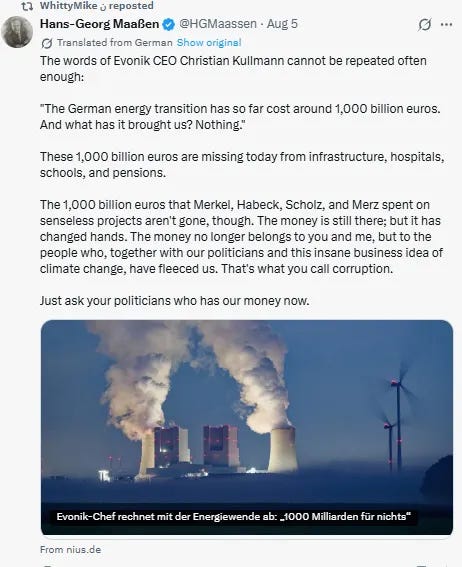
Yesterday in the article, I mentioned Evonik CEO Christian Kullmann has been blunt: Germany’s Energiewende has cost around €1,000 billion and delivered “nothing.” He points to insufficient gas plants, a grid “like in Albania,” no affordable hydrogen, and an unrealistic coal phase-out timeline. Germany’s 1.6% share of global CO₂ means its 2045 neutrality target is irrelevant for the climate but decisive for the survival of its chemical industry.
Capacity utilization in chemicals has hovered near or below 70%, well under the profitability threshold, with ongoing job cuts and output contraction since 2021.
High and volatile prices persist years after the loss of most Russian pipeline gas. Household electricity in Germany remains elevated relative to peers and U.S. levels. The question is whether tripling down on intermittent renewables, accelerated fossil phase-outs, and Net Zero timelines can deliver secure, affordable power—or accelerate deindustrialization and leave the continent weaker.
Current Energy Mixes
In 2025, EU electricity was roughly 47–48% renewables (wind + solar reaching a milestone 30%, ahead of all fossils at 29%). Nuclear contributed about 23%, gas around 17%, and coal a historic low of 9.2%. Solar grew strongly (+20% or more), while hydro and wind faced weather-related dips; gas generation rose to fill gaps, lifting the power-sector gas import bill.
The UK’s 2025 mix showed renewables above 50% in full-year data (wind the largest single source near 30%, solar rising to ~7%), gas still near 30–32%, nuclear around 12%, biomass significant, and coal fully phased out. Low-carbon sources (renewables + nuclear) hovered near or above 60% in periods, but intermittency and aging nuclear kept gas critical. Early 2026 data continued the pattern of strong wind shares on good days alongside persistent gas dependence.
Both systems have shifted dramatically from coal and toward wind/solar, yet firm capacity (nuclear, gas, remaining coal) remains essential for reliability. Gas has not returned to pre-crisis volumes but still sets marginal prices during low-renewable periods.
Wind Turbines: Scale, Age, and Lifespan
Europe reached about 304 GW of wind capacity by end-2025 (EU-27 ~246 GW: mostly onshore). The UK stood at roughly 33 GW (roughly half offshore). New installations in 2025 were solid but below the sustained pace needed for aggressive 2030 targets.
I have struggled getting data in the United States, and it is worse in the UK and EU.
Design life is typically claimed to be 20–25 years (offshore is often quoted higher). Real-world data show performance declining ~1.6% per year; many farms operate beyond 20 years via life extension, inspections, and component replacement (gearboxes, blades). Median lifetimes may reach ~30+ years onshore and higher offshore with good maintenance, but large volumes installed in the 2000s–2010s are now 15–20+ years old.
Significant capacity will age past 20 years through the late 2020s and 2030s, requiring repowering or replacement. Germany holds a large share of older onshore assets.
Solar Panels: Capacity, Degradation, and Output
Solar capacity has surged, driving the 2025 generation records. Modern panels carry 25–30-year performance warranties and often continue beyond that. Annual degradation is typically 0.3–0.5% (UK climate helps limit heat-related losses), so output at year 25 is commonly 85–90% of initial. Inverters need replacement sooner (10–15 years). Early UK and European fleets from the 2010s are entering mid-life; cumulative end-of-life modules will rise sharply by the 2030s–2050s.
Nuclear, Coal, and Natural Gas
The EU operates ~98 reactors with a mean age around 39 years; many French and other fleets are aging. The UK has 9 operable reactors (mostly AGRs, mean age ~39 years), with several scheduled for closure by 2028–2030 and limited new capacity under construction (Hinkley Point C delayed). Life extensions are being pursued, but the fleet is old.
Coal generation has collapsed: the UK is effectively zero after 2024, and the EU is at historic lows, with further closures planned (many large plants targeted for the early 2030s). And Germany is flooding their last coal-fired mine to make sure it is not reopened. Compare that to Japan, which only mothballed its coal plants and has reopened them during the Hormuz crisis.
There is no shame in mothballing stable power sources for use in an emergency.
Gas plants provide the flexible backup; Europe remains heavily import-dependent on LNG after the Russian cutoff. New gas capacity has been added modestly, but high prices and policy uncertainty constrain investment.
Aging Out, Recycling, and Replacement Costs
Much of the early wind and solar fleet will pass 20 years in the late 2020s–2030s. Life extension is common where economics allow, but full replacement or repowering (often tripling output on the same site with fewer, larger turbines) will be needed at scale.
Storage (batteries) has shorter cycles—utility-scale lithium-ion systems often require augmentation or replacement in 10–20 years depending on use intensity. EU battery capacity is growing rapidly from a low base (~tens of GW toward projected multiples by 2030), but replacement schedules will add recurring capital needs.
Recycling is claimed to be improving but imperfect and costly. Wind turbines: steel, copper, and aluminum are highly recyclable; blades (composites/fiberglass) are the challenge—mechanical grinding, cement co-processing, pyrolysis, or emerging chemical methods exist, but costs often exceed landfill (where still allowed), and infrastructure is scaling slowly. Many countries in the EU are banning landfills of wind blades and solar panels, but data on actual recycling are nonexistent.
Solar: glass, aluminum frames, and some metals are recoverable under WEEE rules (EU targets high recovery rates); silicon and silver recovery is advancing, but net costs remain positive in many cases. Battery recycling faces collection, safety, and refining bottlenecks, with used packs accumulating in places like the UK.
Replacement will require hundreds of billions more in capital for turbines, panels, grids, storage, and firm capacity—on top of the already-spent trillions on the transition. Intermittency means overbuilding and storage/gas backup multiply system costs.
Wind Turbines
Around 85–95% of a wind turbine’s mass (mainly steel, copper, aluminum, and concrete foundations) is already recyclable through established industrial channels. But they are not being recycled in mass yet, and there is no money for land reclamation.
The difficult part is the blades (glass- or carbon-fiber composites with resin). Europe generated roughly 20,000–25,000 tonnes of decommissioned blade material in 2025.
This is forecast to rise to about 55,000 tonnes per year by 2030, driven mainly by Germany, Spain and other early markets.
The European wind industry (WindEurope) imposed a voluntary landfill ban on blades from 1 January 2026. Operators are expected to reuse, repurpose, recycle or recover 100% of decommissioned blades. I do not see this happening and will be watching to see if they hit them with a wet noodle or force them out of business.
Current methods include:
- Mechanical shredding (most mature) → fibers used as filler in cement or other products (downcycling).
- Cement co-processing (energy + mineral substitution).
- Emerging thermal (pyrolysis) and chemical (solvolysis) processes that recover higher-quality fibers and resins.
- New “recyclable” blades using special resins (e.g., Siemens Gamesa RecyclableBlade already installed at scale on the UK’s Sofia offshore project).
Large-scale, high-value commercial recycling is still limited and not yet fully economic everywhere. Life extension and second-hand turbine markets also reduce immediate waste.
Solar Panels (PV)
The EU covers PV modules under the WEEE Directive, with mandatory producer take-back schemes and targets of 85% recovery / 80% recycling by weight.
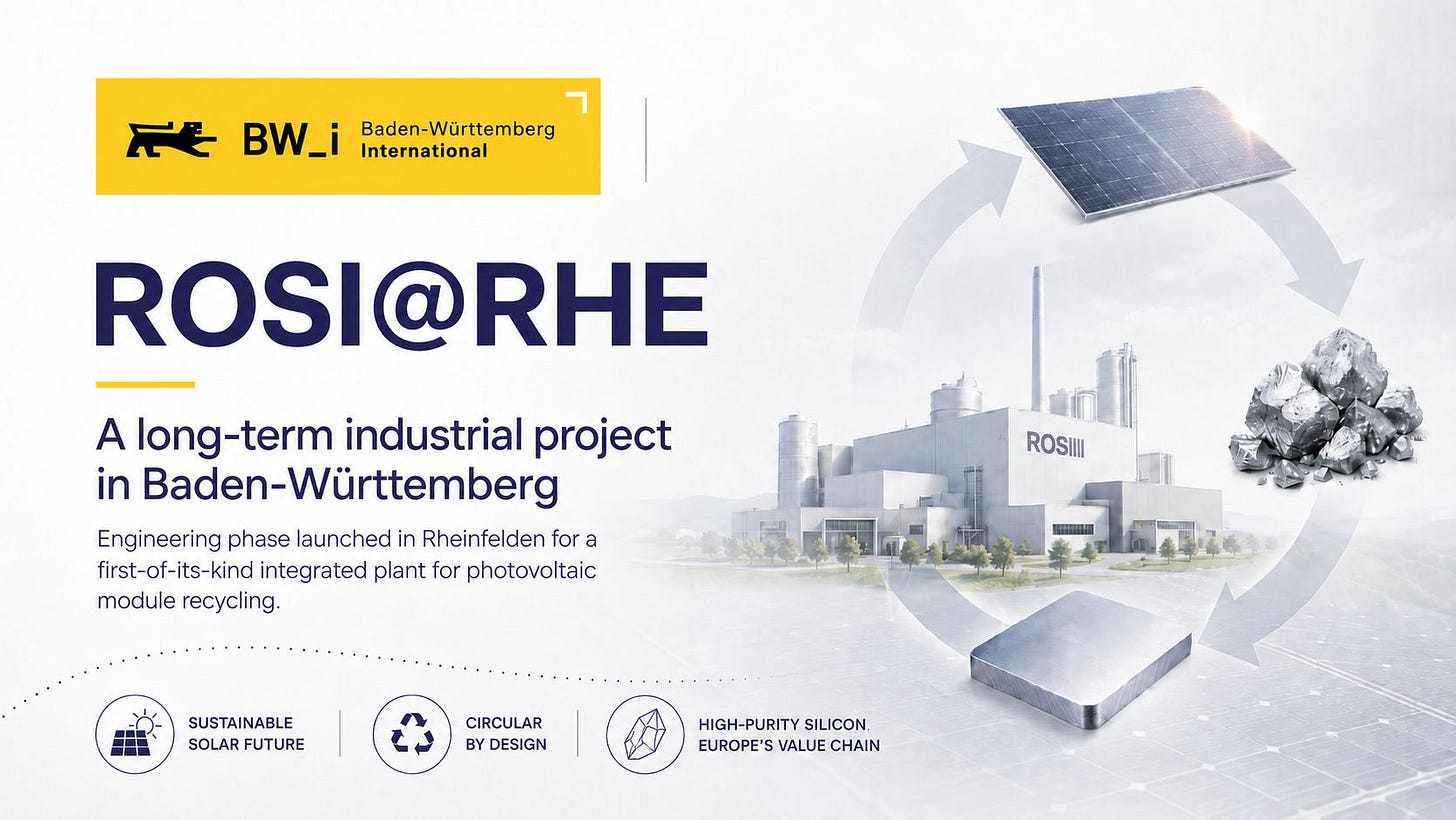
In 2023, EU countries collected ≈58,500 tonnes of end-of-life solar panels (more than triple the 2019 figure). Over 84% of the collected volume has been claimed to have been recycled or prepared for reuse. I don’t believe that number and am cross-checking. Especially as I cannot find the funding source. Looking at Rosi, they are building new recycling plants, and this could be a great thing. But money and regulatory burdens are a huge roadblock.
Current EU recycling capacity is about 170,000 tonnes per year — adequate for today’s modest volumes.
The UK generates only ≈650–1,000 tonnes per year at present (most panels are still under 15 years old).
Recovery rates of 85–95% by weight are routinely achieved for glass, aluminum frames, and copper. Higher-value recovery of silicon and silver is improving with newer thermal/chemical processes, but remains less common and more expensive. Germany hosts some of the largest dedicated facilities (e.g., capacities in the tens of thousands of tonnes).
Volumes will rise sharply from the mid-2030s as early Feed-in-Tariff panels reach end-of-life. Projections show annual EU waste exceeding 195,000 tonnes by 2030 and over 2 million tonnes by 2050, creating a significant capacity gap unless new plants are built.
- Batteries (Energy Storage and EV-related)
- The new EU Batteries Regulation (2023) sets binding targets:
- Recycling efficiency for lithium-based batteries: 65% by end-2025, rising to 70% by 2030.
- High material recovery rates for cobalt, nickel, copper and lithium.
Collection rates for portable batteries reached ≈49% in 2023. Lithium-ion recycling capacity in Europe is expanding rapidly (pretreatment/spoke capacity heading toward 300–350 kt/year by 2026, with further growth planned). Second-life reuse of EV batteries in stationary storage is also growing but still early-stage.
The UK lags: it has shredding capacity but limited commercial refining, so “black mass” is often exported. Tens of thousands of used EV and storage batteries are currently stockpiled (estimates of 20,000–23,500 units, with a large share not yet recycled).
No Russian Gas, Expensive Energy, and Deindustrialization
Without cheap Russian pipeline gas, Europe relies on higher-cost LNG. Prices have moderated from 2022 peaks but remain structurally elevated versus pre-crisis and versus the U.S. or China. German energy-intensive industry (chemicals, metals, glass, paper) has seen production fall sharply since 2022—chemicals at historically low utilization, revenue down, plants closing or relocating, jobs cut. Manufacturing has shifted toward Asia for energy and cost reasons. Analysts and industry groups warn of permanent capacity loss and further offshoring if prices stay high.
Defense Implications
If the U.S. reduces NATO commitments, Europe would need rapid rearmament and expanded domestic manufacturing of weapons, munitions, vehicles, and electronics. High energy prices and the migration of energy-intensive and advanced manufacturing to Asia undermine that capacity.
Germany and others already struggle with procurement scale and industrial base erosion; expensive power makes steel, chemicals, and precision manufacturing less competitive at home. Lower energy costs are a prerequisite for any credible surge in defense production.
Analyst Views on the Future
Optimistic scenarios highlight continued wind/solar cost declines, battery growth, nuclear life extensions or new builds, possible LNG price moderation from global supply, and grid upgrades that could eventually stabilize systems and cut bills.
Some project the UK becoming a net electricity exporter later this decade. Pessimistic and mainstream industrial analyses emphasize persistent high prices, the “death valley” of the next decade, accelerated deindustrialization, fiscal strain from subsidies and replacements, and the risk that aggressive Net Zero timelines hollow out the industrial base needed for prosperity and security.
Affordability has overtaken pure geopolitics as a top energy security risk for many European economies. Without realistic sequencing—retaining or expanding firm power, realistic phase-outs, and competitive industrial energy pricing—survival looks difficult.
Tripling down on the current path risks compounding the very crisis it aims to solve. Physics, capital intensity, aging assets, and global competition do not yield to targets. A course correction toward energy abundance, reliable capacity, and industrial competitiveness is the clearer path to resilience.
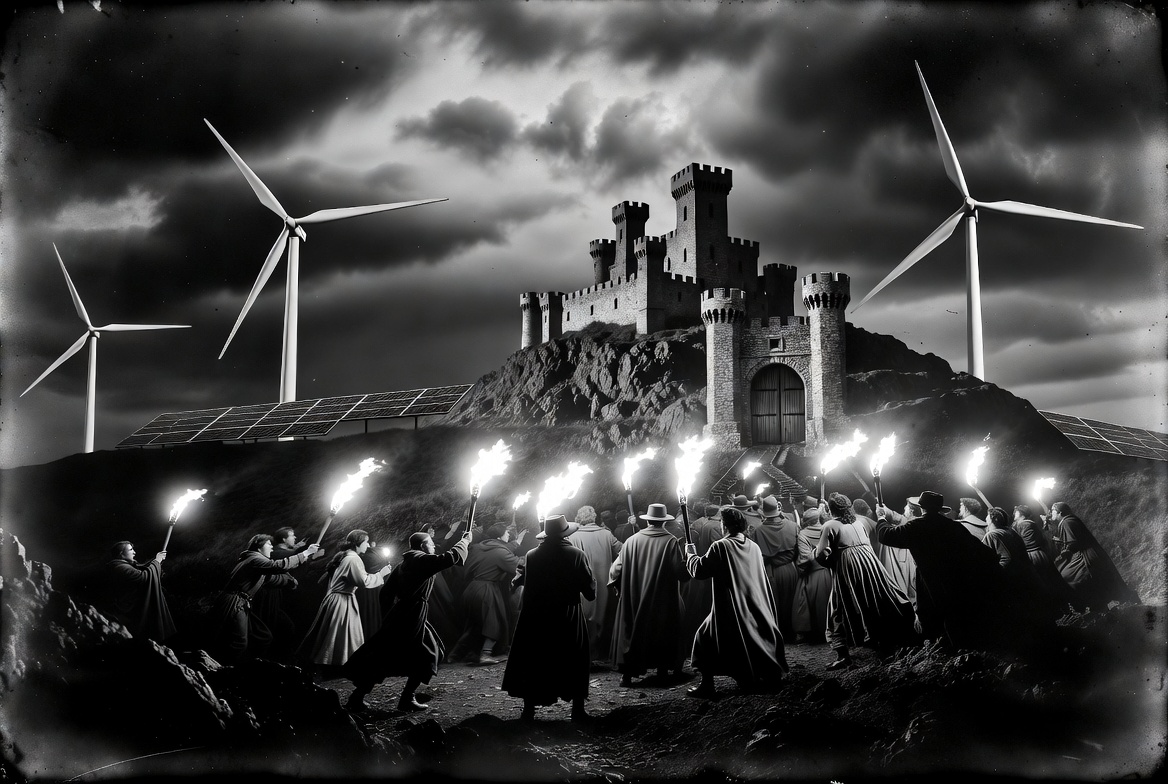
When will the gaslighting stop? – When the pitchforks roll out
At some point, consumers need to say enough of the gaslighting and promises that wind and solar, combined with storage, can do everything that coal, natural gas, and nuclear can do at a lower price.
So, like one of my favorite movies by Mel Brooks, Young Frankinstine, it will take a village to raise an idiot, and only a village can stop the corrupt politicians from forcing bad energy policies down our throats. – Oh, that was not in the movie, but I think almost all of our leaders have had their brains replaced with an “Abby Normal” brain.

Make sure you check out our new time on Monday at 9:00

Appendix: Sources and Links
- Energy News Beat / Evonik CEO Kullmann article: https://energynewsbeat.co/climate-crisis-op-ed/german-energy-policy-meets-the-real-world-evonik-ceo-christian-kullmann-says-the-energy-transition-has-no-value-whatsoever/
- Ember European Electricity Review 2026 and related: https://ember-energy.org/latest-insights/european-electricity-review-2026/ ; https://ember-energy.org/countries-and-regions/european-union/
- Eurostat renewables data: https://ec.europa.eu/eurostat/web/products-eurostat-news/w/ddn-20260319-2
- WindEurope 2025 statistics: https://windeurope.org/data/product/wind-energy-in-europe-2025-statistics-and-the-outlook-for-2026-2030
- UK generation data (DESNZ, NESO, Ember): Government Energy Trends; https://ember-energy.org/countries-and-regions/united-kingdom/
- Nuclear: World Nuclear Association / World Nuclear Report data on EU and UK fleets
- Wind aging/lifespan studies: Staffell & Green; IEA Wind Task 42; various national reviews
- Solar degradation and lifespan: Multiple UK installer/manufacturer analyses and NREL-aligned data
- Recycling: JRC material streams report; WindEurope; industry reports on blades and PV
- Battery storage: Ember, IEA, national targets and pipelines
- German industry/deindustrialization: VCI, Destatis, Bloomberg, Clean Energy Wire, FT, Handelsblatt reports 2025–2026
- Analyst outlooks: Reuters, Wood Mackenzie, Make UK, Centre for European Reform, various energy security indices
Data reflect the most recent available figures through mid-2026; capacities, ages, and costs continue to evolve.