The U.S. power grid faces a long-standing vulnerability that has resurfaced in recent discussions: a coordinated attack on a small number of critical substations could trigger a cascading nationwide blackout lasting months—or longer. This warning, originally highlighted by former Federal Energy Regulatory Commission (FERC) Chairman Jon Wellinghoff, stems from analysis following the 2013 Metcalf substation attack near San Jose, California. Recent coverage, including posts circulating on X and articles drawing from the Daily Mail and earlier Wall Street Journal reporting, has brought it back into focus.
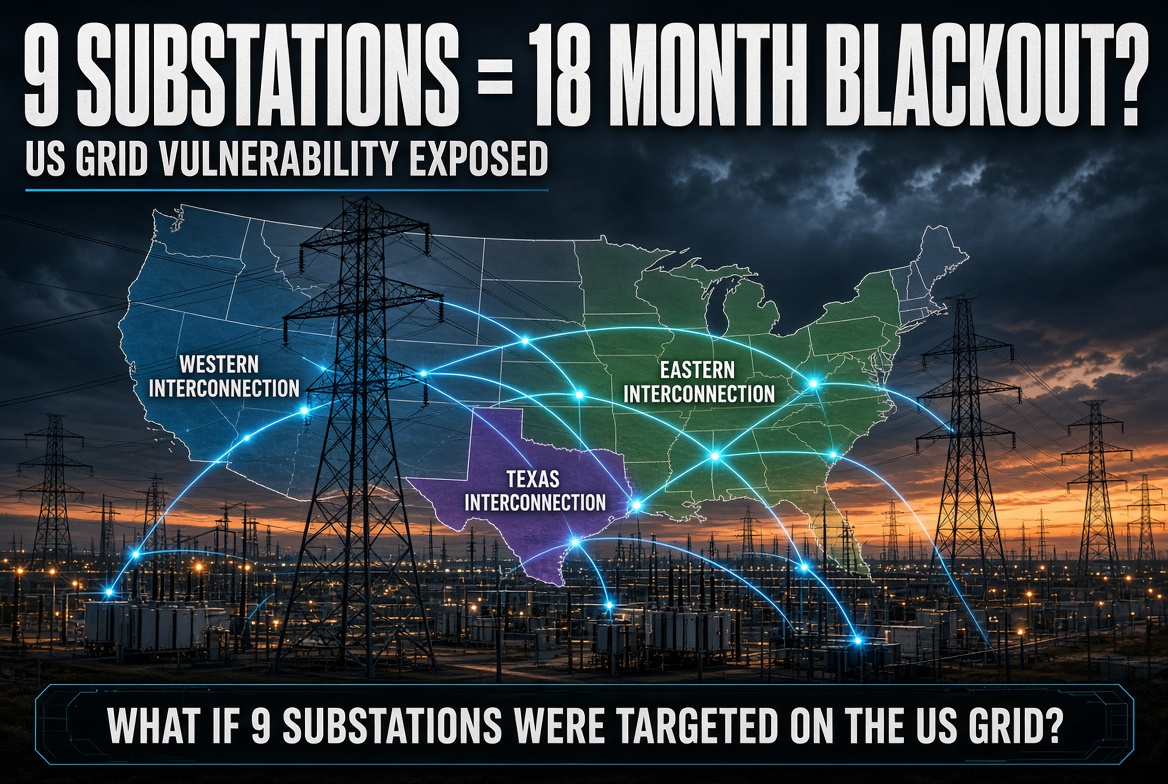
In April 2013, gunmen fired roughly 100–150 rounds at the Pacific Gas & Electric Metcalf substation, damaging 17 transformers and causing about $15 million in damage. The facility was offline for nearly a month, but no widespread blackout occurred. The attack remains unsolved. As FERC chairman at the time, Wellinghoff commissioned a power-flow analysis examining the three major U.S. interconnections (Eastern, Western, and Texas/ERCOT). The modeling showed that disabling just nine critical high-voltage substations—roughly three in each interconnection, selected from among the top 10 most important in each region—could collapse the entire continental U.S. grid.
“We came up with some very astounding numbers,” Wellinghoff has stated. “If you knock out nine total substations among these three grids, you can black out the entire United States.” Specific named sites were not required; any combination of the most critical nodes would suffice, and identifying them via publicly available grid maps was described as relatively straightforward. A blackout driven by destroyed large power transformers could last 18 months or longer because these custom-built units (often weighing hundreds of thousands of pounds) have extremely long manufacturing and replacement lead times.
Would this prediction materialize today?
The core physics and equipment realities have not fundamentally changed. Large power transformers remain custom-designed with limited domestic production capacity (historically around 20% or less of U.S. needs). Lead times, already long, have stretched further due to post-pandemic supply issues, surging demand from data centers and electrification, and material constraints—averaging 128 weeks in recent reports, with some exceeding five years. Redundancies and new transmission lines added since 2013 provide some buffer, and physical security standards (via NERC) were strengthened after Metcalf. Yet experts note that comprehensive hardening of all ~55,000 substations is impractical, and critical nodes remain high-value targets. A sophisticated, simultaneous physical attack (or hybrid physical/cyber) on nine such points during peak demand could still produce cascading failures across the weakly interconnected regions.
Compounding physical risks are supply-chain and remote-control concerns involving foreign equipment. In May 2020, President Trump issued Executive Order 13920 declaring a national emergency regarding the bulk-power system and restricting acquisition or installation of equipment from foreign adversaries (widely understood to target China and others). This followed the U.S. seizure of a large Chinese-built transformer (Jiangsu Huapeng) destined for a Colorado substation; it was diverted to Sandia National Laboratories amid suspicions of embedded electronics that could enable remote monitoring or disablement. Cybersecurity experts, including Joseph Weiss, reported findings of hardware that “should not have been part of the transformer”—potential backdoors.
On his first day in office, President Biden suspended EO 13920 for 90 days for review (it was not fully revoked immediately, and related defense-facility prohibitions continued under scrutiny). Subsequent years saw continued imports of Chinese transformers and related gear. Reports indicate hundreds of Chinese-origin large power transformers entered U.S. service over the prior decade (with numbers cited in the low hundreds as of earlier assessments, and further imports after the suspension). More recently, attention has shifted to Chinese-made solar and battery inverters (from firms like Huawei and Sungrow), which are networked devices capable of remote communication and control.
Utility surveys and analyses (including by Strider Technologies) show high reliance on such equipment, raising risks of cascading outages if compromised. Chinese state-linked actors have previously probed or accessed U.S. critical infrastructure systems.
While no verified public source matches an exact figure of “32 major grid interconnects” specifically removed under Trump and reinstated under Biden, the documented pattern involves Chinese transformers and control-related equipment at critical points, including interconnects and substations, with remote-control potential via hardware or firmware backdoors. These create pathways for disruption that amplify the physical substation risk Wellinghoff identified.
What would a blackout of this magnitude do to the United States?
Even a partial multi-region or prolonged outage would cascade rapidly across interdependent systems. Water treatment and sewage plants, hospitals, and emergency services rely on backup generators with limited fuel (often days, not weeks). Natural-gas compression and pumping for generation and heating would fail without power. Food refrigeration, processing, and distribution would halt; grocery shelves would be empty within days. Fuel stations (requiring electricity for pumps) and refining would stop. Communications (cell networks, internet, banking/ATMs) collapse as towers and data centers lose power and backup fuel depletes. Electronic financial transactions cease. Transportation (traffic signals, rail, airports) freezes.
A 2010 NERC/DOE assessment projected food, water, and fuel degradation within days, followed by social unrest. Longer-term modeling and expert analyses (including EMP Commission-related work) warn of severe societal stress: medical crises, sanitation failures leading to disease, economic paralysis measured in trillions, and potential high mortality from secondary effects over months if restoration lags. Transformers cannot be rapidly replaced at scale; international logistics for multi-hundred-ton units under crisis conditions would be extraordinarily difficult. Partial blackouts in major load centers alone could trigger national economic and security shocks.
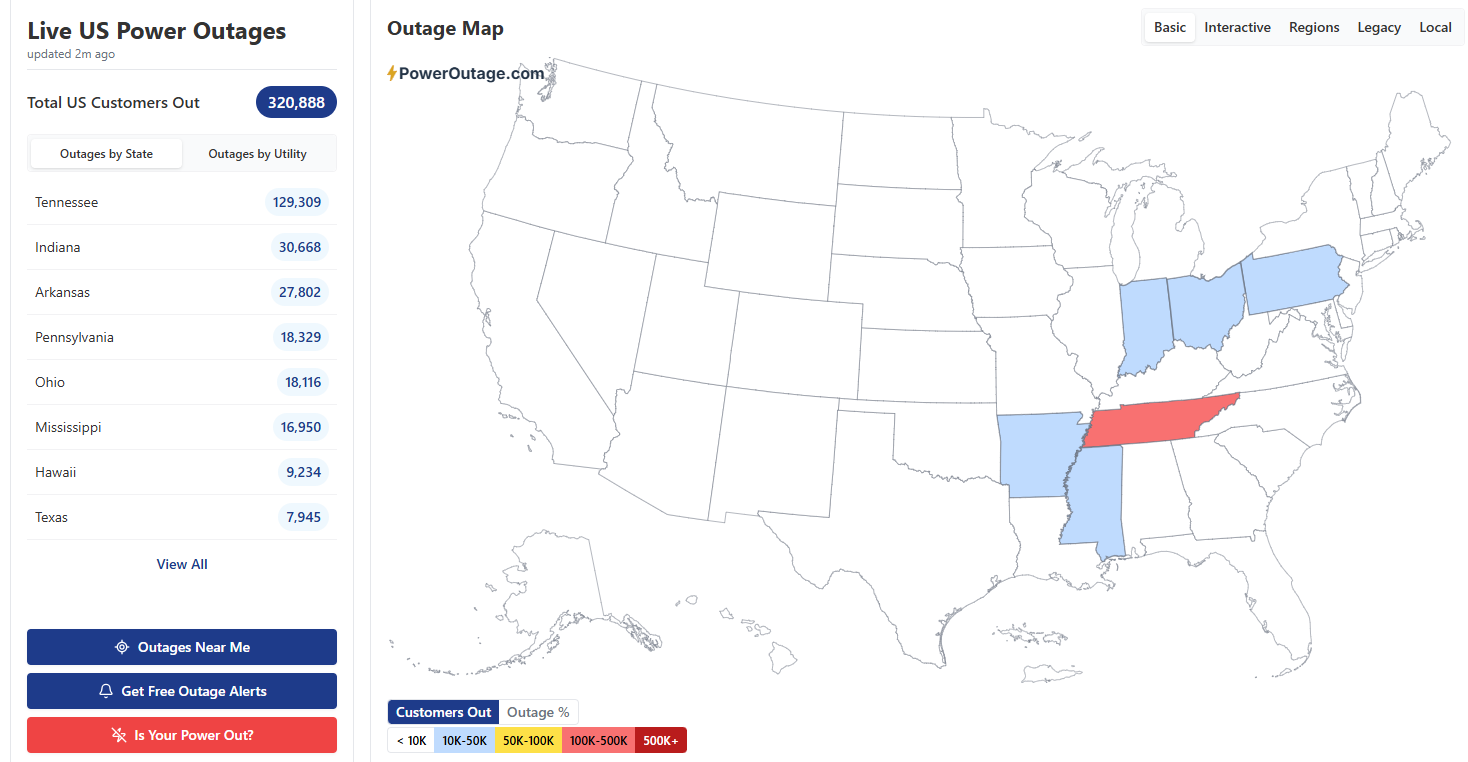
Just as an example- today, the US has 320,888 without power.
What should people do now to prepare for any grid blackout?
Individual and community resilience is the practical response while policy addresses root causes (domestic manufacturing, physical/cyber hardening, supply-chain security).
- Stockpile essentials: At least 2–4 weeks of non-perishable food, one gallon of water per person per day, medications, first-aid supplies, and pet needs. Rotate stock.
- Backup power and lighting: Battery banks, solar chargers, hand-crank radios, LED flashlights/lanterns. Consider a properly installed and ventilated generator or portable power station sized for critical loads (refrigerator, medical devices, communications).
- Never run generators indoors.
- Cash and documents: Keep sufficient cash (ATMs fail) and waterproof copies of important papers.
- Communications and plans: Battery/hand-crank radio; family meeting points and out-of-area contacts. Register critical medical needs with your utility.
- Home readiness: Know how to manually open garage doors; unplug sensitive electronics to avoid surge damage on restoration; maintain vehicle fuel.
- Community level: Coordinate with neighbors for mutual aid; support local resilience efforts. Follow Ready.gov and FEMA guidance for 72-hour kits as a minimum, scaled up for longer scenarios.
The Wellinghoff analysis was never a prediction of inevitability but a call to action on concentrated vulnerabilities. More than a decade later, aging infrastructure, transformer shortages, data-center demand growth, and foreign-equipment risks keep the warning relevant. Strengthening physical security at key nodes, accelerating domestic production of critical components, and reducing reliance on potentially compromised supply chains remain essential to preventing—or shortening—any such event.
- X post by@The_NoizceEra summarizing the warning: https://x.com/The_NoizceEra/status/2090125057897148783
- Daily Mail coverage of Wellinghoff warning (Aug 2026): https://www.dailymail.com/news/article-16062409/nationwide-blackout-18-months-power-grid.html
- New York Post: https://nypost.com/2026/08/19/us-news/shockingly-vulnerable-us-power-grid-could-result-in-18-month-nationwide-blackout-expert-warns/
- Original Wall Street Journal reporting on FERC analysis (2014): “U.S. Risks National Blackout From Small-Scale Attack” by Rebecca Smith – https://www.wsj.com/articles/SB10001424052702304020104579433670284061220 (and related Metcalf coverage)
- WSJ on Chinese transformer seizure (2020): Coverage of the Jiangsu Huapeng unit diverted to Sandia (references in multiple outlets citing Rebecca Smith reporting)
- Trump EO 13920 (May 1, 2020): Securing the United States Bulk-Power System
- Biden EO suspending aspects of prior grid equipment restrictions (Jan 2021) and subsequent reviews
- Washington Examiner on EO implications: https://www.washingtonexaminer.com/opinion/1139117/bidens-order-could-let-china-control-us-electric-grid/
- Strider Technologies / Washington Post on Chinese inverters risks (2025): https://www.washingtonpost.com/business/2025/12/10/us-energy-grid-china-threat-blackouts/
- U.S.-China Economic and Security Review Commission materials on grid equipment dependencies
- Ready.gov / FEMA power outage guidance: https://www.ready.gov/power-outages
- NERC and DOE historical assessments on cascading outage impacts
- Additional analyses on transformer lead times, aging fleet, and economic costs of interruptions from DOE national labs, Wood Mackenzie, and academic modeling
This article draws on publicly reported analyses and official actions. Grid security involves classified elements; the above reflects open-source reporting.