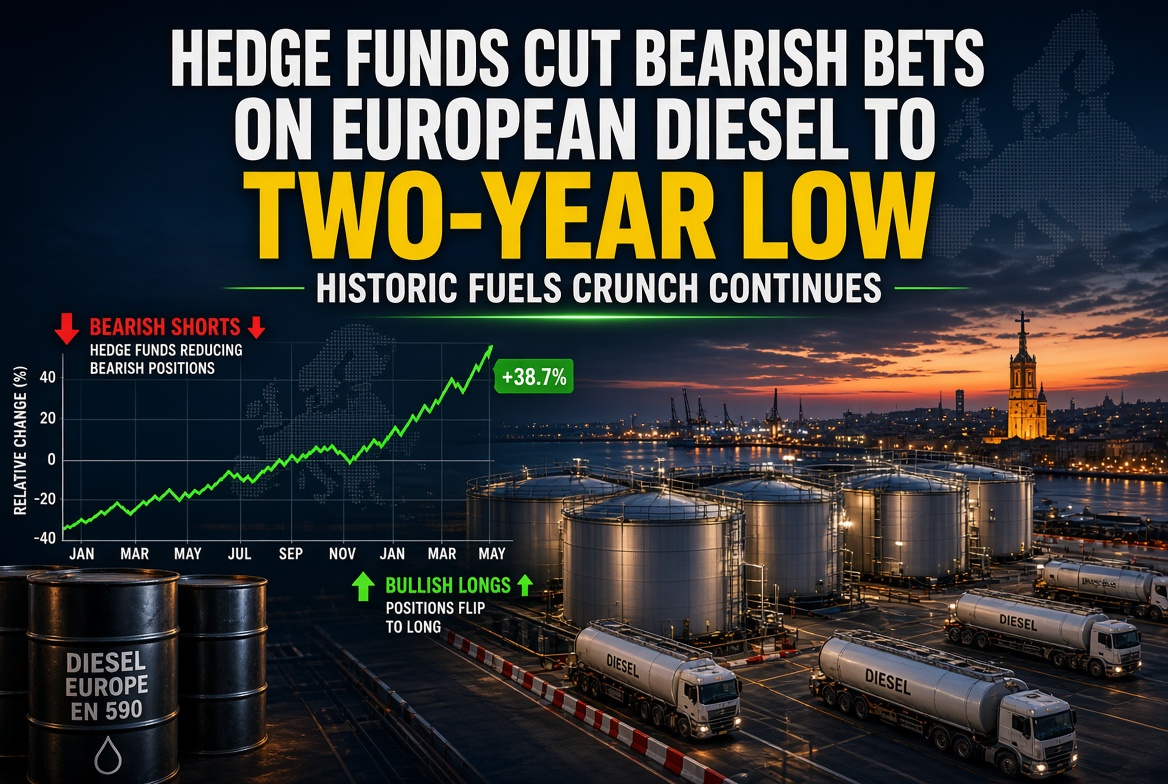
Hedge funds have sharply reduced their short-only positions on European diesel (ICE gasoil) to the lowest level in more than two years while adding fresh long positions, signaling that traders expect the current historic fuels supply crunch to persist.
According to ICE Futures Europe data cited in reports of the Bloomberg story, funds cut short-only bets by 309 lots, bringing them to the lowest since July 2024. They simultaneously added 1,498 long-only positions, reaching the highest total since the week before the US-Iran war began. On a net basis, positioning turned the most bullish in about six months. Parallel bullishness appeared in US-traded diesel contracts, where gross long positions reached the highest since the first week of the US-Iran conflict, per Commodity Futures Trading Commission data.
The shift reflects surging refining margins. Profit margins for turning crude into diesel and gasoil have climbed toward all-time highs amid dramatically tighter supplies. Fewer barrels are available from the Middle East, while an export ban on most Russian diesel shipments remains in place as Ukrainian attacks on Russian refineries intensify once again.
This European development sits against a backdrop of extreme tightness in the broader refined products complex. Morgan Stanley and others have previously flagged that European diesel inventories could fall to multi-year lows later in the year, with Northwest European diesel crack spreads already at record levels earlier in the summer.
The US Picture: Record Crack Spreads and Tight Inventories
While European sentiment turns more constructive (or at least less bearish), the United States is experiencing its own version of the refined-product squeeze. US diesel crack spreads—the premium of ultra-low sulfur diesel futures over WTI crude—hit an all-time high, with an intraday peak of approximately $102.20 per barrel on August 17, 2026, and settled in triple digits for the first time before hovering near $100. Pre-crisis norms typically ran $15–$25 per barrel; prior peaks were in the high $80s to low $90s range (2022) and near $97–$98 earlier in 2026.
These record margins coincide with historically tight inventories. US distillate (diesel plus heating oil) stocks stood near 107.1 million barrels as of early August (week of August 7), the lowest for that time of year since 1996. By the week ending August 14, 2026, distillate inventories fell another 1.5 million barrels and sat about 13% below the five-year average. Gasoline inventories remain tight as well—roughly 5% below the five-year average—with draws and regional pressures (particularly on the Gulf Coast) contributing to the overall product tightness. US refiners have been running near maximum utilization (around 96–97%), and elevated exports have helped fill global gaps even as domestic stocks stay lean.
In short, the US is operating with low diesel and gasoline inventories at the same time refiners enjoy the highest crack spreads in history. High cracks reward refiners handsomely for maximizing product output, yet the physical system has limited spare capacity, and geopolitical disruptions (Russian export restrictions, Middle East refining outages, and residual effects from earlier conflicts) continue to constrain global supply.
What This Means for Consumers: Europe vs. the United States
European consumers face a more structural vulnerability. Europe remains a significant net importer of diesel and has historically relied on Russian supplies that are now heavily restricted. High taxes already push pump prices well above US levels. Recent EU averages hover around €1.95 per liter for diesel (with wide national variation—Malta near €1.21/L at the low end and the Netherlands near €2.38/L at the high end), translating to roughly $8+ per gallon depending on exchange rates and exact taxes. Diesel is critical for trucking, freight, agriculture, and, in some regions, heating. Persistent tightness and elevated crack spreads translate into higher transportation costs that feed into food, goods, and broader inflation. The shift by hedge funds away from heavy short positions suggests the market does not expect rapid relief, raising the odds of continued pressure into the winter heating and agricultural seasons.
US consumers are feeling the pain primarily through elevated retail prices driven by the record cracks and low stocks, even if absolute levels differ. National average diesel prices recently stood in the mid-$5 range (around $5.45–$5.59 per gallon in mid-to-late August data), while regular gasoline hovered near $4.10 per gallon. These are well above year-ago levels. Because diesel powers the bulk of freight, farming, and construction, the high crack acts like a persistent tax on the supply chain, pushing up the cost of goods. The US benefits from a larger, more flexible domestic refining system and the ability to export surplus when economics favor it, but low inventories leave little buffer against further disruptions (hurricanes, additional geopolitical shocks, or stronger seasonal demand). High refining margins do not automatically mean lower pump prices; they signal scarcity of the finished product relative to crude.
In both regions, the core issue is refining capacity and product availability rather than a pure crude shortage. Global refining outages—estimated in the multi-million-barrels-per-day range from Russian and Middle Eastern disruptions—have made diesel the tightest part of the barrel. For European households and businesses already contending with higher baseline energy costs and import dependence, the outlook points to sustained elevated prices. US consumers face similar upward pressure on diesel-dependent sectors and potential further spikes if inventories do not rebuild, though domestic production and export flexibility provide some relative cushion compared with Europe’s more import-reliant position.
The hedge-fund repositioning on European diesel is one more market signal that the fuels crunch is viewed as durable. Until refining capacity recovers or alternative supply routes meaningfully expand, both European and American consumers are likely to continue paying elevated prices for diesel and, by extension, for the goods and services that rely on it.
Appendix: Sources and Links
- Bloomberg original article: https://www.bloomberg.com/news/articles/2026-08-21/hedge-funds-cut-bearish-bets-on-european-diesel-to-two-year-low
- NDTV Profit summary with position details: https://www.ndtvprofit.com/economy/hedge-funds-cut-bearish-bets-on-european-diesel-to-two-year-low-11943744
- Energy News Beat on US diesel crack high: https://energynewsbeat.co/diesel/us-diesel-crack-spread-hit-an-all-time-high-whats-next/
- Bloomberg on diesel margins topping $100/bbl: https://www.bloomberg.com/news/articles/2026-08-18/diesel-margins-top-100-a-barrel-to-reach-record-high-as-supply-crunch-grows
- EIA Weekly Petroleum Status Report (week ending Aug 14, 2026 summary data): https://www.eia.gov/petroleum/supply/weekly/ and related tables
- AAA Fuel Prices (retail gasoline and diesel): https://gasprices.aaa.com/
- European Commission / fuel-prices.eu weekly oil bulletin averages and country data: https://www.fuel-prices.eu/ and related EU bulletins
- Morgan Stanley / Energy Connects on European diesel squeeze (earlier context): https://www.energyconnects.com/news/oil/2026/july/diesel-squeeze-in-europe-set-to-deepen-morgan-stanley-says/
- Additional market context from RBN Energy, Enverus, FreightWaves, and related reporting on cracks and inventories as of mid-to-late August 2026.
Data as of available reports through approximately August 21–22, 2026. Markets move quickly; positions and inventory figures are subject to weekly updates.