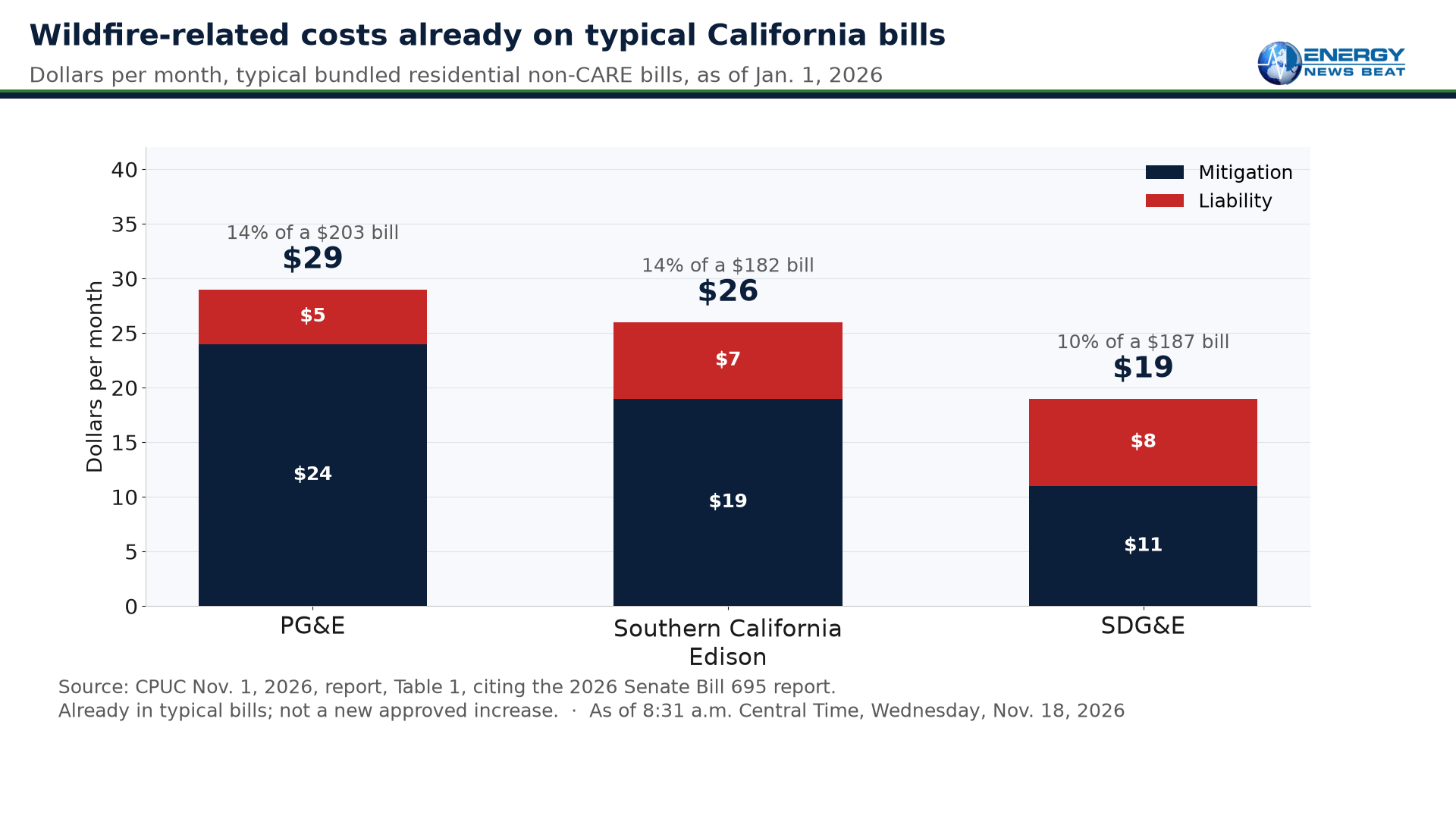
As of Jan. 1, 2026, wildfire-related costs made up $29, or 14 percent, of PG&E’s typical bundled residential non-CARE monthly bill, $26 of Edison’s and $19 of SDG&E’s, the CPUC reported. From 2020 through 2026, those three utilities’ customers paid more than $35 billion in wildfire-related costs, with more already approved for later collection. PacifiCorp has asked to raise rates 57 percent for about 46,000 far-northern customers. That request is a proposal, not a decision.
Jason Isaac, who has been on the Energy News Beat podcast and also leads the American Energy Institute, posted on X on Nov. 16 that “some Californians could soon see electricity rates jump 57% to cover wildfire costs.” He was pointing to a Nov. 15 Daily Caller News Foundation story by Simon August about a rate request from PacifiCorp, which does business in California as Pacific Power. The 57 percent is real. It is not the bill most Californians are already paying.
On Nov. 1, the California Public Utilities Commission reported that from 2020 through 2026, customers of Pacific Gas and Electric, Southern California Edison and San Diego Gas & Electric alone paid more than $35 billion in wildfire-related costs. As of Jan. 1, 2026, those costs accounted for $29, or 14 percent, of PG&E’s typical bundled residential non-CARE monthly bill; $26, or 14 percent, of Edison’s; and $19, or 10 percent, of SDG&E’s. An additional $16 billion already incurred has been approved for later collection. PacifiCorp, which cannot use the state Wildfire Fund, has asked to raise its California rates 57 percent for about 46,000 customers in four far-northern counties. That request has not been approved.
What is already on the large utilities’ bills
The $29, $26 and $19 figures come from the CPUC’s 2026 Senate Bill 695 report, as presented in the Nov. 1 wildfire credit-and-capital report. They cover both mitigation and liability. Of PG&E’s $29, $24 was mitigation and $5 was liability. Edison’s split was $19 and $7; SDG&E’s was $11 and $8. Typical total bills in that table were $203, $182 and $187.
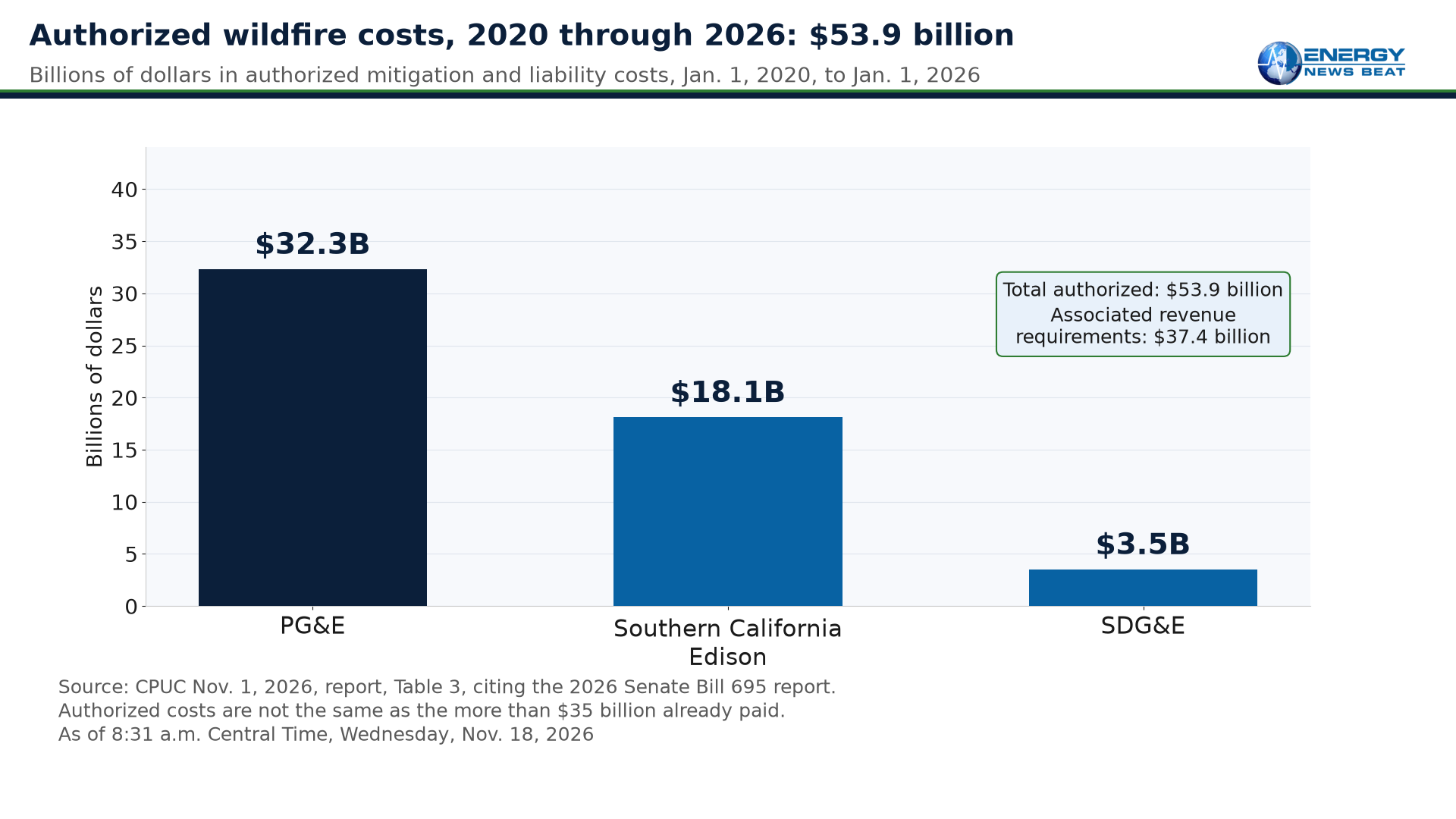
From 2020 through 2026, the three utilities were authorized to recover about $53.9 billion in wildfire mitigation and liability costs, which produced about $37.4 billion in associated revenue requirements, the CPUC said — $32.3 billion of the authorized costs at PG&E, $18.1 billion at Edison and $3.5 billion at SDG&E. As of Jan. 1, 2026, wildfire-related revenue requirements expected to be collected this year were about $3.8 billion at PG&E, $2.8 billion at Edison and $0.7 billion at SDG&E, or 18 percent, 14 percent and 14 percent of each utility’s total revenue requirement.
The spending is not only for past fires. It includes system hardening, including covered conductor and undergrounding, vegetation management, and wildfire liability insurance and self-insurance. The Nov. 1 report estimates that undergrounding distribution lines now costs about $2.3 million to $5.6 million a mile; those are cost estimates, not approved programs. Because most of these costs are collected through volumetric charges, inland customers who use more electricity to cool their homes pay a larger share. In PG&E territory, the CPUC said, wildfire-related costs account for 16 percent of the average coastal customer’s bill and 29 percent of the average inland customer’s.
Eaton, the Wildfire Fund, and a replenishment that is not yet funded
The CPUC, citing the California Earthquake Authority’s SB 254 study, said the January 2025 Los Angeles-area fires produced an estimated $53 billion in total economic losses, and that “not all these losses are utility equipment related.” The Eaton Fire destroyed 9,413 structures, the commission report said, and the Los Angeles County Fire Department and CAL FIRE concluded it was caused by electrical arcing on an out-of-service Edison transmission tower. Edison elected to settle pending litigation, and Eaton is now a covered wildfire that can generate eligible claims on the Wildfire Fund created under Assembly Bill 1054.
As of March 31, 2026, Edison had recorded $1.3 billion in Eaton-related losses and $295 million from the Wildfire Fund to cover eligible costs, the CPUC report said. As of June 30, the fund had reserved $295 million for Eaton claims but had not yet made payments. The fund administrator reported that total eligible claims could ultimately exceed the remaining capacity of the AB 1054 account. The California Department of Insurance reported about $8 billion in insurance payments and nearly 28,000 claims for the Eaton Fire as of March 31, 2026.
The AB 1054 fund was established with about $21 billion in initial claim-paying capacity. As of June 30, 2026, the administrator had reimbursed PG&E about $1.13 billion combined for the Kincade and Dixie fires, the CPUC report said. PacifiCorp and Liberty do not have access to the fund. Ratepayer charges into the fund continue through 2035. Senate Bill 254, signed Sept. 19, 2025, created a Continuation Account with about $18 billion in nominal claim-paying capacity for eligible wildfires ignited on or after that date. As of June 30, 2026, that account held no assets. Shareholder contributions are scheduled to begin in 2029; ratepayer charges would begin in 2036, run through 2045, and remain subject to CPUC approval. The account sunsets if it is not activated by Dec. 31, 2028. The Nov. 1 report called it an interim measure whose present value is below that nominal total.
How long the costs stay on the bill, and where the 57 percent fits
Capital-related wildfire costs are collected over the lives of the assets, which is why costs already incurred can still show up later. Ratepayer contributions to the AB 1054 fund run through 2035; a continuation charge, if approved, could run from 2036 through 2045. In D.26-01-021, decided Jan. 15, 2026, the CPUC authorized SDG&E to recover a net $416.575 million revenue requirement for 2019–2022 wildfire-mitigation memorandum-account costs after subtracting earlier interim relief, amortized over three years, raising the average non-CARE bill by $5.09, or 2.94 percent, the decision said. Track 3 remains open. Edison’s 2025 general rate case, D.25-09-030, approved wildfire-mitigation spending below the company’s 2026–2028 plan, the SB 695 report said.
PacifiCorp is the sharp edge, not the statewide average. On Nov. 6, it asked the commission, in A.26-11-009, for an overall proposed net increase of about $102.6 million, or 57.0 percent, requested effective Jan. 1, 2027, for about 46,000 customers in Siskiyou, Modoc, Shasta and Del Norte counties. If approved as filed, the company’s notice says an average residential customer using 850 kilowatt-hours a month would see a $121.15, or 56.9 percent, increase. The 57 percent is the whole proposed net increase, not a wildfire-only surcharge; the application also names inflation in operations and maintenance. A separate Aug. 3 power-cost and greenhouse-gas filing, A.26-08-001, asks for a 16.1 percent overall decrease, 15.5 percent residential, also effective Jan. 1, 2027. The company’s website describes a 14 percent decrease as a partial offset. Neither case has been decided.
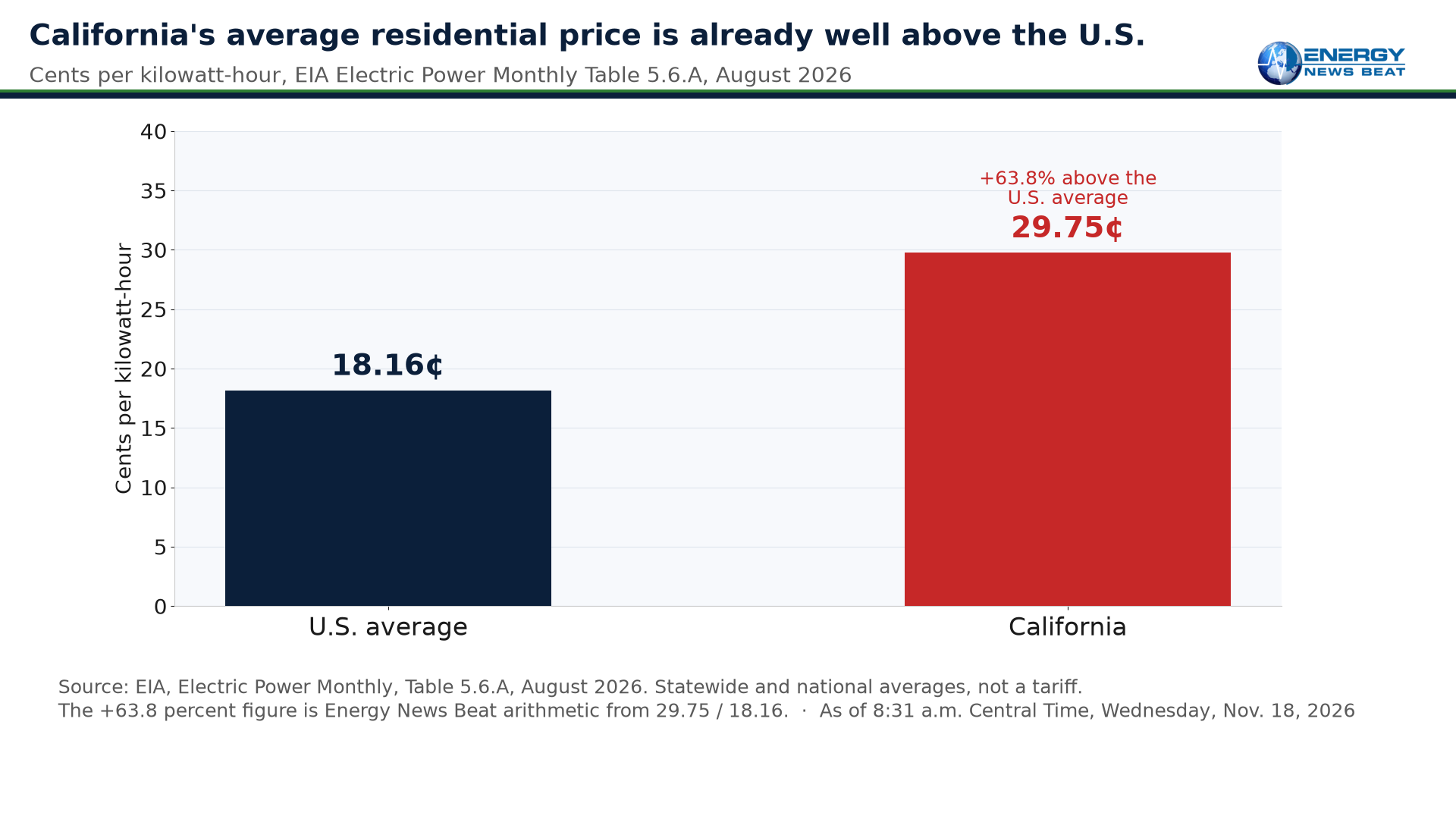
California’s average residential price is already high. The U.S. Energy Information Administration’s Electric Power Monthly, Table 5.6.A, puts the state’s August 2026 average at 29.75 cents a kilowatt-hour, against a U.S. average of 18.16 cents. EIA’s November 2026 Short-Term Energy Outlook still has the national residential average rising, to 18.68 cents in 2027.
Consumer and Investor Views
For consumers, most of the large-utility wildfire hit is already on the bill, not waiting on a 57 percent headline. The dollars are larger for higher-use inland households, and they would be sharp for Pacific Power’s small rural base if the commission grants what was asked — more than $120 a month at 850 kilowatt-hours, before any separate power-cost decrease. In an Oct. 19 commentary, Public Advocates Office director Linda Serizawa said residential rates at the three large utilities have risen by roughly 70 to 100 percent over the last decade, and that “ratepayers cannot continue to be the financial backstop for a system with no clear endpoint.”
For investors, the CPUC’s November report, citing S&P, said that as of September 2026 Edison’s S&P rating was BBB- with a Negative outlook, PG&E remained below investment grade on S&P’s scale, and Fitch had revised its PG&E outlook to Negative. S&P identified Wildfire Fund thresholds of $14 billion for Edison and $11 billion for PG&E that could trigger additional downgrades. As of November 2025, the report said, SDG&E was rated A3 by Moody’s and BBB+ by S&P and Fitch; Sempra is identified as SDG&E’s parent. PacifiCorp, a Berkshire Hathaway Energy subsidiary, said in its Nov. 6 filing that it has suspended upstream dividends to BHE and that its issuer credit rating was one notch above non-investment grade. S&P cut PacifiCorp from A to BBB- between 2023 and 2025, then revised its outlook to Positive in April 2026, the report said.
Caveats and What We Could Not Confirm
The $29, $26 and $19 figures are a Jan. 1, 2026, snapshot for typical bundled residential non-CARE bills, not every household’s current bill and not a new approved increase. The more than $35 billion paid from 2020 through 2026 is not the same as the $53.9 billion authorized or the $37.4 billion in associated revenue requirements; capital costs enter rates over time. The estimated $53 billion from the January 2025 Los Angeles-area fires is a total economic figure, not a utility-only liability. PacifiCorp’s 57 percent and $121.15 illustration are proposals, not decisions; the 57 percent is the whole net request, not a wildfire-only surcharge. The $102.6 million detailed net request is used here; the $103.4 million opening figure is in the appendix. The 14 percent company offset wording is not combined with the official 16.1 percent power-cost filing. Isaac’s line about the state’s “insane ‘green’ energy policies” is his opinion, not a commission finding. A written decision in A.26-11-009 had not been issued when this article was prepared.
Stu’s Take
The 57 percent did not come out of thin air, and it should not be waved away. PacifiCorp put that number in a formal request for about 46,000 customers in California’s far north. What does not hold up is treating it as the statewide wildfire bill, or as a charge that has already been handed to every California household. The large utilities’ customers are already paying. The CPUC has now put dollars on those bills — $29, $26 and $19 a month on typical non-CARE residential accounts — and has said more than $35 billion has already been collected, with more approved to come in later. The Wildfire Fund that the big three can use is under strain from Eaton, and the official replenishment vehicle is still unfunded. In a sparse, high-risk corner of the state with no access to that fund, the catch-up request is 57 percent. That is the uneven load. The next commission and legislative votes will decide how much steeper it gets.
At what point do voters keep handing the political parties power? When the state runs out of people to pay taxes, or when the fires burn the place to the ground?
Sources
Primary and named secondary sources. Access dates are when each source was accessed, Wednesday, Nov. 18, 2026, unless a different date is noted. A written decision in California Public Utilities Commission Application A.26-11-009 had not been issued as of those access dates.
- PacifiCorp, doing business as Pacific Power (U 901 E), Application for Authority to Increase Rates and Charges for Electric Service in California, filed Nov. 6, 2026. The opening request is an increase of approximately $103.4 million, or a 57 percent net increase, effective Jan. 1, 2027. The application states that PacifiCorp serves approximately 46,000 customers over more than 11,292 square miles in Siskiyou, Modoc, Shasta, and Del Norte counties. The summary puts the base revenue-requirement increase at $82.8 million, or 56.8 percent, and the overall proposed net price increase at approximately $102.6 million, or 57.0 percent, including proposed deferral amortizations and excluding impacts from the sale of PacifiCorp’s Washington service territory. Requested overall rate of return 7.96 percent, ROE 10.5 percent, and a 50/50 capital structure, compared with a currently authorized 10.0 percent ROE. Under current rates the company says it would earn a negative 2.636 percent ROE in California. Projected Dec. 31, 2026, balances: approximately $93.8 million WMPMA, $11.1 million WEMA insurance-premium sub-account, and $0.2 million FRMMA, proposed for recovery over six years, about $19.7 million a year; together with 12-month recovery of the 2022 WNDRR contribution, amortizations add about $19.8 million a year. The company says it has suspended upstream dividends to Berkshire Hathaway Energy and that, as of the filing date, its issuer credit rating was one notch above non-investment grade. The PDF on the company site still uses the placeholder docket path a-26-11-___; the assigned number is A.26-11-009 https://www.pacificpower.net/content/dam/pcorp/documents/en/pacificpower/rates-regulation/california/filings/a-26-11-___/000_Application.pdf
- Pacific Power, Notice of Pacific Power’s Rate Increase Request, 2027 General Rate Case, A.26-11-009. Overall increase in revenue of $102.6 million (57%), effective Jan. 1, 2027. Table of proposed class averages: Residential 25.2¢ to 39.6¢, $52,692,358, 56.9%; Commercial and Industrial 22.5¢ to 35.3¢, $36,912,649, 57.2%; Irrigation 24.0¢ to 37.7¢, 57.4%; Lighting 38.1¢ to 59.3¢, 55.6%; Overall 24.1¢ to 37.8¢, $102,612,694, 57.0%. “If the request is approved, the average residential customer using 850 kWh per month would see a rate increase of $121.15, or 56.9%, per month.” Since 2022, over 300 miles of reinforced covered lines and replacement of more than 7,000 wooden poles with steel or fiberglass. An administrative law judge will hold hearings before a proposed decision; commissioners then vote. Public comment: apps.cpuc.ca.gov/c/A.26-11-009 https://www.pacificpower.net/content/dam/pcorp/documents/en/pacificpower/my-account/bill-inserts/ca/CA_GRC_Bill_Onsert_2026.pdf
- PacifiCorp, 2027 Energy Cost Adjustment Clause and Greenhouse Gas application, filed Aug. 3, 2026, docketed as A.26-08-001. “Taken together, PacifiCorp requests an overall rate decrease of $27.2 million (16.1) based on the combined ECAC and GHG Surcharge, for rates effective January 1, 2027.” Components include a −$10.69/MWh Balancing Rate, about a $14.2 million decrease; a $33.92/MWh Offset Rate, about an $8.2 million decrease; and a GHG Surcharge decrease of about $4.8 million. Table 1: Residential −$13,795,000 / −15.5%; Commercial/Industrial −$10,136,000 / −16.9%; Irrigation −$3,210,000 / −16.7%; Lighting −$47,000 / −6.0%; Overall $27,188,000 / −16.1% (the overall dollar figure in the table lacks a minus sign; the narrative is a $27.2 million, 16.1 percent decrease). Proposed semi-annual California Climate Credit $132.24 for small business and residential customers https://www.pacificpower.net/content/dam/pcorp/documents/en/pacificpower/rates-regulation/california/filings/docket-a-26-08-001/0_Application.pdf
- Pacific Power, California Rate Changes page. “The filing proposes a 57% increase in customer rates, which will be partially offset by a 14% decrease in rates that will take effect January 1, 2027.” Requested effective date Jan. 1, 2027, “although the review process could take several months.” Cites A.26-11-009. CARE discount of 25% or more for eligible customers. Drivers: wildfire prevention, higher insurance, inflation, and the same 300-mile / 7,000-pole system-hardening figures as the customer notice. The page was opened from a 301 redirect off /CA-Rates https://www.pacificpower.net/about/rates-regulation/california-rate-changes.html
- California Public Utilities Commission, CPUC docket card for A.26-11-009 (Public Comments tab), accessed Nov. 18, 2026. The short URL resolves. The card shows at least one public comment, dated Nov. 16, 2026. No written decision was posted https://apps.cpuc.ca.gov/c/A.26-11-009
- California Public Utilities Commission, Application A.26-08-001 short URL, confirmed as the ECAC/GHG docket by PacifiCorp’s company folder path and a successful resolution of the commission short URL https://apps.cpuc.ca.gov/c/A.26-08-001
- California Public Utilities Commission, “Statewide Impacts of Wildfires on Utility Credit and Access to Capital,” Nov. 1, 2026, requested by the Governor on Sept. 1, 2026. Table 1 (Jan. 1, 2026, typical bundled residential non-CARE monthly bill), citing the 2026 SB 695 report: PG&E mitigation $24 plus liability $5 equals $29 of $203, or 14 percent; SCE $19 plus $7 equals $26 of $182, or 14 percent; SDG&E $11 plus $8 equals $19 of $187, or 10 percent. Table 3 (Jan. 1, 2020, to Jan. 1, 2026): authorized costs $32.3 billion at PG&E, $18.1 billion at SCE and $3.5 billion at SDG&E, totaling $53.9 billion, which produced $37.4 billion in associated revenue requirements. Ratepayers of the three utilities “paid more than $35 billion” from 2020 through 2026; an additional $16 billion already incurred had been approved for later collection. As of Jan. 1, 2026, wildfire-related revenue requirements expected to be collected this year were about $3.8 billion at PG&E (18 percent of total RR), $2.8 billion at SCE (14 percent) and $0.7 billion at SDG&E (14 percent). Inland versus coastal bill shares in PG&E territory: 29 percent inland and 16 percent coastal. Undergrounding cost estimates of about $2.3 million to $5.6 million a mile; 10,000 additional miles would cost about $23 billion to $56 billion, and all high-fire-threat-district distribution about $92 billion to $224 billion, not including transmission — cost estimates, not approved programs. Table 4 wildfire-mitigation plan spending: actual 2023–2025 total $24.6 billion; projected 2026–2028 $26.7 billion (PG&E $18.7 billion, SCE $7.0 billion, SDG&E $1.0 billion) — projections, not used as results in the body. Eaton Fire: 9,413 structures destroyed, about 14,000 acres; Los Angeles County Fire and CAL FIRE concluded electrical arcing on an out-of-service SCE transmission tower; SCE elected to settle; Eaton is now a covered wildfire. As of March 31, 2026, SCE recorded $1.3 billion in Eaton losses and $295 million from the Wildfire Fund; as of June 30, 2026, the fund reserved $295 million but had not yet paid; the administrator said total eligible claims could exceed remaining AB 1054 capacity. SCE Wildfire Recovery Compensation Program: more than 11,000 claims submitted by June 2026; more than 1,828 claimants paid $272 million (appendix only). California Department of Insurance: about $8 billion in payments and nearly 28,000 claims for Eaton as of March 31, 2026, and about $25.2 billion for Eaton and Palisades combined by July 2026. The January 2025 Los Angeles-area fires produced an estimated $53 billion in total economic losses, “not all these losses are utility equipment related,” citing the California Earthquake Authority’s SB 254 study. The AB 1054 fund had about $21 billion in initial capacity and had reimbursed PG&E $127,619,513 for Kincade and $1,006,283,974 for Dixie, about $1.13 billion combined. As of June 30, 2026, shareholders had contributed $9.6 billion plus $300 million a year through 2028, and ratepayers $5.14 billion plus $902.4 million a year until Jan. 1, 2036. PacifiCorp and Liberty have no access. Senate Bill 254 created a Continuation Account of about $18 billion nominal for ignitions on or after Sept. 19, 2025; it held no assets as of June 30, 2026; shareholder contributions are scheduled for 2029, ratepayer charges 2036–2045 subject to CPUC approval; the account must be activated by Dec. 31, 2028, or it sunsets; the report called it an interim measure whose present value is substantially below the nominal total. Credit ratings, including SDG&E’s November 2025 Moody’s A3 and S&P/Fitch BBB+ ratings and S&P fund thresholds of $14 billion for SCE and $11 billion for PG&E, are set out in Table E https://www.cpuc.ca.gov/-/media/cpuc-website/industries-and-topics/documents/wildfire/wildfire-2026/nov-1-report—final.pdf
- Linda Serizawa, Public Advocates Office, “Why California’s wildfire status quo is not sustainable for ratepayers,” Oct. 19, 2026. Residential rates at the three large investor-owned utilities have risen by roughly 70 percent to 100 percent over the last decade; about $40 billion in wildfire mitigation and liability costs was authorized for recovery from those customers between 2019 and 2024, including more than $9 billion in 2024. Ratepayer contributions to the Wildfire Fund extend through 2035; charges for a Wildfire Continuation Fund can run from 2036 through 2045. Smaller utilities “do not have access to the Wildfire Fund.” “Ratepayers cannot continue to be the financial backstop for a system with no clear endpoint.” https://www.publicadvocates.cpuc.ca.gov/press-room/commentary/261019-why-californias-wildfire-status-quo-is-not-sustainable-for-ratepayers
- U.S. Energy Information Administration, Electric Power Monthly, Table 5.6.A, average price of electricity to ultimate customers by end-use sector, by state. California residential: 29.75 cents/kWh in August 2026 and 30.92 cents in August 2025. U.S. Total residential: 18.16 cents in August 2026 and 17.57 cents in August 2025. The 63.8 percent California-over-U.S. figure used on Chart 3 is Energy News Beat arithmetic (29.75 / 18.16 − 1) https://www.eia.gov/electricity/monthly/epm_table_grapher.php?t=epmt_5_6_a
- U.S. Energy Information Administration, Electric Power Monthly, Table 5.6.B, average price of electricity to ultimate customers by end-use sector, by state, year-to-date through August 2026 and 2025. California residential: 32.58 cents/kWh year-to-date through August 2026. U.S. Total residential: 18.19 cents. The 79.1 percent California-over-U.S. figure in the Table D footnote is Energy News Beat arithmetic (32.58 / 18.19 − 1). The article body uses the August 2026 monthly figures from Table 5.6.A, not these year-to-date averages. Workbook last modified Oct. 22, 2026, opened Nov. 18, 2026 https://www.eia.gov/electricity/monthly/xls/table_5_06_b.xlsx
- U.S. Energy Information Administration, Short-Term Energy Outlook, November 2026, Table 7a, electricity prices to ultimate customers, residential sector, annual averages: 17.24 cents/kWh in 2025, 18.17 cents in 2026, 18.68 cents in 2027. Later 2026 and all of 2027 are outlook figures. Modeling completed Nov. 5, 2026 https://www.eia.gov/outlooks/steo/archives/nov26.pdf
- U.S. Energy Information Administration, Short-Term Energy Outlook, November 2026, Table 7a standalone PDF https://www.eia.gov/outlooks/steo/tables/pdf/7atab.pdf
- Jason Isaac (@ISAACforEnergy), X post, Nov. 16, 2026, 2:04 p.m. Central Time. “Some Californians could soon see electricity rates jump 57% to cover wildfire costs. As I told the @DailyCaller, California’s problem isn’t just the price of electricity. It’s the lack of reliable power, made worse by the state’s insane ‘green’ energy policies.” Attached a screenshot of the Nov. 15 Daily Caller News Foundation headline. Author identified as Fmr. Rep. Jason Isaac, CEO of the American Energy Institute https://x.com/ISAACforEnergy/status/2122420494838202402
- Simon August, Daily Caller News Foundation, “Rural California Utility Asks To Raise Power Rates By More Than Half As Wildfire Costs Pile Up In Newsom’s State,” Nov. 15, 2026, 12:00 p.m. ET (11:00 a.m. Central Time). Reports the Nov. 6 filing, a 57 percent request beginning Jan. 1, 2027, the company website’s 14 percent offset, and Pacific Power’s “about $120” figure given to Jefferson Public Radio. Quotes Simon Gutierrez on the 14 percent power-cost decrease and on sparse population and fire risk. Quotes Jason Isaac: “Americans need more dependable electricity and fewer government obstacles driving up the price.” The 57 percent sentence later used on X is Isaac’s framing of this story, not a quote of Isaac inside the story https://dailycallernewsfoundation.org/2026/11/15/pacific-power-57-percent-rate-hike-wildfire-costs-gavin-newsom/
- California Public Utilities Commission, 2026 Senate Bill 695 Report, published October 2026. Table 1 typical bundled residential non-CARE bills and wildfire shares match the Nov. 1 report’s Table 1. Wildfire-related revenue requirements as of Jan. 1, 2026, were about $3.8 billion at PG&E, $2.8 billion at SCE and $0.7 billion at SDG&E, or 18 percent, 14 percent and 14 percent of each utility’s total revenue requirement, and about $288 to $348 a year per residential customer, or 10 to 14 percent of typical residential bills. Authorized costs of about $54 billion produced about $37 billion in revenue requirements. The report also identifies rooftop solar as a separate cost driver, about 12 to 20 percent, which is not the focus of this article. Footnote 53: SCE’s 2025 general rate case is D.25-09-030, which approved wildfire-mitigation spending below the company’s 2026–2028 plan; SCE later petitioned to amend that plan to about $4.4 billion, a projection not used as a result in the body. SDG&E’s 2024 general rate case, D.24-12-074, was approved Dec. 19, 2024. Insurance and vegetation management are among wildfire-related operating costs https://www.cpuc.ca.gov/-/media/cpuc-website/divisions/office-of-governmental-affairs-division/reports/2026/2026-sb-695-report—final.pdf
- California Public Utilities Commission, Decision 26-01-021, decided Jan. 15, 2026, and issued Jan. 23, 2026, in A.22-05-015 et al., SDG&E Track 2 Wildfire Mitigation Plan Memorandum Account. The decision authorized a net revenue requirement of $416.575 million after subtracting $289.9 million in earlier interim relief from $706.475 million, amortized over three years, raising the average non-CARE bill by $5.09, or 2.94 percent. It approved $77.86 million in operations and maintenance and $945.533 million in capital, and disallowed $206.140 million in operations and maintenance and $242.467 million in capital. Track 3, covering drone costs, remains open. These approve-and-disallow line items are in the appendix; the body uses the net $416.575 million and the $5.09 / 2.94 percent bill effect https://docs.cpuc.ca.gov/PublishedDocs/Published/G000/M596/K291/596291467.PDF
- California Wildfire Fund Administrator, 2026 Annual Report, dated Aug. 15, 2026, covering July 1, 2025, through June 30, 2026. On Sept. 19, 2025, the Governor signed Senate Bill 254 (Sen. Becker, Chapter 119, Statutes of 2025). The AB 1054 Initial Account had about $21 billion in claim-paying capacity for covered wildfires ignited July 12, 2019, through Sept. 19, 2025. The SB 254 Continuation Account has about $18 billion in nominal claim-paying capacity for ignitions on or after Sept. 19, 2025, and held no assets and had not been activated as of the report. Shareholder contributions to the Continuation Account are scheduled from 2029 through 2045 ($5.1 billion at $300 million a year) plus a contingent $3.9 billion; ratepayer non-bypassable charges of $9.0 billion would run from 2036 through 2045 if the CPUC approves them. The account must be activated by Dec. 31, 2028, or it sunsets. These capitalization details are in the appendix; the body uses the signed date, the $18 billion nominal capacity, the unfunded status as of June 30, 2026, the 2029 / 2036 timing, the 2028 sunset, and the CPUC report’s interim-measure / present-value language https://www.cawildfirefund.com/sites/wildfire/files/documents/2026/2026-cwf-annual-report.pdf
- California Public Utilities Commission, wildfire industries-and-topics page, opened for the Senate Bill 254 context linked in the article body https://www.cpuc.ca.gov/industries-and-topics/wildfires
- Legislative Analyst’s Office, “Wildfire Spending and Energy Affordability,” handout dated March 5, 2025. Used only as dated 2025 context. Current typical-bill and authorized-cost figures in the article come from the 2026 CPUC Nov. 1 report and the 2026 SB 695 report, not from this 2025 handout https://lao.ca.gov/handouts/resources/2025/Wildfire-Spending-Energy-Affordability-030525.pdf
- CPUC, Proposed Decision of ALJ Toy in A.23-12-001 (mailed Dec. 26, 2025; Agenda ID #23942, Rev. 1). Not a final decision; later unconfirmed recaps of an adopted D.26-02-004 are not used in the body.
Primary excerpts
PacifiCorp California general rate case application, filed Nov. 6, 2026, opening request. “PacifiCorp d/b/a Pacific Power, respectfully requests the California Public Utilities Commission (Commission) increase PacifiCorp’s rates for electric service by approximately $103.4 million, or a 57 percent net increase, effective January 1, 2027 (Application).” In California, PacifiCorp “serves approximately 46,000 customers spread over more than 11,292 square miles in Siskiyou, Modoc, Shasta, and Del Norte counties.”
PacifiCorp application, financial-health and return language. “As of the date of this filing, PacifiCorp’s issuer credit rating is one notch above non-investment grade, and under current rates, PacifiCorp will earn an overall return on equity (ROE) in California of negative 2.636 percent (−2.636%)—well below PacifiCorp’s currently authorized 10.0 percent ROE.” Stabilization measures “include the suspension of upstream dividends to Berkshire Hathaway Energy (BHE)”. “PacifiCorp’s request includes an overall rate of return of 7.96 percent, an ROE of 10.5 percent, and a capital structure comprised of 50.0 debt and 50.0 equity.”
PacifiCorp application, summary of the net increase and deferred balances. “PacifiCorp proposes a base revenue requirement increase of $82.8 million, or 56.8 percent. On a net basis, including PacifiCorp’s proposed deferral amortizations discussed below and excluding impacts from the SAT, PacifiCorp’s overall proposed net price increase is approximately $102.6 million, an increase of 57.0 percent on a net basis.” “The projected December 31, 2026, balances are approximately $93.8 million for the WMPMA, $11.1 million for the WEMA insurance premium sub-account, and $0.2 million for the FRMMA. To limit the near-term effect on customer bills, PacifiCorp proposes to recover these balances over six years, which results in an annual amortization of approximately $19.7 million.” “Together, these amortizations add approximately $19.8 million to the annual revenue requirement.”
Pacific Power customer notice, 2027 general rate case, A.26-11-009. “Pacific Power is requesting an overall increase in revenue of $102.6 million (57%), effective January 1, 2027.” “If the request is approved, the average residential customer using 850 kWh per month would see a rate increase of $121.15, or 56.9%, per month. The actual impact will vary based on usage and other factors.” The notice also cites “over 300 miles of reinforced, covered power lines and the replacement of more than 7,000 wooden power poles with steel or fiberglass.”
PacifiCorp 2027 ECAC and GHG application, filed Aug. 3, 2026. “Taken together, PacifiCorp requests an overall rate decrease of $27.2 million (16.1) based on the combined ECAC and GHG Surcharge, for rates effective January 1, 2027.”
Pacific Power, California Rate Changes page. “The filing proposes a 57% increase in customer rates, which will be partially offset by a 14% decrease in rates that will take effect January 1, 2027.” “The company has requested that the new rates take effect on January 1, 2027, although the review process could take several months.”
Simon Gutierrez, Pacific Power, as quoted by the Daily Caller News Foundation, Nov. 15, 2026. “The $120 number does not account for the 14% decrease related to lower than expected power costs.” To Jefferson Public Radio: “Not only is the fire risk extreme, but our service area is very sparsely populated. It means fewer customers to spread the costs of these investments.”
Jason Isaac, X post, Nov. 16, 2026, and his quote in the Daily Caller News Foundation story. On X: “Some Californians could soon see electricity rates jump 57% to cover wildfire costs. As I told the @DailyCaller, California’s problem isn’t just the price of electricity. It’s the lack of reliable power, made worse by the state’s insane ‘green’ energy policies.” In the Nov. 15 story, Isaac said: “Americans need more dependable electricity and fewer government obstacles driving up the price.”
California Public Utilities Commission, statewide wildfire credit report, Nov. 1, 2026. “[PG&E], [SCE], and San Diego Gas and Electric (SDG&E) ratepayers alone paid more than $35 billion in wildfire-related costs. As of January 1, 2026, wildfire-related costs accounted for approximately $29 of PG&E’s average monthly residential non-California Alternate Rates for Energy (CARE) bill, or roughly 14 percent of an average bill.” “some investor-owned utilities such as Liberty and PacifiCorp do not have access to the Wildfire Fund under existing State law.” “As of September 2026, SCE’s S&P rating was BBB-, the lowest investment-grade rating, with a Negative outlook. PG&E remained below investment grade under S&P’s scale, while Fitch revised its outlook on PG&E to Negative in September 2026.”
CPUC Nov. 1, 2026, report, PacifiCorp rating history. “S&P downgraded PacifiCorp’s issuer credit rating from A to BBB+ in June 2023. … In July 2025, S&P further downgraded PacifiCorp from BBB+ to BBB. … S&P subsequently downgraded PacifiCorp to BBB- in November 2025. … In March 2026, S&P placed PacifiCorp on CreditWatch Negative amid uncertainty surrounding potential liabilities and liquidity requirements associated with the James wildfire litigation in Oregon. In April 2026, the Oregon Court of Appeals reversed and remanded the James class action judgment for further proceedings. Following the decision, S&P revised PacifiCorp’s outlook to Positive.” Footnote 180 dates that outlook revision to April 20, 2026.
Linda Serizawa, Public Advocates Office, Oct. 19, 2026. “Ratepayers cannot continue to be the financial backstop for a system with no clear endpoint.” Ratepayer contributions “to the Wildfire Fund extend through 2035, while charges supporting the Wildfire Continuation Fund can run from 2036 through 2045.” Smaller utilities “have narrower customer bases and do not have access to the Wildfire Fund.”
CPUC Nov. 1, 2026, report, typical bills and authorized costs. “[F]rom 2020 through 2026, Pacific Gas and Electric (PG&E), Southern California Edison (SCE), and San Diego Gas and Electric (SDG&E) ratepayers alone paid more than $35 billion in wildfire-related costs.” As of Jan. 1, 2026, wildfire-related costs accounted for $29, or 14 percent, of PG&E’s typical bundled residential non-CARE monthly bill; $26, or 14 percent, of SCE’s; and $19, or 10 percent, of SDG&E’s. From Jan. 1, 2020, to Jan. 1, 2026, the three utilities were authorized to recover $53.9 billion in wildfire mitigation and liability costs, which produced $37.4 billion in associated revenue requirements.
CPUC Nov. 1, 2026, report, Eaton Fire and economic-loss language. The Eaton Fire “destroyed 9,413 structures.” The Los Angeles County Fire Department and CAL FIRE “concluded [it] was caused by electrical arcing on an out-of-service SCE transmission tower.” SCE “elected to settle pending litigation,” and Eaton “is now a covered wildfire.” As of March 31, 2026, SCE had recorded $1.3 billion in Eaton-related losses and $295 million from the Wildfire Fund. The January 2025 Los Angeles-area fires produced an estimated $53 billion in total economic losses, and “not all these losses are utility equipment related.”
CPUC Decision 26-01-021, Jan. 15, 2026. The Commission authorized SDG&E to recover a net $416.575 million revenue requirement for 2019–2022 wildfire-mitigation memorandum-account costs after subtracting earlier interim relief, amortized over three years. “As a result, the average non-CARE customer bill will increase by $5.09 or 2.94%.” Track 3 remains open.
Wildfire Fund Administrator, 2026 Annual Report, SB 254. “On September 19, 2025, the Governor signed into law SB 254”. The Continuation Account has about $18 billion in nominal claim-paying capacity for covered wildfires ignited on or after that date. “The SB 254 Account currently holds no assets.” It must be activated by Dec. 31, 2028, or it sunsets.
Data tables
Figures below are taken from the cited primary documents or, where noted, from Energy News Beat arithmetic on those documents. Proposed percentages and dollar amounts in Tables A and B are PacifiCorp requests, not California Public Utilities Commission decisions. Table C is a separate pending case. EIA figures in Table D are statewide or national averages, not a single utility’s tariff. Tables G, H and I compile CPUC and Wildfire Fund figures used for the statewide frame. Table J records Decision 26-01-021. As-of dates are given in the table footnotes.
Table A. PacifiCorp proposed California class increases, 2027 general rate case
| Class | Current avg. ¢/kWh | Proposed avg. ¢/kWh | Revenue change | Proposed % |
| Residential | 25.2 | 39.6 | $52,692,358 | 56.9% |
| Commercial and industrial | 22.5 | 35.3 | $36,912,649 | 57.2% |
| Irrigation | 24.0 | 37.7 | $12,457,198 | 57.4% |
| Lighting | 38.1 | 59.3 | $550,489 | 55.6% |
| Overall | 24.1 | 37.8 | $102,612,694 | 57.0% |
Source: Pacific Power customer notice of the 2027 general rate case (A.26-11-009). Current and proposed figures are company average rates, not an approved tariff. The notice also states that if the request is approved, an average residential customer using 850 kWh per month would see a rate increase of $121.15, or 56.9%, per month. Irrigation and lighting dollar amounts are $12,457,198 and $550,489, from the same notice table. The application’s opening rounded request is approximately $103.4 million; the detailed net request used in the article is $102.6 million (table total $102,612,694). As of the Nov. 6, 2026, filing.
Table B. Proposed revenue-requirement building blocks in the Nov. 6, 2026, application
| Item | Figure | Status |
| Base revenue-requirement increase | $82.8 million, or 56.8% | Proposed |
| Overall proposed net price increase | Approx. $102.6 million, or 57.0% | Proposed; excludes later SAT effect |
| Opening rounded request | Approx. $103.4 million, or 57% | Same filing, opening paragraph |
| WMPMA balance, projected Dec. 31, 2026 | Approx. $93.8 million | Proposed six-year amortization |
| WEMA insurance-premium sub-account | Approx. $11.1 million | Proposed six-year amortization |
| FRMMA balance, projected Dec. 31, 2026 | Approx. $0.2 million | Proposed six-year amortization |
| Annual amortization of those balances | Approx. $19.7 million | Proposed |
| Amortizations including 2022 WNDRR | Approx. $19.8 million a year | WNDRR on a 12-month schedule |
| Requested ROE / overall return | 10.5% ROE; 7.96% overall | Currently authorized ROE is 10.0% |
| Earned ROE under current rates | −2.636% in California | Company projection in the application |
| Capital structure requested | 50% debt / 50% equity | Proposed |
| California customers / area | About 46,000; more than 11,292 sq. mi. | Siskiyou, Modoc, Shasta, Del Norte |
| Requested effective date | Jan. 1, 2027 | Review “could take several months” |
Source: PacifiCorp application, filed Nov. 6, 2026, and, for the review-timing clause, the company’s California rate-changes page. These are company proposals, not commission decisions. The Washington service-area transfer (SAT) incremental adjustment, described in the application as about 0.3 percent or $1.4 million after that sale closes, is excluded from the $102.6 million net figure and is not used as a body-text statistic.
Table C. Separate PacifiCorp ECAC and GHG request, filed Aug. 3, 2026 (A.26-08-001)
| Class | Proposed revenue change | Proposed % | Requested effective date |
| Residential | −$13,795,000 | −15.5% | Jan. 1, 2027 |
| Commercial / industrial | −$10,136,000 | −16.9% | Jan. 1, 2027 |
| Irrigation | −$3,210,000 | −16.7% | Jan. 1, 2027 |
| Lighting | −$47,000 | −6.0% | Jan. 1, 2027 |
| Overall | −$27.2 million (narrative) | −16.1% | Jan. 1, 2027 |
Source: PacifiCorp 2027 ECAC and GHG application, filed Aug. 3, 2026. The narrative requests “an overall rate decrease of $27.2 million (16.1)” effective Jan. 1, 2027. Table 1 prints the overall dollar figure as $27,188,000 without a minus sign, alongside −16.1%; this table follows the narrative’s decrease. The company’s public website describes a 14 percent decrease as a partial offset to the 57 percent general-rate-case request. The two proceedings are not combined here into one unofficial net percentage. A proposed semi-annual California Climate Credit of $132.24 is in the same application and is not used in the article body.
Table D. Residential electricity prices used in the article
| Series | Figure | Period | Source and status |
| California average residential | 29.75 ¢/kWh | August 2026 | EIA Table 5.6.A, actual monthly average |
| U.S. average residential | 18.16 ¢/kWh | August 2026 | EIA Table 5.6.A, actual monthly average |
| California vs. U.S. average | 63.8% higher | August 2026 | Energy News Beat arithmetic: 29.75 / 18.16 − 1 |
| California average residential | 30.92 ¢/kWh | August 2025 | EIA Table 5.6.A, shown for context |
| U.S. average residential | 17.57 ¢/kWh | August 2025 | EIA Table 5.6.A, shown for context |
| U.S. residential annual average | 17.24 ¢/kWh | 2025 | EIA STEO November 2026, Table 7a |
| U.S. residential annual average | 18.17 ¢/kWh | 2026 | EIA STEO Table 7a; later months are outlook |
| U.S. residential annual average | 18.68 ¢/kWh | 2027 | EIA STEO Table 7a outlook; modeling completed Nov. 5, 2026 |
| Pacific Power current avg. residential | 25.2 ¢/kWh | As stated in the notice | Company average, not an EIA statewide figure |
| Pacific Power proposed avg. residential | 39.6 ¢/kWh | If approved as filed | Company proposal, not an approved tariff |
EIA Electric Power Monthly Table 5.6.A figures are statewide and national monthly averages, not Pacific Power’s tariff. Pacific Power’s 25.2 and 39.6 cent figures are company class averages from the customer notice. EIA STEO annual figures are a national outlook, not a California or Pacific Power forecast. EIA Electric Power Monthly Table 5.6.B, year-to-date through August 2026, puts the California residential average at 32.58 cents a kilowatt-hour and the U.S. average at 18.19 cents, or 79.1 percent higher by Energy News Beat arithmetic (32.58 / 18.19 − 1). The article uses the August 2026 monthly figures from Table 5.6.A.
Table E. Attributed credit-rating points from the CPUC Nov. 1, 2026, report and the PacifiCorp application
| Entity | Point | As of / source |
| PacifiCorp, company filing | Issuer credit rating “one notch above non-investment grade” | Nov. 6, 2026, application |
| PacifiCorp, S&P | A to BBB+, citing Oregon 2020-fires verdict | June 2023; CPUC report |
| PacifiCorp, S&P | BBB+ to BBB | July 2025; CPUC report |
| PacifiCorp, S&P | Downgraded to BBB- | November 2025; CPUC report |
| PacifiCorp, S&P | CreditWatch Negative, James wildfire litigation | March 2026; CPUC report |
| PacifiCorp, S&P | Outlook revised to Positive after Oregon appeals decision | April 20, 2026; CPUC report fn. 180 |
| PacifiCorp, Moody’s | A3 to Baa1 | November 2023 (fn. 181, Nov. 21, 2023) |
| PacifiCorp, Moody’s | Baa1 to Baa2 | July 2025; CPUC report |
| PacifiCorp, Moody’s | Outlook revised to stable; ratings affirmed | April 29, 2026; CPUC report fn. 183 |
| SCE / Edison, S&P | BBB- with a Negative outlook | As of September 2026; CPUC report |
| PG&E, S&P | Remained below investment grade on S&P’s scale | As of September 2026; CPUC report |
| PG&E, Fitch | Outlook revised to Negative | September 2026; CPUC report |
| SDG&E, Moody’s | A3 | As of November 2025; CPUC report |
| SDG&E, S&P and Fitch | BBB+ | As of November 2025; CPUC report |
| SDG&E, S&P | Business-risk profile lowered from “excellent” to “strong” | September 2025; CPUC report |
| Sempra | Identified as SDG&E’s parent | CPUC Nov. 1, 2026, report |
| S&P fund-balance threshold, SCE | $14 billion could trigger additional downgrades | CPUC Nov. 1, 2026, report |
| S&P fund-balance threshold, PG&E | $11 billion could trigger additional downgrades | CPUC Nov. 1, 2026, report |
Source: PacifiCorp application (first row) and CPUC, “Statewide Impacts of Wildfires on Utility Credit and Access to Capital,” Nov. 1, 2026, including footnotes 175–183. These are attributed rating-agency actions as reported by the CPUC or, in the first row, as stated by the company. No named-analyst investment views are used. The article does not invent a more specific current PG&E notch than “below investment grade on S&P’s scale.” The CPUC report also states that as of June 30, 2026, PacifiCorp had recorded approximately $2.85 billion in cumulative estimated probable wildfire losses, including amounts already paid in settlements (fn. 184, Berkshire Hathaway Energy quarterly report). That dollar figure is not used in the article body.
Table F. Recovery and reporting timeline
| Date | Event | Status |
| Jan. 2025 | Los Angeles-area fires, including Eaton; estimated $53 billion total economic losses | Economic figure, not a utility-only liability |
| Sept. 19, 2025 | Governor signs Senate Bill 254, creating the Continuation Account | Account unfunded as of June 30, 2026 |
| Jan. 15, 2026 | CPUC decides D.26-01-021, SDG&E Track 2 WMPMA recovery | Issued Jan. 23, 2026; net $416.575 million; +$5.09 / 2.94% |
| March 31, 2026 | SCE recorded $1.3 billion in Eaton losses and $295 million from the fund | As reported in the CPUC Nov. 1, 2026, report |
| June 30, 2026 | Fund reserved $295 million for Eaton but had not yet paid; SB 254 account held no assets | Administrator / CPUC report |
| Aug. 3, 2026 | PacifiCorp files 2027 ECAC/GHG application (A.26-08-001) | Pending; asks 16.1% overall decrease effective Jan. 1, 2027 |
| Aug. 15, 2026 | Wildfire Fund Administrator 2026 annual report | Covers July 1, 2025–June 30, 2026 |
| Oct. 2026 | CPUC publishes 2026 Senate Bill 695 report | Source of Table 1 typical-bill figures |
| Oct. 19, 2026 | Public Advocates Office commentary on wildfire cost pressures | Commentary, not a decision |
| Nov. 1, 2026 | CPUC statewide wildfire credit-and-capital report | Primary source for statewide bill and cost figures |
| Nov. 6, 2026 | PacifiCorp files 2027 general rate case (A.26-11-009) | Pending; asks 57.0% overall net increase effective Jan. 1, 2027 |
| Nov. 15, 2026 | Daily Caller News Foundation story on the 57% request | Secondary account of the filing |
| Nov. 16, 2026 | Jason Isaac X post framing the 57% claim | 2:04 p.m. Central Time |
| Jan. 1, 2027 | Requested effective date in both PacifiCorp applications | Requested, not approved; review may take several months |
| 2029 / 2036–2045 | Scheduled SB 254 shareholder (2029) and, if approved, ratepayer charges | Continuation Account; sunset if not activated by Dec. 31, 2028 |
Sources: the PacifiCorp applications, the CPUC report, the Public Advocates commentary, the Daily Caller News Foundation story, and the Isaac X post as dated above. A written decision in A.26-11-009 had not been issued when this article was prepared.
Table G. Typical bundled residential non-CARE monthly bills and wildfire-related shares, Jan. 1, 2026
| Utility | Mitigation | Liability | Wildfire-related total | Share of typical bill | Typical total bill |
| PG&E | $24 | $5 | $29 | 14% | $203 |
| Southern California Edison | $19 | $7 | $26 | 14% | $182 |
| SDG&E | $11 | $8 | $19 | 10% | $187 |
Source: CPUC, Statewide Impacts of Wildfires on Utility Credit and Access to Capital, Nov. 1, 2026, Table 1, citing the 2026 Senate Bill 695 report, p. 13. These amounts are already in typical bills as of Jan. 1, 2026; they are not a new approved increase and are not every household’s current bill. The SB 695 report also places the annual wildfire-related amount at about $288 to $348 per residential customer.
Table H. Authorized wildfire mitigation and liability costs and associated revenue requirements, Jan. 1, 2020, to Jan. 1, 2026 ($ billions)
| Utility | Mitigation costs | Liability costs | Total authorized costs | Associated revenue requirements |
| PG&E | 24.9 | 7.4 | 32.3 | 22.4 |
| Southern California Edison | 12.2 | 5.9 | 18.1 | 12.0 |
| SDG&E | 1.9 | 1.6 | 3.5 | 3.0 |
| Total | 39.0 | 14.9 | 53.9 | 37.4 |
Source: CPUC Nov. 1, 2026, report, Table 3, citing the 2026 Senate Bill 695 report, p. 42. These authorized costs are not the same as the more than $35 billion already paid from 2020 through 2026, or as the additional $16 billion already incurred and approved for later collection. As of Jan. 1, 2026, wildfire-related revenue requirements expected to be collected this year were about $3.8 billion at PG&E, $2.8 billion at SCE and $0.7 billion at SDG&E, or 18 percent, 14 percent and 14 percent of each utility’s total revenue requirement.
Table I. AB 1054 Wildfire Fund and SB 254 Continuation Account, as reported
| Item | Figure | As of / status |
| AB 1054 initial claim-paying capacity | About $21 billion | For covered ignitions July 12, 2019–Sept. 19, 2025 |
| Reimbursed to PG&E for Kincade and Dixie | About $1.13 billion combined | Kincade $127,619,513; Dixie $1,006,283,974 |
| Shareholder contributions (large IOUs) | $9.6 billion, plus $300 million a year through 2028 | As of June 30, 2026; CPUC Nov. 1 report |
| Ratepayer contributions (large IOUs) | $5.14 billion, plus $902.4 million a year until Jan. 1, 2036 | As of June 30, 2026; CPUC Nov. 1 report |
| Eaton reserve / payments from the fund | $295 million reserved; no payment yet | As of June 30, 2026 |
| SCE recorded Eaton losses | $1.3 billion | As of March 31, 2026, in the Nov. 1 report |
| SB 254 Continuation Account nominal capacity | About $18 billion | For ignitions on or after Sept. 19, 2025 |
| SB 254 account assets | None | As of June 30, 2026; not yet activated |
| Shareholder contributions, Continuation Account | Scheduled to begin in 2029 | Administrator / CPUC report |
| Ratepayer charges, Continuation Account | 2036 through 2045, if CPUC approves | About $9.0 billion nominal in the administrator report |
| Activation deadline / sunset | Must activate by Dec. 31, 2028, or sunset | SB 254 / administrator report |
| Access for PacifiCorp and Liberty | No access | CPUC Nov. 1, 2026, report |
Sources: CPUC Nov. 1, 2026, report and the Wildfire Fund Administrator’s 2026 Annual Report, dated Aug. 15, 2026. Contribution and $9.0 billion continuation-charge figures are in this table and were trimmed from the article body. The Nov. 1 report called the Continuation Account an interim measure whose present value is substantially below the $18 billion nominal total.
Table J. CPUC Decision 26-01-021, SDG&E Track 2 wildfire-mitigation memorandum-account recovery
| Item | Figure | Status |
| Gross memorandum-account request | $706.475 million | Before subtracting interim relief |
| Earlier interim relief subtracted | $289.9 million | Already being recovered |
| Net authorized revenue requirement | $416.575 million | Adopted; amortized over three years |
| Average non-CARE bill effect | +$5.09, or 2.94% | Adopted |
| Operations and maintenance approved | $77.86 million | Adopted |
| Capital approved | $945.533 million | Adopted |
| Operations and maintenance disallowed | $206.140 million | Adopted |
| Capital disallowed | $242.467 million | Adopted |
| Track 3 (drone costs) | Remains open | Not decided in D.26-01-021 |
| Decision date | Voted Jan. 15, 2026; issued Jan. 23, 2026 | Final decision |
Source: CPUC Decision 26-01-021, in A.22-05-015 et al. The article body uses the net $416.575 million and the $5.09, or 2.94 percent, bill effect; the approve-and-disallow line items are recorded here. Edison’s 2025 general rate case, D.25-09-030, is cited in the body only for the SB 695 report’s statement that it approved wildfire-mitigation spending below the company’s 2026–2028 plan.
Background notes
PacifiCorp is a multi-state, Berkshire Hathaway Energy subsidiary that does business in California as Pacific Power. Its California footprint is small and rural relative to PG&E, Southern California Edison and San Diego Gas & Electric: about 46,000 customers across more than 11,292 square miles in four far-northern counties. Unlike the three large investor-owned utilities, PacifiCorp does not have access to the state Wildfire Fund created under Assembly Bill 1054, a point made both in the CPUC’s Nov. 1, 2026, report and by the Public Advocates Office. The company’s last general rate increase in California, according to its rate-changes page, was in 2023, so the Nov. 6, 2026, application covers several years of subsequent investment. That is the local bind behind a 57 percent proposed net increase: high wildfire risk, a thin customer base, and no Wildfire Fund to draw on, in a state whose average residential price is already well above the national figure in EIA’s Electric Power Monthly, and whose large-utility customers are already carrying $29, $26 and $19 a month in wildfire-related costs on typical non-CARE residential bills. A separate PacifiCorp power-cost case filed in August is asking for a decrease on the same requested effective date; it has not been netted here into an unofficial combined percentage.