At a Warsaw energy conference, the U.S. energy secretary, as reported by The Wall Street Journal, said prosperity requires an energy-addition mindset. European household power still costs far more than the U.S. average, German energy-intensive output is down sharply since 2022, and EIA data show California, New York, Massachusetts, New Jersey and Connecticut well above the national rate.
By Stu Turley, Energy News Beat | As of 8:10 a.m. Central Time, Wednesday, Nov. 18, 2026
David Blackmon, writing as EnergyAbsurdity, said Energy Secretary Chris Wright is “100% right.” In a Wednesday post, he pointed to Wright’s remarks at the Partnership for Transatlantic Energy Cooperation conference in Warsaw and to a Wall Street Journal dispatch from the Polish capital.
The Journal, in a Warsaw report by Adam Whittaker published at 5:33 a.m. Eastern Time on Wednesday, Nov. 18, 2026, said Wright told Western European countries they should stop closing power plants in pursuit of lower carbon emissions and instead expand energy production. Western European nations have done too little to grow their energy resources, Wright said, and have too often celebrated plant closures while targeting lower carbon-dioxide emissions without expanding their energy mix. Prosperity, he said, needs an energy-addition mindset. Western civilization’s future, he added, depends on energy and energy security.
No Department of Energy transcript, Reuters write-up, or official video of those sentences had been located as of this writing. The account rests on the Journal’s report, republished in full by MarketScreener as a Dow Jones Newswire. The only quoted words in that dispatch belong to Polish Energy Minister Miłosz Motyka, who said, “Russia used energy sources like a weapon.”
Poland’s Energy Ministry, as reported by Gospodarka Morska, quoted Wright as calling Poland a key strategic ally and a gateway to the rest of Central and Eastern Europe, and saying the work is not only about America selling energy to Europe but about a partnership to develop energy, technology and infrastructure. The Journal likewise reported Wright calling Poland a gateway for American liquefied natural gas and saying the future of European economic growth is Poland and Eastern Europe.
The same argument has a domestic echo. In a Nov. 11 Forbes column, Blackmon argued that blue-state campaigns to push natural gas out of homes may now be headed to Washington, with Democrats taking Congress. That is his view, not a filed bill. What can be measured is on the bills.
Consumer and investor views
Households on both sides of the Atlantic are already paying for the mix Wright was criticizing. Eurostat, on Oct. 30, said average household electricity prices in the European Union were €0.28 a kilowatthour in the first half of 2026, down 2.2 percent from €0.29 in the second half of 2025, but still well above levels from before the 2022 energy crisis. Ireland was highest at €0.39. Germany and Belgium were both at €0.36. At the European Central Bank’s Nov. 17 reference rate of $1.0989 per euro, that EU average is about 31.1 U.S. cents a kilowatthour, and the German figure is about 39.8 cents. That is a currency translation, not an identical tariff comparison: Eurostat’s series is a first-half 2026 average including taxes.
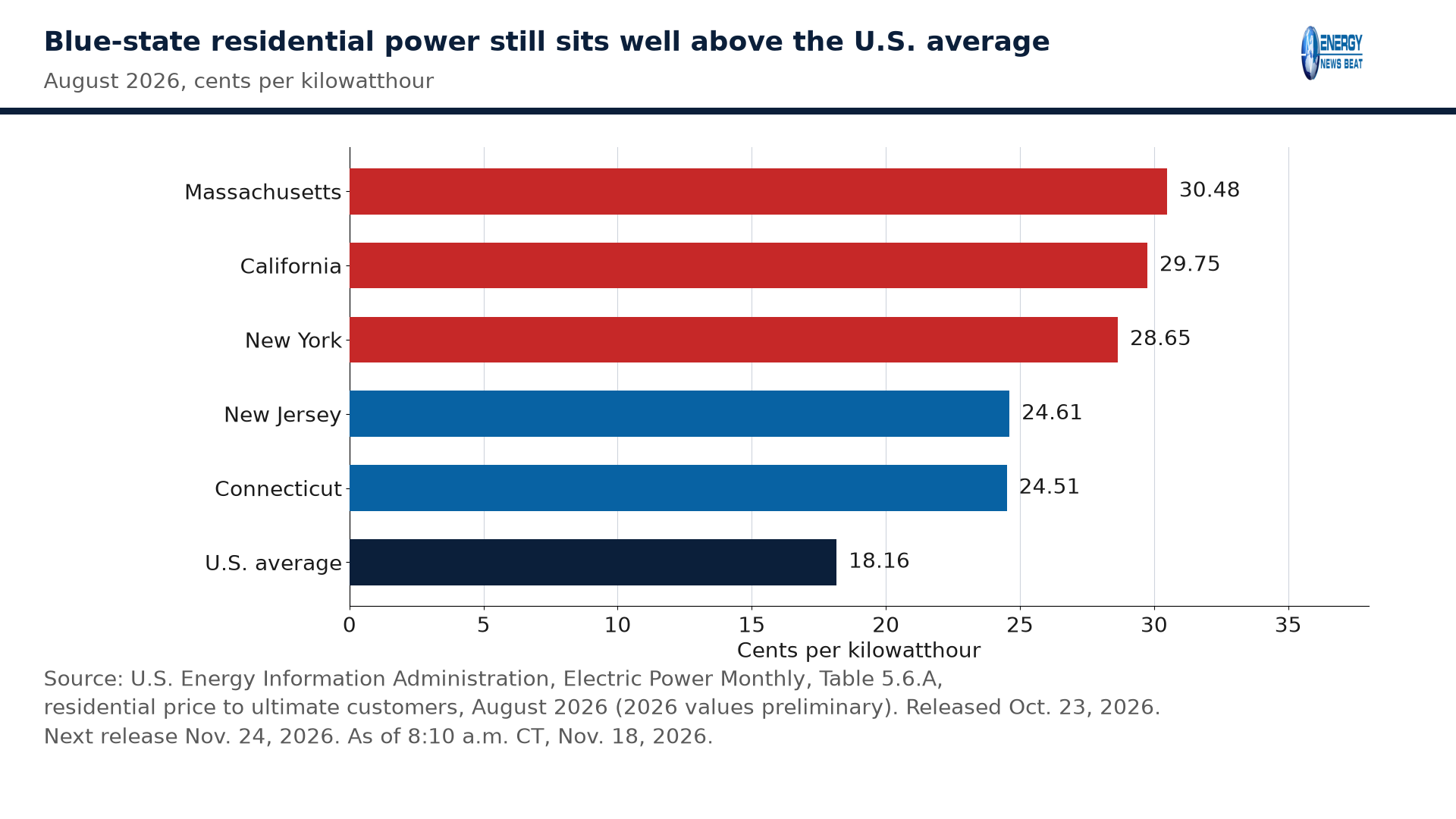
The U.S. Energy Information Administration, in Electric Power Monthly Table 5.6.A for August 2026, released Oct. 23, put the U.S. residential average at 18.16 cents a kilowatthour. Massachusetts was at 30.48 cents, California at 29.75, New York at 28.65, New Jersey at 24.61 and Connecticut at 24.51 — 68, 64, 58, 36 and 35 percent above the national average, respectively. Year to date through August, closer to Eurostat’s half-year window, California averaged 32.58 cents and Connecticut 27.47.
Investors can see the other side of the ledger. EIA reported on Sept. 1 that U.S. liquefied natural gas exports averaged 17.4 billion cubic feet a day in the first half of 2026, 23 percent more than a year earlier. Shipments to Europe rose only 1 percent, while shipments to Asia more than doubled after disruptions in the Strait of Hormuz. The Short-Term Energy Outlook then current, cited in that note, estimated exports at 17.3 billion cubic feet a day in the second half of 2026 and 18.7 billion in the first half of 2027. Wright’s Warsaw pitch, as the Journal described it, treats Poland and Eastern Europe as a natural destination for more of that gas and for American infrastructure efforts — a commercial interest, and it should be read as one.
A recovery timeline
The path to Wednesday’s warning is a four-year ledger. Russia’s full-scale invasion of Ukraine in February 2022, and the later cutoff of Russian pipeline gas, forced Europe to replace a fuel it had treated as cheap. Governments added terminals and signed long-term U.S. LNG contracts. They also kept retiring dispatchable plants in the name of lower emissions. Wright’s critique, as the Journal reported it, is that the second habit has been celebrated even as the first has not been large enough.
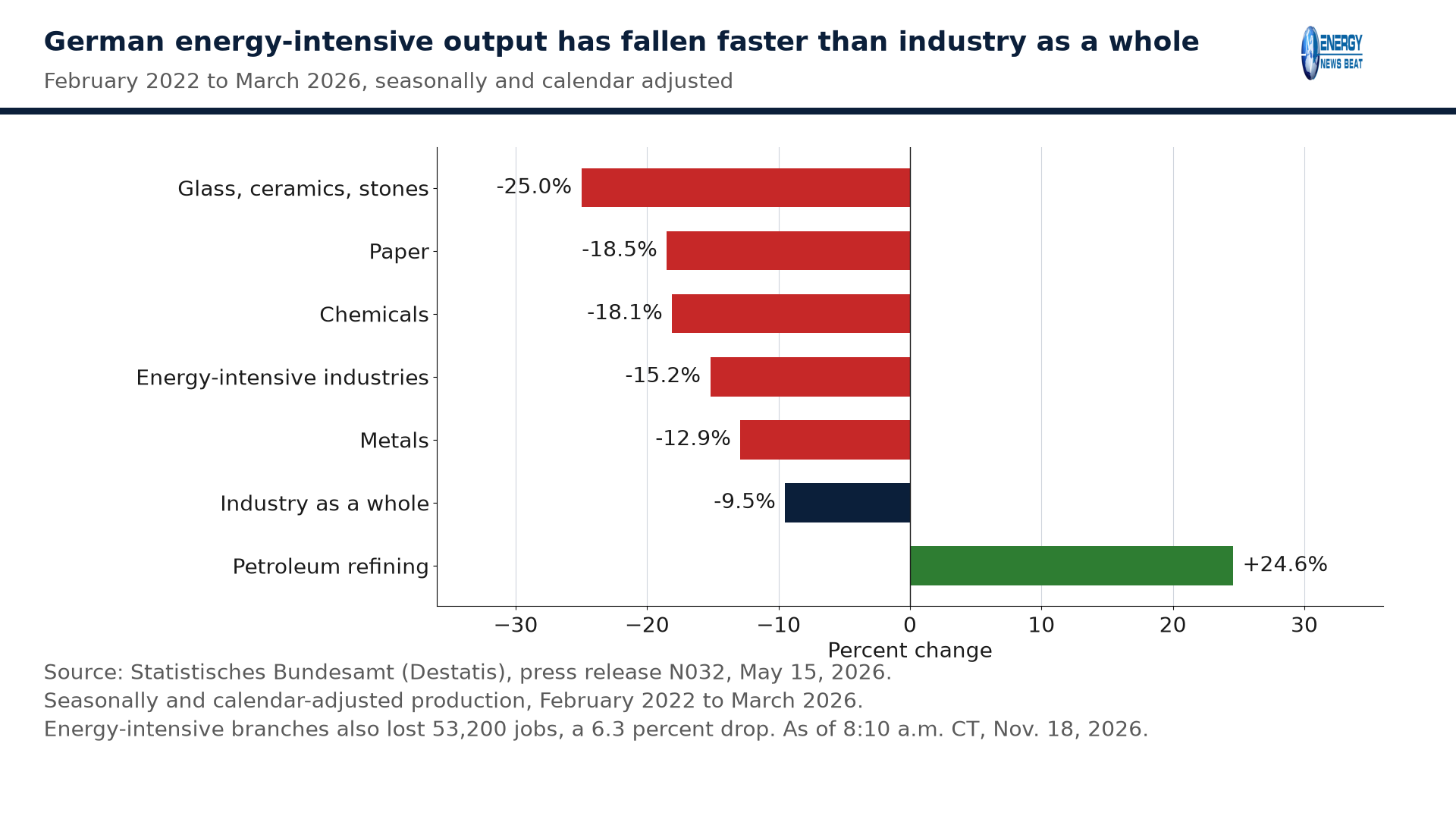
The industrial result is documented. Germany’s Federal Statistical Office, in a May 15 release, said production in energy-intensive industries fell 15.2 percent from February 2022 to March 2026, seasonally and calendar adjusted, compared with a 9.5 percent decline in industry as a whole. Chemicals were down 18.1 percent, paper 18.5 percent, and glass, ceramics and building materials 25.0 percent. Metal production fell 12.9 percent; petroleum refining rose 24.6 percent. Those branches employed 53,200 fewer people, a 6.3 percent drop, to 794,400.
Winter inventories tell a related story. An Allgäuer Zeitung update posted midday in Germany on Nov. 18 put the country’s gas-storage fill at 57.19 percent, against a European average of 70.15 percent. Those figures match Gasspeicher.app‘s compilation of GIE AGSI+ filings for the Nov. 16 gas day, which the site flagged as provisional. German rules call for an 80 percent fill at most sites by Nov. 1; the same Zeitung table put the Nov. 1, 2026, level at 61.17 percent.
Poland is trying to hold household gas costs in place as it builds a different supply map. On Nov. 17, the Energy Ministry said the Council of Ministers had approved a draft law freezing the maximum gas-fuel price for protected customers at 197.29 zlotys a megawatthour, net of tax and distribution charges, for all of 2027, matching the 2026 official-seller tariff. At the ECB’s Nov. 17 rate of 4.4038 zlotys per euro, that cap is €44.80 a megawatthour. The ministry said 7.5 million households would be covered. The recovery path Wright was selling in Warsaw is more supply: U.S. LNG through Poland, shared energy infrastructure, and, in the Journal’s paraphrase, an energy-addition mindset rather than celebrated plant closures.
The case officials make
European and blue-state officials do not describe this as celebrating scarcity. They describe it as climate policy, public health policy, and a break with Russian fuel. Motyka’s own line at the conference — “Russia used energy sources like a weapon” — is the security case for leaving Moscow, not a defense of high prices. Polish Prime Minister Donald Tusk, opening the summit, said mutual loyalty between the United States and Europe is “not only the foundation of security. It is the foundation of our civilization,” according to Gospodarka Morska, and that LNG, nuclear and power-transmission cooperation with the United States is “our future, for which there is no alternative.”
Germany’s network regulator has declined to treat the storage gap as a present emergency. In mid-October, the Allgäuer Zeitung quoted the Bundesnetzagentur as saying gas supply was stable, security of supply was guaranteed, and the risk of a tight situation was low, because Germany still draws pipeline gas from Norway, LNG — “currently essentially from the United States” — and possible imports through France and Belgium. Eurostat’s first-half EU average eased, though it remains far above the pre-crisis floor. EU Energy Commissioner Dan Jørgensen argued in an Oct. 1 State of Green interview that the measures for security, lower prices and climate largely overlap: more homegrown, mainly renewable, energy.
In the United States, the same dispute is usually framed as electrification, not as a ban for its own sake. Blackmon’s Forbes column quotes Healey administration officials as saying heat pumps are “up to three times as energy efficient” as conventional boilers and furnaces, and notes that Mass Save has steered rebates toward heat pumps, capped at $8,500 on an average $22,000 installation in the program’s own example. New York’s all-electric new-buildings rule and Colorado’s Clean Heat Standard are defended as ways to cut greenhouse gases. The Regional Greenhouse Gas Initiative calls itself a “market-based effort” to cap and reduce power-sector carbon dioxide, and offshore-wind sponsors argue their projects are about long-term supply. Colorado’s standard, Forbes notes, requires gas utilities to cut emissions 22 percent by 2030.
The counter-record is why the warning travels. Forbes, citing WCVB’s Ben Simmoneau, reported that Laura and Joe Stephens of Stoughton, Massachusetts, saw a December electric bill of $853 after replacing a gas furnace with a qualifying heat pump, against less than $800 for the entire prior winter. “I thoroughly regret it,” Laura Stephens told WCVB, according to that account. Blackmon argues that only after the promised savings failed to appear did regulators order winter discount rates for heat-pump customers, and, citing WCVB, that gas delivery charges help fund the rebates. He also cites a July 2023 GTI Energy analysis, prepared for Black Hills Energy, that found converting Colorado gas homes to high-efficiency electric heat pumps would raise annual consumer energy costs 112 percent, more than $1.7 billion a year statewide. Those are reported findings, not new calculations.
Stu’s Take
Wright is not a neutral referee in Warsaw. He is also selling American gas, energy technology and infrastructure, and he said so. That does not make the underlying numbers go away. Europe’s official household power price is still far above the U.S. average, Germany’s energy-intensive factories have shrunk since 2022, and California, New York and Massachusetts already charge residents in a European-looking range. Officials have real arguments — climate, public health, and a clean break with Russian fuel — and some bills have come down. They have not come down enough to call the experiment finished. If blue-state gas rules now become a federal fight, as Blackmon argues they might, Congress should start with the actual rates, not the brochures.
Sources
Primary and official sources opened for this article, with access on Wednesday, Nov. 18, 2026, unless a different date is noted. Direct quotation marks are used only where the named source set the words in quotes or an official English text was retrieved.
- Adam Whittaker, The Wall Street Journal / Dow Jones Newswires, “U.S. Energy Chief Urges Western Europe to Pivot to Power Expansion,” Warsaw, Nov. 18, 2026, 5:33 a.m. Eastern Time. Paraphrased account of Energy Secretary Chris Wright’s remarks at the Partnership for Transatlantic Energy Cooperation conference. The dispatch puts quotation marks only around Polish Energy Minister Miłosz Motyka: “Russia used energy sources like a weapon.” Full newswire text also retrieved from MarketScreener Australia, which carried the same byline and “Write to Adam Whittaker at adam.whittaker@wsj.com” https://www.wsj.com/world/europe/u-s-energy-chief-urges-western-europe-to-pivot-to-power-expansion-e75d8bfe
- MarketScreener Australia republication of the Whittaker Dow Jones Newswire, Nov. 18, 2026, 9:33 p.m. AEDT (5:33 a.m. ET). Used to read the full wire text https://au.marketscreener.com/news/u-s-energy-chief-urges-western-europe-to-pivot-to-power-expansion-ce785eddd98ff32d
- David Blackmon (@EnergyAbsurdity), post 2123043539114148200, Nov. 18, 2026, 1:19 p.m. UTC (7:19 a.m. Central Time). “Energy Secretary Chris Wright is 100% right.” Full text in the post’s extended note; the Wall Street Journal link followed in post 2123043542205669887 https://x.com/EnergyAbsurdity/status/2123043539114148200
- David Blackmon, Forbes, “State Battles Pitting Natural Gas Vs. Electric May Go National,” Nov. 11, 2026, 12:36 p.m. EST. Blackmon’s view that blue-state gas and electrification fights may now go to a Democratic Congress. The column cites WCVB’s Ben Simmoneau, Mass Save rebate figures, Healey administration officials, a GTI Energy analysis for Black Hills Energy, and New York and Colorado policies. Linked from https://x.com/EnergyAbsurdity/status/2120575789775413504 https://www.forbes.com/sites/davidblackmon/2026/11/11/state-battles-pitting-natural-gas-heat-vs-electric-may-go-national/
- Gospodarka Morska, “W Warszawie 7. szczyt Partnerstwa na rzecz Transatlantyckiej Współpracy Energetycznej,” Nov. 18, 2026, 1:25 p.m. local. Reports ministry-attributed quotations from Wright, Motyka and Prime Minister Donald Tusk at the opening of the seventh P-TEC. No official English original of Wright’s ministry-reported remarks was located; the article translates that passage and labels it as a translation https://www.gospodarkamorska.pl/w-warszawie-szczyt-partnerstwa-na-rzecz-transatlantyckiej-wspolpracy-energetycznej-96578
- Polish Ministry of Energy, “P-TEC w Warszawie. Polska w centrum transatlantyckiego dialogu o bezpieczeństwie energetycznym,” event page for the seventh P-TEC ministerial, Nov. 18–19, 2026, Warsaw, organized with the U.S. Department of Energy and the Atlantic Council Global Energy Center. Lists Wright, EU Energy Commissioner Dan Jørgensen and regional energy ministers among invited guests https://www.gov.pl/web/energia/p-tec-w-warszawie-polska-w-centrum-transatlantyckiego-dialogu-o-bezpieczenstwie-energetycznym
- Atlantic Council, “Seventh Partnership for Transatlantic Energy Cooperation (P-TEC),” event agenda for Nov. 18–19, 2026, Warsaw, including a Nov. 18 fireside chat with Wright and Motyka https://www.atlanticcouncil.org/event/seventh-partnership-for-transatlantic-energy-cooperation/
- U.S. Embassy Warsaw, post 2122990529818320901, Nov. 18, 2026, 9:49 a.m. UTC, on a bilateral meeting of Secretary Wright, Ambassador Rose and Prime Minister Tusk at P-TEC. The post does not contain the plant-closure remarks later reported by the Journal https://x.com/USEmbassyWarsaw/status/2122990529818320901
- Eurostat, “Household electricity prices ease in 1st half of 2026,” Oct. 30, 2026. EU average €0.28/kWh in the first half of 2026, down 2.2 percent from €0.29 in the second half of 2025, still well above pre-2022 crisis levels. Ireland €0.39; Germany and Belgium €0.36; Hungary €0.11. Source dataset nrg_pc_204, consumption band DC (2,500–4,999 kWh), all taxes and levies included. Unrounded band-DC values used for dollar conversions include EU €0.2832 and Germany €0.3618 https://ec.europa.eu/eurostat/web/products-eurostat-news/w/ddn-20261030-2
- U.S. Energy Information Administration, Electric Power Monthly Table 5.6.A, Average Price of Electricity to Ultimate Customers by End-Use Sector, by State, August 2026 and 2025, cents per kilowatthour. Data for August 2026, released Oct. 23, 2026; next release scheduled Nov. 24, 2026, and was not out as of this morning. Residential: U.S. 18.16; Massachusetts 30.48; California 29.75; New York 28.65; New Jersey 24.61; Connecticut 24.51 (30.17 in August 2025). 2026 values are preliminary https://www.eia.gov/electricity/monthly/epm_table_grapher.php?t=epmt_5_6_a
- EIA, Today in Energy, “U.S. LNG exports rose 23% in the first half of 2026 because of higher capacity,” Sept. 1, 2026, principal contributor Jordan Young. U.S. LNG exports averaged 17.4 Bcf/d in the first half of 2026, up 23 percent. Europe +0.1 Bcf/d (1 percent); Asia +2.3 Bcf/d (108 percent). STEO estimates 17.3 Bcf/d in the second half of 2026 and 18.7 Bcf/d in the first half of 2027. First-half 2026 TTF average $14.74/MMBtu, up from $13.10 in the first half of 2025 https://www.eia.gov/todayinenergy/detail.php?id=68064
- Statistisches Bundesamt (Destatis), press release N032, May 15, 2026, “Energieintensive Industriezweige mit Produktionsrückgang um 15,2 % von Februar 2022 bis März 2026.” Energy-intensive production −15.2 percent from February 2022 to March 2026, seasonally and calendar adjusted; industry as a whole −9.5 percent; chemicals −18.1; paper −18.5; glass, ceramics and building materials −25.0; metals −12.9; petroleum refining +24.6. Employment in those branches −53,200, or −6.3 percent, to 794,400 https://www.destatis.de/DE/Presse/Pressemitteilungen/2026/05/PD26_N032_42.html
- Polish Ministry of Energy, “Chronimy odbiorców gazu przed podwyżkami w 2027 r. Nowe rozwiązania przyjęte przez Radę Ministrów,” Nov. 17, 2026. Council of Ministers approved a draft law setting a maximum gas-fuel price of 197.29 zlotys/MWh net for protected customers throughout 2027, matching the 2026 official-seller tariff. The cap excludes VAT, excise and distribution charges. The ministry said 7.5 million households would be covered. Minister Motyka is quoted on the page https://www.gov.pl/web/energia/chronimy-odbiorcow-gazu-przed-podwyzkami-w-2027-r-nowe-rozwiazania-przyjete-przez-rade-ministrow
- Polskie Radio, English service, “Poland to cap gas prices for households at current level in 2027,” Nov. 17, 2026, citing PAP. Reports the cap as PLN 197.29 (EUR 45) per megawatthour https://www.polskieradio.pl/395/7784/artykul/3753923,poland-to-cap-gas-prices-for-households-at-current-level-in-2027
- European Central Bank, euro foreign-exchange reference rates, Nov. 17, 2026: $1.0989 per euro; 4.4038 zlotys per euro. Used to convert Eurostat nrg_pc_204 band-DC unrounded figures (€0.2832 EU average; €0.3618 Germany) and the 197.29 zloty cap (€44.80/MWh) https://www.ecb.europa.eu/stats/eurofxref/eurofxref-daily.xml
- Allgäuer Zeitung, “Das ist der Füllstand der Gasspeicher in Deutschland aktuell (18.11.2026),” updated Nov. 18, 2026, 12:32 p.m. local, figure stamped 12:35. German gas storage 57.19 percent, European average 70.15 percent; Nov. 1, 2026, level 61.17 percent against a legal 80 percent Nov. 1 target at most sites. Quotes a mid-October Bundesnetzagentur assessment that supply was stable, security of supply was guaranteed, and the risk of a tight situation was at that moment low, with LNG “currently essentially from the United States” https://www.allgaeuer-zeitung.de/politik/das-ist-der-fuellstand-der-gasspeicher-in-deutschland-heute-aktuell-18-11-2026-103508260
- Gasspeicher.app, daily report for the Nov. 16, 2026, gas day, published Nov. 17, 2026, compiled automatically from GIE AGSI+ filings and flagged by the site as provisional. Germany 57.19 percent full; EU 70.15 percent. The Nov. 18 Zeitung figures match these readings https://gasspeicher.app/en/daily-report/2026-11-16/
- Secretary Chris Wright (@SecretaryWright), post 2123039446098481293, Nov. 18, 2026, 1:03 p.m. UTC (7:03 a.m. Central Time). On-record statement that, at the seventh P-TEC in Warsaw, the United States “celebrated the arrival of new, long-term American LNG from @Venture_Global to Poland—there will now be enough American LNG to meet roughly one-third of Poland’s annual natural gas demand.” The post does not contain the plant-closure language later reported by the Journal https://x.com/SecretaryWright/status/2123039446098481293
- State of Green, “Sound of Green: Can Europe afford climate policy in an energy crisis?,” Oct. 1, 2026. Interview with EU Energy Commissioner Dan Jørgensen. The outlet says the article “includes lightly edited and paraphrased quotes for clarity and readability.” Jørgensen is quoted: “The good news is that the things we need to do to become independent, so strengthen our security in the field of energy, and the things we need to do to lower prices, and the things we need to do to fight climate change are more or less the same. We need to produce more homegrown energy.” Paraphrased in the body because the outlet says its quotes are lightly edited and paraphrased; page updated Oct. 30, 2026. https://stateofgreen.com/en/news/sound-of-green-can-europe-afford-climate-policy-in-an-energy-crisis/
- Regional Greenhouse Gas Initiative, program homepage. RGGI describes itself as a “market-based effort” among participating states to cap and reduce carbon dioxide from the power sector https://www.rggi.org/
- U.S. Energy Information Administration, Electric Power Monthly Table 5.6.B, year-to-date residential averages through August 2026, cents per kilowatthour: U.S. 18.19; California 32.58; Connecticut 27.47 https://www.eia.gov/electricity/monthly/epm_table_grapher.php?t=epmt_5_6_b
Key primary excerpts
The Wall Street Journal / Dow Jones, Adam Whittaker, Nov. 18, 2026 (paraphrase of Wright). Western European countries should stop closing power plants in pursuit of lower carbon emissions and instead expand energy production, U.S. Energy Secretary Chris Wright said Wednesday, calling the shift fundamental to the continent’s economic and national security. … Too often they have celebrated the closure of power plants as they target lower carbon-dioxide emissions while failing to expand their energy mix, he said. For prosperity, an energy-addition mindset is needed, Wright said.
Miłosz Motyka, as quoted by the Journal, Nov. 18, 2026. Russia used energy sources like a weapon.
Poland’s Energy Ministry, Wright remarks as reported by Gospodarka Morska, Nov. 18, 2026 (translated). Poland is our key strategic ally and a gateway to the rest of the Central and Eastern European region. It is not only that America sells energy to Europe. It is about a partnership with the countries of Central Europe in developing energy sources. We want to build energy, technologies and energy infrastructure together, develop a dynamic, thriving economy, and act as strong allies in an increasingly uncertain world.
Donald Tusk, as reported by Gospodarka Morska, Nov. 18, 2026 (translated). Mutual loyalty between the United States and Europe is not only the foundation of security. It is the foundation of our civilization. There is not a word of exaggeration in that.
David Blackmon, X, Nov. 18, 2026. Energy Secretary Chris Wright is 100% right, and Western Europe had better start listening before it’s too late.
Laura Stephens, as reported by Forbes citing WCVB, in Blackmon’s Nov. 11, 2026, column. I thoroughly regret it.
Miłosz Motyka, Polish Energy Ministry gas-cap page, Nov. 17, 2026 (translated from the official Polish text). We have prepared a draft law thanks to which gas prices will not rise in 2027. We want to give households more stable and predictable costs for using this fuel.
Data tables
Residential electricity prices, August 2026
| Jurisdiction | August 2026 | August 2025 | Vs. U.S. 2026 |
| U.S. average | 18.16 | 17.57 | — |
| Massachusetts | 30.48 | 30.55 | +68% |
| California | 29.75 | 30.92 | +64% |
| New York | 28.65 | 26.64 | +58% |
| New Jersey | 24.61 | 24.70 | +36% |
| Connecticut | 24.51 | 30.17 | +35% |
EIA Electric Power Monthly Table 5.6.A, released Oct. 23, 2026. Cents per kilowatthour. 2026 values preliminary. Next release scheduled Nov. 24, 2026, and was not out as of this morning. Percent versus the U.S. average is rounded to the nearest whole percent.
EU household electricity prices, first half of 2026
| Area | €/kWh | U.S. ¢/kWh, translated |
| EU average | 0.28 | 31.1 |
| Ireland | 0.39 | 42.5 |
| Germany | 0.36 | 39.8 |
| Belgium | 0.36 | 39.3 |
| Hungary | 0.11 | 12.5 |
Eurostat, Oct. 30, 2026, dataset nrg_pc_204, consumption band DC (2,500–4,999 kWh), all taxes and levies included. Dollar figures use the ECB euro reference rate of $1.0989 on Nov. 17, 2026, applied to unrounded band-DC values (EU €0.2832; Germany €0.3618), and are a currency translation, not an identical tariff comparison with the EIA August series.
German industrial production, February 2022 to March 2026
| Branch | Production change |
| Energy-intensive industries | −15.2% |
| Industry as a whole | −9.5% |
| Glass, ceramics and building materials | −25.0% |
| Paper | −18.5% |
| Chemicals | −18.1% |
| Metals | −12.9% |
| Petroleum refining | +24.6% |
Destatis press release N032, May 15, 2026. Seasonally and calendar adjusted. Employment change in energy-intensive branches: −53,200, or −6.3 percent, to 794,400.
Selected U.S. LNG and Polish gas-cap figures
| Item | Figure |
| U.S. LNG exports, first half 2026 | 17.4 Bcf/d, +23% year over year |
| U.S. LNG to Europe, first half 2026 | +0.1 Bcf/d, or +1% |
| U.S. LNG to Asia, first half 2026 | +2.3 Bcf/d, or +108% |
| STEO then current, U.S. LNG, second half 2026 | 17.3 Bcf/d |
| STEO then current, U.S. LNG, first half 2027 | 18.7 Bcf/d |
| TTF average, first half 2026 | $14.74/MMBtu |
| Polish 2027 household gas-fuel cap, net | 197.29 zlotys/MWh (€44.80) |
| Households covered, ministry estimate | 7.5 million |
LNG figures: EIA Today in Energy, Sept. 1, 2026, including the Short-Term Energy Outlook figures then current. Polish cap: Energy Ministry, Nov. 17, 2026; euro equivalent uses the ECB zloty rate of 4.4038 on Nov. 17, 2026.
Timeline
February 2022. Russia’s full-scale invasion of Ukraine begins the period Destatis later uses as the start of its energy-intensive production comparison.
2022–2024. Europe replaces Russian pipeline gas with Norwegian pipeline supply, LNG including U.S. cargoes, and lower demand, and adds import terminals; some countries continue to retire dispatchable plants.
July 2023. Date of the GTI Energy analysis for Black Hills Energy cited in Blackmon’s Forbes column, finding a 112 percent rise in annual consumer energy costs if Colorado gas homes converted to high-efficiency electric heat pumps and appliances.
November 2025. Massachusetts utilities implement winter discount rates for heat-pump customers, according to Blackmon’s Forbes column, after a Department of Public Utilities order.
January–June 2026. U.S. LNG exports average 17.4 Bcf/d, up 23 percent from a year earlier, EIA reported Sept. 1, 2026. Shipments to Asia more than double after Strait of Hormuz disruptions; shipments to Europe rise 1 percent.
March 2026. End month of the Destatis energy-intensive production comparison: −15.2 percent versus February 2022.
First half of 2026. Eurostat household electricity average in the EU is €0.28/kWh, down 2.2 percent from the second half of 2025, still well above pre-crisis levels.
August 2026. Latest EIA state residential electricity prices in Table 5.6.A, released Oct. 23, 2026. Year-to-date through August, Table 5.6.B: U.S. 18.19 cents; California 32.58; Connecticut 27.47.
Oct. 23, 2026. EIA releases the August Electric Power Monthly. Next table scheduled Nov. 24, 2026.
Oct. 30, 2026. Eurostat publishes first-half 2026 household electricity prices.
Nov. 1, 2026. German gas-storage fill 61.17 percent, against a legal 80 percent target at most sites for that date, according to the Allgäuer Zeitung table.
Nov. 11, 2026. Blackmon publishes the Forbes column arguing that blue-state gas-versus-electric fights may go national under a Democratic Congress.
Nov. 16, 2026. Gasspeicher.app compilation of GIE AGSI+ filings, flagged as provisional: German storage 57.19 percent; EU 70.15 percent.
Nov. 17, 2026. Polish Council of Ministers approves a draft 2027 household gas-price freeze at 197.29 zlotys/MWh net. ECB reference rates: $1.0989 per euro; 4.4038 zlotys per euro.
Nov. 18, 2026. Seventh P-TEC opens in Warsaw. Wright’s remarks are reported by the Journal at 5:33 a.m. ET. At 7:03 a.m. Central Time, Wright posts that new long-term American LNG from Venture Global has arrived and that American LNG will now be enough to meet roughly one-third of Poland’s annual gas demand. Blackmon posts at 7:19 a.m. Central Time that Wright is “100% right.”