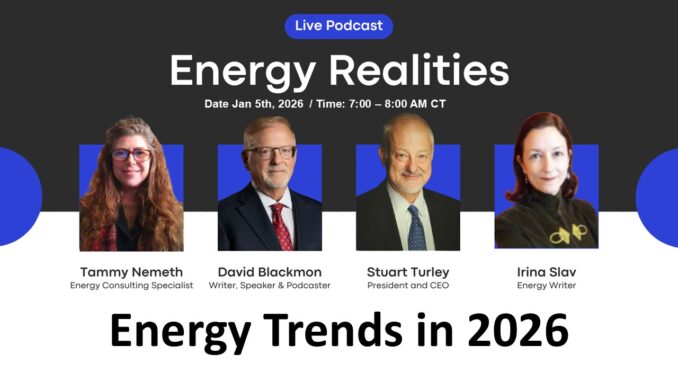
The Energy Realities team of David Blackmon, Irina Slav, Dr. Tammy Nemeth, and Stu Turley kicks off 2026 with a bang! This is a wild ride, and we are off to the Energy Realities Races in 2026.
00:00 Introduction
02:09 Dr. Tammy Nemeth looks to kick off energy trends in Canada and Oil markets
05:00 David Blackmon Venezuela
06:29 Irina Slav – Common Sense
09:34 David – Battery Advancements
11:18 Stu Turley – batteries must be recyclable, and it will take Billions to get Venezuelan oil moving
14:57 If North Korea, Democrats, or Republicans who allegedly took money grumble, it means you’re on the right track.
15:26 Trillions spent on the energy transition, only to have higher costs
22:07 EVs and Norway
30:55 Corporate Sustainability Due Diligence Directive
34:33 Orsted and Equinor
43:26 Climate action faces key tests
— STUART TURLEY – Energy Podcast Host (@STUARTTURLEY16) January 5, 2026
1. Energy trends and outlook for 2026:
– The impact of the situation in Venezuela on the global oil market and Canada’s oil exports
– The European Union’s Carbon Border Adjustment Mechanism (CBAM) and its expansion to more industries
– Challenges facing the energy transition, such as the viability of new battery technologies and the reliability of renewable energy sources like wind and solar
2. Geopolitical and economic issues:
– Tensions between the US, Canada, and the EU
– Concerns about corruption and fraud in China’s electric vehicle industry
– The potential impact of the US taking action in Venezuela on Chinese investments in South America
3. Energy policies and their effects:
– The differences in electricity prices and affordability between Democratic-led and Republican-led states in the US
– The unintended consequences of renewable energy policies, such as increased electricity costs for consumers
4. Specific energy-related news and developments:
– Legal challenges by offshore wind companies against the US government’s suspension of offshore wind projects
– The decline in oil prices in 2025 and OPEC’s efforts to manage the resulting glut
The transcript covers a wide range of energy-related topics, from geopolitics and policies to technological developments and market trends, providing a comprehensive discussion of the key issues facing the energy sector in 2026.
International Author writing about energy, mining, and geopolitical issues. Bulgaria
Principal at DB Energy Advisors, energy author, and podcast host.Principal at DB Energy Advisors, energy author, and podcast host.
Energy Consulting Specialist
President and CEO, Sandstone Group, Podcast Host
David Blackmon, Energy Realities Host [00:00:11] Well, hey, good morning everybody. We are starting off the new year, right? Beginning our energy realities podcast on time at 7 AM central time. And what time is it in Bulgaria? Arena.
Irina Slav, Energy Realities Host [00:00:23] It’s 3 p.m.
David Blackmon, Energy Realities Host [00:00:25] 3Pm in Bulgaria and Tammy and you are in Canada today. No, you’re in Britain today.
Tammy Nemeth, Energy Realties Host [00:00:31] No, I’m in the U.K. And it is 1 p.m.
David Blackmon, Energy Realities Host [00:00:34] One PM. Okay. So we got, we got several of the time zones covered today, uh, as we do every week here at energy realities, we deal with, uh global issues, uh not just parochial concerns, uh here in Texas or, uh well, Stu’s in Texas too. Sometimes he’s in Oklahoma. Um, we go all over the world here at Energy Realities and, uh it’s a beautiful day in Texas. Uh, it’s. A beautiful day. I’m sure in Bulgaria, is it warm?
Irina Slav, Energy Realities Host [00:01:04] It’s warmer than I’d like it to be in early January, but that’s climate change for you. Yes, that’s global warming.
David Blackmon, Energy Realities Host [00:01:11] Yeah, Al Gore celebrating and Tammy, what’s it like?
Tammy Nemeth, Energy Realties Host [00:01:14] It’s global cooling here in the UK.
David Blackmon, Energy Realities Host [00:01:17] Oh, wow.
Tammy Nemeth, Energy Realties Host [00:01:19] Minus five and frost and ice everywhere so minus five winter it’s winter sort of
David Blackmon, Energy Realities Host [00:01:28] Maybe the Gulf Stream is stopping, who knows? Maybe they’re right about that. We’re here today. We couldn’t decide on a single topic to cover today. So we are gonna kind of cover the landscape, talk about energy trends as we enter 2026, things that we see coming, things that are already happening. And hopefully this will be entertaining and educational. I’m sure it’ll be educational for me because I have a hard time keeping up these days. Let’s start our roundtable today with, just go top to bottom here, Tammy Nemeth. What are your topics today?
Tammy Nemeth, Energy Realties Host [00:02:09] Well if we’re looking at what the energy trends are for 2026, I think it’s going to be a very interesting year given what just happened over the weekend with Venezuela and how that has thrown various issues of the oil market into turmoil and where countries stand like Canada for example which has been sort of filling the gap on the Gulf refineries. Replacing Venezuelan oil that is because their industry was such a mess. And so now with the Canada, US, Mexico free trade agreement being renegotiated this year, this adds an interesting or removes for Canada anyway, any leverage they might have had with respect to oil for that agreement. So it also puts more emphasis on the need for building. Building another pipeline to the west coast to export more oil and gas and away from the American market. So that’s been the sort of chatter in Canada is that, oh my gosh, we need to diversify more than ever and, oh, wait, the EU needs help. We should also be diversifying to the EU. And so then one of the stories that I guess we’ll talk about later is the On January 1st, the European carbon border adjustment mechanism came into force, which is initially it’s six or seven major high emitting industries, but the plan over time is to roll this out to every industry in Europe, including oil and gas and transmission and all that kind of thing. Actually, I think electricity is already kind of in there. So, you know, the implications going forward are quite… Quite big. So we’ll see what happens. I know for Canada, this has really been a bit of a shock and now there’s sort of talk. What I found interesting in Trump’s speech on the weekend was his repeated emphasis on having good neighbors who won’t be putting drugs and illegals into America. So has Canada been a good neighbor? I don’t know. There’s been you know, over the past 10 years or so, there’s been this increase in negativity in the Canada-U.S. Relationship, and you can’t put it all on America’s side with tariffs and all that. Canada hasn’t necessarily been a good neighbor, so I think this is also a bit of a wake-up call for Canada.
David Blackmon, Energy Realities Host [00:04:48] Well, those relationships, uh, internationally between countries are complex and there’s plenty of blame to go around. I’m sure, um, in that one, uh.
Irina Slav, Energy Realities Host [00:05:00] Well, David, I think we’ll all agree that the big news of this year so far, the bang of this is that the European Union is monitoring the situation in Venezuela closely. I think it will be a year with a lot of situation monitoring, close monitoring probably, But joke aside, the EU is pathetic. And it’s going to have a lot more problems in the energy department this year. My sub-stack today was about gas imports and the state of the European gas inventories, which is much worse than it was last year, this time last year and the year before. And I have some theories on the issue, but I can’t wait to see how Europe comes out of winter season, how much gas it will have in storage, because I think it won’t be a lot. And it will need to buy a lot more US LNG, which will be interesting because the US has stated plainly that it wants its LNG exempted from the methane regulation. I think Europe is in for a lot more humiliation this year, if you can believe it. But yes, you can’t believe it because you know what the EU leadership is capable of. The transition is going to get even more exposed this year as the host that it is, or at least the unworkable utopia that it it. That’s all I have for now. We can still get a prize.
David Blackmon, Energy Realities Host [00:06:49] I love your last comment because it just shows that our podcast, uh, going on, it’s into its fourth year now has been right all along.
Irina Slav, Energy Realities Host [00:06:57] Hasn’t been for years. I know because these are, you know, it’s common sense. We always talk about common sense and if something doesn’t work because common sense and the laws of physics don’t allow it to work, it will sooner or later be revealed as non-working. Like, for example, I didn’t include this story because it only came out today in Bloomberg, but last year in Europe, there was a record number of hours. With negative electricity prices because of overproduction from wind and solar installations. In Germany, in France, there are over 500 hours in total. It may not sound like a lot, because it’s hours rather than days, but it is a lot. Generators lost money during these hours. But people did not pay less for electricity, which is very strange, isn’t it?
David Blackmon, Energy Realities Host [00:07:52] Very odd, yes.
Tammy Nemeth, Energy Realties Host [00:07:55] But apparently the solution is that they’ll have this variable pricing. So depending on how the wind is blowing at any particular time, supposedly AI will help lower a person’s or a household’s price that they pay because it’ll be rolling every 30 minutes.
Irina Slav, Energy Realities Host [00:08:12] To try and move demand. Yeah, good luck with that. They’ll have to change work hours because not everyone works from home. Did they think about that? No.
Tammy Nemeth, Energy Realties Host [00:08:23] Can I add something to what you said there about the transition and how reality hits the wall? And I wanna know what you guys think. This story came out at the end of December, maybe like a week ago, where CATL has these new sodium ion batteries, and they’re touting it as being a game changer for not just EVs because they can charge quicker and be more robust than the lithium, but also for battery backup for the wind and solar. Do you all think this is a possibility in 2026? Is this just a bunch of hype or is there some actual realistic benefits to the sodium ion batteries?
Irina Slav, Energy Realities Host [00:09:08] I reserve judgment for now. I have yet to see a battery that is both cheap enough to not send electricity bills even higher and be able to store electricity for longer than a few minutes. If we’re talking about thousands of households that need to be powered during the night and when it’s not windy.
David Blackmon, Energy Realities Host [00:09:34] Yeah, so on these battery advancements, I, you know, I continue to believe eventually there’s going to be a step change in that technology that makes wind and solar more viable and electric vehicles, whether the sodium ion batteries satisfy that who knows 10 years ago, it was going to be solid state batteries. You know and there’s been you know various other solutions that everybody says. Oh, this is the game-changer that’s going to solve it all Maybe this one will be maybe it won’t be I so much of it has to do with lack of infrastructure and You know, and then you have to have the needed in belt investment Available to scale it up to societal extent and in the meantime We’re still going to need oil and gas and coal to keep the lights on And I just don’t know. It’s hard to see how we ever get to a situation where wind and solar are the truly viable solutions to any of this. Just because of their unpredictable nature and how dependent they are on the weather. And even with backup batteries, as we saw in Texas in 2021, the battery installations are completely vulnerable to the weather too. It just, it, I’ll believe it when I see it, we’ve been, you know, this new battery technology has been just around the corner for 30 years and it never makes its way around the corners. So.
Tammy Nemeth, Energy Realties Host [00:11:02] Sort of like fusion.
David Blackmon, Energy Realities Host [00:11:04] Yes. The same as nuclear fusing. Yes. I’m you and you assume that it’s, it will come Sunday, someday, but when that is, you know, Stewart, good morning. I’ll tell you what the table to you, buddy.
Stu Turley, Energy Realities Host [00:11:18] Well, I’ll tell you what the first thing is on the energy transition until the, the batteries are recyclable. I’m not interested if they’re not recyclables because these things are absolutely toxic and they cannot be fiscally responsible or responsible for that until they are recycable and that the economics have to be there. But let’s back up also to the, the, uh, a Maduro effect going on right now on the oil markets and you sit back and take a look at what happened this weekend was incredible. It has been planned for four months past October, November time period, the president Trump and his team telegraphed that the Monroe Doctrine is now in full effect. The Financial Times released this morning with the head of Chevron, who used to run Venezuela in that area, has now been seeking $2 billion to get Venezuela oiled back online. Let’s really hit for about two and a half seconds what has happened in Venezuela. Russia took the gold and China took gold from Venezuela, from what I understand. They Rosen fit had been in working the oil fields in the tankers. The dark fleet is really tied to Venezuela. When you talk about avoiding sanctions, Venezuela was very important in this whole process. And when you sit back and look at what just happened, the United States waltzed in. And took Maduro in the dark of night and they had Russian air defense systems. They had Russian equipment. They had rushing train personnel. Believe me, Putin heard this loud and clear, and I had made a comment on my podcast last week. Oh, by the way, this is going to help in the Ukraine war. And then sure enough, this happens. They noticed what happened with us equipment and us military. The US military head of the US military also said we can put boots on the ground in one hour, anywhere on the planet. I did not have that one on my dingo card. And they said that about three weeks ago, that was at the white house. So will you sit back and take a look at what’s happening right now? This is an important time in the United States when the Monroe doctrine is actually what is going on. Narco terrorism is very real. Narco terrorism is at the front, but there’s also something else that is happening this morning. Rand Paul is now leading the charge saying, wait a minute, politically, we don’t need to be doing anything in Venezuela. Why is he saying that? There are 60 US senators that have been paid millions upon millions of dollars from Venezuela. This rabbit hole, as we have Mur-Murray-Og-Uhm Um, Mara, what’s his name? Uh, being, thank you, Maduro. Thank you, uh, being rolled into New York. Uh, I’m wondering if he’s been talking to Pam Bondi this morning going, okay, I will talk.
David Blackmon, Energy Realities Host [00:14:45] Well, it’s just one thing though, in defense of Senator Paul, he is a libertarian who is opposed to literally any international, uh, adventure by the United States.
Stu Turley, Energy Realities Host [00:14:57] He’s on the list. He’s on the list that was released for receiving funds from Venezuela. I don’t, it’s alleged. So I’m going to say a leg and this is for entertainment purposes only, but I’m telling you, if you are out there grumping, if North Korea doesn’t like it and the Democrats and then the rhinos don’t like it, it means you’re on the right track.
David Blackmon, Energy Realities Host [00:15:21] That is a pretty reliable principle, yes.
Stu Turley, Energy Realities Host [00:15:26] We are seeing a very huge change globally. The trillions of dollars that have been spent, trillions of dollars have been spend in the energy transition. Two percent has been taken up globally in additional electricity around the world. In fact, check me out if those numbers are right. Now we still see 78% of the world relies on natural gas. Coal and oil. And guess what? United States is right in there as well. We’ve reduced our emissions. We can’t reduce our emissions any more than China. I mean, everything else manufacturing is coming back to the United States. Yeah. I think about to reverse. And that is, thank you. That’s what I was about to say. And so when you sit back and take a look. The world is bifurcating into two groups. And I’ve been talking about this for a long time. Those that follow net zero and fiscal insanity and energy transition carbon tax, right, carbon tax, all of that net zero bull hockey is going to go this way. You’re going to have another set of countries going this way, which is part of the energy trend. You’re gonna have all things are okay. They have to follow the laws of physics and they have to be able to be fiscally sound and I call batteries. Okay. If they can be recycled and fiscaly brought to market without subsidies. So I’m all in on storage. If it works, uh, I’m only in on wind and solar, if it obeys the laws of physics, but everybody forgets that we talk about AC versus DC. You’ve got DC wind and solar. You got to put it on a 50 megahertz Hertz grid or a 60 Hertz grid that is asynchronous and you sit back and take a look, there are physics at play on these grids that have been around for a hundred years. So you take a. Look at all of the things that I just said in my own head exploded. You asked, I, I think we’re in for a wonderful podcast series on the energy realities because a, it is going to be a hoot this year and I am absolutely looking forward to everybody fact checking everything that I just threw out and clip this.
David Blackmon, Energy Realities Host [00:18:07] Flip it. Okay. Flip it, uh, turning the floor over to me. Uh, I don’t have a lot to add to what’s already been said. Just a couple of things. I, I think the electric vehicle sector, um, is, is in for big trouble this year. Uh, you know, with the last year wasn’t much better, but, uh. Now without the U S subsidies, particularly in the United States, the EV industry is, isn’t for a complete restructuring. We’ve already seen it at four with their 19. Point five billion dollar right down, which is not the end. It’s the beginning of the fallout at Ford. Uh, GM has, has been very stealth, uh, in, in covering its own EV losses in, opaque financial reporting. But that, that is not sustainable either. And GM is going to have to reshuffle their deck too. And so will Stellantis, even Tesla’s got big problems. Now they’re, their sales in the fourth quarter were drastically below 2024, uh, the cyber truck sales have completely collapsed. So much so that Tesla now refuses to break out report on its sales of the cyber truck individually and has lumped it in with sales of two of its other low selling models, right. And in other category, uh their, their model S is still doing great. It’s best selling EV in the world. The rest of the Tesla line is in big trouble. Deep problems at Tesla. The Cybertruck is complete disaster as we all knew it would be when it was introduced. It’s too radical a design for consumers and it’s too expensive. So I think Tesla is probably in better shape than any of the other pure play EV companies outside of China. The China EV companies are in better shape, then. Anyone else because of the communist government’s intense subsidization of them. And even that’s not really sustainable for the long term because China’s economy is struggling and is going to continue to struggle, particularly as the United States gets more aggressive in the Western Hemisphere to follow up on some of what Stu said. What happened in Venezuela over the weekend puts trillions of dollars, well not trillions, hundreds of billions of dollars. In Chinese investment in South America and Central America, now completely at risk. And we don’t know where that’s going to go. But anyone who thinks this little incursion America did to take out Maduro is the end of the story, is in for a very robust awakening during the course of 2026. It’s just the beginning of the story. There’s a lot of other issues besides oil and money at play here. And it’s a very complex situation that’s going to continue to roll out as the year goes on. So all of it has to do with energy. Oil is a very important piece of it, but it’s not all of it and it’s all interrelated as we.
Stu Turley, Energy Realities Host [00:21:15] I can I add this to the stage here? Let me add this. Let me remove add. I found I wrote this article, China’s EV market scandal is about to come around in a bombshell exposed by Ken cow on X China’s electric vehicle industry long touted as global powerhouses unraveling under a web of systematic fraud and financial manipulation. What a, what a shocker, what are shocker. And he says that there’s zero kilometer used cars has been dumped. Oh my goodness. This is going to be a huge story. And, uh, I think that it’s going to really roll out to be a big problem, uh come rolling around. Fraud matters in China too.
Tammy Nemeth, Energy Realties Host [00:22:07] I think they are going to try to flood the European market with them. Norway has this high take-up of new vehicles, 96% are EVs, the majority is divided between Volvo, which is now owned by a Chinese company and has been for some years, and BYD and some of other Chinese EV makers because I mean how can the Europeans compete with the subsidized cars coming through. But that’s what makes it interesting for the different carbon taxes and whatnot that the EU is bringing in. Because China has rolled out its version of carbon taxes and doing scope three emissions accounting and whatnot. But who’s verifying the Chinese numbers, right? It has to be a Chinese company. The end. So, I mean, the fact that they can manipulate how they produce things also indicates that they have the capacity to manipulate what data they’re reporting. So, you know, Europe thinks they’re protecting themselves from China that’s producing things with coal or whatever, but there’s always ways around that, especially for a government that seeks global economic domination. You know, they talk about rules-based order and you create rules, but if you’re not obligated to follow them, or at least lie about it, or manipulate, or deceive, or whatever, it doesn’t even have the best rules in the world, doesn’t matter.
Irina Slav, Energy Realities Host [00:23:43] Well, that is 100% true for the European Union itself. I know. It’s something that it’s difficult to make, yeah. But it’s adorable how they think that the rules are for everyone else except them, while everyone else in the face of China or other big players said, yeah, we’ll find a way around the rules that you set for us, but you don’t follow. There is always a way round. Especially in such a setup.
David Blackmon, Energy Realities Host [00:24:17] That’s correct.
Tammy Nemeth, Energy Realties Host [00:24:18] Yeah, because it really, there’s ways to be corrupt, right? It’s a very corrupt system, am I allowed to say that? You’re right, you’re allowed to listen to me. You know?
Stu Turley, Energy Realities Host [00:24:29] There are ways to be corrupt. I’m going to quote you on that one.
Irina Slav, Energy Realities Host [00:24:36] Less people can be smart and corrupt or stupid and corrupt. For example, we made the report that the head of the European Central Bank that we just joined after a year showed an economic contraction for the Eurozone, but never mind. Uh, that so christine lagarde is actually getting paid twice what? She should officially be getting paid? Of course. And it was the full names of the times that reported it. I mean, could you try and be smart about it?
David Blackmon, Energy Realities Host [00:25:16] As George Carlin famously said in his comedy routine, 30 years ago, it’s all a big club and we aren’t in it. Yeah. Christine Lagarde is.
Irina Slav, Energy Realities Host [00:25:27] Yeah, but the problem is that once upon a time, those in the club were smart.
David Blackmon, Energy Realities Host [00:25:32] Now they’re stupid.
Tammy Nemeth, Energy Realties Host [00:25:33] Aren’t they stupid or are they brazen? They’re brazen and shameless because they’re like, okay, what are you going to do about it?
Irina Slav, Energy Realities Host [00:25:41] Yeah, that’s true as well.
David Blackmon, Energy Realities Host [00:25:44] Oh, here’s a great comment from AZ land pilot car. Governor Tim waltz is both stupid and corrupt. Yes, absolutely. And he’s about to pull himself out of his reelection campaign.
Stu Turley, Energy Realities Host [00:25:58] And Gavin Newsom just said, hold my beer. I’ll show you corruption.
Tammy Nemeth, Energy Realties Host [00:26:04] Yeah. Well, the fact that the the new Mamdani in New York appointed as his deputy mayor, somebody who was unable to find all this fraud in in California.
David Blackmon, Energy Realities Host [00:26:16] Didn’t look.
Tammy Nemeth, Energy Realties Host [00:26:19] Um, can I go to Robert’s comment there about the evs in Norway? Um, he’s absolutely right I mean one of the reasons why That the new cars are our evs is because they tax the crap if you have a normal car Um, you get all these taxes all these fines, whatever. Um It makes it really hard to drive it on the uh to park it or whatever. There’s all these additional charges um but if you look at what the used car numbers are in Norway, they’ve gone like this. So there’s lots of used cars that are traditional petrol or diesel, but for new ones, they’re EVs just because they’ve used the stick so hard to make it so people can’t, it’s not affordable to buy a new normal.
David Blackmon, Energy Realities Host [00:27:09] Yeah, at least Biden had a carrot and stick approach to all this in Norway is just the stick.
Tammy Nemeth, Energy Realties Host [00:27:15] Well, no, because they subsidized the purchase of the EVs. So they subsidize the purchase of it, they subsidize the charging infrastructure. Basically, if you have an EV, you don’t have to pay for the road tax, although they changed that. They’re introducing a road tax for EVs this year, but they made it really. So they use their oil revenues to subsidize the EV owners and then raked in a whole bunch of taxes to make it really difficult for someone with a regular vehicle to drive or to purchase a new one in Norway. So yeah that was it’s an interesting thing how they do it.
David Blackmon, Energy Realities Host [00:27:58] Well, we are almost halfway through the show and we haven’t gotten to any of the special topics we all agreed to bring to the table today. Okay. Let’s get started on that. There you go, Stu. T up Tammy first.
Tammy Nemeth, Energy Realties Host [00:28:13] Okay, so Irene and I actually have a similar story where it’s about the… She has a Financial Times article where they talk about the new carbon border tax and how they’re praising all this. This is great. Europe is rolling it out. It’s gonna hit everybody this year for these six major industries. Then one of the interesting things that happened just before Christmas, of course, is that they expanded the CBAM. The carbon border adjustment mechanism, to include an additional number of smaller products. So in order to stop the offshoring of different things. And so here it says, on December 17th, they expanded the mechanism for an additional 180 downstream products. Machine parts, vehicle components, construction materials, and so on. So it’s not just the raw materials that they initially covered or if you have like a big chunk of steel or aluminum or whatever, but a bunch of these different things like that you would components of washing machines and car doors and gearboxes and so. Garden hose garden hose it like come on so they expanded it. And everybody, when they first talked about it, they said, oh, it’s just going to affect these really big things and these really guys. So if you’re a small company and you’re importing these smaller items, these components, now you have to be able to track the entire supply chain. What is the emissions profile? How are they paying the carbon tax? And so on and so forth. So it just adding an additional burden. Now, the LeMond story suggests that… This addition has to be approved by the parliament and it may take several months and therefore it may not be implemented until January 2028 but you know we’ll see we’ll see how that works it could be that companies then just offshore for the next couple of years until this is actually in place but the the first tranche of items are being covered by the carbon border adjustment mechanism starting in January. And I don’t think, you know, the United States pushed back on some stuff, but they really didn’t push back that hard on this aspect of it, which is disappointing.
David Blackmon, Energy Realities Host [00:30:51] Yeah, they were more focused on the, what is it, CS3D regulation.
Tammy Nemeth, Energy Realties Host [00:30:55] Yeah, the corporate sustainability due diligence directive, but these are all interrelated. So it’s this framework that’s being created in order to account for how everything, the emissions profile of everything eventually. So this is the first tier hitting the really big corporations, the things that they call high emitting products and whatnot. So it’ll be interesting to see you know, will companies just stop trading with the EU? I don’t know. But like Stu has been saying, we’re dividing into those who put embracing at zero and those who don’t. Unfortunately, Canada is trying to straddle both sides, which is never gonna work. So on December 17th, the federal government in Canada put out a call for comments on changing our industrial carbon tax. So that because right now different provinces can charge different stuff and then there’s a federal backstop and it’s kind of complicated or whatever but they want to expand their exports to the EU which would require a more unified system and so they drop it just before Christmas. What are your comments on this policy? And I think the the comment is only for 30 days or something so people come back to work today or whatever be like oh no I’ve got a week to come up with comment on this complex system. So I suspect there’s going to be a national all Canadian industrial carbon tax in order to increase or facilitate exports to the EU under the carbon border adjustment mechanism. And they’re also working on a green taxonomy. So just like the EU, Canada is rolling out all this stuff at the same time that America isn’t. So our biggest trading partner is America. I don’t know what it’s going to make it really difficult for Canadian companies to operate. And what I’m hearing is there’s a lot of companies just moving. They’re just moving to the US to stop having to deal with all this garbage. And then quickly, Manhattan Contrarian had a great piece about the unreported story of grid scale battery fires. And he does an amazing job of outlining some of the most egregious where you know, there’s a lot of grid scale battery fires happening and nobody seems, well, none of the mainstream media really wants to talk about it, just like they didn’t really want to talk the fraud in Minnesota and whatnot. So it’s actually increasing as there’s more and more of these grid scale, battery systems. There’s obviously an increase in the fires, but it’s going unreported because that doesn’t fit the narrative that they want to do so. I highly recommend checking out Manhattan Contrarian for the information on how these grid scale batteries are increasing and this is a real risk going forward as they try to roll more of these out to stabilize an unstable grid.
David Blackmon, Energy Realities Host [00:34:04] Seems like battery fires would, would be unstable just in and of themselves.
Tammy Nemeth, Energy Realties Host [00:34:08] No, I know it’s crazy, but there we are. And you can find me at Substack. I’ll be getting back into writing this week. It’s been a busy December with Christmas and family and everything. So I’ll beginning back into the thick of it this week, so check out my Substack, the name of the report on substack.com.
David Blackmon, Energy Realities Host [00:34:33] Okay. Well, thank you for that. Let’s tee up. Oh, uh, go well. Okay. I’ll, I’ll go. Um, so, uh. So, uh Orsted and Equinor filed legal challenges to Trump’s offshore wind suspension. Uh, this is lawsuit filed by the big wind producers. Equinore of course is also a big oil company, but they’re big in wind as well, and then they, they have a couple of projects, but Orsted does. Equinure. Has interest in one big project, the revolution wind project, offshore New York city in Massachusetts. Um, that has been suspended, uh, you know, along with all the other offshore wind developments that were under already under construction, uh by the department of interior, uh in mid December and they are not taking their lump sitting down. They’re going to Sue, um, even though, I mean, the interior departments suspension is basically trying to make them comply with regulations under the National Environmental Policy Act requiring legitimate environmental resource impact studies that were rushed through by the Biden administration and really a lot of corners got and everyone knew it at the time and everyone new it would backfire on them when it was But and so now interior stepped in and say no you got to do legitimate environmental impact study. And, uh, yeah, that might take you a couple of years, but too bad. So sad it’s a requirement of the law. Uh, no one, you know, media won’t report it that way because they don’t understand any of it. And they’re biased in favor of offshore wind. And so, you, know, the, the public’s kind of ignorant here, but, uh. I’m sure Orsted and Equinor will be able to judge shop and find a Biden or Obama district court judge that will issue them a temporary injunction against interior. Um, and that will quickly be overturned by the appeals court and overruled by the Supreme court later on, uh, because they really don’t have a foot to stand on here, the laws, the law, and you kind of comply with. All prices settle lower after biggest annual loss since 2020. That’s a story of, um, 2025, uh, all prices saw their biggest, uh downturn since 2020 and, you know, 2020 was caused mainly by COVID and the falling apart of the OPEC plus. Alliance due to that conflict between Russia and Saudi Arabia that happened in May of that year. Uh, OPEc plus got its act back together, but, uh. You know, a couple of months later, but still all prices are way down in 2020. Really, if you look at the decreased of over 25% in all prices during 2025, it’s really the biggest collapse that wasn’t caused by a global pandemic since 2014. OPEC decided to flood the market with crude oil to try to kill the U.S. Shale industry and regain its market share from the U S shale industry. And that turned out to be a miserable flop. And the irony of all of that is the price decrease caused by OPEX flooding the market in 2014 led to OPECs joining with these non-OPEC countries like Russia and Mexico to farm OPEC Plus and try to prop the price back up. And so, you know, it’s just this endless circle that we go through with oil prices and all supply year after year after. And, um, we’ll see how OPEC plus is able to deal with the glut that, uh, Stu doesn’t believe exists. And frankly, I kind of agree with Stu. I think there is a small glut, but it’s certainly not four million barrels a day. And, uh we’ll, see how they deal with it all this year. I suspect they won’t have great success.
Tammy Nemeth, Energy Realties Host [00:38:29] Can’t they use it to fill the SPR? I mean, it’s still not filled.
David Blackmon, Energy Realities Host [00:38:33] Yeah, you know, and, and so the DOE runs that program. They have increased their solicitations for bids, but the problem is that DOE has is it’s just very bureaucratic process governs all of that. So, you, know, they can’t just ask for, Oh, we want somebody to give us a hundred million barrels of oil to put back in the SBR. They got to do it in these five million barrel, 10 million barrel chunks, and there’s a lot of paperwork, a lot of bids and you know. Hey, you got to give them 30 days for bids and you know, it just, it’s a complex things and it causes the result is when you have an energy department that really wants to refill the SPR, they end up missing a lot of opportunities at low prices because of all the bureaucracy involved. And that’s another thing. Or there’s the Trump way. Yeah, well, they’ve got to, they’re got to change all that bureaucracy. Uh, I think I am.
Stu Turley, Energy Realities Host [00:39:33] Few dark fleet tankers.
David Blackmon, Energy Realities Host [00:39:35] Exactly. There you go. Well, they’ve done that, haven’t they? A couple of them anyway. High electricity prices are a choice blue states make every day. That is for certain, sure. Um, and this is why affordability is an issue. You know, the Democrats want to use the affordability issue as a hammer on president Trump, but when you really break it down state by state, the affordability of problems are driven by democratic policies in blue states like New York, that’s Kathy Hockle, governor of New York pictured there. Um, and it varies wildly, uh, you know, the, there’s not as nearly as big an affordability crisis in red States like Texas as there is in New York. But that’s a choice voters make. They, they elected a communist to be mayor of New York city now, and just wait till you see what happens with electricity prices and, and rents in New York city over the coming four years.
Stu Turley, Energy Realities Host [00:40:33] Um, the average Democrat versus Republican state is 37% higher increase in electricity prices.
David Blackmon, Energy Realities Host [00:40:41] Yeah. That drives the electricity costs, drive the cost of all sorts of other things. And, you know, these states also have higher gas taxes. California has the highest gas tax in the country. Oh, gee, California also has the highest gas prices at the pump in the country. What a coincidence. Same thing in New York, very high gas taxes, very high gasoline prices, yada, yadda, yata, blah, blah. The beat goes on. And I got one more, I think. I’m sorry. I don’t mean to monopolize this, but you should be the next one. The next one I have was about Venezuela piece. I wrote over the weekend, got a big response. Um, it’s not behind my paywall. You can go read it at David Blackman’s energy additions. Uh, a lot of details in there that you’re not going to see in the mainstream media.
Stu Turley, Energy Realities Host [00:41:35] There you go, David. I’m showing it on the screen now. It is an outstanding article.
David Blackmon, Energy Realities Host [00:41:41] It’s a long read, but I just included an awful lot of detail in there that you’re probably not going to see at CBS News. And that’s all for me, baby. Come see me at David Blackman’s energy additions. I’d love to have you there.
Stu Turley, Energy Realities Host [00:42:02] I wonder how many wardrobe changes he had on his flight. I keep seeing all these different pictures.
David Blackmon, Energy Realities Host [00:42:08] I know he’s got different clothes on there every shot. It’s kind of fun. And arena.
Irina Slav, Energy Realities Host [00:42:17] Can I just say I just opened a Wall Street Journal article titled Be Prepared to Keep Paying More for Electricity. I’ve been keeping it in my inbox for a late moment, but I just scroll through it. I’d like to quote from it in relation to what you said, David. So one factor behind price increases. Was the rising number of homes using rooftop solar panels, which can reduce the bills of the owners of those residences, but increase system costs for others. That’s one of the many unseen costs of the so-called energy transition that nobody likes to talk about until they absolutely must, like the Wall Street Journal decided to be decent about it and mentioned.
Tammy Nemeth, Energy Realties Host [00:43:09] Who wrote that article, do you know?
Irina Slav, Energy Realities Host [00:43:11] Oh, let me see. It’s Jennifer Hiller and Max Rust. Okay.
David Blackmon, Energy Realities Host [00:43:19] Hey, listen, Jennifer Hiller is a hell of a good energy reporter. Just a shout out to Jennifer.
Irina Slav, Energy Realities Host [00:43:26] Great, yeah, it’s good to know there’s still people like that in mainstream media. Okay, my story is now that climate action faces key tests in 2026. Yeah, climate action is going to face many key tests not just this year but in the coming years as well. One of the biggest, from my selfish point of view being in Europe, is of course the carbon border adjustment mechanism that Tammy talked about and I wrote about twice. Today. My focus as an energy consumer is always on people like me and the fact that while Wopke Hoekstra celebrates the fruit of his efforts that they’re going to basically teach third world countries how to trade carbon emissions and how to reduce their emissions more meaningfully, which is not going to happen of course. But he very conveniently omits the fact that everything will become more expensive for the people who use everyday stuff and the people who buy houses, because they’re going to sebum cement imports, they’re going to sebum a seal imports, they’re gonna sebum fertilizer imports. Which means more expensive food for everyone. Nobody seems to be thinking about this, or either they’re ignoring it purposely, or they don’t know what to do about it, or both. But by leveling the playing field for European manufacturers of cement and steel and fertilizers and Chinese and Indian exporters, they’re making everything more expensive. This is what I really cannot understand why the European leadership keeps doing things that will only make life more expensive for Europeans, the same Europeans who will be voting again. Because there are always elections, or maybe they will just cancel elections altogether. Whatever they do, it ends up making our lives more expensive. Over the longer term it will but not, no, nobody cares about that.
Tammy Nemeth, Energy Realties Host [00:45:52] Cost of an ice cream scoop is what the spin was in Germany for the Energiewende. It’ll just cost you the equivalent of an Ice Cream Scoop. But it didn’t, did it? But it did it. It didn’t. It was more. And what’s interesting, Irina, I love what you said, because it’s not just about making energy more expensive and everything more expensive in the EU. It’s to make it more expensive everywhere. Everywhere. Not just the, everyone will have a level playing field of paying more for less.
Irina Slav, Energy Realities Host [00:46:25] And by the way, I see your prediction or rather informed forecast about the UK rejoining the European Union is moving ahead at speed. I mean, Kiyosawa just said they’re going to rejoin the European common market.
Tammy Nemeth, Energy Realties Host [00:46:46] It’s bit by bit, so they’re making an agreement so that lawyers and doctors from the UK will have an easier time of working in the EU. Then they’re they’re, making it easier for do it, they rejoined the Erasmus program. So they’re doing, they’re taking Brexit apart one by one until all of a sudden it’s like, well, you know, we’re already part of the ETS, we are already part of the CBAM, we already part this, oh, why don’t we just join the common market again? Right. Maybe they should also do
Irina Slav, Energy Realities Host [00:47:16] joined the Eurozone, so we know the only one was completely screwed.
David Blackmon, Energy Realities Host [00:47:24] It’s the old boiling the frog strategy.
Irina Slav, Energy Realities Host [00:47:28] It’s not even funny anymore. No, among the other key tests is making the grid more resilient. Now, I would love to see how these plans to build more interconnectors and expand the grid will go because it will cost a lot and the EU has no money and it needs to refill its gas storage. So this should be fun to watch. What else was there?
Tammy Nemeth, Energy Realties Host [00:47:57] Irina, did you see there was a story today, I didn’t have time to share it with everybody, but it was about the increase in cables being, undersea cables being destroyed or disrupted or whatever by bad actors, whether it’s China, Russia, whatever, that they troll with their anchors, and then they rip out the interconnectors. So…
Irina Slav, Energy Realities Host [00:48:20] I don’t know, is it actually verified fact or are they making up stuff again? Like they did with those drones that turns out to be German guys, remember?
Tammy Nemeth, Energy Realties Host [00:48:32] Yeah, good question. I don’t know, but if that’s the case and they want to invest all this extra money into interconnectors, how are they going to keep them secure? That’s a very good question!
Irina Slav, Energy Realities Host [00:48:45] Question. I’m sure they won’t be able to answer that question.
Stu Turley, Energy Realities Host [00:48:52] Energy security starts at home.
Irina Slav, Energy Realities Host [00:48:57] Oh yeah, which reminds me of an ex-status by a Net Zero fan, a very big Net Zero fan, who said, nobody has ever invaded a country for its renewable resources.
Speaker 5 [00:49:15] Wow
Irina Slav, Energy Realities Host [00:49:18] No, no, no. I didn’t know why.
Speaker 5 [00:49:20] There’s a reason for that.
Irina Slav, Energy Realities Host [00:49:22] He had no idea how ridiculous this was, but I’m sure they are thinking about me. Not a cell phone. Yeah. Yeah, yeah. Wow. And speaking of renewable, yeah, I know. Speaking of renewable energy, a sort of renewable new study shows how micro-earthquakes can help unlock geothermal power. Of course, we’re going to dim the sun, we are going to make artificial clouds to bring rain. Now, let’s make micro-EARTHQUAKES! What could go wrong?
David Blackmon, Energy Realities Host [00:49:56] Hey, you know what creates micro earthquakes, hydraulic fracturing and unlocked geothermal. Wow.
Tammy Nemeth, Energy Realties Host [00:50:11] I do. OK. Using fracking for good, though, instead of.
Irina Slav, Energy Realities Host [00:50:17] They never said fracking, they said micro-earthquakes, which, I thought it could be a bit of a larger scale thing than fracking. Are they talking about…
Stu Turley, Energy Realities Host [00:50:31] Direct energy weapons, trying to do this. I don’t understand.
David Blackmon, Energy Realities Host [00:50:38] I’m gonna have to read that one. I see that story, so I’m going to go read it as soon as we’re done.
Irina Slav, Energy Realities Host [00:50:45] Yeah, it’s not very very
David Blackmon, Energy Realities Host [00:50:47] I’m for it.
Irina Slav, Energy Realities Host [00:50:48] Good, but I zeroed in on the word micro-earthquakes. That’s the one thing we haven’t tried yet, so let’s try it.
Stu Turley, Energy Realities Host [00:50:56] Let’s try that, yeah.
Irina Slav, Energy Realities Host [00:50:58] Yeah.
Stu Turley, Energy Realities Host [00:50:59] And your subject again, I apologize. The picture has been gone through.
Irina Slav, Energy Realities Host [00:51:03] I have no idea what this is, anyway, my sub-stack is Arena Slavoun Energy and I will be writing more this year. Alright.
Stu Turley, Energy Realities Host [00:51:14] I’ll tell you, you can’t buy this kind of entertainment. Um, we’ve already talked about the EV market in China, uh, faces California and Minnesota levels of corruption. Just when Tim Walts told, um, um. Uh, Gavin Newsom to hold my beer, uh. President Z called both of them and said, hold my keg. Uh, cause it’s a pretty big story. Sable gets the go ahead to restart a pipeline. But it’s actually not going to really be significant enough. And I see this is on my trends watch. We’re gonna see the West coast of the United States become a national security risk beyond what it is currently right now.
David Blackmon, Energy Realities Host [00:52:03] That’s a big lift.
Stu Turley, Energy Realities Host [00:52:05] It is a big lift and it is very ugly. When you sit back and think we’ve got refineries closing, the main pipeline is closing in California. You have, uh, they’re, they are going to slow walk 2000 permits in Kern County. You have Sable getting the go ahead offshore that they can start bringing oil back online all too little too late and it has spread to the. Uh, to the Washington refinery is about to close, which impacts Oregon. So you’re going to see the evisceration started by Gavin Newsom spread to the entire West coast for eight to $10 gasoline and diesel, and they’ve been importing more of it. Uh, was it by design or was it intentional, uh, follow the money? And I think you’ll probably find that out. And then on the Maduro thing, let me, uh, share the screen here. Um, I want to also give a shout out to feed spot. Uh, I found out that I ended up number three out of the top 70 pods, podcasts in the world. That’s kind of cool. Uh, shout out for those guys. And it’s because I have great guests. It’s not cause of my hairline. When we talk a lot at, uh, David’s, I love David’s sub stack and I love Irene’s and I loved Tammy’s, but when I’m my sub stack, I had fun writing this one and it’s more of a financial look is where the same information, but I’ve got more of spin on finances in here. And when I wrote my story, I was looking at, there’s the dark fleet. This is really a huge issue that is tied to the ending the Ukraine war. And when you sit back and look at the involvement, what just happened? Uh, I, this is got some serious financial things. Uh, Chevron is up this morning. Let’s take a look. Yes. Chevron. Is up and trading right now. But I also love and I S he is a cool cat on, on, uh, he’s got a great substack as well. I respect his opinions, uh as well, and when you take a look at this article, this was on X let me bring this up. This is us electricity by state. I want to give a shout out to the energy bad boys. They did this particular video and as you see it roll by.
David Blackmon, Energy Realities Host [00:54:52] I’ll ask around on the left there
Stu Turley, Energy Realities Host [00:54:55] Yeah. Look at the blue crowd and you’ve got Alaska is the only one move staying in there. Um, this is a real rep, I want to do this for energy countries around the world as they go to net zero in energy prices, this is going to be one to work on. And I think that you’re going to see this really roll through. I’ve got it. Hey, I actually put a very cool song with this, but I don’t want to wipe out our YouTube channels. So I’m not going to be playing the music, uh, to this. It’s got some really cool songs, but the red states end up on the right. And the left ends up over here with the exception of Alaska and Alaska. You can understand cause of location. Do you can’t overcome a location, um, you know, for energy prices, but you combine the two. And then you see the purple that are in there. Those are the purple states. And it’s pretty amazing when you sit back and look at this. Pretty consistent. It is. And so when you just sit back and take a look at it, it’s just so beautiful. It looks like this, and I’m going to take a picture of it.
Irina Slav, Energy Realities Host [00:55:59] And the cheapest blue states have a lot of respectively coal and what was the other one? And oil, one’s New Mexico, the other ones Virginia, so.
David Blackmon, Energy Realities Host [00:56:13] Yeah, New Mexico really benefits a lot from all the natural gas.
Stu Turley, Energy Realities Host [00:56:19] And, and you can also find me on the energy newsbeat, uh, sub stack. And you can also find me on the energy newsbeat website. So, uh. I love all I I’m just stunned that we’ve had such a phenomenal year. Uh, and I’d like to thank all of our patrons and all of our subscribers and the numbers have just been through the roof.
David Blackmon, Energy Realities Host [00:56:44] And do us all a favor and go to YouTube and find our podcast today and give us a like and subscribe. It’s free. Doesn’t cost you anything, but it helps our metrics.
Irina Slav, Energy Realities Host [00:56:53] Yeah, for sure. And thanks for all the comments.
Tammy Nemeth, Energy Realties Host [00:56:57] Yes, thank you for all the comments. Yeah, amazing comments today. Lots of interaction. Love it. It’s fantastic. I hope we have a good year. I think it’ll be really interesting, a lot of different stuff happening.
David Blackmon, Energy Realities Host [00:57:14] Just to clarify one thing I said up front, we’re not celebrating a four year anniversary. We kick off our fourth year. We’re celebrating a three-year anniversary this month for the Energy Realities podcast, but this will begin our fourth-year now. So it’s been wonderful. It’s a great way to start Monday mornings, certainly for me, because I get so much information I didn’t know about from all of you and all of our viewers as well, and really appreciate it. And thank you, everyone, for being a part of it.
Speaker 5 [00:57:50] Of this.
David Blackmon, Energy Realities Host [00:57:53] Hope you all have a wonderful week. We’ll see you again next Monday and I won’t be moderating. So we’ll be a lot more organized.
Tammy Nemeth, Energy Realties Host [00:58:03] Oh, David.
David Blackmon, Energy Realities Host [00:58:05] You were fantastic, thank you. All right. Here we go, guys. Have a good one.