


On August 7, 2026, the U.S. Department of the Treasury’s Office of Foreign Assets Control (OFAC) announced sweeping sanctions targeting digital asset exchanges and networks used by the Iranian regime to launder funds, evade sanctions, and support the Islamic Revolutionary Guard Corps (IRGC) and other terrorist groups. The action hits two major platforms exploited by Tehran—along with the ringleader of a multi-nation front-company network—disrupting covert access to the international financial system.
Treasury Secretary Scott Bessent framed the move as further proof that the administration’s “Economic Fury” campaign is succeeding: “The Iranian regime’s reliance on digital assets and shadow banking networks is further evidence that Economic Fury is working. We will continue to increase the economic pressure. Whether in dollars, rials, or crypto, Treasury will hunt down and dismantle the illicit financial networks that keep the regime afloat.”
The designations focus on Siavash Kayvanpour (with citizenships including Iran, Dominica, and Afghanistan, and residence ties to the UAE), who operates SHPS Shelbit (Shelbit Exchange) based in the Republic of Georgia. Shelbit and related entities facilitated transfers involving IRGC-linked digital currency addresses exceeding $1 million inbound and over $2 million outbound, plus tens of millions linked to a Persian-language online gambling network run by Iranian influencers. Kayvanpour-controlled addresses also sent more than $2 million to the previously designated Iranian exchange Nobitex. Additional targets include UAE-based Shelbit General Trading LLC, Crypto Home DMCC, and NFT Home DMCC; a Poland-based Shelbit Technologies entity; and the Iran-based Aban Tether exchange, which processed millions in transactions with other designated Iranian platforms such as Nobitex, Wallex, Bitpin, and Ramzinex.
These measures build on OFAC’s sustained campaign under National Security Presidential Memorandum 2, developed in coordination with IRS Criminal Investigation. They underscore secondary sanctions risks for anyone dealing with Iranian digital asset activity. The State Department’s Rewards for Justice program continues to offer up to $15 million for information disrupting IRGC financial mechanisms.
Secretary Bessent has repeatedly pressed international partners to join the effort aggressively. This includes urging European allies to designate financiers, expose shell companies, and close related bank branches; calling on Middle East and Asian countries to dismantle shadow banking networks; and partnering with Gulf allies who have shown greater willingness to share information on Iranian regime-linked bank accounts. The U.S. has also reached out to global banks, including Chinese institutions, warning of secondary sanctions. Networks targeted in related actions have spanned jurisdictions such as the UAE (where local Virtual Assets Regulatory Authority enforcement has already hit some entities), Hong Kong, Turkey, and others.
Iran’s cash-flow situation is dire.
The U.S. naval blockade has driven crude oil exports near zero at times (down sharply from pre-conflict levels exceeding 2 million barrels per day), with monthly revenues collapsing and estimated daily economic damage in the hundreds of millions of dollars. GDP is projected to contract around 6% in 2026, inflation has surged (reports ranging from the high 50s to nearly 90% year-on-year in recent months), the rial has plummeted, job losses number in the millions, and poverty rates have risen. Frozen assets overseas (estimates vary widely, often cited in the tens to over $100 billion) remain largely inaccessible, while domestic liquidity crises, fuel shortages, banking disruptions, and war-related infrastructure damage compound the pressure. The regime has relied on opaque channels, subsidies, and IRGC-controlled revenue streams to stave off total collapse, but hard-currency shortages and the inability to freely sell oil leave it severely constrained.
Maritime data underscores the bind. As of early August 2026, roughly 50 laden vessels—mostly Iranian oil tankers carrying crude, fuels, and LPG—were idling along Iran’s coastline in the Persian Gulf and Gulf of Oman, up from lower numbers when the blockade was renewed in mid-July. Broader tallies show at least 70 ships still trapped in the Persian Gulf (of which 29 are tankers), down from higher peaks earlier in the conflict but with additional vessels that entered during a temporary memorandum period still unable to exit freely. Floating storage of Iranian crude has climbed, and successful outbound laden crude movements have been heavily constrained under renewed enforcement.
Meanwhile, the IRGC-linked leadership is digging in on maximalist conditions.
On August 8, 2026, Mohammad Bagher Zolghadr—secretary of Iran’s Supreme National Security Council and an IRGC commander—issued a statement via state media declaring that the Strait of Hormuz will not reopen until the United States “corrects its behavior.” The demands include: the U.S. must never threaten Iran again; permanently end the war with Iran and its armed allies in the region; lift the naval blockade of Iranian ports; withdraw its military from the area; completely compensate Iran for war damage; lift sanctions; and unconditionally release frozen assets. These conditions effectively hold global energy transit hostage while Iran seeks recognition of control over the strait and major economic concessions.
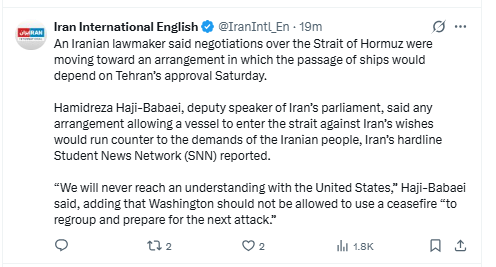
“An Iranian lawmaker said negotiations over the Strait of Hormuz were moving toward an arrangement in which the passage of ships would depend on Tehran’s approval Saturday. Hamidreza Haji-Babaei, deputy speaker of Iran’s parliament, said any arrangement allowing a vessel to enter the strait against Iran’s wishes would run counter to the demands of the Iranian people, Iran’s hardline Student News Network (SNN) reported. “We will never reach an understanding with the United States,” Haji-Babaei said, adding that Washington should not be allowed to use a ceasefire “to regroup and prepare for the next attack.”
The combination is telling.
Crypto and shadow networks are being systematically dismantled, oil revenues are choked, tankers sit idle, and the regime’s own statements reveal leverage attempts born of pressure rather than strength. Secretary Bessent and the Treasury team are locking down the funding streams—dollar, rial, or crypto—that sustain the IRGC’s operations, proxies, and weapons programs. For energy markets and global shipping, the message is clear: maximum pressure continues until the conditions that enable illicit finance and maritime disruption are removed.
Appendix: Sources and Links
- U.S. Department of the Treasury press release (Aug. 7, 2026): https://home.treasury.gov/news/press-releases/sb0598
- Related Treasury actions and Bessent statements on Economic Fury / IRGC oil and networks: https://home.treasury.gov/news/press-releases/sb0498; various OFAC designations 2025–2026
- Bessent on partners/allies (Gulf, Europe, Asia, G7 context): Bloomberg reporting on May 2026 remarks urging aggressive enforcement; Anadolu Agency on Gulf allies sharing bank data (April 2026); broader Economic Fury coverage
- Iran economic/cash-flow assessments: Foundation for Defense of Democracies analyses; IMF projections; AGBI, Al Jazeera, FDD, and other reporting on inflation, GDP contraction, oil revenue collapse, frozen assets, and blockade impacts (June–August 2026)
- Tanker and shipping data: USNI News (Aug. 7, 2026) on 70 ships / 29 tankers trapped; Bloomberg / United Against Nuclear Iran (Aug. 5–7, 2026) on ~50 laden Iranian vessels idling; Lloyd’s List Intelligence; Vortexa / Kpler floating storage notes; Globe and Mail broader vessel counts
- IRGC / SNSC demands on Strait of Hormuz: Associated Press (Aug. 8, 2026) reporting on Mohammad Bagher Zolghadr statement; Iran Press and related state media summaries; additional context from MEMRI and regional outlets on control claims and conditions
All data reflects publicly available reporting as of August 8, 2026.