


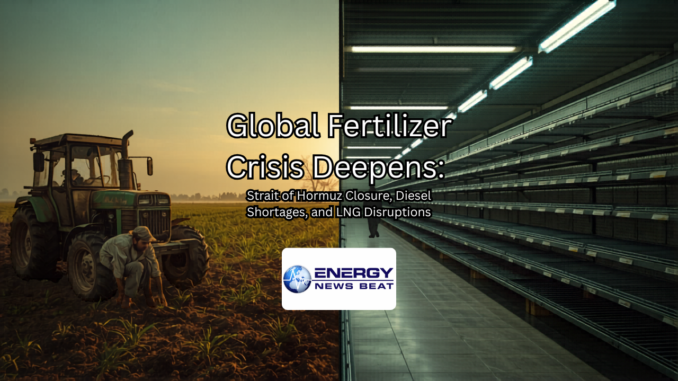
The global agriculture sector is staring down a perfect storm of fertilizer disruptions, diesel fuel shortages, and skyrocketing energy costs—all triggered by the effective closure of the Strait of Hormuz following the escalation of conflict in the Middle East after “Operation Epic Fury” on February 28, 2026. What began as a geopolitical flashpoint has rapidly become an energy and food security crisis, with ripple effects hitting farms from the U.S. heartland to Australia, California, Europe, and beyond. Fertilizer production is inextricably linked to natural gas (via the energy-intensive Haber-Bosch process for nitrogen fertilizers), while diesel powers the tractors, combines, and transport fleets that keep fields productive. With roughly one-third of global seaborne fertilizer trade, significant LNG flows, and 20-25% of world oil passing through the Hormuz chokepoint, the blockade has choked supplies and sent prices surging.
LNG and Natural Gas: The Hidden Driver of Fertilizer Production
Nitrogen fertilizers like urea and ammonia—accounting for the bulk of global use—rely on natural gas for ~80% of production costs. Qatar, a Hormuz-dependent LNG powerhouse (roughly 20% of global LNG exports), halted output after strikes on facilities, triggering force majeure on shipments and forcing downstream fertilizer plants in India, Pakistan, Bangladesh, Egypt, and Europe to cut production. Gulf countries supply 34-49% of world urea and ammonia exports, plus massive volumes of phosphate precursors and sulfur (up to 45% of global sulfur supply stranded). Monthly Gulf urea exports of over 1.5 million tons (plus Iran’s 350,000-400,000 tons) are now largely unavailable, with vessels idle and logistics paralyzed.
This isn’t just a trade route issue—it’s a production crisis. Natural gas prices have spiked globally, prompting widespread plant shutdowns and compounding earlier 2025 pressures from China’s export curbs. Urea prices have jumped 28-50% in weeks (some benchmarks up over 42% year-over-year), with broader fertilizer indices rising 18-35% since late February.
Diesel: The Lifeblood of Farming Under Siege
Fertilizer sits in the warehouse only if farms can apply it—and that requires diesel. Tractors, harvesters, and trucks consume vast quantities during spring planting and harvest seasons. The Hormuz closure has also tightened global diesel supplies via higher oil prices and refined product shortages, hitting agriculture hardest in import-reliant regions.
Australia’s Diesel Crisis: With just 32-36 days of diesel reserves (well below IEA standards), farmers face outright shortages. Deliveries are canceled or partial, prices have surged past 225 cents per liter (from ~175 c/L pre-conflict), and some regions report no fuel at bowsers. Winter crop planting is at risk, with warnings that food production could be “halved” without sufficient diesel for seeding and harvesting. Farmers in Western Australia, NSW, and Queensland are rationing or halting operations entirely.
California’s Looming Crisis: Golden State farmers are already seeing fertilizer prices rise 25%+ in weeks due to stuck Gulf shipments, while diesel has climbed over $1 per gallon (with forecasts up to $8/gallon by year-end amid refinery issues and state Low Carbon Fuel Standard rules). Central Valley operations—critical for U.S. fruits, vegetables, and nuts—are squeezed by higher fuel, fertilizer, and water costs.
EU, UK, and Global Hotspots: Europe, still heavily reliant on Russian fertilizer imports (22% of EU supply in 2025 despite sanctions), faces gas prices up 60% and fertilizer production cuts of up to 70% in some facilities. Diesel and jet fuel shortfalls compound the pain. The UK is revisiting 2022-style support measures as energy bills soar. Developing nations in Africa, Asia, and Latin America (e.g., Brazil) are even more exposed, with potential grain contract cancellations and yield drops.
How Short Are We? The Numbers Paint a Dire Picture
Global Scale: One-third of the seaborne fertilizer trade (~16 million tonnes annually) routed through Hormuz is disrupted. Gulf sources represent ~43% of urea exports, 25-30% of ammonia, 18-20% of phosphates, and 45% of sulfur. India alone lost ~800,000 tons/month of urea production due to LNG cuts.
U.S. Exposure: While domestically insulated on some nitrogen and potash, the U.S. relies on Gulf urea and phosphates. One in four American farmers has secured zero fertilizer for spring planting. Urea prices at New Orleans ports are up ~25-33%, with overall nitrogen costs climbing amid global tightness. Farm bankruptcies were already up 46% in 2025; margins are now under even more pressure.
Yield Risk: Analysts warn 15-20% global crop yield cuts if shortages persist into planting seasons, far worse than the 2022 Ukraine shock in some projections.
Russia Halts Ammonium Nitrate Exports As Global Fertilizer Crisis Set To Worsen https://t.co/isGbDL8ego
— zerohedge (@zerohedge) March 24, 2026
Energy Consumption and Efficiency
The Haber-Bosch process consumes 1–2% of global energy supply and accounts for ~3% of worldwide CO₂ emissions (mostly from hydrogen production). A typical plant uses 25–40 GJ of energy per tonne of ammonia (improved from early plants via better reforming and compression). Natural gas is the dominant feedstock (steam reforming route); coal is used in some regions like China. “Green” variants using renewable electrolysis for H₂ are emerging but remain more expensive.
Global Importance and Ties to Agriculture/Energy
Roughly 230 million tonnes of ammonia are produced annually (as of recent data), with ~80–90% going to fertilizers. It “fixes” inert atmospheric nitrogen into plant-usable form, enabling the Green Revolution and feeding billions. However, inefficiencies in fertilizer use lead to environmental issues like runoff, eutrophication, and nitrous oxide emissions (a potent greenhouse gas).In the context of current energy markets, the process’s heavy reliance on natural gas/LNG for hydrogen explains why disruptions (e.g., Strait of Hormuz issues or price spikes) directly hammer fertilizer production costs and availability—exactly as seen in the ongoing global agriculture crisis.
The Haber-Bosch process remains the most economical method for nitrogen fixation a century later, though research continues into lower-energy catalysts, electrochemical alternatives, and carbon-capture integrations. It’s a masterpiece of applied thermodynamics, catalysis, and engineering that literally sustains modern civilization.
Consumer Impacts: From Farm Gate to Grocery Aisle
Higher input costs mean farmers plant less, apply less fertilizer, or switch crops—reducing output of staples like corn, wheat, soybeans, and specialty crops. The result? Rising food prices and potential shortages. U.S. consumers already faced 40-year-high food inflation in 2022; this could repeat or exceed it. Globally, the poorest nations face acute hunger risks as developing-country farmers cut usage. Grocery bills will climb, hitting households hardest on meat, dairy, bread, and produce. Long-term, sustained high prices could reshape global trade and accelerate food inflation into 2027.
The fertilizer-diesel-energy nexus underscores a harsh reality: modern agriculture runs on fossil fuels at every step. Without swift resolution in the Middle East or strategic policy interventions (prioritized shipping, reserve releases, or targeted farmer aid), the 2026 planting season risks major shortfalls. Energy News Beat will continue tracking these developments—because when energy markets seize, food security is never far behind.
Sources include Farmdoc Daily, Reuters, American Farm Bureau, UNCTAD, and industry analysts. Markets remain fluid; monitor updates closely.
Check out The Energy News Beat Substack: https://theenergynewsbeat.substack.com/




Be the first to comment