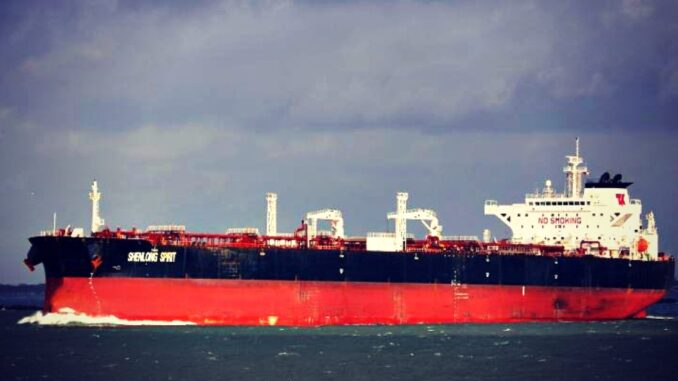
In a bold move amid escalating tensions in the Middle East, the Greek-operated oil tanker Shenlong successfully navigated the treacherous Strait of Hormuz, carrying approximately 1 million barrels of Saudi Arabian crude oil. This crossing, which occurred in recent days, marks one of the first major transits by a large commercial vessel since Iran issued stark warnings against shipping in the vital waterway. The event underscores the fragility of global energy supply chains and highlights the determination of some operators to maintain oil flows despite significant risks.
The Details of the Shenlong’s Daring Voyage
The Shenlong, a Suezmax-class tanker with a capacity of around 1 million barrels, is operated by Greece’s Dynacom Tankers Management Ltd. It loaded its cargo of Saudi crude at the port of Ras Tanura in Saudi Arabia before heading toward the Strait of Hormuz. To evade potential detection and threats, the vessel switched off its automatic identification system (AIS) transponder on March 4, 2026, while still in the Persian Gulf. It reappeared on ship-tracking systems near India’s coastline on the morning of March 9, 2026, signaling its successful passage through the strait en route to the Indian port of Mumbai.
This transit came against a backdrop of severe Iranian threats. A senior official from Iran’s Islamic Revolutionary Guard Corps (IRGC) declared the Strait of Hormuz “closed” and warned that any ship attempting to pass would be fired upon, as reported by Iranian media in early March 2026.
The strait, a narrow chokepoint between the Persian Gulf and the Gulf of Oman, typically handles about 20% of the world’s oil supply—equivalent to 16-18 million barrels per day—making any disruption a potential catalyst for global energy price spikes.
The Shenlong’s journey was confirmed through a combination of ship-tracking data from platforms like Bloomberg, Kpler, Lloyd’s List Intelligence, and MarineTraffic. No direct involvement from the U.S. or UK navies was reported in this specific crossing, though the U.S. has pledged potential escorts for future transits.
U.S. President Donald J. Trump publicly urged shipping companies to “show some guts” and defy Iran’s prohibitions, while U.S. Energy Secretary Chris Wright highlighted the tanker’s passage in a Fox News interview over the weekend.
The war between the U.S., Israel, and Iran, which began on February 28, 2026, has led to multiple attacks on vessels, including at least five tankers struck since the conflict’s onset.
These incidents, combined with Iran’s retaliatory strikes, have caused tanker traffic through the strait to plummet by around 90%, with hundreds of ships anchored on both sides awaiting safer conditions.
UPDATE: One of the Suezmax tankers has now appeared back on AIS, and is approaching Mumbai, India with a million barrels of Saudi crude oil. Her name is SHENLONG (9379210). There are still a few more which may appear on AIS given that at least one of them is heading to China. pic.twitter.com/MFqnjpkuCe
— TankerTrackers.com, Inc. (@TankerTrackers) March 9, 2026
DRIVE-BY MEDIA: Oil tankers never stopped crossing the Strait of Hormuz. They turned off mandatory AIS tracking to move through safely and switched it back on after. Media reported a crisis that was not happening causing oil and gas prices to spike.
h/t @MarineTraffic pic.twitter.com/dS1a9rNdyO
— @amuse (@amuse) March 9, 2026
How Many Other Tankers Have Made the Crossing?
While the Shenlong has garnered significant attention as one of the first large tankers to exit the Persian Gulf post-threats, it is not entirely alone. Ship-tracking data and maritime analyses indicate that a small number of other vessels have attempted similar transits since the Iranian warnings intensified in early March 2026.
According to MarineTraffic data analyzed by AFP, only nine commercial ships—including oil tankers, cargo vessels, and container ships—have been detected crossing the Strait of Hormuz since Monday, March 2, 2026. Of these, at least three were tankers, and one carried liquefied natural gas (LNG).
Dynacom Tankers Management Ltd., the operator of the Shenlong, appears to be leading the charge. Reports suggest that at least five ships from the company have crossed the strait since the war began on February 28, 2026, all with their transponders switched off to minimize risks.
Broader data from the Joint Maritime Information Center (JMIC) shows a sharp decline: 50 tankers crossed on February 28, but only three each on March 1 and March 2, with zero on March 3.
Subsequent days have seen sporadic crossings, but overall traffic remains a trickle compared to pre-conflict levels.
Notably, Iran itself has continued exporting its own oil through the strait, with estimates of 11-12 million barrels shipped since late February, often under less scrutiny as unsanctioned cargoes hesitate.
However, attacks continue, with vessels like the Maltese-flagged Prima struck by an Iranian drone on March 7, 2026.
This low volume of successful crossings reflects heightened war risks, soaring insurance premiums, and widespread caution among shipowners.
Updates on Timelines for Trump’s New Insurance Plans
In response to the shipping paralysis, President Trump announced a major initiative on March 3, 2026, to support maritime traffic through the Strait of Hormuz. The plan involves a $20 billion government-backed reinsurance program administered by the U.S. International Development Finance Corporation (DFC), aimed at covering political and war risks for vessels, particularly those carrying energy cargoes.
Key timelines and details:
Announcement and Immediate Effect: Trump declared the program “effective immediately” via Truth Social on March 3, ordering the DFC to provide political risk insurance at a “very reasonable price” for all maritime trade in the Gulf.
Launch and Operational Details: The facility was officially unveiled on March 6, 2026, with the DFC and U.S. Treasury confirming coverage for losses up to $20 billion on a rolling basis. It initially focuses on hull, machinery, and cargo insurance, with eligibility criteria for shippers still being finalized.
U.S. Navy Escorts: The plan includes provisions for U.S. Navy escorts “if necessary,” with no specific start date announced but indicated as “as soon as possible.”
Ongoing Developments: As of March 9, 2026, doubts persist about the program’s full feasibility, with analysts questioning quick execution due to statutory limits on the DFC’s role.
However, it aims to counter rising war-risk premiums and encourage more transits, potentially stabilizing oil prices that have surged amid the conflict.
This insurance backstop could pave the way for increased tanker movements, but its success depends on rapid implementation and de-escalation of threats. As the situation evolves, the Energy News Beat will continue monitoring impacts on global energy markets. Stay tuned for more updates on this critical geopolitical flashpoint.
Get your CEO on the #1 Energy Podcast in the United States: https://energynewsbeat.co/energy-news-beat-media-kit/
Is oil and gas right for your portfolio? https://energynewsbeat.co/invest/