


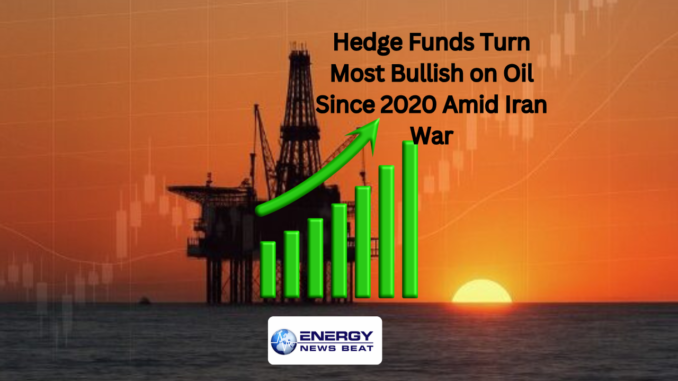
In the midst of escalating tensions in the Middle East, hedge funds have ramped up their bullish positions on oil to levels not seen since early 2020, betting on sustained supply disruptions from the ongoing U.S.-Israel conflict with Iran. As of late February 2026, just before the strikes intensified, money managers boosted their net-long stance on Brent crude to 320,952 lots—the highest in nearly two years—according to data from ICE Futures Europe.
This surge in optimism reflects growing concerns over potential long-term interruptions in oil flows through the Strait of Hormuz, a critical chokepoint for global energy supplies. The conflict, which erupted on February 28, 2026, has already driven Brent crude prices from around $73 per barrel to peaks near $120, before settling in the $90-$100 range amid volatile trading.
While some analysts predict a swift resolution, others warn that even a short war could leave lingering effects on markets. Here’s a breakdown of the hedge fund sentiment, key players pushing for higher prices, and the broader implications for investors and consumers.
Hedge Funds Betting Big on Prolonged Disruptions
Hedge funds began building these positions in early January, flipping from a cautious stance amid earlier forecasts of a 2026 supply glut to aggressive bullish bets as U.S.-Iran frictions escalated.
By the week ending February 24, net-long Brent positions had jumped by 57,766 lots, equivalent to about $4 billion in notional exposure at prevailing prices.
This marks the most optimistic outlook since the early days of the COVID-19 pandemic, when similar geopolitical risks and supply fears dominated. Several prominent funds have been vocal or active in calling for extended high oil prices, anticipating that the war could drag on and exacerbate supply shortages:
Citadel and Coatue Management: These macro-focused giants posted losses during the initial volatility but had pre-positioned for upside in oil, viewing the Iran risks as a catalyst for prices to remain elevated into late 2026.
Citadel, in particular, has highlighted the potential for backwardation—a market structure where near-term prices exceed future ones—signaling tight supplies that could persist for months.
Balyasny Asset Management and Point72: Both funds suffered weekly drawdowns (Balyasny down 3.5%, Point72 down 1.1%) amid the conflict’s market whiplash, but their earlier increases in long positions reflect bets on oil climbing toward $100+ if Hormuz disruptions linger.
Point72 has publicly noted the underpricing of geopolitical premiums, forecasting Brent averages of $75-$90 through mid-2026.
Commodity Trading Advisers (CTAs) like those at Goldman Sachs: While not a pure hedge fund, Goldman’s commodities team has reset 2026 forecasts higher, predicting Brent at $77 for the year and $71 in Q4, up from prior estimates, due to historic supply cuts from the Hormuz closure.
Broader CTA strategies have faced their worst drawdowns since April 2025 but continue to hold momentum-driven longs expecting prolonged backwardation.
This collective positioning has more than doubled net-long exposure since early January, shifting the market narrative from oversupply to fear-driven deficits.
Impacts on Investors and Consumers
The bullish hedge fund bets underscore a precarious outlook for both investors and everyday consumers. For investors, high oil prices are a double-edged sword. Energy stocks like ExxonMobil and Chevron have hit all-time highs, benefiting portfolios heavy in the sector.
However, broader markets have suffered: The S&P 500 is down nearly 3% year-to-date, with Goldman Sachs slashing U.S. growth forecasts amid surging yields and oil-driven inflation.
A sustained $90+ oil price could trigger a 10-15% stock market decline via wealth effects, reducing consumer spending by about 1% for every 10% drop in equities.
Strategies like gold, hedge funds, and energy equities are recommended as hedges against stagflation risks.
Consumers face more immediate pain. Gasoline prices have risen from $2.83 to $3.60 per gallon nationally, with every $0.10 increase siphoning $13-14 billion from household budgets annually.
A $100 oil scenario could add $50-150 billion to yearly energy costs, hitting lower-income earners hardest and potentially offsetting benefits from recent economic policies like the One Big Beautiful Bill Act.
Inflation could rise by 0.4-0.6% under such conditions, delaying Federal Reserve rate cuts and risking a recession if prices double.
Globally, demand growth is already revised down by 210,000 barrels per day for 2026 due to higher prices and economic uncertainty.
What If the War Ends in Weeks? Will Prices Plunge?
President Trump has signaled the conflict could end “very soon,” potentially easing market fears.
If resolved quickly, oil prices should fall rapidly as the war premium—estimated at $4-31 per barrel pre-escalation—unwinds.
Analysts like those at Rystad Energy forecast Brent dropping below $80 within months if Hormuz reopens swiftly.
However, tanker backlogs, damaged infrastructure, and restart complications could keep prices elevated for weeks or even months, with extreme backwardation signaling a sharp but delayed reversal.
Historical precedents, like post-Iranian Revolution recoveries, suggest full normalization might take longer if production shut-ins persist.
Can Alternatives and Russian Supply Calm the Storm?
Alternative pipelines offer partial relief. Saudi Arabia’s East-West Pipeline can handle 5-7 million barrels per day (bpd) to the Red Sea, while the UAE’s Habshan-Fujairah line manages 1.5-2 million bpd to the Gulf of Oman—combined, about 6.5-9 million bpd under max capacity.
But with 18-20 million bpd typically transiting Hormuz (excluding Iran), this leaves a 11-13 million bpd gap, far from enough to fully calm markets.
Iraq is exploring revivals like the Kirkuk-Ceyhan line and new Jordan routes, but these are years away.
Additional Russian oil, freed via U.S. sanction waivers, could help bridge the shortfall. The Trump administration’s 30-day waiver (extendable) unlocks 100-124 million barrels of stranded Russian crude, primarily for India, without major revenue boosts to Moscow.
Treasury Secretary Bessent has hinted at further easing, potentially releasing hundreds of millions more barrels.
This could narrow Russian discounts and add 1-2 million bpd to global supply, providing temporary stability—but not a full offset for Hormuz losses.
Combined with IEA’s 400 million barrel reserve release, it might temper spikes, but prolonged conflict risks pushing Brent to $135 if shut-ins continue.
As the Energy News Beat Channel continues to monitor this fast-evolving story, one thing is clear: the Iran war has thrust oil markets into uncharted territory. Hedge funds’ bullish turn signals confidence in high prices ahead, but a quick de-escalation and alternative supplies could flip the script. Investors and consumers alike should brace for volatility—stay tuned for updates.
Source: cnbc.com, energyandcleanair.org, forbes.com, jpmorgan.com, uk.finance.yahoo.com
Get your CEO on the #1 Energy Podcast in the United States: https://energynewsbeat.co/energy-news-beat-media-kit/
Is oil and gas right for your portfolio? https://energynewsbeat.co/invest/




Be the first to comment