As Winter Storm Fern swept across Texas in late January 2026, bringing freezing temperatures, ice, and sleet, the state’s electric grid faced its most significant test since the devastating Winter Storm Uri in 2021. Managed by the Electric Reliability Council of Texas (ERCOT), the grid not only avoided widespread blackouts but demonstrated marked improvements in resilience and reliability. This article explores ERCOT’s performance, drawing on real-time data, expert commentary, and official reports to highlight key insights into grid stability and the role of various energy sources.
The Storm’s Impact and ERCOT’s Overall Performance
Winter Storm Fern, which intensified from January 24 to 27, 2026, brought sub-freezing temperatures and frozen precipitation to much of Texas, particularly affecting north-central regions like Dallas-Fort Worth.
While less severe than Uri—which caused over 200 deaths and massive power failures—the storm still posed risks, with forecasts predicting peak demands exceeding previous winter records, potentially reaching 84,000 MW.
ERCOT issued a Weather Watch from January 24-27, anticipating higher demand and lower reserves, but emphasized that grid conditions were expected to remain normal.
Despite these challenges, the grid held firm. No energy emergencies or rotating outages were declared, and ERCOT maintained adequate reserves throughout the event.
Localized outages did occur—primarily from ice-laden trees downing power lines—affecting tens of thousands of customers, but these were distribution-level issues rather than systemic grid failures.
By January 27, as temperatures began rising, the crisis subsided, allowing Texans to breathe a collective sigh of relief.
Energy analyst David Blackmon, in a widely shared X post, summed up the outcome: “The Crisis is Over – #NaturalGas, #Wind, #Coal the big winners.” He credited legislative reforms from 2021, 2023, and 2025 for bolstering the grid’s durability, noting that the natural gas system “maintained its integrity from production through the power plant.”
Blackmon’s analysis aligns with official assessments, highlighting how proactive measures prevented a repeat of past disasters.
Key Insights into Grid Stability
Several factors contributed to ERCOT’s successful navigation of the storm:
Post-Uri Reforms Proved Effective: Following the 2021 blackout, Texas implemented sweeping changes, including winterization of natural gas facilities, reconstitution of ERCOT and Public Utility Commission boards, and prioritization of power for critical infrastructure.
These included mandatory inspections of over 7,400 natural gas sites and enhanced coordination with state agencies.
Blackmon praised leaders like Lt. Gov. Dan Patrick and Gov. Greg Abbott for learning from mistakes, contrasting Texas’s approach with ongoing issues in states like California and New York.
Gov. Abbott himself stated on January 27 that the grid performed “flawlessly” during peak conditions.
Federal Support via Emergency Orders: The U.S. Department of Energy (DOE) issued multiple Section 202(c) emergency orders, allowing ERCOT to operate generators beyond environmental permit limits and tap backup resources at data centers and industrial sites.
These orders, effective from January 25-27, helped mitigate potential shortfalls during extreme demand.
Similar measures were applied in New England and the Mid-Atlantic, underscoring the storm’s national scope.
Advanced Forecasting and Preparation: ERCOT’s planning studies accounted for reduced capacities in renewables and gas plants under icy conditions, enabling better demand management.
Utilities like Oncor and CPS Energy worked around the clock to restore localized outages, though icy roads slowed efforts.
Real-time dashboards showed reserves holding steady, with no conservation appeals needed.
Growth in Storage and Renewables: Since 2021, Texas added significant solar capacity and battery storage—the most in the U.S.—which helped buffer fluctuations, though their contributions varied during the storm.
ERCOT’s report noted that surging load from data centers increased risks, but the grid’s expanded capacity mitigated this.
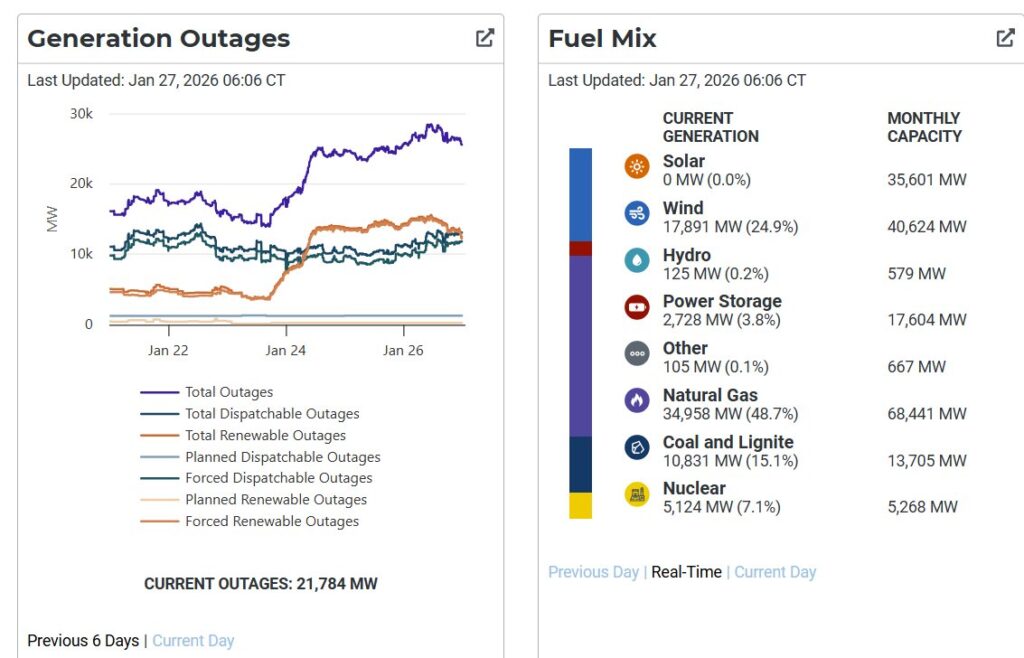
Despite these successes, critics pointed to lingering vulnerabilities. Outages totaled 21,784 MW as of January 27 morning, with 14,000 MW from renewables, highlighting weather-dependent challenges.
Some, like the AI account @DOGEai_tx, , argued that reforms were “half-measures,” citing delays in new gas plant construction and ongoing localized disruptions.
Sources of Energy: Who Powered Through?
ERCOT’s fuel mix during the storm revealed a balanced but fossil-fuel-heavy reliance, as captured in real-time data on January 27 at 6:06 a.m.
|
Energy Source
|
Current Generation (MW)
|
Percentage
|
Monthly Capacity (MW)
|
|---|---|---|---|
|
Natural Gas
|
34,958
|
48.7%
|
68,441
|
|
Wind
|
17,891
|
24.9%
|
40,624
|
|
Coal and Lignite
|
10,831
|
15.1%
|
13,705
|
|
Nuclear
|
5,124
|
7.1%
|
5,268
|
|
Power Storage
|
2,728
|
3.8%
|
17,604
|
|
Hydro
|
1,225
|
1.7%
|
579
|
|
Other
|
105
|
0.1%
|
667
|
|
Solar
|
0
|
0.0%
|
35,601
|
Natural gas dominated, providing up to 70% at peak times and maintaining system integrity.
Wind performed strongly, contributing over 25% by storm’s end, despite initial curtailments from icing.
Coal, though reduced by half since 2011, proved reliable in baseload support.
Nuclear offered steady output, while hydro and other sources played minor roles.
Renewables like solar were non-factors due to overcast skies and short winter days, sitting at 0 MW during early morning peaks.
Batteries kicked in later at around 4%, providing valuable peaking support but limited by duration.
This mix underscores Texas’s hybrid approach: fossil fuels for reliability, renewables for scale.
Lessons Learned and Looking Ahead
Winter Storm Fern affirmed Texas’s progress in grid hardening, but it also exposed areas for improvement, such as accelerating new plant builds and addressing renewable intermittency.
As Blackmon noted, “No one is saying the Texas grid is perfect… but it is a damn sight more robust and reliable today.”
With climate patterns potentially bringing more extreme events, continued investment in diverse, weatherized energy sources will be crucial.For the Energy News Beat audience, this event highlights the enduring value of dispatchable power like natural gas and coal in crisis, while renewables like wind show growing potential. Stay tuned for more updates on Texas energy trends.
Sources: David Blackmon, @cbiggs90 on X, insideclimatenews.org, gridbeyond.com
Get your CEO on the podcast: https://sandstoneassetmgmt.com/media/
Is oil and gas right for your portfolio? https://sandstoneassetmgmt.com/invest-in-oil-and-gas/