


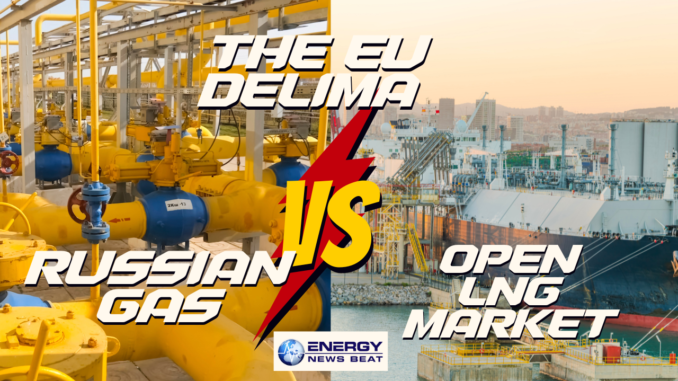
The global LNG market just received a stark reminder of its fragility. Qatar, the world’s second-largest LNG exporter after the United States, shipped nearly 81 million metric tons in 2025 — roughly 20% of all global LNG trade. Over 80% of those cargoes flowed to Asia (primarily China, India, Japan, South Korea, Taiwan, and Pakistan), with Europe taking a smaller but strategically vital slice.
A complete, sustained removal of Qatari LNG — whether from geopolitical disruption, force majeure, or prolonged repairs at facilities like Ras Laffan — would represent one of the largest supply shocks in energy history. Recent events at QatarEnergy’s Ras Laffan complex (the planet’s largest LNG export hub) have already triggered 30–50%+ spikes in European benchmark prices and even sharper moves in Asian spot LNG, providing a real-time preview of the damage.
Here is a clear-eyed assessment of the fallout for Qatar’s customers, global pricing, and the European Union’s already-stressed industrial base.
The Scale of the Shock: Qatar’s Customers and Their LNG Demands
Qatar’s 2025 exports equated to approximately 3.6–4.4 Tcf (trillion cubic feet) of LNG, with nameplate capacity around 77–81 MTPA before any expansion delays.
Asia would absorb the heaviest direct blow. China alone took record volumes (over 14 million tons in the first nine months of 2025), followed by India (8.5+ million tons in the same period). These buyers operate under long-term contracts but would immediately face shortfalls, forcing them into the spot market alongside everyone else.
Survival options for Asian buyers are limited in the short term:
Aggressive bidding for U.S., Australian, and African cargoes.
Fuel switching to coal or oil in power generation (already happening in price-sensitive markets).
Demand destruction in the industry and LNG-dependent power plants.
China has some buffers via Russian pipeline gas and domestic production, but India, Pakistan, Bangladesh, and smaller Southeast Asian importers have far fewer alternatives. The result: spot LNG prices could double or more, pricing out marginal buyers and triggering blackouts or factory shutdowns in emerging Asia.
Europe’s direct volumetric exposure is smaller — Qatar supplied roughly 9% of EU LNG imports and only 3.8–4% of total gas supply (about 12 bcm) in 2025.
Italy relies on Qatar for ~30% of its LNG, Belgium ~8%, and Poland ~17% of total gas imports. Most EU countries have already pivoted heavily to U.S. LNG (now ~58% of EU imports). Yet the global ripple effect is what matters: every lost Qatari cargo tightens the worldwide pool, forcing Europe to compete head-to-head with Asia for remaining supply.
Global LNG Prices: From Surplus to Severe Tightness
Analysts had expected a global LNG supply wave in 2026–2030 from U.S. and Qatari expansions, potentially creating a structural surplus. A full Qatari outage erases that outlook overnight. With ~20% of supply removed — and repairs potentially taking years in a worst-case scenario — the market flips from balanced to critically tight.
Recent price action is instructive: European TTF futures surged 30–50% in days, hitting three-year highs, while Asian spot LNG jumped 39–91%. Goldman Sachs and others warned of potential 100–130% spikes if Hormuz shipping remains disrupted even briefly. A sustained outage would embed a permanent geopolitical risk premium, keeping prices elevated for the rest of the decade and delaying the “cheap LNG era” that Europe was counting on. U.S. exporters (already the No. 1 supplier at 111 million tons in 2025) would benefit enormously, but even they face limits — many plants are running near full capacity, and new trains (Golden Pass, Plaquemines expansions) take time to ramp. Australia and Africa can squeeze out modest extra volumes, but global LNG elasticity is notoriously low in the near term.
The EU Impact: Skyrocketing Natural Gas Prices and Accelerated Deindustrialization
Europe thought it had solved its Russia problem by pivoting to LNG and Norwegian pipeline gas. A Qatari shock proves the vulnerability remains structural.
Natural gas prices would spike dramatically. TTF contracts could easily revisit or exceed 2022 crisis levels (€50–70+/MWh or higher), driving electricity prices upward in lockstep. Households face higher heating bills; utilities scramble for summer refill cargoes at astronomical rates.
The bigger threat is further deindustrialization. Europe’s energy-intensive sectors (chemicals, steel, fertilizers, glass, refining) never fully recovered from the 2022 price shock. German industry, for example, has operated at reduced capacity for years; chemical output remains depressed, and companies continue relocating production to the U.S. or Asia, where gas is 3–5 times cheaper. A new price surge would accelerate permanent demand destruction — already estimated at ~20% in some sectors — and trigger fresh waves of plant closures or idling.
High energy costs have already made EU industrial electricity prices twice those in the U.S. and 50% above those in China. Add another sustained LNG crisis, and the math becomes existential for heavy industry. Inflation would reignite, ECB policy would tighten, and GDP growth would suffer — exactly the vicious cycle Europe experienced in 2022–2023.
How the EU Could Survive — And What It Must Do Now
Short-term survival is possible but painful:
Draw down storage aggressively (already lower than ideal heading into shoulder seasons).
Activate EU solidarity mechanisms, coordinated demand reduction, and joint purchasing.
Maximize U.S. LNG diversions and Norwegian pipeline flows.
Accelerate efficiency measures and fuel switching where feasible.
Long-term, the EU must treat this as a wake-up call:
Double down on reliable U.S. LNG partnerships (already the lifeline).
Fast-track permitting for new regasification and domestic production where possible.
Revisit nuclear and all-of-the-above strategies instead of betting everything on intermittent renewables.
Build strategic reserves and long-term contracts with diversified suppliers to hedge geopolitical risk.
A real hard look at the Russian situation needs to be had. After seeing President Zelensky’s behavior, he seems to be the problem. If corruption charges come out and are proven, you have to wonder if Russia was provoked by the Ukrainian mistreatment of the Russian-speaking population. I am just asking questions. Then the converse question arises: should the EU buy Russian Gas and oil?
The harsh reality: Europe cannot “renewables its way” out of a 20% global LNG shock overnight. High energy prices have already hollowed out industrial competitiveness; another round risks permanent structural decline.
Qatar’s near-total removal from the market would not just raise prices — it would expose the fragility of global energy security and the high cost of Europe’s energy transition gamble. The winners would be U.S. LNG producers and those nations with diversified, flexible supply chains. The losers would be European factories, workers, and households already bearing the brunt of deindustrialization.
Energy News Beat will continue tracking this evolving crisis. The lesson is clear: in today’s geopolitically charged world, energy security is national security — and betting on any single supplier, no matter how reliable in peacetime, carries catastrophic downside risk. The EU’s survival depends on learning that lesson before the next shock hits.
Sources: oilprice.com, consilium.europa.eu, eia.gov
Check out The Energy News Beat Substack: https://theenergynewsbeat.substack.com/


Be the first to comment