ENB Pub Note: This article first ran on America Outloud by Ronald Stein and Mike Ariza. Both are great energy leaders and have been on the Energy News Beat Podcast. We highly recommend checking out America Outloud and subscribing.
Because California’s transportation fuel market is isolated from the rest of the country, with no major transportation fuel pipelines from out of state over the majestic Sierra Mountain range, supply imbalances quickly translate into high retail prices at the pump.
There is a pipeline that runs from the San Francisco Bay Area in Concord to Reno called the Kinder Morgan SFPP North Line. It supplies Sacramento, Travis Air Force Base, and Beale Air Force Base. Also, the CALNEVA pipeline, also operated by Kinder Morgan, runs from Colton, California, to Las Vegas and supplies 90% of Southern Nevada’s fuel, including jet fuel for Nellis Air Force Base.
- Those two pipelines let California refineries send transportation fuels to Arizona and Nevada.
- California refineries supply 45% of Arizona’s and 88% of Nevada’s transportation fuel demands for their airports, cars, and trucks, so any disruption in California impacts all three states.
California refineries have always produced California’s humongous transportation fuel requirements. This is why there have never been any pipelines run over the majestic Sierra Mountains from the other refineries in the Midwest.
The California “energy island” economy, which is 8 percent of California’s GDP, runs on transportation via planes, ships, trucks, construction equipment, and vehicles. It is important to note that the other 92% of California’s economy would be impossible to achieve without the transportation fuels that the refineries produce. In the 1980s, California had more than 40 operating refineries. Today, with the recent closures of the Phillips and Valero refineries, the humongous demands for transportation fuels by the 4th largest economy in the world CANNOT be met from the remaining 7 refineries still operating in the state.
The shutdown of Phillips in Wilmington and Valero was a direct result of egregious regulatory policies and fines that were levied against both refineries. Valero in Benicia took a $1.1 billion loss to shut down and leave, despite the state offering over $200 million to keep it open. One would think that California would take a step back and review its policies that drove Phillips and Valero out. But instead of reconsidering their policies, the Air Board doubled down. They proposed new amendments to the state’s Cap and Invest (theft and invest) policies, which would have increased Chevron’s fees by a projected $500 million and those of PBF by an estimated $340 million. And with these new amendments, the foreign suppliers with gross polluting refineries would not have to pay these fees. At this point, Chevron, Marathon, and PBF reached their limits. In early 2026, they dispatched a series of desperate joint warnings to regulators, making it clear that California is on the verge of losing its entire refining industry:
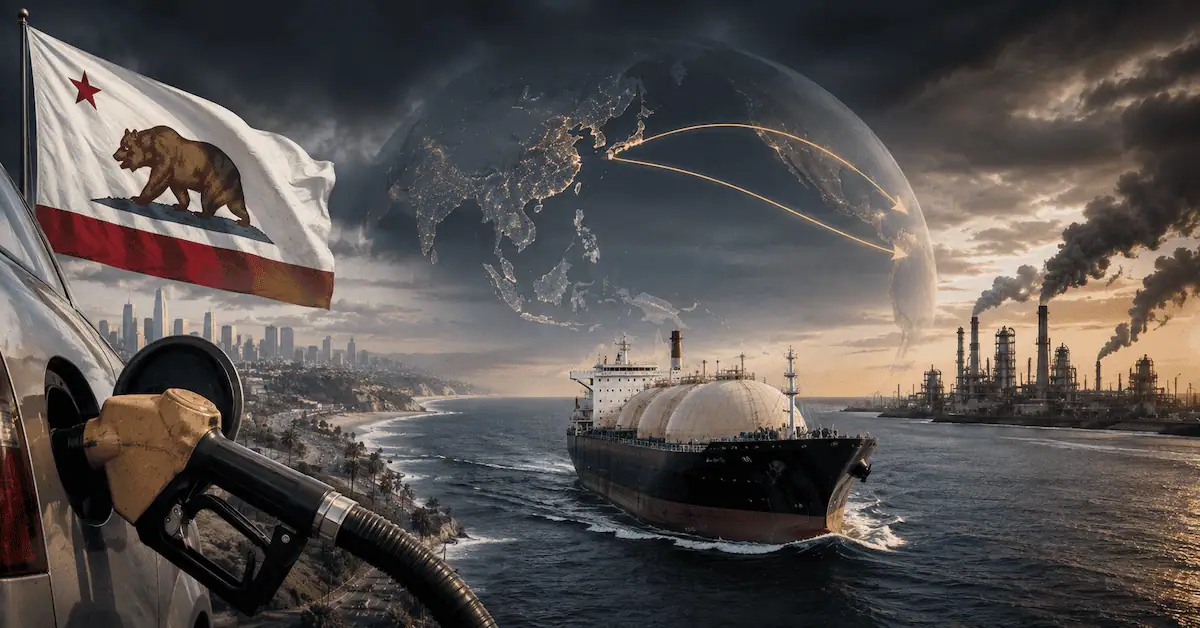
As more refinery closures are anticipated in the coming years, more of the demands of 58 million gallons of transportation fuel DAILY will be dependent on Asian refineries to meet these daily supply chain demands to keep the 4th largest economy humming:
- 11 million gallons/day for Jet fuel for the States’ 40 military and 9 international airports.
- 10 million gallons/day for Diesel for the States’ trucking and construction industries.
- 37 million gallons/day for Gasoline for the States’ more than 36 million vehicles.
The refineries located in foreign countries, such as those in Asia, are not accountable to the California Air Resources Board and thus do not have the same stringent emission standards as clean-running refineries in California. In fact, some of those overseas refineries would be classified as “GROSS POLLUTERS in California. Once the transportation fuels have been produced, they must be transported across the Pacific Ocean in GROSS POLLUTING tankers, some taking as long as 45 days to transit the ocean.
California’s Governor, Legislature, Senators, and Representatives are not supporting the retention of the 7 remaining refineries. The current manufacturing shortages of transportation fuels due to the closure of the Phillips and Valero refineries will become humongous, catastrophic shortages of historical proportions. They will also affect Nevada, Arizona, and if three of the busiest ports at Long Beach, Los Angeles, and Oakland are shut down due to a lack of bunker fuel to refuel the merchant ships and diesel fuel to operate the port equipment, those West Coast transportation fuel shortages will reach well into the center of the nation.
In addition, California is not proactively supporting the reanimating of the closed Valero Refinery in Benicia or the closed Phillips Refinery in Wilmington, to reinstate the loss in the supply chain for the transportation fuels demanded by the State.
With more in-state refinery closures imminent, Asian refineries will be gaining control of the supply chain of the jet fuel demanded by the military and international airports in California, as well as the diesel fuel for the trucking and construction equipment in the State, and for the gasoline demands of the state’s 36 million vehicles.
While the State is facing shortages of transportation fuels never before experienced in California, the State continues to spend billions to build more wind and solar that are not reducing the number of coal, natural gas, and nuclear power plants that maintain the continuous electricity demanded by our infrastructure and economy.
California state leaders are CLUELESS that the word ENERGY is comprised of 3 topics:
- Transportation fuels
- Products
- Electricity
Net Zero Green Energy Ideologists are OBLIVIOUS to the reality that “Energy Transition” is only an “Electricity Transition.”
We’re constantly told that wind and solar power are low-cost, clean, and sustainable, but Net Zero ideologists never engage in conversations about the monstrous garbage heaps these “alternative, green” electricity systems are leaving behind. To cite just one example, existing US wind turbines alone will leave behind some 145,000,000 tons of concrete and rebar and 5,500,000 tons of blades that, laid end-to-end, would stretch 9,100 miles.
Wind Turbines and Solar Panels have limited capabilities:
- CANNOT produce the transportation fuels required by airplanes, trucks, merchant and cruise ships, construction equipment, and vehicles.
- CANNOT make any of the more than 6,000 products made from fossil fuels for today’s materialistic society and economies around the world.
- ONLY generates electricity under favorable weather conditions.
With their consistent over-regulations on the cleanest refineries in the world, which are currently located in California, the State promotes an increase in emissions from the Asian refineries and transporting ships demanded by the California economy. In addition, California is promoting the State to be a national security risk for America by promoting those Asian refineries to have control of the transportation fuels that are the basis of the 4th largest economy in the world located in California.
If the State of California continues its mission to run the state’s economy with transportation fuels imported from Asia, we strongly encourage President Trump to immediately invoke the Defense Production Act (DPA) of 1950, which is a United States federal law that gives the President emergency powers to control domestic industries and private businesses. It ensures the nation has enough industrial resources and supplies for national defense, energy infrastructure, and major emergencies.
Please share this information with teachers, students, and friends to encourage Energy Literacy conversations at the family dinner table.
Click this Link to Sign up for Energy Literacy from Ronald Stein.