ENB Pub Note: This is a fantastic article from Giacomo Prandelli, and Stu Turley will be interviewing him next week on the Energy News Beat podcast. This is going to be a great interview, as The Merchant News Substack is packed with fantastic insights from the global energy markets.
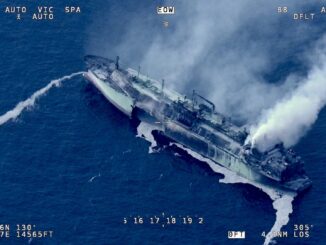
On a quiet morning off the coast of Senegal (5,000 kilometers from the nearest Ukrainian territory) the Turkish owned tanker Mersin nearly went to the bottom of the Atlantic. The explosion that ripped through her hull wasn’t an accident. It was a message. If you’re paying attention to global energy markets, it’s a message that should fundamentally reshape how you think about one of 2025’s most explosive investment opportunities.
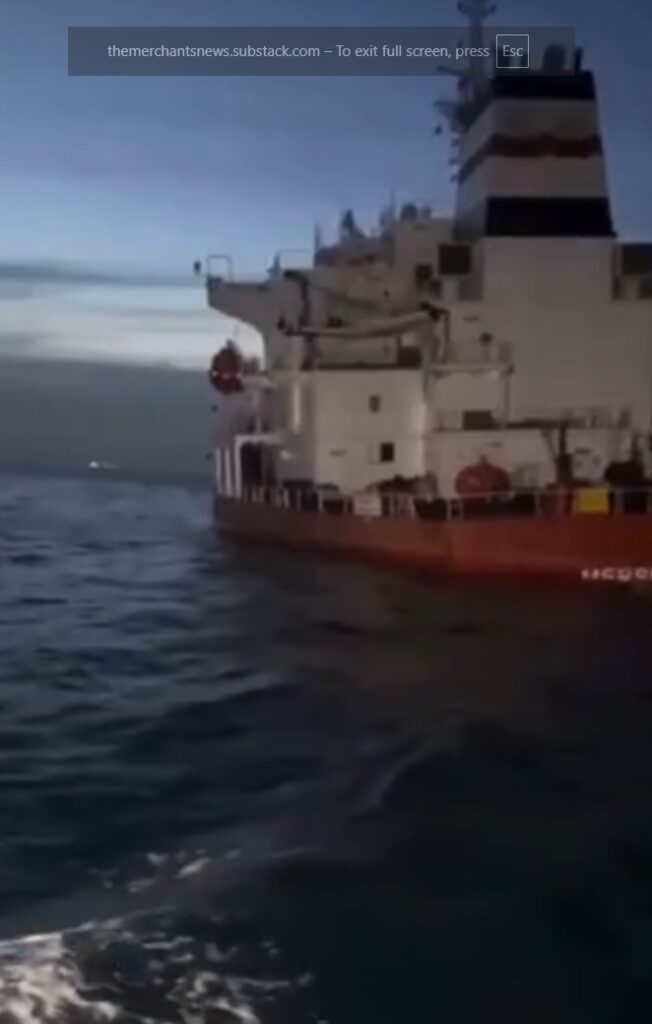
Ukraine just demonstrated it can strike Russian oil infrastructure anywhere on the planet. Not just in the Black Sea. Not just in the Mediterranean. Anywhere…
And that changes everything about how oil moves, how it’s priced, and how the ships that carry it make money.
The Mersin was a commercial tanker with a documented history of loading Russian crude from ports like Novorossiysk and Tuapse part of what’s known in shipping circles as Russia’s “shadow fleet”
Let me walk you through why this matters, how we got here, and where the money is hiding in plain sight.
To understand what’s happening, you need to grasp how Russia has been moving oil since Western sanctions really started biting in 2022-2023. Before sanctions, moving Russian crude was simple: one tanker, one voyage, load port to discharge terminal. Done.
Now? That same barrel of oil touches 3 different vessels (full explanation here)
This cascading system multiplies the tonne miles required per barrel by 300%. Think about that. Every Russian barrel now needs 3 times the shipping capacity it used to. That’s not just inefficient it’s a structural scarcity creator for compliant tanker capacity worldwide.
And here’s where it gets interesting for investors this system locked up older tonnage and created what amounts to a hidden tax on global shipping capacity. Russia’s shadow fleet circumvent sanctions and literally removed 8-20% of global crude tanker supply from mainstream operations and trapped it in specialized sanctioned oil routes.

Ukraine’s naval drone program started modestly modified jet skis with explosives, basically harassing Russian warships in the Black Sea. Annoying, but limited in scope.
Fast forward to November-December 2025, and we’re watching something qualitatively different. The strikes on the Kairos and Virat in the Black Sea were precise, calculated hits on vessels already sanctioned for sanctions evasion. Ukraine explicitly claimed responsibility for those, providing legal cover: “We struck sanctioned vessels aiding an enemy war effort”

But the Mersin attack off Senegal? Ukraine maintained strategic ambiguity. No direct claims. Just enough information leaked to make sure shipping markets understood the message: we can reach you anywhere.
The technical evolution is remarkable. Ukraine’s Sea naval drones now pack 2,000 kilograms of explosives, operate up to 1,500 kilometers from launch points, and use Starlink-controlled guidance systems with AI based object recognition accurate to within 10 meters. These are precision strike platforms that can execute complex targeting sequences with minimal human oversight.

Why does Ukraine care so much about oil tankers?
Because Russia’s war machine runs on oil revenue. Degrading the infrastructure that enables oil monetization isn’t just economically savvy under international law frameworks governing economic warfare, it’s a legitimate military objective. Hit the tankers, you hit the cash flow. Hit the cash flow, you hit Russia’s ability to sustain military operations.

When Ukraine demonstrated it could sink tankers thousands of kilometers from home, the insurance markets immediately repriced risk.
War-risk insurance premiums for Black Sea ports jumped 250% in less than two weeks. Marsh, the world’s largest marine insurance broker, reported that Russian port calls spiked from 0.25-0.30% of vessel value to as much as 1.0% for certain routes. That’s a massive increase.
Let me translate that into dollars. A $300 million VLCC (Very Large Crude Carrier) now carries $3 million in incremental insurance costs per round voyage through the Black Sea versus $750,000 before the escalation. That’s a $2.25 million swing. At current 50 day voyage cycles, that translates into $50,000 in daily rate impact.
Ship owners can’t absorb that. It flows through directly as margin expansion or forces charterers to reroute around conflict zones entirely which brings us to the 2nd cascading effect (+ 💰The Merchant’s Play)
Here’s where things get weird.
Asian waters are holding 53-70 million barrels of crude in floating storage a 40% increase since August. Iranian floating storage alone doubled from 18 to 36 million barrels over the same period.

Why are they parking oil on ships instead of selling it?
Multiple reasons, all interconnected:
Chinese independent refineries in Shandong province hit import quota restrictions, limiting how much crude they can process.
Iranian export margins compressed as Chinese buyers pulled back, forcing Tehran to park barrels at sea waiting for better discharge opportunities.
Venezuelan crude sits on water because refinery outlets remain constrained by US sanctions and Russian crude fills offshore anchorages because sanctions on Rosneft and Lukoil disrupted traditional Indian buyer relationships.
An estimated 240 million barrels accumulated between late August and mid-November 2025. That’s roughly 1.36 million barrels per day of shipping capacity sitting idle, doing nothing but storage duty.
Connect the dots…if 1.36 million barrels per day of capacity sits stationary, and Russia’s shadow fleet operations displace another 8-20% of global crude tanker supply into specialized sanctioned routes, then the compliant mainstream tanker market is operating with aggregate fleet availability roughly 20-25% below nominal capacity.

That’s not a temporary squeeze. That’s structural scarcity and it’s why VLCC spot rates hit $34,300 per day in Q3 2025, with forward bookings for Q4 reaching $63,700 per day for some routes.
Those rates exceed vessel operating costs by 150-300%.
Now here’s where timing becomes everything for this investment thesis.
Ukraine escalated its shadow fleet campaign precisely as US envoys push for peace. Kyiv signaled maximum operational capability we can sink your tankers off Africa right when Trump’s team was preparing to offer sanctions relief as a negotiating carrot.
The US Treasury announced in December 2025 it was suspending certain Lukoil sanctions until at least April 29, 2026 (see here). First major sanctions easing since Trump took office. Markets immediately started speculating is this the beginning of comprehensive sanctions relief?
Putin responded with predictable bluster threatening to “cut Ukraine off from the sea entirely” and retaliate against ships from nations supporting Ukraine. Classic negotiating theater, raising the costs of continued Western support.
But here’s the critical detail, peace negotiations faltered by early December. After a very long Moscow meeting, Russian officials declared no agreement had been reached. Oil markets repriced upward on speculation that sanctions would remain in place longer than anticipated.
This creates the central analytical fork for investors: the thesis underlying elevated tanker valuations depends entirely on whether the current sanctions regime persists through 2026 and beyond.
So how do you actually play this?
If Trump negotiates a Ukraine peace settlement with sanctions relief on Russian oil majors, the structural tightness could evaporate within months. Russian crude would flow through simplified logistics chains again. Insurance costs would normalize. Floating storage would liquidate as buyers accessed previously sanctioned supplies. Shadow fleet tonnage would return to mainstream competition, collapsing rates back toward historical averages of $20-25,000 per day for VLCCs.
If sanctions persist because negotiations fail or because Ukraine’s demonstrated strike capability keeps diplomatic resolution elusive then we’re looking at sustained elevated rates through 2026 and potentially into 2027.
3 companies stand out as direct beneficiaries of the current environment each with different risk-reward profiles.
Teekay Tankers (TNK): The Peak Cycle Play
Their fleet composition skews heavily toward VLCCs and Suezmax tonnage, which directly captures the tonne mile expansion driven by Russian crude rerouting patterns and Indian buyer diversification. Forward spot fixtures show VLCCs at $63,700 per day and Suezmaxes at $45,500 per day, suggesting another strong Q4 ahead.
But here’s what’s telling TNK’s management is systematically selling older tonnage $95.5 million in vessel sale proceeds from Q1 2025 alone and reducing overall fleet count through 2026. That’s not the behavior of management expecting this super-cycle to persist. They’re harvesting current premium valuations while managing downside by reducing exposure to what could be a transient peak.
Hold into Q1 2026 earnings for maximum momentum (current $55.47 could reach $62-68 range), then sell 40-50% of your position immediately after earnings to lock in gains accumulated through the peak rate cycle.

Frontline (FRO): The Leveraged Bet
Their 2025 debt restructuring reduced cash breakeven rates from approximately $25,000 per day to roughly $23,100 per day, creating operational leverage if rates stay elevated but also creating negative leverage if rates compress. At current spot rates, the company’s cash generation potential reaches $1.8 billion or $8.15 per share.
The catch? FRO trades at a 23.71 P/E versus TNK’s 6.16. The market is already pricing in near term earnings visibility but also embedding expectations that those earnings eventually normalize.
Also for this take profits on FRO’s aggressive leverage by early Q1 2026. The 58% ytd return has already captured most of the geopolitical premium. Further upside depends on sustained super-cycle conditions that look increasingly unlikely to persist.

International Seaways (INSW): The Defensive Income Play
What makes INSW different is balanced exposure to both crude and product tankers VLCC volatility gets offset by steadier product tanker earnings in commodity trading and regional arbitrage routes. Plus they’re sitting on roughly $1 billion in liquidity with a conservative balance sheet.
Investors received $0.86 per share in combined dividends in December 2025 (regular dividend of $0.12 plus supplemental of $0.74), locking in a 6.3% dividend yield on current valuations. If rates compress 30-40% from current peaks, INSW’s lower valuation multiple (11.76 P/E) and dividend support provide downside protection that pure leverage plays like FRO lack.
Core holding with dividend capture through Q2 2026, providing downside protection while maintaining upside exposure if geopolitical circumstances extend the rate environment.

For me the catalysts that create explosive returns are precisely the moments when those catalysts are most likely to resolve.
The Senegal attack and Black Sea drone campaign that drove these companies’ 34-58% ytd returns simultaneously signal maximum conflict intensity the exact point at which diplomatic resolution becomes most probable. Ukraine demonstrated capabilities thousands of kilometers from home precisely when Trump’s negotiators were preparing peace talks. That’s not coincidence it’s strategic signaling designed to maximize negotiating leverage.
But signaling maximum capability accelerates the timeline toward resolution. Russia can’t effectively defend its shadow fleet. Ukraine can’t sustain indefinite worldwide targeting campaigns without Western intelligence support that could evaporate with a diplomatic settlement. Trump’s administration has clearly demonstrated preference for negotiated settlements over indefinite sanctions regimes.
The most probable scenario call it 45-55% likelihood involves a partial peace deal with selective sanctions relief by mid-2026. Russian crude flows accelerate through simplified logistics chains. Shadow fleet operations scale back. Floating storage liquidates aggressively in Q2-Q3 2026. VLCC rates compress to $18-22,000 daily range. Tanker equities correct 35-50% from current peak valuations.
All 3 companies should report exceptional Q1 2026 earnings results driven by the current elevated rate environment running through December 2025 and early January 2026. We’re likely looking at $85-100 million for TNK, $45-50 million for FRO, and $75-85 million for INSW.
But those earnings represent the peak. They’re the monetization of contracts signed when Ukraine was sinking tankers off Senegal and insurance markets were repricing war risk in real-time.
By the time Q2 2026 results roll around, we’ll know whether Trump’s negotiations produced sanctions relief or whether geopolitical circumstances forced continued confrontation. And that determination will dictate whether current tanker valuations represent fair compensation for sustained structural advantages or temporary peaks that rational investors should harvest.
The shadow fleet war illuminates a fundamental truth about commodity and geopolitics investing being directionally correct about a thesis matters far less than timing your exposure properly.
Ukraine’s campaign against Russia’s oil infrastructure created genuine structural scarcity in compliant tanker capacity. The insurance premium spike is real. The floating storage accumulation is verifiable. The tonne-mile expansion from shadow fleet operations is measurable. This isn’t speculative it’s documented market reality driving 34-58% returns in 2025.
But structural advantages created by conflict have expiration dates determined by diplomatic calendars, not market fundamentals. The same Ukrainian capability that drove tanker rates to multi-year highs simultaneously accelerated the negotiating timeline that could collapse those rates by mid-2026.
So yes, own TNK into Q1 earnings for peak momentum exposure. Yes, collect INSW’s 6.3% dividend yield as downside protection. And yes, consider taking FRO profits early given its already stretched valuation multiple.
But understand you’re not buying sustainable competitive advantages you’re harvesting a geopolitical moment. And moments, by definition, pass.
The tankers capturing Russian oil premiums today are the same tankers that will compete for normalized global crude volumes tomorrow. The only question is whether “tomorrow” arrives in 6 months or 18 months.
Position accordingly.
The Merchant’s News
GP
Please remember that everything written in this newsletter/website is for educational purposes only and should not be interpreted as financial, legal, or tax advice. The opinions, analyses, information, or recommendations expressed here are solely my own. Remember that financial decisions involve risks and should be made based on your own personal circumstances and after consulting a qualified professional.
Want to get your story in front of our massive audience? Get a media Kit Here. Please help us help you grow your business in Energy.