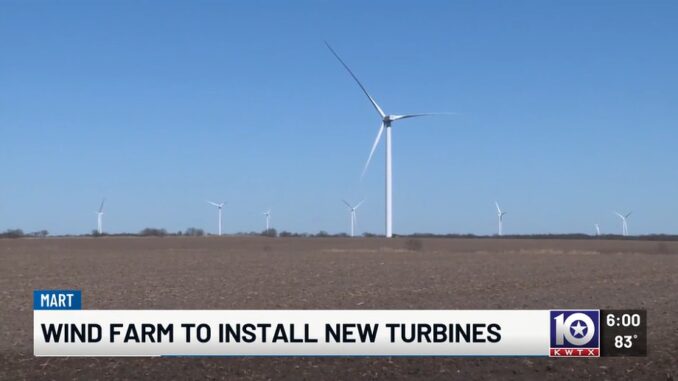
In the rolling hills of Central Texas, where wind farms dot the landscape like metallic sentinels, a massive overhaul is underway at the Prairie Hill Wind Farm. Owned and operated by French energy giant ENGIE North America, the facility spanning Limestone and McLennan counties near Mart is set to demolish all 100 of its existing turbines and replace them with just 63 newer models. Proponents hail it as a leap in efficiency—maintaining the farm’s 300-megawatt capacity with fewer machines. But as the explosives prepare to level these aging giants, questions loom large: Who’s footing the bill, and at what true expense to Texas taxpayers, the environment, and the land itself?
A “Repower” That’s More Demolition Than Upgrade
The Prairie Hill Wind Farm, commissioned by ENGIE in 2021 as one of the company’s largest U.S. renewable projects, was built at a reported cost of around $300 million.
Now, just five years later, the entire array is facing the wrecking ball. According to ENGIE representatives who briefed local officials in January, the old turbines—each standing over 300 feet tall—are being fully decommissioned, not merely refurbished.
In their place? Sleeker, more powerful units that promise the same energy output from 37 fewer foundations. We cannot obtain confirmation that the 37 foundations will be cleaned to farm standards.
This isn’t your garden-variety maintenance; it’s a full-scale repowering that boosts nameplate capacity without expanding the footprint. On paper, it sounds like a win for green energy: higher efficiency, lower visual clutter, and sustained power for the ERCOT grid. But dig deeper, and the story shifts. The reduction in turbine count means 37 concrete pads—each a sprawling scar on the prairie—will sit idle unless reclaimed. Yet, neither ENGIE’s public statements nor local reports mention any plans for land restoration or repurposing these spots back to their original agricultural use, like grazing cattle that coexist with the farm today.
In Texas, where ranchers lease land to wind developers for steady income, this could lock up prime real estate indefinitely, raising eyebrows among landowners who expected a revolving door of temporary installations.
The Recycling Riddle: Towers Yes, Blades Maybe
One silver lining, at least on ENGIE’s end, is the fate of the old hardware. Company officials assure that each turbine will be meticulously stripped on-site—steel towers, copper wiring, gearboxes, and all—before components are hauled to recycling facilities scattered across the state.
ENGIE touts its turbines as 100% recyclable, with parts funneled into specialized recovery channels for metals and other materials.
That’s a step up from the industry’s dirty secret: decommissioned blades, those fiberglass behemoths longer than a football field, often end up shredded into low-value fillers for roads or, worse, landfilled.
Texas knows this pain all too well. Just last week, Attorney General Ken Paxton slapped a lawsuit on Global Fiberglass Solutions for allegedly dumping over 3,000 blades on unpermitted West Texas sites, turning scenic deserts into junkyards.
It’s a stark reminder that while towers melt down nicely, blades—made of composites resistant to breakdown—pose a recycling nightmare. ENGIE’s broader initiatives, like research into blade circularity, show promise for repurposing them into construction materials or even playground equipment.
But for Prairie Hill specifically? No details on blade handling beyond the general “recycling” pledge. With over 100 sets of blades headed for the scrap heap, skeptics wonder if this upgrade is greenwashing a disposal crisis.
We’re with @POTUS.
“I don’t want to just hope the wind blows to light up your home and factories.” pic.twitter.com/3sZSV119a4
— U.S. Department of Energy (@ENERGY) February 8, 2026
China’s Energy Mix
In reference to President Trump’s comment about not finding any windmills in China, he is more accurate than not. They have more solar working, but do have some wind farms for show, and we are working to confirm these numbers, but it is diffcult to prove numbers from China.
|
Source
|
Share of Primary Energy Consumption (%)
|
Notes
|
|---|---|---|
|
Coal
|
53.2
|
Still the backbone, primarily for power and industry; absolute consumption rose slightly despite share decline.
|
|
Oil (Crude)
|
18.2
|
Mainly for transport and petrochemicals; stable share with modest demand growth.
|
|
Natural Gas
|
9.0
|
Increasing for heating, power, and industry; imports met much of the rise.
|
|
Non-Fossil (Total)
|
19.7
|
Includes hydro, wind, solar, nuclear, and biomass; fastest-growing segment.
|
|
– Hydropower
|
~7-8 (est.)
|
Mature source; variable due to weather.
|
|
– Wind & Solar
|
~6-7 (est.)
|
Explosive growth: China added ~356 GW of non-hydro renewables in 2024.
|
|
– Nuclear
|
~2-3
|
Steady expansion with new reactors.
|
|
– Other (biomass, etc.)
|
~3-4 (est.)
|
Includes waste and traditional biomass.
|
Subsidies: The Hidden Taxpayer Tab
ENGIE insists it’s bankrolling the entire demolition and rebuild—no small feat, given the original farm’s $300 million price tag suggests this sequel could run hundreds of millions more.
But here’s where the “cost to taxpayers” narrative heats up: Wind projects like Prairie Hill have long leaned on government lifelines, and this repower smells like more of the same.
The farm’s 2021 launch benefited from Texas’ Chapter 313 program, a now-expired tax abatement scheme that slashed property taxes for school districts in exchange for job promises—essentially a sweetheart deal funded by public coffers.
Federally, the Production Tax Credit (PTC) has propped up wind farms for decades, doling out 2.6 cents per kilowatt-hour (adjusted for inflation) to keep the blades turning. While no direct PTC confirmation ties to this repower, ENGIE’s history screams subsidy dependency: The company has harvested billions in U.S. renewable incentives since entering the market.
Critics, including Texas lawmakers railing against “wind and solar subsidies,” argue these upgrades are just another round of corporate welfare.
Why? Because repowering extends the PTC gravy train, locking in taxpayer dollars for “upgrades” that boost capacity factors without true innovation. In a state swimming in cheap natural gas and oil, should ratepayers subsidize ENGIE’s efficiency tweaks? The silence from ENGIE on fresh incentives for Prairie Hill only fuels the fire—transparency would be a start.
Bigger Picture: Efficiency or Illusion?
At its core, Prairie Hill’s transformation underscores the wind industry’s double-edged sword. Fewer turbines mean fewer bird strikes and shadow flicker for locals, and the same clean megawatts for Texas’s grid. But it also spotlights systemic flaws: Short-lived infrastructure demanding constant reinvestment, recycling hurdles that tarnish the “sustainable” badge, and land use that prioritizes leases over legacy farming.
As ENGIE’s crews gear up for the blasts—expected to echo across Mart like controlled thunder—Texans deserve answers. Will those 37 extra pads sprout wildflowers or stay as concrete ghosts? Are blades truly reborn, or bound for the boneyard? And most crucially, in an era of fiscal scrutiny, how much of this “upgrade” is on ENGIE’s dime versus Uncle Sam’s?
Energy News Beat will keep watching. After all, in the Lone Star State, wind might be free—but nothing else is.
Stuart Turley is the host of the Energy News Beat Podcast. Follow @STUARTTURLEY16 on X for more unfiltered takes on the energy transition.
Sources: houstonchronicle.com, assets.comptroller.texas.gov, kwtx.com
Get your CEO on the podcast: https://sandstoneassetmgmt.com/media/
Is oil and gas right for your portfolio? https://sandstoneassetmgmt.com/invest-in-oil-and-gas/