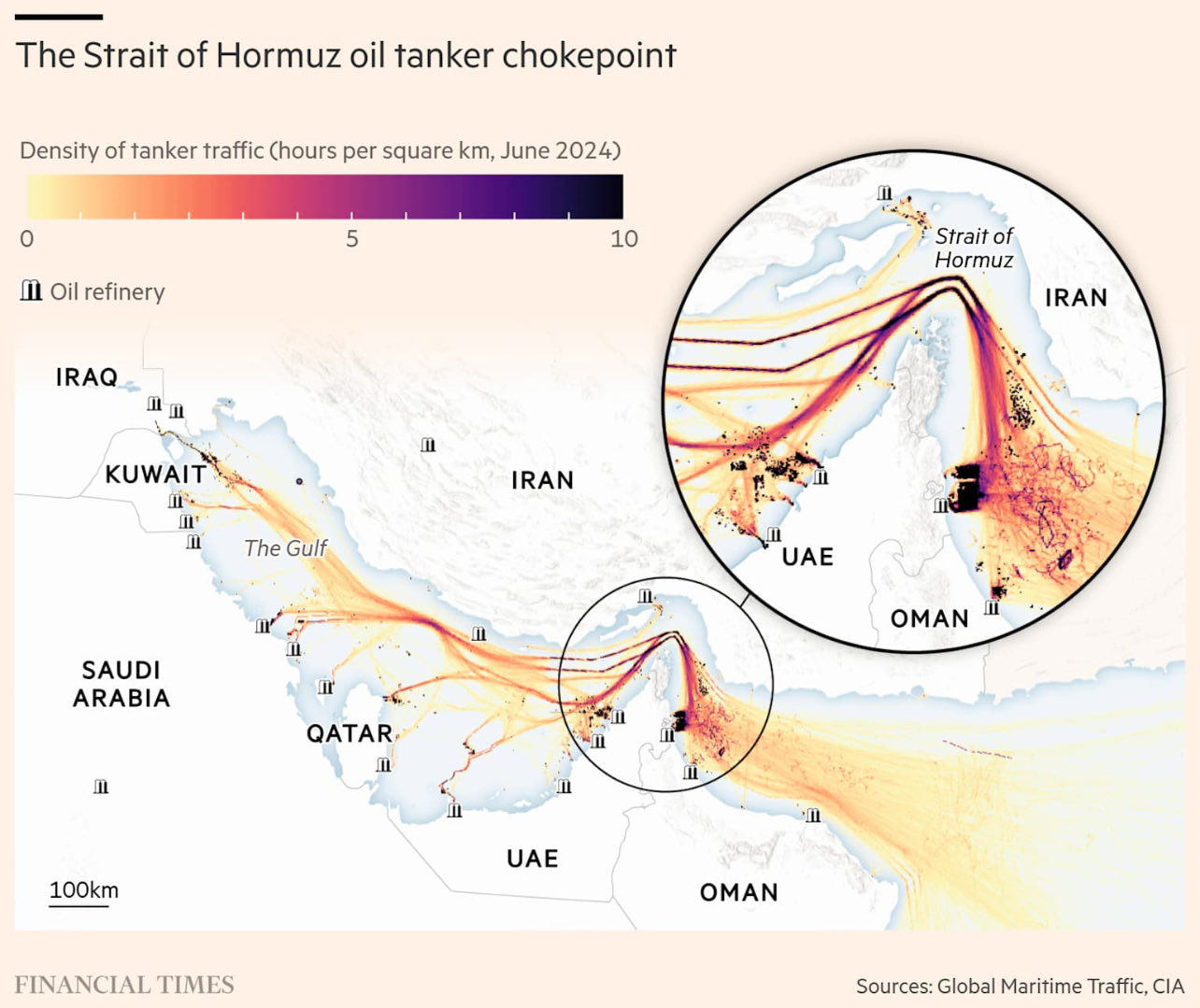
In just six weeks, the global energy paradigm has flipped. What a decade of climate summits, net-zero pledges, and green industrial policy could not achieve, Iran’s effective closure of the Strait of Hormuz—and the raw reality of AI’s insatiable power hunger—has done in a flash. Energy security is no longer a side note; it is the commanding priority, shoving aside net-zero timelines and the deindustrialization risks they carry.
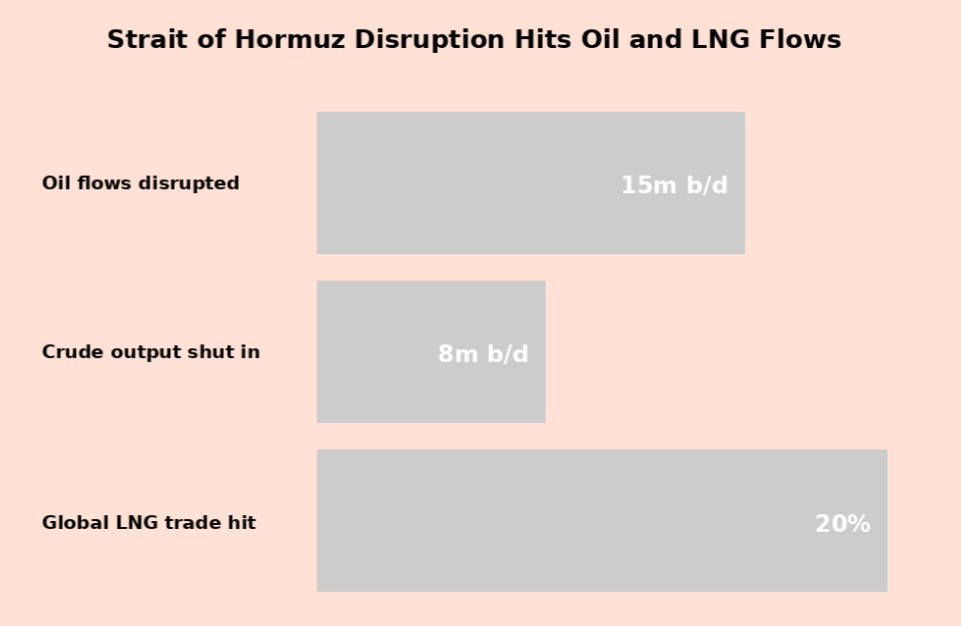
The catalyst was Iran’s blockade of the Strait of Hormuz, the narrow chokepoint that normally carries ~20% of global oil and ~20% of liquefied natural gas (LNG) trade. In one stroke, roughly 15 million barrels per day of oil flows were disrupted, 8 million b/d of crude output was effectively shut in, and 20% of global LNG trade ground to a halt.
We are looking into the Downstream or refineries that are also damaged around the world for a separate article.
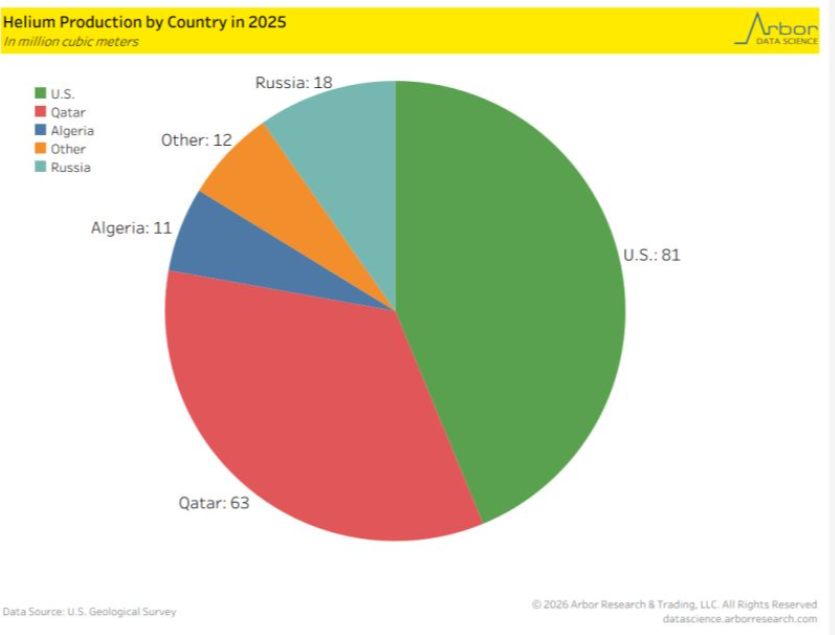
But the pain went far beyond hydrocarbons. The Gulf is also the world’s fertilizer factory and helium powerhouse. Roughly 30% of global seaborne fertilizer trade (including 46% of urea and significant ammonia volumes) and about one-third of the world’s helium supply transits the strait. Helium is critical for semiconductor manufacturing and MRI machines; fertilizers are the backbone of global food production. The result: spiking input costs for farms, chip fabs, and hospitals alike.
“The Six Weeks That Killed Climate-First Politics”
This exact shift was captured perfectly in a widely discussed post by strategist James E. Thorne (@DrJStrategy) on X today. He wrote:“The past six weeks have done what a decade of speeches could not: they have ended the fantasy that climate targets can sit atop the commanding heights of industrial policy.Two shocks did the work. Iran turned the Strait of Hormuz from a taken-for-granted shipping lane into a visible weapon… At the same time, AI has revealed itself as… a horizontal general-purpose technology… that will permeate every sector. Data centers and chip fabs… are industrial plants with energy appetites measured in gigawatts…
Donald Trump’s return to the White House is the political forcing function that strips away the pretense… Energy and resource security are back at the top of the pyramid.”
The post (full thread and image available link below) has resonated because it crystallizes the new reality: fragile, intermittent power systems designed to flatter climate metrics cannot run an AI-driven economy or guarantee food and medical security.
Consumer Impacts: Higher Prices Across the Board
The blockade has already driven Brent crude above $100–$110/bbl in recent weeks, with spot LNG prices in Asia (JKM) surging over 140% and European TTF benchmarks climbing sharply. U.S. consumers feel it at the pump, in utility bills, and—soon—at the grocery store.
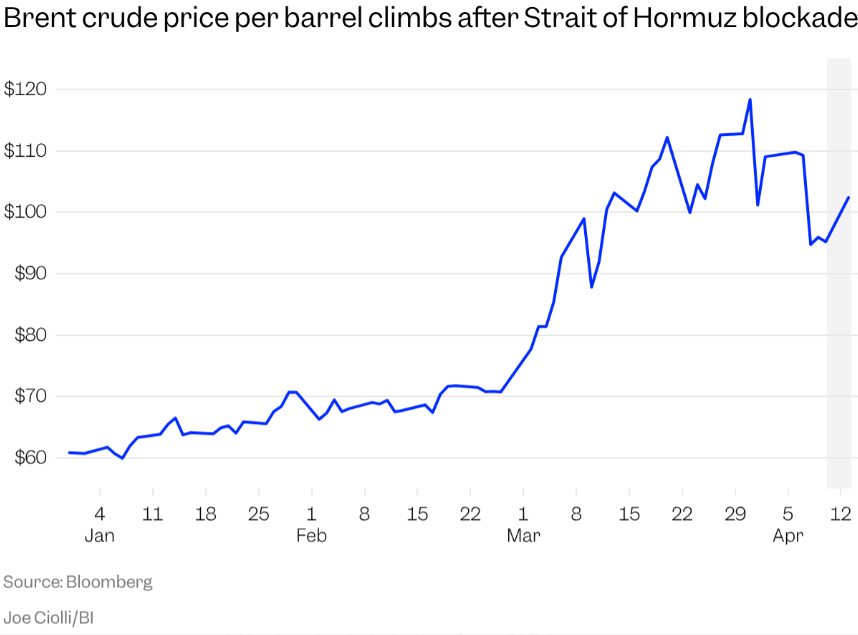
Fertilizer shortages are the stealth inflation driver. With half the world’s traded urea and a third of ammonia trapped, global food production costs are rising fast. Analysts warn of “agflation”—food-price inflation that hits household budgets hardest. Helium shortages threaten everything from chip supply chains (raising electronics prices) to healthcare (MRI availability). Rough back-of-the-envelope calculation using pre-crisis baselines and current market moves: Energy bills: U.S. households could see 15–25% higher natural gas and electricity costs through 2026 if disruptions linger (IEA and Oxford Energy models).
Food inflation: Fertilizer-driven cost increases could add 2–4 percentage points to global food CPI in 2026, per USDA-linked estimates and Farm Bureau analysis.
Overall consumer hit: Combined energy + food effects equate to a ~$1,200–$2,000 annual hit to the average U.S. household (extrapolated from 2022-style shocks scaled to current disruption size).
Investor Impacts: Returns Shift to Energy Security Winners
Markets are already repricing. Domestic U.S. producers of coal, natural gas, and nuclear stand to gain as nations scramble for reliable, dispatchable power. CF Industries (NYSE: CF), a major North American nitrogen fertilizer maker with low-cost U.S. natural gas feedstock, has surged 60%+ from 2025 lows and hit record highs as Gulf competitors falter—proving the “North American moat” pays off.
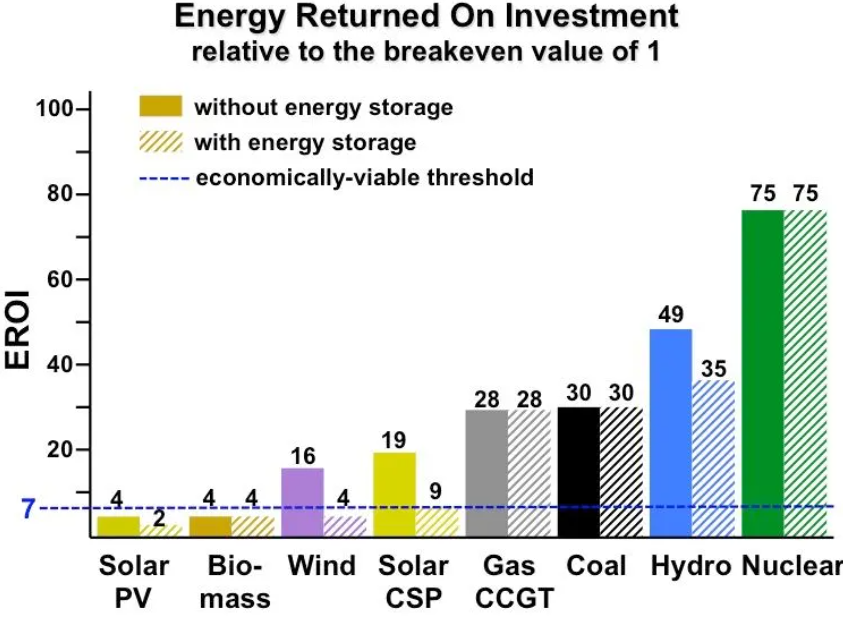
Energy Returned on Investment (EROI) data underscores why coal, natural gas, and especially nuclear are back in favor: they deliver far higher net energy than intermittent renewables without massive storage. Nuclear’s EROI of 75 dwarfs solar PV (4–9) or wind (16).
Strategic Shift: Bypassing Chokepoints
The new playbook is clear—return to energy security through diversified, resilient supply: Coal & Natural Gas: Baseload power that can ramp quickly and pair with carbon-capture where needed
Nuclear: High-EROI, 24/7 power for AI data centers and industry—exactly what the post highlighted.
Bypassing chokepoints: Accelerate U.S. shale, domestic LNG terminals, Saudi East-West pipelines, and friend-shoring alliances. Reduce reliance on any single strait.
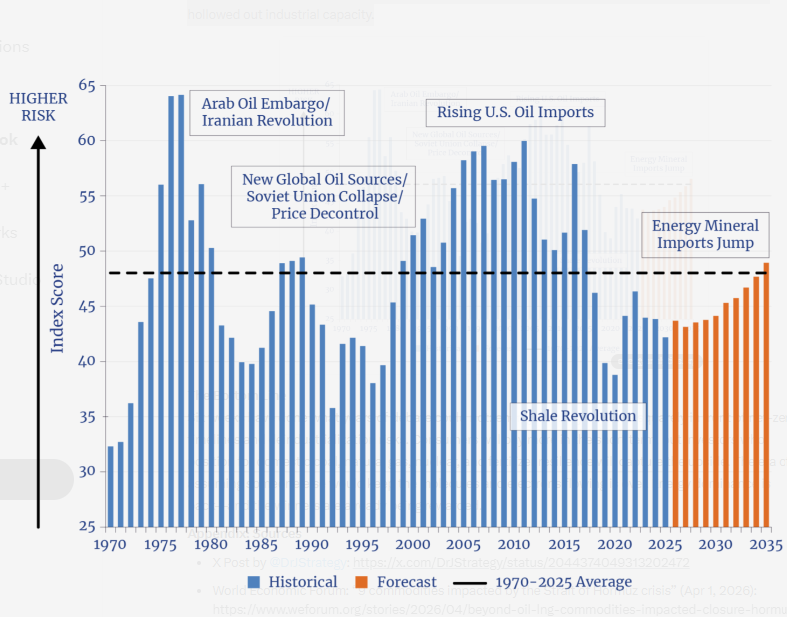
Longer-term, the U.S. Energy Security Index (ESI) forecasts show rising scores post-2025 as domestic production and technology investments climb—exactly the opposite of net-zero-only scenarios that hollowed out industrial capacity.
The Bottom Line
Six weeks have done what years of debate could not: energy security now sits squarely in front of net-zero timelines and deindustrialization risks. Consumers will pay more in the short term, but investors who position for domestic coal, natural gas, nuclear, and fertilizer resilience will capture the upside.
As Stu Turley on the Energy News Beat podcast says, “Energy Security Starts at home, and Energy Dominance is exhibited through your exports.” Well, these six weeks have changed the entire narrative, and as people are now saying, this has changed what discussions and world leaders could not. This will get past the sensorship of big tech and what governments want to hide.
The era of assuming someone else would keep the molecules and electrons flowing is over. Energy dominance is back—and the winners are already being rewarded.
Appendix: Sources
- X Post by
@DrJStrategy
- World Economic Forum: “9 commodities impacted by the Strait of Hormuz crisis” (Apr 1, 2026): https://www.weforum.org/stories/2026/04/beyond-oil-lng-commodities-impacted-closure-hormuz-strait/
- NPR: “Strait of Hormuz closure deflates global helium supply” (Apr 3, 2026): https://www.npr.org/2026/04/03/nx-s1-5762568/strait-of-hormuz-closure-deflates-global-helium-supply
- Politico: “It’s not just oil. Here comes Hormuz inflation” (Mar 14, 2026): https://www.politico.com/news/2026/03/14/hormuz-inflation-helium-fertilizer-00828680
- Carnegie Endowment: “Fertilizer isn’t getting through the Strait of Hormuz” (Mar 12, 2026): https://carnegieendowment.org/emissary/2026/03/fertilizer-iran-hormuz-food-crisis
- Bloomberg: “The Strait of Hormuz Oil Shock Is Now Heading West” (Mar 29, 2026): https://www.bloomberg.com/graphics/2026-iran-war-hormuz-closure-oil-shock/
- Oxford Energy: “Modelling the Impact of the Strait of Hormuz Closure on Global Gas Flows” (Mar 30, 2026): https://www.oxfordenergy.org/publications/modelling-the-impact-of-the-strait-of-hormuz-closure-on-global-gas-flows-and-prices/
- CF Industries coverage (various): Motley Fool, FinancialContent, etc. (Mar–Apr 2026)
- EROI data and Energy Security Index charts from public analyses (Forbes, National Center for Energy Analytics).
- All images sourced via public web search for illustrative datapoints as of April 2026.
Energy News Beat Channel – Unfiltered energy intelligence for investors and decision-makers.
Check out The Energy News Beat Substack: https://theenergynewsbeat.substack.com/