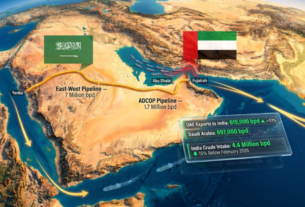
The International Energy Agency (IEA) has delivered a stark warning: global oil demand is now on track to contract sharply in 2026 amid the ongoing Strait of Hormuz supply shock triggered by the Iran war. What began as a geopolitical disruption has morphed into a full-blown demand destruction event, with high prices, scarce supplies, and logistical chaos forcing consumers, refiners, and economies worldwide to cut back.
This aligns directly with analysis shared on X by energy commentator David Blackmon (@EnergyAbsurdity) on May 13, 2026, highlighting the WSJ/IEA “bombshell.” The post notes that the IEA has revised its 2026 global oil demand forecast downward to a contraction of 420,000 barrels per day (bpd)—a dramatic shift from its prior outlook of just an 80,000 bpd decline.
The near-closure of the Strait of Hormuz (which normally carries ~20% of global seaborne oil) has created an unprecedented supply shock, with tanker traffic severely restricted, stalled U.S.-Iran negotiations, and cascading economic effects hammering consumption. Even in the IEA’s base-case scenario, flows only gradually resume from June, with demand growth not turning positive until August. Supplies will remain constrained for months due to tanker repositioning, insurance issues, and logistics snarls.
Cross-checks with independent sources confirm the trend. The IEA’s April 2026 Oil Market Report (with further updates reflected in May commentary) already projected a baseline contraction of 80,000 bpd for 2026—reversing pre-war growth expectations of +730,000 bpd—and warned that “demand destruction will spread as scarcity and higher prices persist.”
Initial hits have been deepest in the Middle East and Asia-Pacific (naphtha, LPG, jet fuel), but the pain is broadening. S&P Global cut its 2026 demand growth forecast by 700,000 bpd due to the war. Reuters, Bloomberg, Fortune, and Axios reports echo the same: the largest supply disruption in history (up to 13 million bpd lost) is triggering the sharpest monthly demand collapse since COVID-19, with Q2 2026 declines estimated at 1.5 million bpd or more in some scenarios.
How Demand Destruction Works Here
Demand destruction occurs when sustained high prices and shortages force behavioral and structural changes: refiners slash runs (global crude runs down ~1 million bpd projected for 2026), governments ration fuel, industries switch feedstocks or curtail output, and consumers drive less, fly less, or shift to alternatives. Inventories are being drawn at record rates (117 million barrels in April alone per IEA May updates), and physical crude prices have spiked to records near $150/bbl in spot markets. This isn’t just cyclical—it risks becoming partly permanent if high prices accelerate efficiency gains, renewables/nuclear/coal adoption, or LNG/renewable substitution in power and transport.
Global Market Impacts
The shock is reshaping everything: prolonged oil price volatility (“higher-for-longer”), elevated inflation, slower global growth, and tighter refining margins outside the U.S. Gulf. Stockpiles are depleting fast, pushing policymakers toward emergency releases (IEA members already tapped the largest in history). Long-term, it could accelerate energy diversification but near-term risks stagflation in import-heavy economies.
Ranking Regions/Countries: Most Hurt vs. Most Insulated
Based on import dependence, storage levels, exposure to Hormuz flows, and economic buffers (drawing from IEA, IMF, SocGen, GlobalData, and Kpler analyses):
Top Hurt the Most (Highest Vulnerability to Shortages, Inflation, and Growth Contraction): Asia-Pacific importers with extreme Hormuz reliance and low stocks (e.g., Philippines, Vietnam, Myanmar—80%+ of oil via Hormuz, ~1 month cover; Thailand, Singapore, Taiwan, Bangladesh). Rationing, refinery cuts, and emergency measures already underway; fuel shortages hitting transport, petrochemicals, and power.
Other major Asian importers (India, South Korea, Japan, China). High Middle East exposure (70-75% for Korea/Japan), refinery run cuts, and export reductions (e.g., India ~15%, Korea ~30%). Demand destruction visible in naphtha/LPG/jet; broader economic drag via inflation and trade balances.
Europe and other OECD importers. Jet fuel/diesel stocks are critically low by June; higher pass-through prices exacerbate inflation.
Developing economies with high oil import bills as % of GDP (many in Sub-Saharan Africa and small island states). Least policy space, highest recession risk.
Most Insulated (or Even Positioned to Benefit): Major net exporters with secure/non-Hormuz routes: United States (world’s top producer, net exporter; Gulf Coast refiners running near 95%+ utilization and boosting exports). Domestic supply shields much of the economy; higher prices support producers.
Other non-disrupted producers (Canada, Brazil, Norway). Pipeline/intra-regional access and diversified markets limit exposure.
Gulf exporters (partial offset): Saudi Arabia, UAE, Kuwait—hit hard by export curtailments (20-90% reductions) and infrastructure risks, but higher spot prices provide some revenue buffer (though overall production/infrastructure damage dominates downside).
Economies with large strategic reserves, diversification, or domestic production (e.g., Russia if unaffected by secondary sanctions).
U.S. Breakdown: West Coast vs. Central/East
The U.S. as a whole is relatively insulated as the world’s largest oil producer and net exporter. However, stark regional divides exist due to infrastructure and sourcing:
West Coast (PADD 5, especially California): More reliant on imports (~70-75% of crude from foreign sources and declining Alaska; historically 30%+ from the Middle East via longer routes like Hormuz). Limited pipeline access from domestic basins (e.g., Permian) due to regulations and geography makes it an “energy island.” Higher vulnerability to global price spikes, potential gasoline/diesel shortages, and import rerouting costs.
California prices already reflect a “war premium,” with refiners scrambling for alternatives from Ecuador, Canada, or rerouted Gulf product via the Bahamas.
Central and East (Gulf Coast/PADD 3 and beyond): Heavily insulated and advantaged. Domestic production (Permian, etc.), heavy imports from nearby Canada/Mexico, and massive export infrastructure. Refineries running at record utilization, exporting refined products globally, and benefiting from wide discounts on U.S. crude vs. Brent. Lower exposure to Hormuz disruptions; higher prices boost margins and revenues.
In short, the West Coast faces import-driven pain while the Gulf and East Coast leverage U.S. energy dominance.
Outlook
Demand destruction has clearly kicked in and could linger even if Hormuz flows partially resume. Markets face multi-month volatility, with risks of permanent shifts toward efficiency and alternatives. For energy producers, traders, and policymakers, the message is clear: prepare for a tighter, more fragmented oil world. The Hormuz shock isn’t just a supply story—it’s rewriting demand curves globally.
It is sad that we need to categorize California as an “Emerging Market” under Energy Security, since it relies on foreign imports rather than being energy-independent, as it used to be until Gavin Newsom.
- X Post by
@EnergyAbsurdity
(May 13, 2026): https://x.com/EnergyAbsurdity/status/2054517493750771719
- WSJ Article (referenced in post): https://www.wsj.com/business/energy-oil/oil-demand-to-contract-further-as-hormuz-shock-deepens-recovery-will-take-months-306bb2ce
- IEA Oil Market Report – April 2026: https://www.iea.org/reports/oil-market-report-april-2026
- Reuters on S&P Global cut and IEA: https://www.reuters.com/business/energy/sp-global-cuts-2026-oil-demand-forecast-by-700000-bpd-due-iran-war-2026-04-23/ ; https://www.reuters.com/markets/commodities/iran-war-may-crush-oil-demand-today-send-it-soaring-long-term-2026-04-22/
- Fool.com / Motley Fool on IEA cut: https://www.fool.com/investing/2026/04/21/iea-just-cut-its-oil-demand-forecast-heres-what/
- Fortune on demand destruction: https://fortune.com/2026/04/16/oil-prices-demand-destruction-iran-war-renewable-energy-push/
- Axios: https://www.axios.com/2026/04/14/iran-war-oil-demand-iea
- Bloomberg, Forbes, Yahoo Finance, Economist (various on shock and permanent destruction): Linked via search summaries.
- U.S. Regional Data: EIA reports, California Energy Commission/Kpler data via Governing.com, Hydrocarbon Engineering.
- Vulnerability Rankings: SocGen/Kpler (Forbes), IMF, GlobalData, CNBC, Reuters analyses.
All data cross-verified as of May 13, 2026. Energy News Beat will continue monitoring IEA/EIA updates.