This is an outstanding article from Nathan Hammer’s Substack Hammer and Anvil.
Every time you see a 400 foot wind turbine cutting through the sky, you are looking at a machine designed to harvest the wind. It feels clean. It feels weightless, like a piece of the future that has successfully severed its ties to the old world of fossil fuels.
But if you peel back the layers of that turbine, down past the white paint, into the fiberglass blades, inside the gearbox, and deep into the concrete foundation buried in the earth, you find reality.
A wind turbine is not a replacement for oil and gas. It is a product of them.
Let’s look at the hammer-hard facts of what it actually takes to build a “zero-emission” machine from the ground up, and why the wind industry is entirely dependent on the fossil fuel industry for its very existence.
Part 1: The Blades Are Literally Made of Petroleum
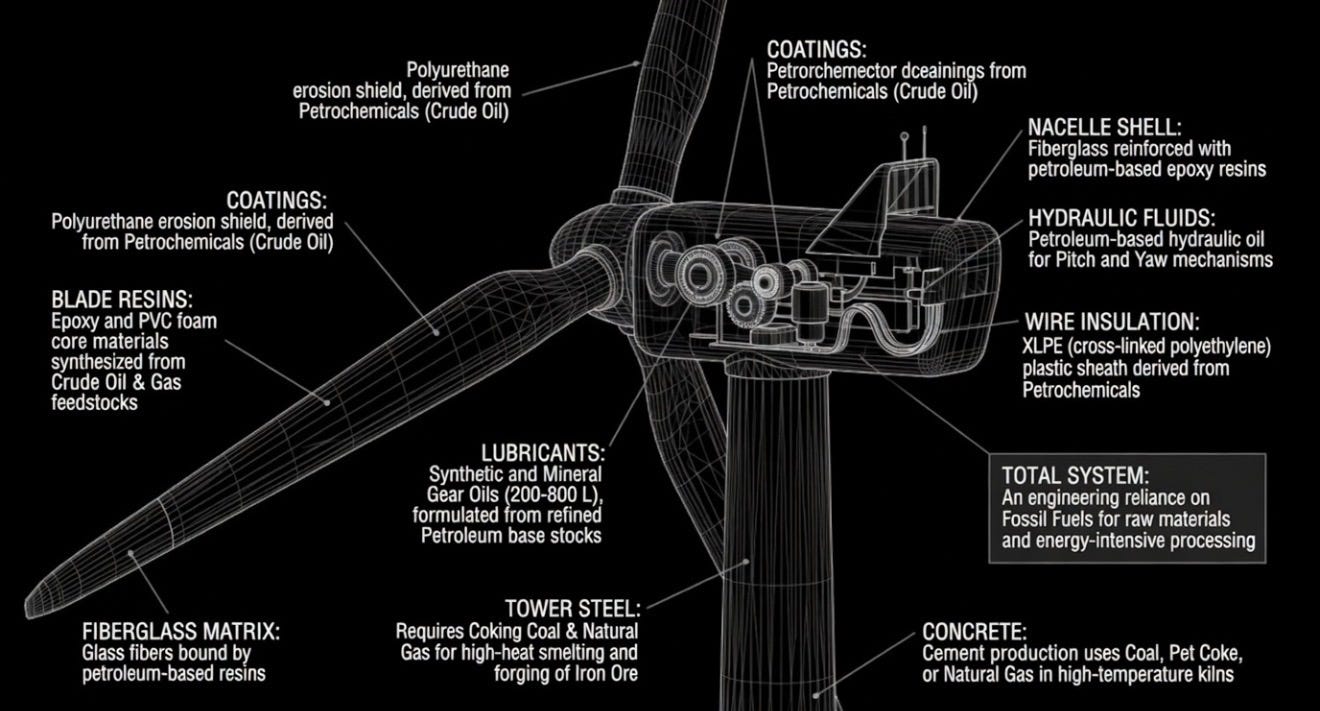
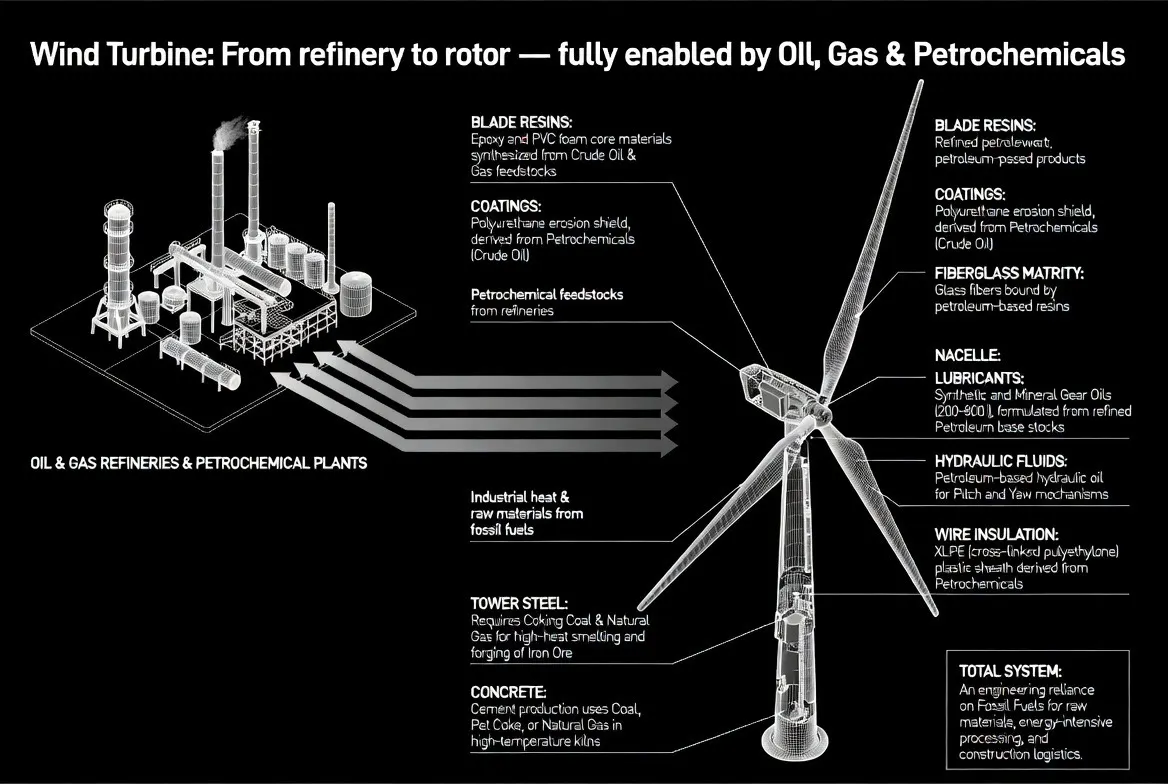
- The blade gets its strength from layers of fiberglass or carbon fiber, but those fibers are completely useless without a glue to hold them rigid. Manufacturers use thousands of pounds of epoxy resins to bind the blades together. Epoxy is synthesized from chemical feedstocks like bisphenol-A, which are cracked directly from crude oil.
- To keep the blades lightweight enough to spin in a light breeze, the insides are stuffed with structural foam cores. These are made from Polyvinyl Chloride (PVC) foam or Polyethylene Terephthalate (PET) foam, which are 100% synthetic plastics birthed from natural gas and petroleum processing.
- The tips of these blades spin at speeds exceeding 150 miles per hour, meaning raindrops, hail, and dust hit the blade like sandpaper. To keep the fiberglass from tearing apart, the blades are coated in thick polyurethane weatherproofing, which is a crude oil derivative.
If you removed every petroleum-based molecule from a wind turbine blade, you would be left with a pile of loose, floppy glass fibers.
Part 2: The Drivetrain Needs Oil to Move
Inside the bus-sized box at the top of the tower sits a massive gearbox and a series of heavy bearings. A standard onshore turbine requires 53 to 211 gallons of high-performance gear oil. The massive offshore turbines operating in the ocean can require up to 2,113 gallons of specialized synthetic oil.
These are not standard lubricants. They are highly engineered synthetic polyalphaolefins (PAOs) or mineral oils. They utilize highly refined petroleum base stocks mixed with chemical additives derived from fossil fuel processing. Furthermore, the hydraulic systems that twist the blades to catch the wind run on petroleum-based hydraulic fluids kept under immense pressure. Without these petroleum products, the internal components would seize up and fail in a matter of hours.
Part 3: The Industrial Heat of Metals and Concrete
- A single wind turbine requires hundreds of tons of structural steel. Smelting iron ore into steel requires temperatures exceeding 1,500°C (2,700°F). To reach those temperatures and chemically strip the oxygen out of iron ore, the global supply chain relies entirely on coking coal and natural gas.
- To keep a 300-ton tower from blowing over, it must be anchored into a massive underground block of concrete. Making cement, the glue in concrete, requires baking limestone in industrial kilns at 1,400°C. These kilns are overwhelmingly fired by coal, petroleum coke, or natural gas because the electric grid cannot deliver that level of massive, volumetric heat.
- Concrete alone has no tensile strength; it will snap under the intense leverage of the wind without a dense skeleton of steel rebar inside it. A single utility-scale turbine foundation requires anywhere from 50 to over 100 metric tons of steel rebar. Just like the tower itself, every pound of this rebar is born from high-heat blast furnaces fueled by coking coal and natural gas.
Part 4: The Heavy Diesel Muscle of Construction
- Transporting a single turbine requires up to a dozen specialized, multi-axle semi-trucks to haul the massive tower segments, the nacelle, and the 200-foot blades from manufacturing plants to the job site. These fleets burn thousands of gallons of diesel fuel just to get the components on-site.
- Preparing the ground requires a fleet of heavy earthmovers, bulldozers, and excavators to clear land and dig out the massive foundation pits. These machines run exclusively on diesel fuel.
- Erecting the turbine requires some of the largest cranes in the world. A main lift crane capable of hoisting a 100-ton nacelle 400 feet into the air requires its own separate convoy of transport trucks just to assemble it, and burns through hundreds of gallons of diesel fuel per day while operating.
I write about heavy industry facts with no emotional attachment. If you support my work, please consider subscribing for free to help spread the facts. $8 a month helps spread the facts even further.
The fundamental truth is that oil, gas, and coal provide the foundational materials, the mechanical survival, the transport logistics, and the high-density industrial heat required to build modern wind power. Every wind turbine spinning in America today is, from its very conception, anchored firmly to the global oil and gas supply chain. You cannot build the “green” grid of tomorrow without using the fossil fuels of today.
Sources
Coronado, D., & Wenske, J. (2018). Monitoring the oil of wind-turbine gearboxes: Main degradation indicators and detection methods. Machines, 6(2), 25.
González-Reyes, G. A., Bayo-Besteiro, S., Vich Llobet, J., & Añel, J. A. (2020). Environmental and economic constraints on the use of lubricant oils for wind and hydropower generation: The case of NATURGY. Sustainability, 12(10), 4242.
Mishnaevsky, L., Branner, Kim., Petersen, H., Beauson, J., McGugan, M., & Sørensen, B. (2017). Materials for wind turbine blades: An overview. Materials, 10(11), 1285.