In a significant sign of cautious normalization amid the ongoing U.S.-Israel-Iran conflict, two Very Large Crude Carriers (VLCCs) and at least two LNG tankers have successfully transited the Strait of Hormuz this week, with cargoes bound for key Asian buyers in China and India. The vessels operated in “dark mode” — transponders switched off to avoid detection — highlighting the persistent risks in one of the world’s most critical energy chokepoints.
According to vessel-tracking data from Kpler and LSEG, cited by Reuters and OilPrice.com:
The VLCC Eagle Veracruz (operated by AET Tankers) is carrying approximately 2 million barrels of Saudi crude loaded in late February. It is en route to Quanzhou port in China’s Fujian province, where it is expected to discharge at Sinochem’s refinery around June 16.
The VLCC Nissos Keros is loaded with about 1.8 million barrels of Das crude from the United Arab Emirates and is heading to Visakhapatnam, India, for delivery to Hindustan Petroleum’s refinery around June 3.
Complementing the oil shipments, LNG carriers — including Umm Al Ashtan and others linked to Qatari and UAE cargoes — have also cleared the strait, with destinations tied to China and India (alongside some Pakistan-bound flows in recent passages).
These movements follow earlier successful transits of additional supertankers and LNG vessels in recent weeks, though traffic remains a fraction of pre-conflict levels.
The Strait of Hormuz, which normally carries about one-fifth of global oil and significant LNG volumes, has been severely disrupted since late February 2026 due to the conflict. This has led to the largest supply shock in oil market history, with Gulf production shut-ins estimated at 10–15 million barrels per day (mbpd) and cumulative losses exceeding 1 billion barrels.
Hundreds of vessels were initially stranded, but selective passages — often in dark mode along Iran-designated routes — are now allowing limited flows to priority Asian markets, which historically sourced up to 80% of their crude from the Middle East.
China’s Strategic Stock Draws: A Buffer That Caps the Rally — For Now
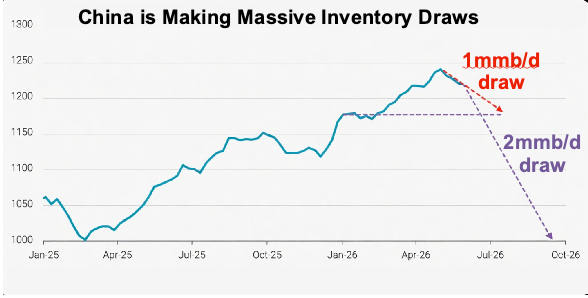
China, the world’s largest crude importer, has played a pivotal role in tempering the price impact of the Hormuz disruptions. According to Vortexa analysis, onshore crude stocks in above-ground tanks stood at 1.22 billion barrels as of May 25 — down nearly 20 million barrels from record highs reached earlier in the month.
After aggressive builds earlier in 2026 (and heavy stockpiling in 2025), China has shifted to drawing down commercial inventories to offset sharp import shortfalls. Seaborne crude arrivals plunged to around 8.4 mbpd in April (the lowest since September 2022), with further declines expected in May and June.
This inventory strategy has helped cap the spot crude oil rally despite the massive Middle East supply gap. Refiners have cut runs amid high prices and thin margins, using stored barrels rather than aggressively chasing alternative spot cargoes. The result: global oil prices, while elevated (with Brent recently around $90–106/bbl and subject to volatility from U.S. strikes and ceasefire rumors), have not spiked to the extreme levels some feared.
Cross-sourced outlook: As these commercial draws continue — and with limited access to strategic petroleum reserves (SPR) for refiners — China is expected to ramp up buying from non-Middle East sources in the coming weeks. Analysts from Vortexa, Mercuria, and others note that once inventories normalize, Chinese demand for discounted or alternative crudes (e.g., Russian pipeline oil, U.S. exports, or high-risk grades from other producers) will surge.
This rebound in Asian buying, combined with ongoing global inventory draws (EIA forecasts an average 8.5 mbpd draw in Q2 2026), could add upward pressure on prices even as some Hormuz traffic resumes.
IEA and EIA outlooks underscore the tightness: global supply is projected to run below demand through much of 2026, with demand destruction (cuts in refining, aviation, and petrochemicals) providing only partial relief. Prices could average around $106/bbl in May–June before easing later in the year if flows gradually recover — but any delay in normalization or renewed escalation keeps risks firmly to the upside.
Market Implications and What’s Next
These tanker passages to China and India demonstrate Asia’s continued reliance on Gulf supplies and the selective reopening of critical trade routes. However, the broader picture remains one of constrained supply, strategic buffering by major importers like China, and heightened volatility. U.S. exports have surged to fill gaps (including rare cargoes to Asia), while non-Middle East producers ramp up where possible.
For energy markets, the message is clear: China’s stock draws have bought time and capped immediate price spikes, but they are not infinite. Renewed demand from the world’s top importer — coupled with persistent global tightness — points to sustained pressure on oil prices and opportunities (and risks) for alternative suppliers.
Energy News Beat will continue monitoring vessel movements, inventory data, and price developments as the situation evolves.
- OilPrice.com: “Three Oil and Two Gas Carriers Clear Hormuz” (May 28, 2026) – https://oilprice.com/Latest-Energy-News/World-News/Three-Oil-and-Two-Gas-Carriers-Clear-Hormuz.html
oilprice.com
- Vortexa Insights: “Chinese stock draws cap spot crude rally” – https://www.vortexa.com/insights/chinese-stock-draws-cap-spot-crude-rally
vortexa.com
- Reuters (via multiple reports): Vessel tracking on Hormuz transits (May 25–28, 2026) – e.g., https://www.reuters.com/business/energy/vessels-carrying-middle-east-oil-lng-exit-hormuz-head-pakistan-china-2026-05-25/
reuters.com
- IEA Oil Market Report (May 2026) and related analyses – https://www.iea.org/reports/oil-market-report-may-2026
iea.org
- EIA Short-Term Energy Outlook (global oil markets section) – https://www.eia.gov/outlooks/steo/report/global_oil.php
eia.gov
- Additional cross-references: Vortexa related reports on import losses/stock builds; Mercuria and Oxford Energy commentary on China’s crude levers (April–May 2026).
All data cross-verified with public vessel tracking, analyst reports, and official outlooks as of May 28, 2026. Markets move fast — stay tuned to Energy News Beat for updates.