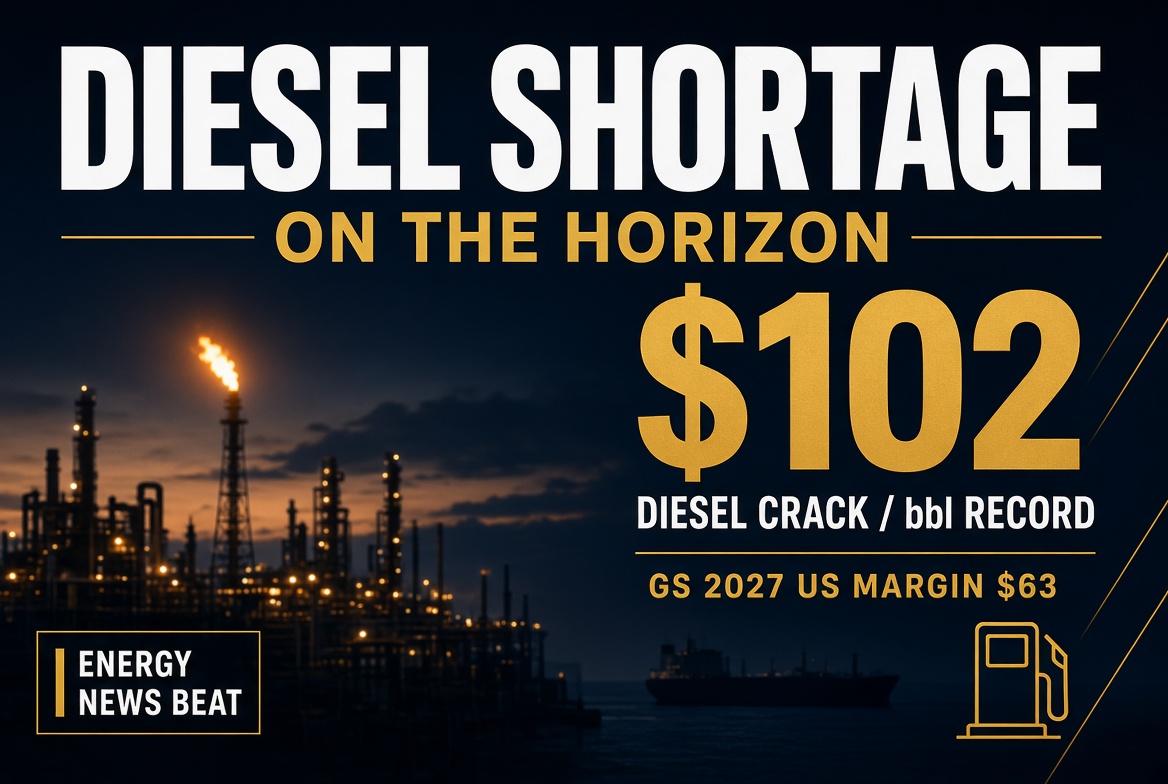
If you think diesel prices will ease next year, Wall Street is not with you. On August 31, 2026, CoinBureau founder Nic Puckrin flagged Goldman Sachs for more than doubling its 2027 diesel-margin forecasts, arguing that refineries are being hit from every direction—Middle East strikes, Russian export bans, and winter demand—with diesel at the epicenter of a fuel crisis that could outlast the wars themselves.
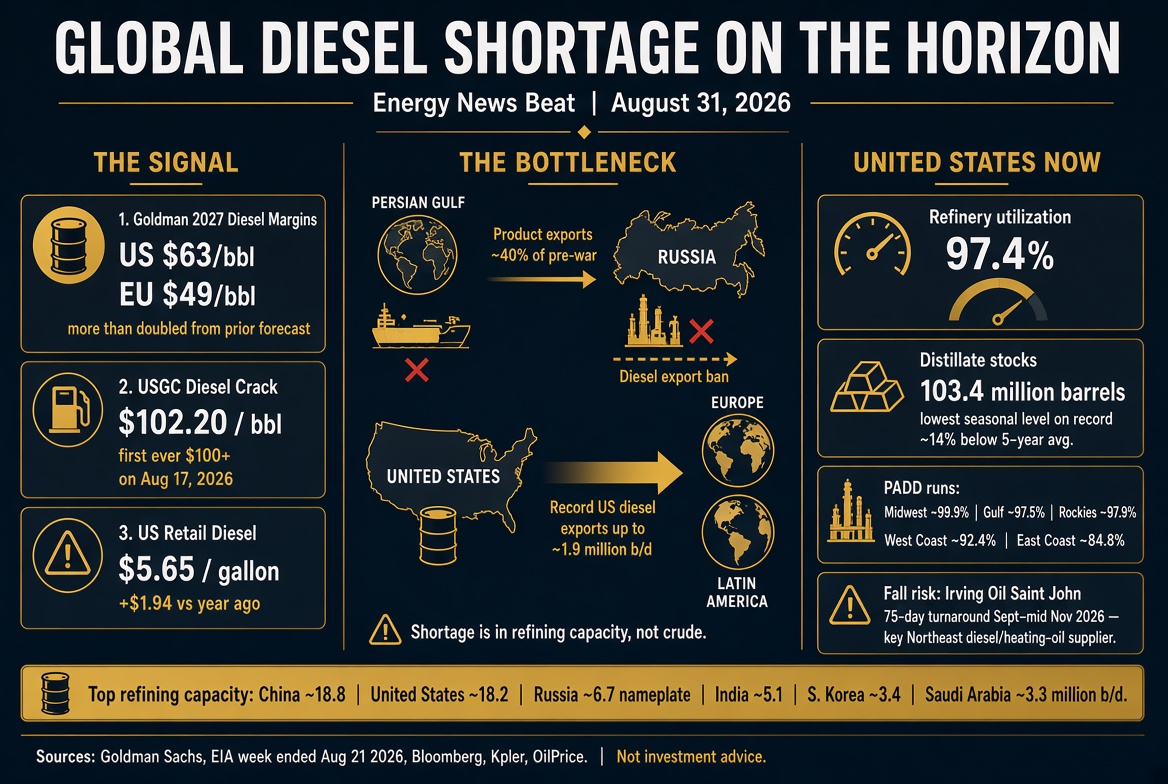
Goldman now sees U.S. diesel refining margins averaging $63 per barrel in 2027 and European Union margins at $49 per barrel, up from earlier forecasts of $27 and $19. The bank says refinery outages are running about 60% above the seasonal average, Persian Gulf fuel exports are only about 40% of pre-war levels (versus 70–80% for crude), and the tightness extends into next year.
That is the story the market is already pricing. Crude has been relatively resilient. Diesel has not.
The shortage is in the machinery, not the oil
The world is not short of crude so much as it is short of working refineries that can turn oil into middle distillates—diesel, heating oil, and jet. Global throughput has run several million barrels per day below year-ago levels for months. The International Energy Agency and multiple banks have made the same point: product markets are tighter than crude markets.
Three shocks are stacked on a structural problem:
Middle East / Strait of Hormuz. Conflict damage and shipping risk have slashed product exports from the Persian Gulf. More than 20% of Middle Eastern refining capacity has been knocked out or impaired at points this year. Product flows through Hormuz have been far weaker than crude flows.
Russia. Ukrainian drone strikes have hammered Russian plants. Throughput has dropped below 4 million b/d at times—under 60% of capacity and the lowest in more than two decades. Moscow banned diesel exports to protect the domestic market and has extended the ban into late September. Russia was the world’s second-largest diesel exporter; that barrel is largely gone from seaborne trade.
Structural tightness. COVID-era closures, European plant shutdowns and conversions, limited new conversion capacity, and a lighter global crude slate all reduce the system’s ability to make distillate even when crude is available. Europe closed or slated hundreds of thousands of barrels per day of capacity in recent years; more is at risk this decade.
Lost internationally traded diesel from Russia and the Middle East has been estimated around 1 million b/d or more at peaks—material against a seaborne diesel market of roughly 8–9 million b/d. U.S. exports and some demand destruction have only partly filled the hole.
Who actually refines the world’s oil
Installed capacity still sits in a handful of countries. Approximate operable crude distillation capacity in the mid-2020s:
|
Rank
|
Country
|
Capacity(approx.)
|
|---|---|---|
|
1
|
China
|
18.5–18.8millionb/d
|
|
2
|
UnitedStates
|
18.2millionb/d
|
|
3
|
Russia
|
~6.7–6.8millionb/dnameplate(farlessrunning)
|
|
4
|
India
|
~5.0–5.2millionb/d
|
|
5
|
SouthKorea
|
~3.3–3.6millionb/d
|
|
6
|
SaudiArabia
|
~3.3millionb/d
|
|
7
|
Japan
|
~3.0millionb/d
|
Iran, Brazil, Germany, Canada, Italy, Spain, Mexico, Singapore, the UAE, and Kuwait follow. China and the United States together hold more than a third of global capacity. Russia’s nameplate number is now a fiction for export markets. India and South Korea remain critical swing product exporters when they can get feedstock and run hard. Europe has been shrinking its own fleet even as it remains a large diesel importer.
Nameplate capacity is not the same as barrels of diesel on the water. That is why the export map matters more than the capacity ranking right now.
Who exports diesel—and where those barrels go
Before this crisis, the main seaborne diesel suppliers were the United States, Russia, India, Saudi Arabia, South Korea, Kuwait, the UAE, and trading hubs such as the Netherlands and Singapore.
Now the map is rewritten:
- United States is the backstop. Distillate exports have run at record or near-record rates—weekly figures as high as about 1.9 million b/d, with April–August averages well above a year ago. Destinations: Latin America (Mexico, Chile, Brazil and neighbors—the shortest haul from the Gulf Coast) and, increasingly, Northwest Europe, where transatlantic diesel flows have hit records as Russian and Middle Eastern barrels disappeared. Europe’s share of U.S. diesel exports has jumped sharply. Africa is also in the bid.
- Russia is largely closed for diesel export business.
Middle East product exports to Africa and Europe have collapsed toward multi-year lows; Asia has stepped in to replace some of those African barrels. - India and East Asia (South Korea, Taiwan, China when quotas allow) are opportunistic exporters. Indian and Asian barrels have moved more toward Africa and other westbound markets as the east–west gasoil spread blew out.
- Hubs (ARA, Singapore) still re-export, but they cannot manufacture barrels that do not exist upstream.
The United States is therefore doing two jobs at once: supplying its own trucking, farm, and heating markets, and acting as the swing diesel supplier to Europe and the Western Hemisphere. That is why U.S. inventories can fall even while U.S. refineries run flat out.
Crack spreads at historic highs
The diesel crack spread—the margin between ultra-low sulfur diesel and crude—is the market’s distress signal.
On August 17, 2026, the U.S. Gulf Coast ULSD crack versus WTI Cushing punched through $100 per barrel for the first time on record, with an intraday high around $102.20. It has since eased into the $90s, still far above the prior all-time mark near $89 set in October 2022 and multiples of the $15–$40 range that defined balanced markets. Northwest Europe gasoil cracks and Singapore gasoil cracks have also been at or near records.
Goldman is not forecasting $100 cracks forever. It is saying the average 2027 U.S. diesel margin stays extraordinarily elevated at $63. That is a multi-year tightness call, not a one-week spike.
What this means for U.S. consumers
Diesel is the workhorse fuel: trucking, freight, agriculture, construction, mining, and—especially in the Northeast—heating oil.
National average retail diesel recently moved to about $5.65 per gallon, roughly $1.94 above a year earlier and close to the post-2022 crisis highs.
Distillate inventories for the week ending August 21, 2026, stood at 103.4 million barrels—about 14% below the five-year average and the lowest seasonal level in the modern EIA record stretching back to the early 1980s. Stocks have never been this thin at this point on the calendar.
Harvest season and Northern Hemisphere winter heating demand typically lift distillate use into October and the first quarter. Inventories are entering that window already depleted.
High diesel is a freight tax. It shows up in food, retail goods, and industrial costs. That is the inflation channel policymakers care about heading into winter and the political calendar.
U.S. households do not import Russian diesel directly. They still feel the global bid: every extra cargo that sails to Europe or Latin America is a barrel that is not sitting in PADD 1 or PADD 3 storage.
What this means for U.S. investors
High cracks are a windfall for complex refiners and a tax on the real economy.
Winners: Gulf Coast and Midcontinent refiners with distillate-heavy slates and export docks—names such as Valero, Marathon Petroleum, Phillips 66, and PBF have already seen large equity moves on 2026 margin expansion. Goldman’s doubled 2027 forecast implies the earnings cycle is not just a 2026 event. Product tankers on the U.S. Gulf–Europe and U.S. Gulf–Latin America routes stay supported if export volumes hold.
Risks to the long thesis: deferred maintenance that produces unplanned outages; hurricane damage on the Gulf Coast; political pressure to restrict product exports if pump prices stay politically toxic; and any sudden peace-plus-repair scenario that brings Russian and Gulf product barrels back faster than expected. Product markets mean-revert eventually. Banks do not always get the timing right.
Losers / pass-through names: trucking, agriculture, food distribution, and any industrial consumer that cannot fully surcharge fuel. Heating-oil-exposed Northeast utilities and households face a second-order hit if PADD 1 stays tight into winter.
The investment distinction is simple: the shortage is in conversion capacity, so the profit pool has shifted from crude producers toward refiners and product logistics—until new runs or repaired plants catch up.U.S. utilization is already near the ceilingFor the week ending August 21, 2026, EIA data show U.S. refineries running at 97.4% of operable capacity—the highest rate since 2018—on crude inputs of about 17.3–17.4 million b/d. Distillate production was still about 5.1–5.2 million b/d. That is “all out,” not “we have spare kit.”
Regional utilization (EIA, week of August 21):
- East Coast (PADD 1): ~84.8% — structurally tighter, more import-dependent
- Midwest (PADD 2): ~99.9%
- Gulf Coast (PADD 3): ~97.5% — the export engine, above 95% for many consecutive weeks
- Rocky Mountain (PADD 4): ~97.9%
- West Coast (PADD 5): ~92.4% — lower runs, still import-sensitive, especially California
There is almost no unused U.S. capacity left to absorb the next outage. Analysts have warned that running this hard for this long raises the odds of mechanical failure. Several companies deferred spring work to capture margins. That bill comes due.
Maintenance that can hit regions this fall and winter
The usual autumn turnaround season is arriving with a twist: U.S. Gulf Coast scheduled work looks unusually light because margins are too good to shut units. That supports near-term supply—and stores up deferred work for late 2026 or 2027.
Known or widely reported items:
- Irving Oil Saint John, New Brunswick (~320,000 b/d) — Canada’s largest refinery. A major 75-day “Operation Osprey” turnaround is slated from early September through mid-November 2026, including a first-in-a-generation RFCCU revamp. Saint John is a key supplier of gasoline and distillate to the U.S. Northeast. This is the clearest regional risk for PADD 1 heating oil and diesel into early winter.
- Gulf Coast: limited confirmed autumn CDU downtime. Reported items include later-year work at Valero units (including Corpus Christi CDU timing in some calendars) and ExxonMobil Beaumont FCC/hydrotreater work into December–January. PBF has pushed Chalmette CDU/coker work into 2027; CITGO has similarly deferred Lake Charles coker work. Valero has guided robust Q3 Gulf throughput.
- West Coast / California: already lower utilization and import-dependent; any unplanned outage or hydrocracker work tightens PADD 5 quickly.
Global slate: a heavier international turnaround wave from September into October is still expected even if U.S. plants stay up. That is the opposite of what a 103-million-barrel U.S. distillate tank wants.
Wildcard: Gulf hurricane season against plants that have been run hard for months.
Net: the United States can keep exporting and still starve domestic stocks if one large coastal plant trips. The Northeast is the most exposed U.S. region this fall because of Irving plus thin PADD 1 inventories. The Gulf is the most exposed to weather and deferred mechanical risk.
The horizon, not just the headline
Goldman’s doubled 2027 diesel-margin forecast is a statement that this is not a two-month war premium. It is a refining-system problem: too many plants offline or closed, too little spare conversion capacity, winter demand ahead, and the United States already running at 97% while shipping record diesel abroad.
For consumers, that points to diesel and freight costs staying elevated into the heating season and, if Goldman is right, well into 2027. For investors, it points to a still-wide refining profit pool—with the usual energy-market caveat that geopolitics can close the gap as violently as they opened it.
The crude market can look orderly. The diesel market is telling you the bottleneck has moved downstream. That is the shortage on the horizon. This could be the biggest inflationary impact on consumers and the market, driven by transportation, agriculture, and manufacturing, and the Fed is powerless against it.
We are working on details of the next article on which US refineries are best for investors. We do not give investment advice; we just show you what we are doing and the tools that we use.
Appendix: Sources and links
Primary social / forecast trigger
- Nic Puckrin (@puckrin) post, August 31, 2026: https://x.com/puckrin/status/2094327581609005342
- Goldman Sachs diesel margin forecast chart via that post (GS Research / Bloomberg)
Goldman Sachs and bank research coverage
- OilPrice.com, “Goldman Sachs Sees Diesel Refining Margins Soaring to $63 a Barrel,” Aug. 31, 2026: https://oilprice.com/Latest-Energy-News/World-News/Goldman-Sachs-Sees-Diesel-Refining-Margins-Soaring-to-63-a-Barrel.html
- OilPrice.com, “Goldman Sachs: Diesel Crunch Is Now the Biggest Threat in Oil Markets,” July 30, 2026: https://oilprice.com/Latest-Energy-News/World-News/Goldman-Sachs-Diesel-Crunch-Is-Now-the-Biggest-Threat-in-Oil-Markets.html
- Goldman Sachs, “What Is the Outlook for Diesel and Gasoline Supplies?” Aug. 28, 2026: https://www.goldmansachs.com/insights/the-markets/what-is-the-outlook-for-diesel-and-gasoline-supplies
- Oil & Gas 360 recap of Goldman diesel note: https://www.oilandgas360.com/goldman-sachs-diesel-crunch-is-now-the-biggest-threat-in-oil-markets/
Inventories, utilization, prices (EIA and secondary)
- EIA Weekly Petroleum Status Report (week ending Aug. 21, 2026; released Aug. 26): https://www.eia.gov/petroleum/supply/weekly/
- EIA highlights PDF: https://www.eia.gov/petroleum/supply/weekly/pdf/highlights.pdf
- EIA refiner operable capacity percent utilization: https://www.eia.gov/dnav/pet/PET_PNP_WIUP_A_(NA)_YUP_PCT_4.htm
- EIA Refinery Capacity Report: https://www.eia.gov/petroleum/refinerycapacity/
- Bloomberg, “US Diesel Supplies Hit Record Low as Demand Season Looms,” Aug. 26, 2026: https://www.bloomberg.com/news/articles/2026-08-26/us-diesel-supplies-hit-record-low-as-demand-season-looms
- The Straits Times recap of EIA distillate stocks: https://www.straitstimes.com/business/us-diesel-supplies-hit-record-low-as-demand-deason-looms
Crack spreads and market structure
- RBN Energy / Novi Labs, “Basket Case – The $100/bbl Diesel Crack,” Aug. 27, 2026: https://rbnenergy.com/daily-posts/blog/100bbl-diesel-crack-or-how-2026-exposed-fragility-global-refining
- FXStreet, “Diesel’s record $100 warning,” Aug. 27, 2026: https://www.fxstreet.com/analysis/diesels-record-100-warning-the-oil-shock-hiding-in-plain-sight-202608271226
- Transport Topics, “Diesel margins top $100 a barrel,” Aug. 18, 2026: https://www.ttnews.com/articles/diesel-margins-record-high
- Energy News Beat, “US Diesel Crack Spread Hit an All-Time High. What’s Next?” Aug. 19, 2026: https://energynewsbeat.co/diesel/us-diesel-crack-spread-hit-an-all-time-high-whats-next/
- Energy News Beat, “Asia, Europe and US Diesel Crack Spreads Are On Fire,” Aug. 24, 2026: https://energynewsbeat.co/downstream/asia-europe-and-us-diesel-crack-spreads-are-on-fire-what-does-this-mean-for-consumers-and-investors/
- S&P Global, “US has few options to boost refining amid global diesel shortage,” Aug. 26, 2026: https://www.spglobal.com/energy/en/news-research/latest-news/crude-oil/082626-us-has-few-options-to-boost-refining-amid-global-diesel-shortage-analysts
- Forbes, “Refining Stocks Soar As Crack Spread Hits Record High In 2026,” July 23, 2026: https://www.forbes.com/sites/garthfriesen/2026/07/23/refining-stocks-soar-as-crack-spread-hits-record-high-in-2026/
Global refining tightness and geopolitics
- Energy Intelligence, “Diesel Disconnect Draws Bullish Picture Despite Demand Warnings,” Aug. 27, 2026: https://www.energyintel.com/000001a0-4351-d3e9-a3f4-67592fae0000
- OilPrice.com, “Diesel Crisis Threatens to Outlast the Middle East War,” Aug. 23, 2026: https://oilprice.com/Energy/Energy-General/Diesel-Crisis-Threatens-to-Outlast-the-Middle-East-War.html
- Reuters, “Putin’s diesel export ban risks new fuel shock,” July 1, 2026: https://www.reuters.com/commentary/reuters-open-interest/putins-diesel-export-ban-risks-new-fuel-shock-2026-07-01/
- Reuters, “Forget crude. War pushes refiners to the brink,” July 20, 2026: https://www.reuters.com/commentary/reuters-open-interest/forget-crude-war-pushes-refiners-brink-2026-07-20/
- Reuters, “US refiners face historic stress test,” Aug. 24, 2026: https://www.reuters.com/commentary/reuters-open-interest/us-refiners-face-historic-stress-test-global-crisis-looms-2026-08-24/
- The Oil Slick, “Why the World Keeps Running Short of Diesel While Awash in Crude”: https://theoilslick.com/article-global-diesel-refining-capacity-shortfall.html
- AGBI, “Gulf refinery disruption sends diesel margins to record highs,” Aug. 21, 2026: https://www.agbi.com/analysis/oil-and-gas/2026/08/gulf-refinery-disruption-sends-diesel-margins-to-record-highs/
- Rigzone, global refining spare-room analysis, Aug. 13, 2026: https://www.rigzone.com/news/global_refining_system_has_little_spare_room_left-13-aug-2026-184369-article/
- WSJ, “Diesel Buyers Compete for Shrinking Supply Pool,” Aug. 18, 2026: https://www.wsj.com/business/energy-oil/diesel-buyers-compete-for-shrinking-supply-pool-bf53d9fa
Top refining countries / capacity
- Energy Institute / country capacity compilations (2024–2025): China ~18.5–18.8 mmb/d, U.S. ~18.2 mmb/d, Russia ~6.7 mmb/d, India ~5.0 mmb/d
- Statbase, oil refining capacity by country: https://statbase.org/datasets/energy/oil-refining-capacity/
- energtx country rankings: https://energtx.com/indicators/refinery-capacity-thousand-barrels-day
- GLOBAL NOTE capacity ranking (2025 values): https://www.globalnote.jp/post-3208.html
Diesel exporters and trade flows
- Reuters, “Asia’s diesel exports to Africa jump in August,” Aug. 31, 2026: https://www.reuters.com/business/energy/asias-diesel-exports-africa-jump-august-replace-mideast-supply-data-shows-2026-08-31/
- EIA, U.S. transportation-fuel export destinations (2025 baseline): https://www.eia.gov/todayinenergy/detail.php?id=67304
- Energy Intelligence, “High Prices Draw Record Volumes of US Diesel to Europe,” Aug. 27, 2026: https://www.energyintel.com/000001a0-4263-dc68-ade7-5e6f3c560000
- Vortexa insight on Europe leaning on U.S. diesel: https://www.vortexa.com/insights/europes-diesel-rebuild-leans-on-us
- Kpler, U.S. product-export destination discussion: https://www.kpler.com/blog/us-export-controls-scenario-how-would-the-market-react
- Financial Post / Bloomberg, “US Goes All-In on Diesel Production,” July 22, 2026: https://financialpost.com/pmn/business-pmn/us-goes-all-in-on-diesel-production-amid-growing-global-shortage
U.S. utilization and maintenance
- Heatmap News, “America’s Oil Refineries Are Going All Out,” Aug. 28, 2026: https://heatmap.news/energy/oil-refineries-iran
- Energy News Beat, “U.S. Refinery Utilization Hits 96.2%,” July 23, 2026: https://energynewsbeat.co/downstream/u-s-refinery-utilization-hits-96-2-as-global-markets-tighten/
- Hellenic Shipping News / Gibson, U.S. autumn turnaround slate and deferred work: https://www.hellenicshippingnews.com/tanker-market-unplanned-us-refinery-outages-could-impact-freight-trade/
- ExecGraph, 2026 Gulf Coast turnaround calendar: https://execgraphenergy.com/turnarounds/2026
- Oil & Gas Journal, Irving Oil Saint John Operation Osprey, Aug. 25, 2026: https://www.ogj.com/refining-processing/news/55400669/irving-oil-details-plans-for-2026-turnaround-of-canadas-largest-refinery
- Oil & Gas Journal, Irving schedule Sept.–Nov. 2026: https://www.ogj.com/refining-processing/news/55392068/irving-oil-schedules-2-month-turnaround-for-saint-john-refinery
- Transport Topics, Canadian shutdown risk to U.S. Northeast: https://www.ttnews.com/articles/canadian-oil-refinery-shutdown
- Transport Topics, U.S. refiners ramping diesel / fall turnarounds: https://www.ttnews.com/articles/us-refiners-ramping-diesel
Data current as of EIA’s August 26, 2026 weekly release and contemporaneous market reports through August 31, 2026. Markets remain highly sensitive to war-related outages, export-ban extensions, and unplanned refinery trips.