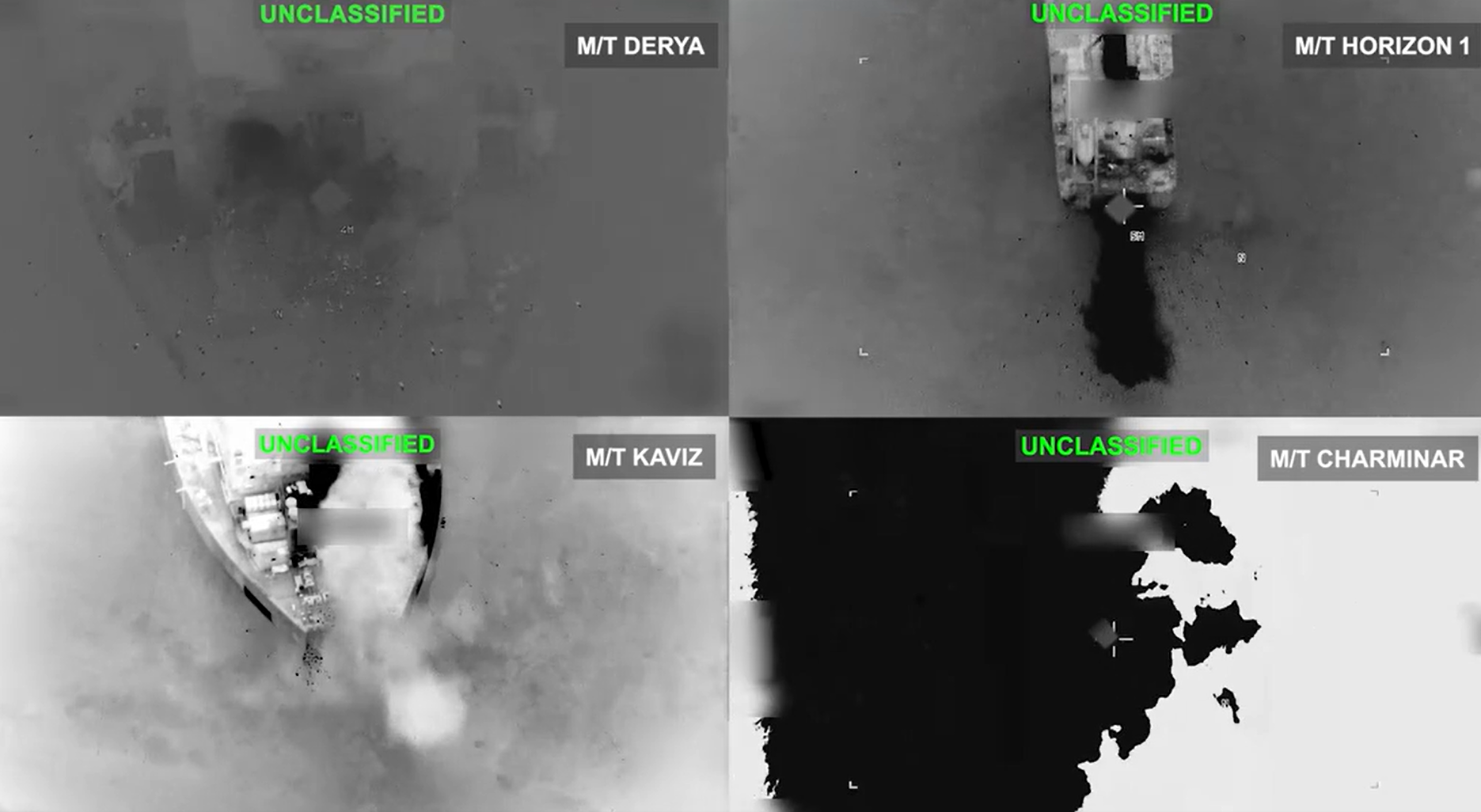
U.S. Central Command forces destroyed five Iranian crude oil carriers on September 8 after the Islamic Revolutionary Guard Corps launched ballistic missiles at a U.S. Navy warship twice in two days. The American vessel evaded both attacks and continued patrols with no personnel harmed.
CENTCOM identified the targeted vessels as the M/T Kaviz, M/T Charminar, M/T Horizon 1, and M/T Riesco in the Gulf of Oman, along with the M/T Derya near Kharg Island. U.S. forces directed crews to abandon ship before striking the tankers and rendering them inoperable. The command described the ships as part of a multibillion-dollar shadow network funding the IRGC and its regional proxies, noting Iran has no means to defend them.
The September 8 strikes followed a similar operation three days earlier. On September 5, after IRGC ballistic missiles targeted a U.S. aircraft carrier and guided-missile destroyer, CENTCOM permanently disabled the M/T Downy off Kharg Island and the M/T Stark 1 near Jask while completely destroying the unladen M/T Kylo (also known as Noxen) in the Gulf of Oman. CENTCOM later confirmed the Kylo sank. Combined, the two operations took eight Iranian-linked tankers out of service.
These kinetic actions mark an escalation from earlier blockade enforcement. The United States first imposed a naval blockade on vessels entering or leaving Iranian ports on April 13, 2026. After a brief lifting under a June memorandum of understanding, the blockade was reinstated on July 14. As of September 7, CENTCOM reported redirecting 94 commercial vessels, disabling three that failed to comply, and boarding two others since the July restart. Earlier in the year, U.S. aircraft used Hellfire missiles, precision munitions, and cannon fire to disable multiple non-compliant tankers attempting to reach Iranian ports, including the M/T Hasna, Sea Star III, Sevda, Lexie, Marivex, Settebello, and Jalveer.
The latest tanker strikes come as Iranian oil exports have collapsed under the blockade. Tracker United Against Nuclear Iran reported that August 2026 saw only three small handymax tankers depart the Gulf of Oman carrying 1.54 million barrels of LPG, with zero crude oil vessels successfully crossing the blockade line. Pre-war monthly exports typically averaged around 55 million barrels. No laden crude tanker has successfully departed the Gulf of Oman since July 12. As of September 8, UANI identified at least 51 tankers laden with Iranian oil clustered along the Iranian coastline, with only 29 loadings recorded since the July 14 blockade restart—just six of them from Kharg Island.
Other trackers corroborate the drop. Vortexa and Kpler estimated Iran loaded 220,000–260,000 barrels per day of crude and condensate in August, down from roughly 740,000 bpd in July and about 2 million bpd in March. June had seen a rebound to 1.75 million bpd after the temporary lifting of restrictions, with UANI tracking 52.7 million barrels that month. July exports fell to about 30 million barrels, or 967,000 bpd. Iran has relied on existing floating storage and ship-to-ship transfers in Asian waters, but those inventories cannot be replenished while the blockade holds.
The repeated targeting of Iran’s limited oil tanker fleet, combined with the ongoing blockade, has sharply reduced Tehran’s primary source of foreign-currency revenue at a time of heightened regional tension. CENTCOM has framed the tanker strikes as a direct economic response to attacks on U.S. naval forces, stating that all IRGC attempts against American warships have failed.

Appendix: Sources and Links
- U.S. Destroys 5 IRGC Tankers After Iran Targets Another American Warship (Sept. 8, 2026): https://www.centcom.mil/MEDIA/PUBLIC-RELEASES/Article/4593050/us-destroys-5-irgc-tankers-after-iran-targets-another-american-warship/
- CENTCOM Destroys 3 IRGC Oil Tankers After Iran Targets 2 U.S. Navy Warships (Sept. 5, 2026): https://www.centcom.mil/MEDIA/PUBLIC-RELEASES/Article/4591744/centcom-destroys-3-irgc-oil-tankers-after-iran-targets-2-us-navy-warships/
Iranian Oil Export Tracking
- August 2026 Iran Tanker Tracker | UANI: https://www.unitedagainstnucleariran.com/tanker-tracker/august-2026-iran-tanker-tracker
- Iran Shipping Update – September 8, 2026 | UANI: https://www.unitedagainstnucleariran.com/analysis/iran-shipping-update-september-8-2026
- June 2026 Iran Tanker Tracker | UANI: https://www.unitedagainstnucleariran.com/analysis/june-2026-iran-tanker-tracker
- July 2026 Iran Tanker Tracker | UANI: https://www.unitedagainstnucleariran.com/analysis/july-2026-iran-tanker-tracker-offshore-oil-reserves-cushion-iran-as-us-reinstates-blockade
- Blockade Succeeds Where Sanctions Failed as Iran Oil Exports Stall (Reuters/US News, Sept. 1, 2026): https://www.usnews.com/news/world/articles/2026-09-01/blockade-succeeds-where-sanctions-failed-as-iran-oil-exports-stall
Additional Reporting on Strikes and Blockade
- U.S. Forces Destroy One Iranian Tanker and Damage Two More (Maritime Executive): https://maritime-executive.com/article/u-s-forces-destroy-one-iranian-tanker-and-damage-two-more
- US destroys 5 Iranian tankers after attacks on warship (Ynet): https://www.ynetnews.com/article/byofsf0uzg
- US says it has redirected 94 vessels as Iran blockade continues: https://www.moneycontrol.com/world/us-says-it-has-redirected-94-vessels-as-iran-blockade-continues-article-14024710.html
- List of ships attacked during the 2026 Iran war (Wikipedia compilation of reported incidents): https://en.wikipedia.org/wiki/List_of_ships_attacked_during_the_2026_Iran_war
Video footage of the September 8 strikes is available via CENTCOM at https://www.centcom.mil/MEDIA/VIDEO-AND-IMAGERY/VIDEOS/videoid/1022155/.