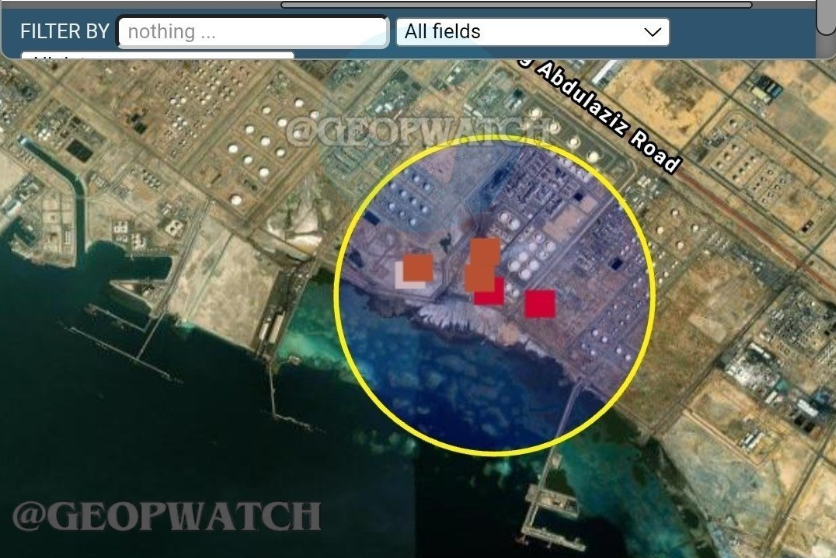
NASA fire-detection satellites and open-source thermal data captured two intense fires at the Aramco complex in Yanbu on Saudi Arabia’s Red Sea coast, each radiating roughly 40 megawatts of heat—far above the 5–10 megawatts typical of a routine flare. The detections, highlighted in reporting shared by Chris Martenson quoting Mario Nawfal, come as Yanbu has become the kingdom’s primary remaining crude outlet after months of disruption in the Strait of Hormuz.
Yanbu is the western terminus of the East-West Pipeline (Petroline). Hitting it, or the line that feeds it, strikes the workaround Saudi Arabia has used since Hormuz traffic collapsed. The pipeline itself was already shut after drones launched from Iraq struck pumping stations on September 10.
Satellite imagery of those earlier strikes shows charred pumping stations, blackened compounds, and burn scars southeast of Medina. Thermal detections identified seven new fire sites along a 110-kilometer stretch of the right-of-way; the worst-hit pump station complex burned at 61 megawatts on the first pass after the attack.
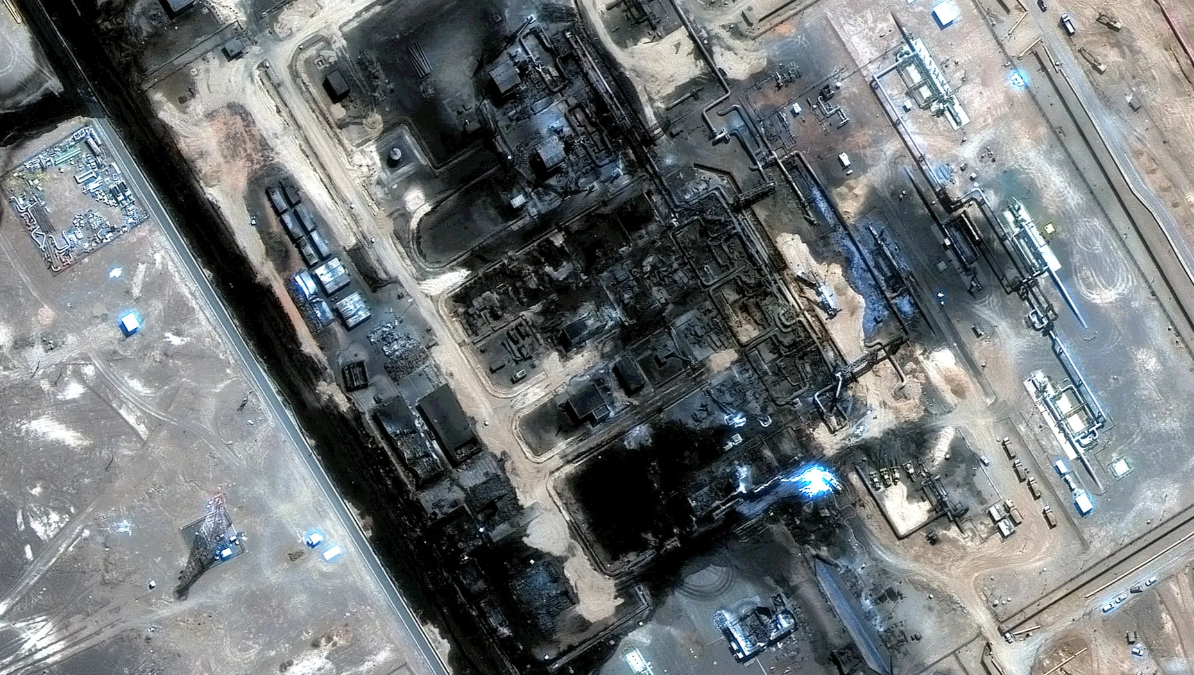
The pattern is no longer isolated incidents. Over the past month, Houthi forces in Yemen and Iran-aligned groups operating from Iraq have repeatedly targeted Saudi energy infrastructure, compounding the effects of the wider U.S.-Israel-Iran conflict that began in late February 2026.
Attacks on Saudi Energy Infrastructure (Last Month and Immediate Context)
Key incidents affecting export systems and refining:
- July 25 (and follow-on strikes): Houthi missiles and drones hit the 400,000 bpd Jazan (Jizan) refinery and claimed strikes toward Yanbu. Satellite imagery showed tank fires and a long smoke plume. The plant was shut; later imagery indicated additional tanks damaged in subsequent waves, with reports of at least 14 tanks affected over time.
- Early August: Additional Houthi claims against Jazan (fire extinguished August 9 with no casualties reported by Saudi authorities) and tanker traffic near Yanbu. A Saudi-operated tanker was damaged in the Red Sea.
- September 8: Large Houthi barrage with dozens of ballistic missiles and drones on southern cities including Abha, Jazan, Najran, and Khamis Mushait. Saudi authorities reported fires at energy facilities, temporary operational shutdowns, and 73 wounded (including civilians). Satellite analysis showed at least six storage tanks destroyed at the Aramco bulk fuel plant in Abha, with the distribution hub largely out of operation. A refinery north of Abha also produced a visible smoke plume. King Khalid Air Base was targeted.
- September 10: Drones from Maysan province, Iraq, struck East-West Pipeline pumping stations in the Riyadh and Medina regions. Multiple fires, injuries, and a precautionary shutdown of the entire 1,200 km line. Iraq later dismissed a local commander after tracing the launches.
- September 13–15: Additional Houthi claims and satellite-confirmed damage at southern fuel depots and military sites (Sharurah). Fresh missile and drone attack on Khamis Mushait airbase (hangars, radar, runways, ammunition). Reports and NASA detections of intense fires at the Yanbu Aramco/YASREF-area refinery complex. YASREF processes about 400,000 bpd of diesel, gasoline, jet fuel, and other products.
Houthis have simultaneously tightened control over the southern Red Sea, capturing Mocha and Perim Island and declaring a blockade on Saudi shipping through Bab el-Mandeb. Only a handful of Saudi cargoes have transited that strait recently.
Current Export Picture: Can Saudi Arabia Still Move Oil?
Yes, but at a sharply reduced volume and with a rapidly shrinking buffer.
Saudi crude production fell to 6.238 million bpd in August—the lowest since 1990—according to the kingdom’s report to OPEC. Observed seaborne crude exports dropped to roughly 3–3.2 million bpd, the lowest in at least 13 years. That is well below pre-war levels near 7 million bpd or higher.
The East-West Pipeline had been moving 4–5 million bpd (about 4% of global supply) to Yanbu after Hormuz was effectively closed. Design capacity is cited at up to 7 million bpd, of which roughly 5 million was intended for export and 2 million for west-coast refineries. Yanbu terminal loading capacity is nominally 4.5 million bpd but effectively closer to 4 million. Pre-attack September loadings were estimated at 2.9–3.7 million bpd.
With the pipeline offline, Yanbu is drawing on stored crude. Industry sources estimate stocks can support current export rates for 5–8 days. After that, production cuts become likely unless the line restarts or alternative routes scale up. Additional limited volumes exist at Egyptian terminals (Ain Sukhna and Sidi Kerir via SUMED), but they are not a full substitute.
Strait of Hormuz: Traffic remains a fraction of the pre-war ~20 million bpd of oil and products. Recent daily commodity vessel counts have fallen as low as 4–10, versus dozens previously. Some “dark” shipping and U.S. Navy-supervised routes along the Omani coast continue, and Saudi tankers have exited during temporary lulls earlier in the year. It is not a reliable large-scale “sneak-out” option; risk, insurance, and targeting remain high. Most remaining Saudi volumes have been forced west.
Refined-product exports are also hit. Jazan’s 400,000 bpd plant has suffered repeated tank-farm damage. Yanbu-area refining (YASREF ~400,000 bpd plus other west-coast plants) now faces fire reports. Southern distribution hubs such as Abha are offline or severely damaged. Domestic fuel supply and product exports both suffer.
Repair Timeline and Market Loss
Official Saudi statements have been limited: the pipeline was closed “as a precaution” while damage is assessed. Regional officials cited by AP said repairs to the pumping system could take 3–5 weeks. Other assessments range from “very soon” (partial restart) to 8 weeks. Aramco has a strong restoration record—Abqaiq in 2019 recovered most volumes in days to weeks—but pumping-station damage plus ongoing attack risk complicates the outlook.
If the pipeline stays down beyond the inventory window, analysts warn of the loss of up to 4 million bpd, or about 4% of global oil supply, on top of already-reduced Saudi and regional flows. The IEA has already recorded Saudi supply at multi-decade lows and revised 2026 forecasts downward. Brent has traded above $107 amid the latest news. A prolonged outage would tighten sour crude for Asian refiners and add pressure to refined-product markets already strained by Jazan and other outages.
Saudi Arabia can still export some crude and products from remaining stocks and limited alternative routes, but the combination of a shut pipeline, damaged terminals and refineries, Houthi control of the southern Red Sea, and residual Hormuz risk has collapsed volumes far below normal. The satellite fires at Yanbu are the latest visible sign that the last major workaround is itself under fire.The situation remains fluid. Aramco and the Saudi Energy Ministry have not released detailed damage assessments or restart schedules as of September 15.
- Chris Martenson / Mario Nawfal post on Yanbu fires and NASA detections: https://x.com/chrismartenson/status/2099719006961754472
- Middle East Forum satellite analysis of East-West Pipeline fires: https://www.meforum.org/mef-reports/where-the-east-west-pipeline-actually-burned
- Reuters: Oil prices rise on pipeline outage and fresh attacks (Sept 15): https://www.reuters.com/business/energy/oil-prices-rise-saudi-pipeline-outage-fresh-attacks-raise-supply-concerns-2026-09-15/
- Reuters: Pipeline outage threatens 4% of global supply: https://www.reuters.com/business/energy/saudi-pipeline-outage-threatens-loss-4-global-oil-supply-2026-09-13/
- AP: What the pipeline closure means; 3–5 week repair estimate: https://apnews.com/article/saudi-pipeline-oil-iran-war-efa431e2fa771e34880c8453c62ffb92
- New York Times: Saudi oil “lifeline” attacked: https://www.nytimes.com/2026/09/12/world/middleeast/saudi-arabia-oil-pipeline-attack.html
- Al-Monitor / Bloomberg: Saudi production 6.238 million bpd in August, lowest since 1990: https://www.al-monitor.com/originals/2026/09/saudi-arabias-oil-production-slumps-lowest-36-years-war-bites
- IEA-related reporting on August supply drop: https://www.reuters.com/world/middle-east/saudi-oil-supply-hits-more-than-three-decade-low-after-houthi-attacks-iea-says-2026-09-11/
- Bloomberg: August exports ~3 million bpd: https://www.bloomberg.com/news/articles/2026-09-02/saudi-oil-exports-dive-as-tankers-at-risk-from-hormuz-to-red-sea
- Middle East Monitor / Soar analysis of Abha fuel depot tanks: https://www.middleeastmonitor.com/20260914-satellite-images-show-damage-to-saudi-fuel-depot-military-site-after-houthi-attacks/
- Reuters on Sept 8 Houthi attacks and 73 wounded: https://www.reuters.com/world/middle-east/saudi-led-coalition-yemen-says-73-injured-houthi-attacks-kingdom-2026-09-08/
- Bloomberg on Jazan tank fire (July): https://www.bloomberg.com/news/articles/2026-07-27/satellites-show-tank-fire-at-saudi-oil-plant-jazan-after-attack
- CNBC on pipeline scramble and inventories: https://www.cnbc.com/2026/09/15/oil-prices-saudi-arabia-east-west-pipeline-iran.html
- Guardian on pipeline damage and prices: https://www.theguardian.com/world/2026/sep/14/saudi-pipeline-drone-attack-houthis-global-oil-supply-prices
- Additional context on Yanbu/YASREF capacity and earlier July strikes from industry reporting and tanker trackers (Kpler, Vortexa).