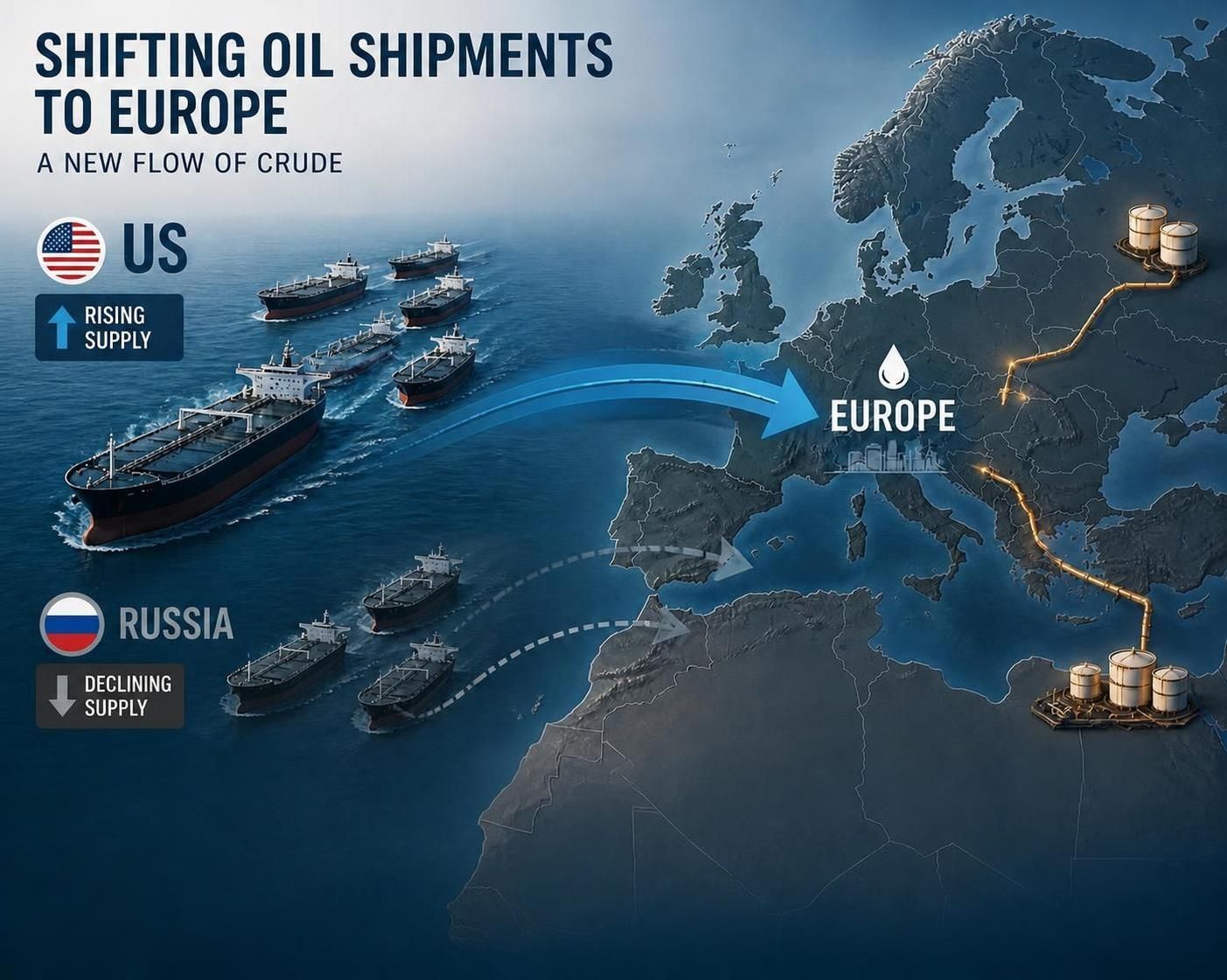
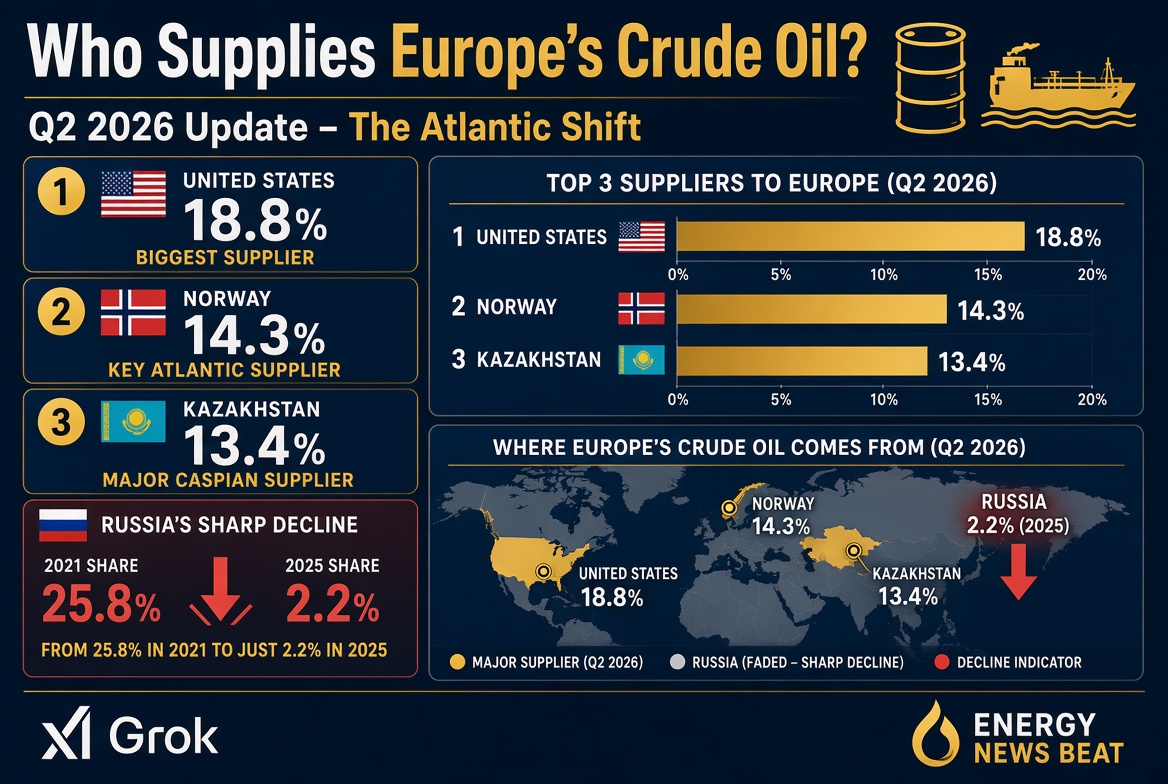
The United States has solidified its position as Europe’s top crude oil supplier. According to Eurostat data highlighted in a recent analysis by commodity markets observer Jack Prandelli, the US accounted for 18.8% of the EU’s petroleum oil imports by value in the second quarter of 2026. That marked a rise from 15.1% in 2025 (and lower levels earlier). Norway followed at 14.3% and Kazakhstan at 13.4% over the same period.X
This represents a dramatic reversal from the pre-invasion era. Russia supplied 25.8% of EU crude imports in 2021. By 2025 that share had fallen to just 2.2%, and by Q2 2026 it stood at roughly 1%. Volumes tell the same story: Russian crude deliveries to the EU dropped from 114.4 million tonnes in 2021 to 9.7 million tonnes in 2025, while US volumes rose from 37.1 Mt to 63.5 Mt over the same span. In full-year 2025, the top three suppliers by quantity were the United States (14.6%), Kazakhstan (12.8%), and Norway (12.8%).Consilium.europa
The shift reflects the EU’s 2022–2023 embargoes on seaborne Russian crude (from December 2022) and refined products (from February 2023), plus broader sanctions. Remaining Russian crude flows are largely limited to the Druzhba pipeline serving Hungary and Slovakia under exemptions. Europe bought roughly the same volume of crude in Q2 2026 as a year earlier but paid significantly more—around 56% higher in the period cited by Prandelli—as prices and the mix of longer-haul barrels adjusted.
Crude Was Never Europe’s Biggest Vulnerability
Europe has closed roughly a quarter of its refining capacity over the past two decades. The result is structural dependence on imported diesel and other products even when crude supplies are secure. Direct Russian diesel and gasoline imports have largely ended under the 2023 ban. Russian diesel shipments to Europe fell from nearly 30 million tonnes (almost 50% market share) in 2022 to about 2.9 million tonnes (roughly 5% share) by 2024.
The residual problem has been the “refining loophole”: diesel and jet fuel refined in India, Turkey, and elsewhere from Russian crude and then sold into the EU. New EU rules effective in 2026 require evidence that imported products were not made from Russian crude, tightening that channel. US and Middle Eastern refiners have filled much of the gap; US diesel exports to Europe hit record levels in early 2026 as the new restrictions took effect. Gasoline flows from Russia are negligible under the same product ban.
Natural Gas and LNG: Russia Still Present, But Shrinking
Pipeline natural gas and LNG tell a different story. In Q2 2026, Russia still supplied 10.2% of the EU’s gaseous (pipeline) natural gas imports and 17.3% of LNG imports. The US dominated LNG at 63.2%, with Algeria at 8.1%. For pipeline gas, Norway led at 51.2%, followed by Algeria (18.2%) and the UK (11.1%).
Full-year 2025 figures showed Russia’s LNG share in the mid-teens (around 13.9–16% depending on the source), while the US exceeded 50–56%. The EU spent roughly €7.2 billion on Russian LNG in 2025, primarily from the Yamal project, with France, Belgium, and Spain among the largest buyers. Pipeline volumes have fallen more sharply, with remaining flows concentrated via TurkStream into southeastern Europe under temporary exemptions.
The EU has adopted a roadmap to end all Russian gas imports (pipeline and LNG) by the end of 2027 or early 2028, with accelerated timelines for LNG. Short-term contracts face earlier cutoffs. Overall gas import dependence on Russia has already dropped from over 40–45% pre-war to the low-to-mid teens.
Remaining Risks and the Broader Picture
Diversification has succeeded on crude, but Europe remains exposed to chokepoints. Kazakhstan’s CPC Blend loads on the Russian Black Sea coast and has faced drone disruptions. Saudi and Iraqi barrels transit or sit near the Strait of Hormuz. Libya’s light sweet grades can halt with political instability. WTI Midland (now part of the Brent basket), Norwegian grades such as Johan Sverdrup and Oseberg, and Brazilian Tupi have become reliable Atlantic-basin alternatives.
Major European refiners (Shell, TotalEnergies, BP) posted strong refining margins in recent quarters, capturing some of the value from the tight product market. The EU’s total energy import bill has declined in value and volume from 2022 peaks, yet price volatility and the diesel shortfall keep costs elevated for consumers and industry.
In short, the US has stepped into a leading role on crude (nearly one in five barrels by recent value shares) and dominates LNG. Russia’s crude presence is residual. On gas and LNG the drawdown is real but incomplete until the 2027–2028 phase-out deadlines. Europe’s refining capacity gap means product imports—and the associated price exposure—will remain a structural feature even as crude origins continue to diversify.
Check out the World’s Greatest Podcast Show Notes at EnergyNewsBeat.co or EnergyNewsBeat.com. And subscribe to: The Energy News Beat Substack.
Appendix: Sources and Links
- Jack Prandelli (@jackprandelli) post on US and European crude shares (1 Nov 2026), including chart: https://x.com/jackprandelli/status/2116940295288074563
- Council of the European Union, “Where does the EU get its oil from?” (2025 data): https://www.consilium.europa.eu/en/infographics/where-does-the-eu-get-its-oil-from/
- Eurostat, “EU imports of energy products – latest developments” (Q2 2026 quarterly shares for petroleum oils, LNG, and gaseous natural gas): https://ec.europa.eu/eurostat/statistics-explained/index.php?title=EU_imports_of_energy_products_-_latest_developments
- Eurostat news on 2024 and 2025 energy import trends: https://ec.europa.eu/eurostat/web/products-eurostat-news/w/ddn-20250321-1 and related 2025 updates
- Visual Capitalist / Energy Institute data on 2024 European crude imports by origin
- Kpler / Urgewald analyses on remaining Russian LNG and commodity flows (2025)
- S&P Global and Reuters reporting on the redrawn European diesel trade map post-2022 and 2026 product-origin rules
- Centre for Research on Energy and Clean Air (CREA) monthly fossil-fuel export tracking
- European Commission / Consilium materials on gas diversification and phase-out timelines
- Trading Economics / UN Comtrade aggregates on EU mineral-fuel imports from Russia
- IEA and national statistical notes on refined-product exemptions and Druzhba flows
All figures are drawn from the above official statistical releases, institutional explainers, and contemporaneous market reporting as of early November 2026. Shares can vary slightly between value and volume bases and between quarterly and annual snapshots.