
In a notable development underscoring shifting global energy trade flows amid ongoing Middle East tensions, a cargo of crude oil drawn from the U.S. Strategic Petroleum Reserve (SPR) is heading to California for the first time ever, according to ship-tracking firm Kpler.
The shipment involves approximately 460,000 barrels of Bayou Choctaw Sweet crude destined for Chevron’s Richmond refinery in the San Francisco Bay Area, with an additional 50,000 barrels of the same grade delivered to Chevron’s El Segundo refinery near Los Angeles. The complex logistics highlight the lengths energy companies are going to keep California’s refineries supplied during a period of significant stress.
Kpler tracked the movement through bills of lading. The tanker Red Moon loaded nearly 980,000 barrels of Bayou Choctaw Sweet crude in Louisiana before discharging at the Atlantic Terminal on Panama’s east coast in early May. From there, a 131 km (81.4 miles) pipeline transported the oil to the Pacific Terminal. Chevron-chartered supertanker Pascagoula Voyager then loaded about 2 million barrels at the Pacific Terminal — co-loading with Guyana’s Unity Gold crude — and sailed toward the U.S. West Coast. Upon arrival, the SPR crude was offloaded to two smaller vessels for final delivery to the California refineries. Chevron was listed as the seller of the cargo.
Chevron spokesman Ross Allen confirmed the company has been moving crude and gasoline blendstocks “under the Jones Act fleet and under the Jones Act waiver program to help supply California in a time of significant energy stress.” The company declined to provide further details on this specific shipment.
California, once a major U.S. oil producer, has become increasingly reliant on imports. Last year it imported roughly 230,000 barrels per day from the Middle East. The ongoing conflict involving Iran has disrupted those supplies by effectively choking off tanker traffic through the Strait of Hormuz, forcing refiners to scramble for alternatives. Asian demand has further tightened availability of replacement crudes.
This SPR delivery to California coincides with broader U.S. efforts to stabilize domestic fuel markets. The Trump Administration authorized releases from the SPR, including a third batch of 26.03 million barrels loaned since the Iran conflict escalated.
Trump Administration’s Jones Act Waiver Prevents a Worse Crisis in California
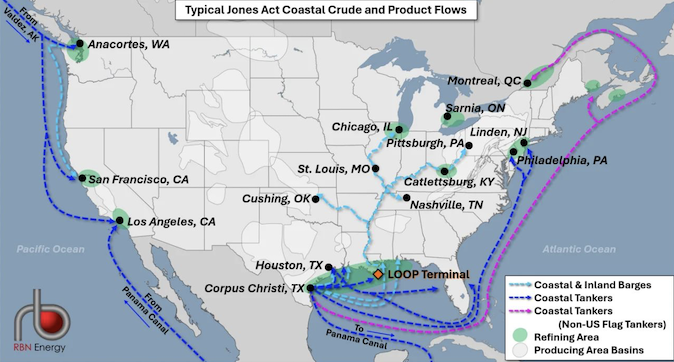
To address the acute energy supply challenges, the Trump Administration took decisive action by issuing a historic 60-day waiver of the Jones Act (Merchant Marine Act of 1920) on March 17, 2026. The waiver, requested by the Department of Defense under 46 U.S.C. § 501(a) on national defense grounds, temporarily allowed foreign-flagged vessels to transport oil, natural gas, fertilizer, coal, and 659 other critical commodities between U.S. ports. It was explicitly designed to mitigate short-term oil market disruptions caused by the Iran war and to ensure fuel reached high-demand areas like California.
The waiver was later extended for an additional 90 days (to approximately August 16, 2026) as global energy disruptions persisted.
Data from the U.S. Maritime Administration (MARAD) shows the waiver has been actively utilized. As of mid-May 2026, more than 45 voyages had been completed under the program, involving dozens of foreign-flagged vessels and millions of barrels of energy products. California emerged as the biggest beneficiary, with roughly 21 of those 45 voyages directly related to the state — including shipments from the Gulf Coast, intra-California movements, and deliveries from Pacific Northwest refineries.
In the roughly 60 days preceding the latest reports, multiple full-tanker loads of gasoline, crude, and other fuels moved under the waiver, directly supporting California’s refineries and helping avert more severe fuel shortages and price spikes that analysts warned could have crippled the state’s energy supply chain.
The waiver enabled faster, more flexible routing of domestic energy resources that would otherwise have been restricted to a limited fleet of Jones Act-qualified U.S.-built, U.S.-crewed, and U.S.-flagged vessels. Without it, California — already facing refinery constraints and import shortfalls — risked significantly worse supply disruptions and higher gasoline prices.
Broader Implications
The first-ever SPR crude delivery to California via this multi-leg route through Panama illustrates both the creativity of supply chains under pressure and the ongoing strain on West Coast refining. It also demonstrates how policy tools like the Jones Act waiver, combined with SPR releases, are working in tandem to bolster domestic energy security during geopolitical shocks.
Energy News Beat will continue monitoring developments as more SPR barrels move and the extended waiver remains in effect.
Appendix: All Sources and Links
- Original Al Arabiya article (May 28, 2026): “Oil from US emergency reserves head to California for the first time, Kpler says” — https://english.alarabiya.net/amp/business/energy/2026/05/28/oil-from-us-emergency-reserves-head-to-california-for-the-first-time-kpler-says
- U.S. Maritime Administration (MARAD) Domestic Shipping page with Jones Act waiver reports (latest as of May 26, 2026): https://www.maritime.dot.gov/ports/domestic-shipping/domestic-shipping
- Cato Institute analysis (May 13, 2026) on waiver voyages and California impact: https://www.cato.org/blog/jones-act-waiver-data-reveals-universe-blocked-american-trade
- Center for Maritime Strategy report (May 7, 2026) detailing early waiver usage: https://centerformaritimestrategy.org/publications/the-jones-act-waivers-arent-achieving-stated-purpose-but-hinder-long-term-maritime-goals/
- PBS News on Trump 60-day Jones Act waiver (March 2026): https://www.pbs.org/newshour/politics/what-to-know-about-the-jones-act-as-the-trump-administration-unveils-a-60-day-waiver
- Fox Business on waiver announcement: https://www.foxbusiness.com/politics/trump-waives-jones-act-60-days-bid-free-up-flow-oil-us
- Reed Smith legal alert on new Jones Act waiver (March 18, 2026): https://www.reedsmith.com/our-insights/blogs/viewpoints/102mnbe/new-jones-act-waiver/
- Additional context from KFI AM 640, Supply Chain Brain, AEI, and Holland & Knight reports on waiver implementation and California benefits (March–May 2026).
All data and quotes drawn directly from publicly available reports and the cited primary sources as of May 28, 2026.