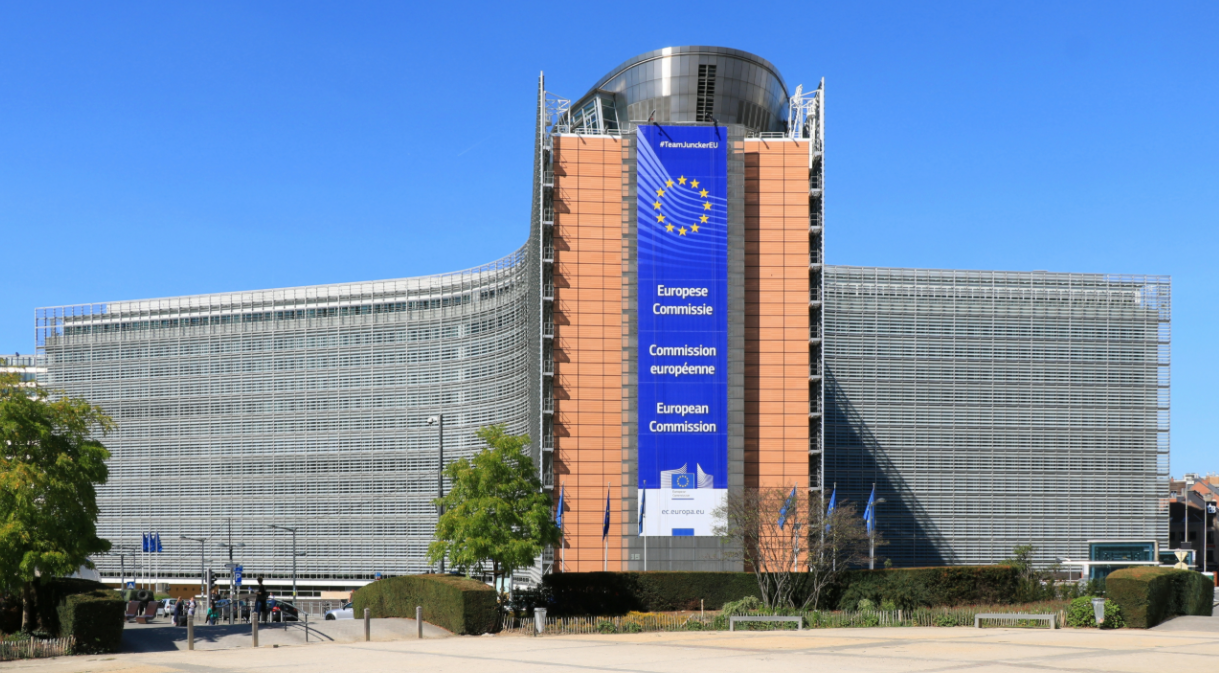
As much of Europe sweltered under a recent heatwave with record temperatures in parts of Belgium and surrounding countries, staff at the European Commission’s iconic Berlaymont headquarters in Brussels faced a stark reminder of hierarchy.
On Friday, June 27, 2026 (or the relevant recent date matching reports), employees on floors 1 through 7 received an urgent text: “BERL — URGENT — Due to extreme weather conditions, forced shutdown of air cooling system from floor 1 to 7 for the rest of the day.”The 13-story building houses Commission President Ursula von der Leyen (on the 13th floor) and most of her 26 commissioners on floors eight and above. Those upper levels kept their air conditioning running. Lower-level staff did not. One anonymous official called it “like feudalism.” Another labeled the decision a “disgrace.” A staffer on the eighth floor noted indoor temperatures still reached 25.7°C despite AC on their level.
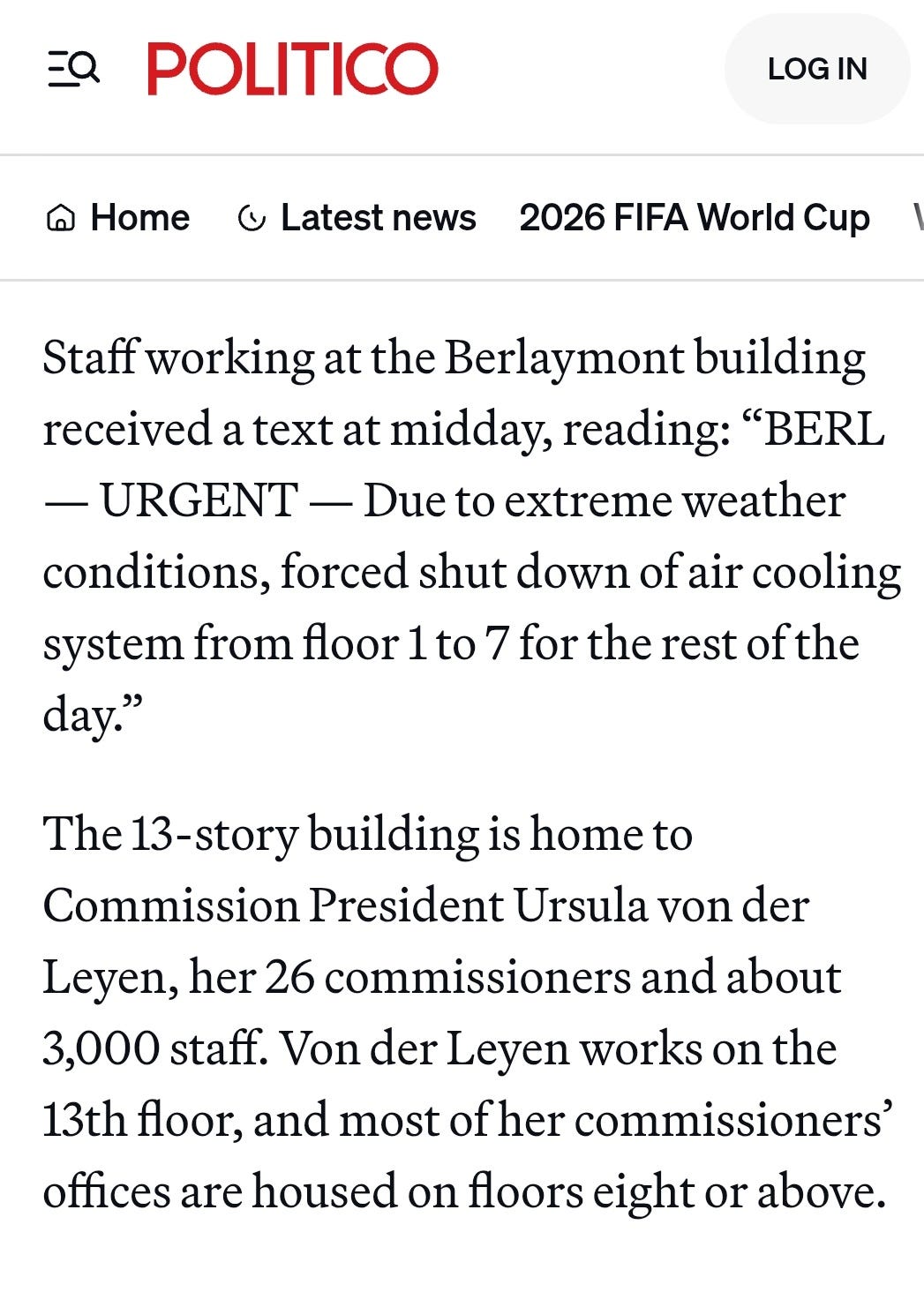
Politico broke the story, highlighting the irony during a heatwave that tested energy grids, workers, and vulnerable populations across Europe.
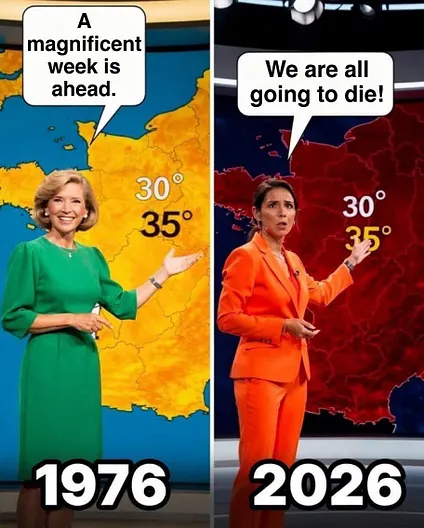
The Heat Narrative and Shifting Weather Map Colors
This incident ties into broader debates about how “extreme heat” is framed. Viral social media posts over recent years have circulated comparisons of weather maps from past decades versus today, claiming identical temperatures now appear in alarming reds and oranges instead of cooler greens or blues—allegedly to push a climate crisis narrative.
Fact-checks and analyses consistently show these comparisons are often misleading. Many contrast a general forecast map (with a neutral green background and numbers) against a dedicated temperature color-scale map, or maps from different providers with varying scales for accessibility and clarity. Color choices depend on the data type and purpose, not deliberate exaggeration of the same temperatures.
That said, the perception of heightened alarmism persists, especially when elite institutions impose costs and restrictions on ordinary citizens while shielding themselves.
Climate Policies, Renewables Spending, and Grid Realities
Europe’s aggressive climate policies—driven by the Green Deal, REPowerEU, and net-zero targets—have funneled hundreds of billions (part of trillions globally) into wind and solar. These intermittent sources now form a large share of electricity in many EU countries.The continental European grid operates at 50 Hz and is largely synchronous. High penetration of inverter-based renewables (wind and solar) reduces system inertia, complicating frequency stability and increasing risks of voltage issues or curtailment. Grid operators have reported rising stability challenges, with some regions facing higher costs for backups, interconnectors, and upgrades. Europe has invested heavily in grid reinforcements precisely because of this transition.
The US grid (primarily 60 Hz, with major interconnections) faces parallel issues in high-renewable areas like California and Texas, though natural gas provides more flexible baseload and peaking support. US policies like the Inflation Reduction Act have accelerated wind and solar deployment with substantial subsidies, but energy security concerns have kept gas and interest in nuclear prominent.
The result in both systems: higher electricity costs for consumers in many jurisdictions, supply volatility, and questions about whether the spending delivers proportional benefits versus reliable, dispatchable power.
UN/IPCC Quietly Updates Extreme Scenarios
Adding fuel to skepticism, Energy News Beat reported on updates to climate modeling scenarios for the IPCC’s upcoming Seventh Assessment Report (CMIP7). The extreme “doomsday” pathways—particularly RCP8.5 and its successor SSP5-8.5—have been deemed “implausible” given real-world trends in renewables deployment, coal use trajectories, and policy developments.
These scenarios, which assumed massive ongoing coal expansion and projected up to 4–5°C warming by 2100, dominated thousands of studies, media coverage, and policy justifications for over a decade. Climate policy expert Roger Pielke Jr. noted: “The IPCC and broader research community have now admitted that the scenarios that have dominated climate research, assessment, and policy during the past two cycles of the IPCC assessment process are implausible. They describe impossible futures.”
Global energy transition investment hit around $2.3 trillion in 2025 alone (with hundreds of billions annually into wind and solar), part of roughly $10 trillion over two decades in green initiatives, subsidies, and related spending. Critics argue much of this was accelerated by fear based on now-retired worst-case assumptions.
This does not negate observed warming or the role of greenhouse gases. It does highlight how policy rushed ahead of robust, updated scenario analysis, with real-world costs in energy prices, grid strain, and opportunity costs.
China and the US: Adding Reliable Baseload
While Europe doubles down on intermittent renewables, major powers prioritize energy security with dispatchable sources:
China continues approving and constructing large amounts of new coal capacity (dozens of GW annually in recent years) alongside rapid nuclear expansion (aiming for significant growth toward 70+ GW operational soon and much higher long-term targets) and renewables. Coal provides an essential baseload for its massive and growing demand.
The United States relies heavily on natural gas for flexible generation, has completed major nuclear projects (e.g., Vogtle), and sees renewed policy support for nuclear expansion alongside renewables. Coal retirements continue in some areas, but gas and nuclear remain central to reliability.
Both nations recognize that wind and solar alone cannot guarantee 24/7 power without massive overbuild, storage, or backups—lessons Europe is learning the hard way on its 50 Hz grid.
We will be covering this story on the Energy Realities Podcast tomorrow morning at 7;00 Central.

Bottom Line
The Berlaymont AC episode crystallizes a recurring pattern: narratives of climate emergency drive policies that raise costs and reduce reliability for workers and citizens, while decision-makers often insulate themselves. Trillions spent on the energy transition have delivered renewables growth but also exposed grid vulnerabilities and highlighted the enduring need for baseload power.
Pragmatic energy strategy—all-of-the-above, emphasizing affordability, reliability, and technological innovation without mandates—better serves people than fear-driven overreach. China and the US appear to understand this reality more clearly than some EU institutions.
Appendix: Sources and Links
- Politico: “EU Commission HQ forced to shut down air-conditioning amid heatwave” – https://www.politico.eu/article/eu-commission-heatwave-hq-forced-shut-down-air-conditioning-europe/ (and related E&E News by POLITICO coverage)
- Energy News Beat: “UN Climate Panel Quietly Admits Its Doomsday Climate Scenarios Were ‘Implausible’” – https://energynewsbeat.co/enb-publisher-picks/un-climate-panel-quietly-admits-its-doomsday-climate-scenarios-were-implausible-how-much-money-has-been-spent-on-net-zero-because-of-lies/
- IPCC/CMIP7 scenarios update paper (Geoscientific Model Development): https://gmd.copernicus.org/articles/19/2627/2026/
- Roger Pielke Jr. Substack on RCP8.5: https://rogerpielkejr.substack.com/p/rcp85-is-officially-dead
- Broader reporting on China coal/nuclear additions: Global Energy Monitor, EIA, Ember Energy analyses (various 2024–2026 reports)
- US nuclear and energy mix: World Nuclear Association, EIA data
- Grid and renewables integration challenges: Various technical papers on 50 Hz European system stability and US interconnection issues (e.g., studies on inertia and frequency control)
- Weather map color claims: Fact-checking analyses from outlets like Maldita.es, AFP, and others explaining common miscomparisons (2022–2024 coverage)
All facts presented are drawn from the cited public sources as of late June 2026. Readers are encouraged to review primary documents for full context.