We have been here 39 times before; maybe 40 will hold.
In a significant development for global energy security, Pakistani Prime Minister Shehbaz Sharif announced today that a peace deal between the United States and Iran has been reached following intensive mediation efforts. The official signing ceremony is scheduled for Friday, June 19, 2026, in Switzerland.
This builds on Sharif’s earlier statements this week. On June 12, he confirmed that a “final, agreed upon text of the peace deal has been reached,” with Pakistan working closely with both sides on next steps. On June 13, he noted the sides were “closer to a peace deal than ever before,” with finalization likely in the next 24 hours and preparations for an electronic signing followed by technical talks.
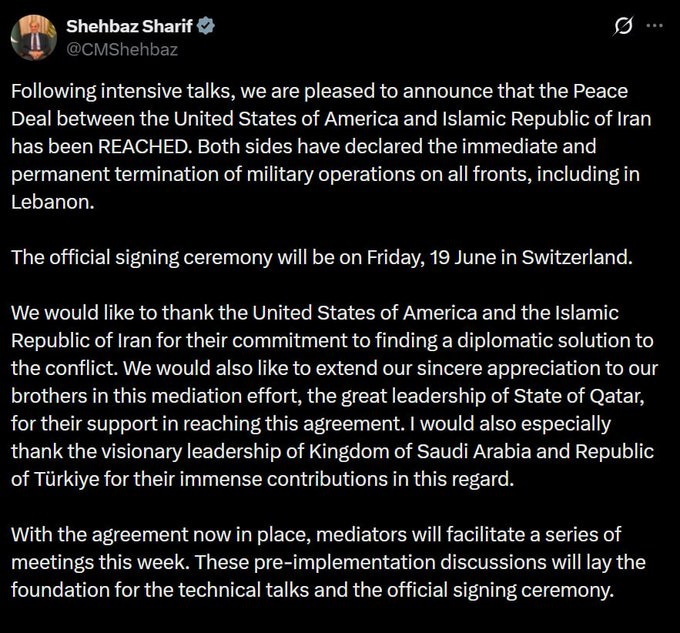
The Rapid Response 47 X account (@RapidResponse47) highlighted related developments in a post today that included media (likely a screenshot or related visual of the Pakistan statement), sparking widespread discussion.
What the Deal Entails and the Strait of Hormuz Factor
The agreement is described as a memorandum of understanding (MoU) or framework that includes:
Immediate and permanent termination of military operations on all fronts, including Lebanon.
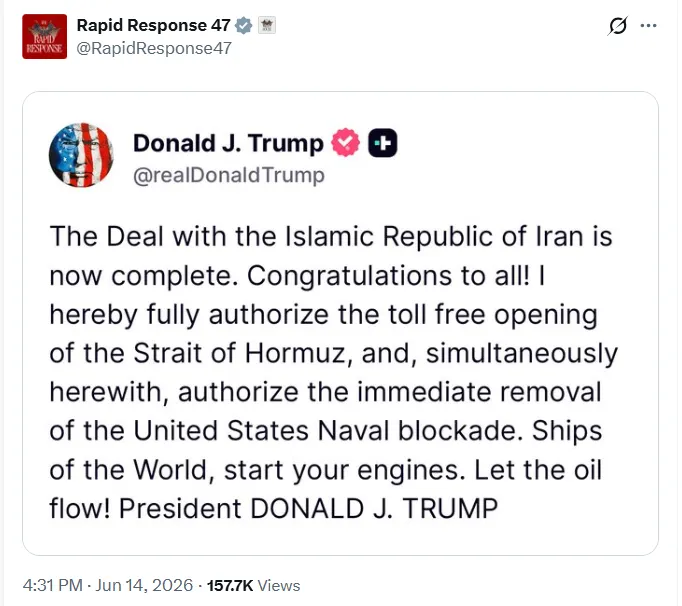
Reopening of the Strait of Hormuz.
Lifting of the U.S. blockade on Iranian ports.
A potential 60-day extension of the ceasefire.
The Strait of Hormuz — the narrow waterway between Iran and Oman through which approximately 20% of the world’s oil transited before the conflict — is the centerpiece for energy markets. Iran imposed strict controls over the strait since the war began in late February 2026, severely disrupting global shipping and causing chaos in oil markets.
According to U.S. and regional sources familiar with the text:
The strait would reopen immediately without tolls.
Pre-war shipping levels would be restored within approximately 30 days.
Iranian Foreign Minister Abbas Araghchi has indicated Tehran intends to maintain control and charge a “service fee” for passage (while acknowledging it is not possible to levy a traditional toll under international law). He stated Iran’s “sword will remain poised over the Strait of Hormuz indefinitely.”
Reopening the strait would represent one of the most significant positive developments for global energy supply in years, potentially easing upward pressure on oil prices and stabilizing tanker routes from the Persian Gulf.
Context: Months of Conflict and Energy Disruption
The current conflict escalated at the end of February 2026 when the U.S. and Israel launched strikes on Iran. Iran responded by restricting traffic through the Strait of Hormuz. A ceasefire was reached in mid-April, but intermittent exchanges continued, with recent escalations including Israeli strikes in Lebanon.
Pakistan has played a key mediating role, alongside support from Qatar, Saudi Arabia, and Türkiye. Sharif specifically thanked these partners in today’s announcement.
How Many Times Have We Been Here? Iran and the Strait of Hormuz
This is not the first time tensions over the Strait of Hormuz have dominated energy headlines:1980s Tanker War (Iran-Iraq War): Iran mined parts of the strait and attacked shipping; the U.S. responded with naval operations.
2011–2012: Iranian officials threatened closure amid tightening sanctions on oil exports. Oil prices spiked temporarily.
2018–2019: After the U.S. withdrawal from the JCPOA nuclear deal, Iran conducted tanker attacks, seized vessels, and downing a U.S. drone near the strait, leading to heightened alerts and insurance spikes.
Multiple other incidents involving harassment, missile threats, and proxy actions.
Iran has repeatedly used the threat (or limited disruption) of closing or controlling the strait as leverage during sanctions or military tensions. The current situation marks one of the more sustained actual restrictions in recent history.
In the last few months alone (since late February 2026), Iran has actively imposed controls on the strait as part of the broader conflict, directly impacting global oil flows and contributing to market volatility.
Energy Market Implications
A successful reopening could:
Increase available global oil supply (including resumed or expanded Iranian exports).
Reduce shipping insurance premiums and rerouting costs (some vessels had diverted around Africa or faced delays).
Contribute to downward pressure on benchmark crude prices (recent reports already noted futures reacting positively to deal optimism, with U.S. crude around $85 and Brent near $87 in recent trading).
However, uncertainties remain:Iran has previously pushed back on exact signing timelines.
Differing interpretations exist on Hormuz fees/control.
Israel is not a direct party and has continued operations against Hezbollah in Lebanon.
Nuclear program details and sanctions relief are slated for later technical talks.
Skepticism exists in some quarters (both in the U.S. and Iran) regarding long-term compliance, echoing past experiences with agreements like the JCPOA.
Do you think Iran can keep their hands off the trigger?
I, for one, do not trust this peace will hold, but am hopeful. Verification is critical. Just like AI without validation is worthless, so is any agreement with the IRGC.
Buckle up, it should be entertaining, as we are two weeks away from tank bottoms at Cushing, and the last time Cushing was overfilling and the June 24th contract came due, we went negative $34. So if we are at tank bottoms, we may see a short-term spike, as it will still take months to get the balance back to the market.
What do you think?