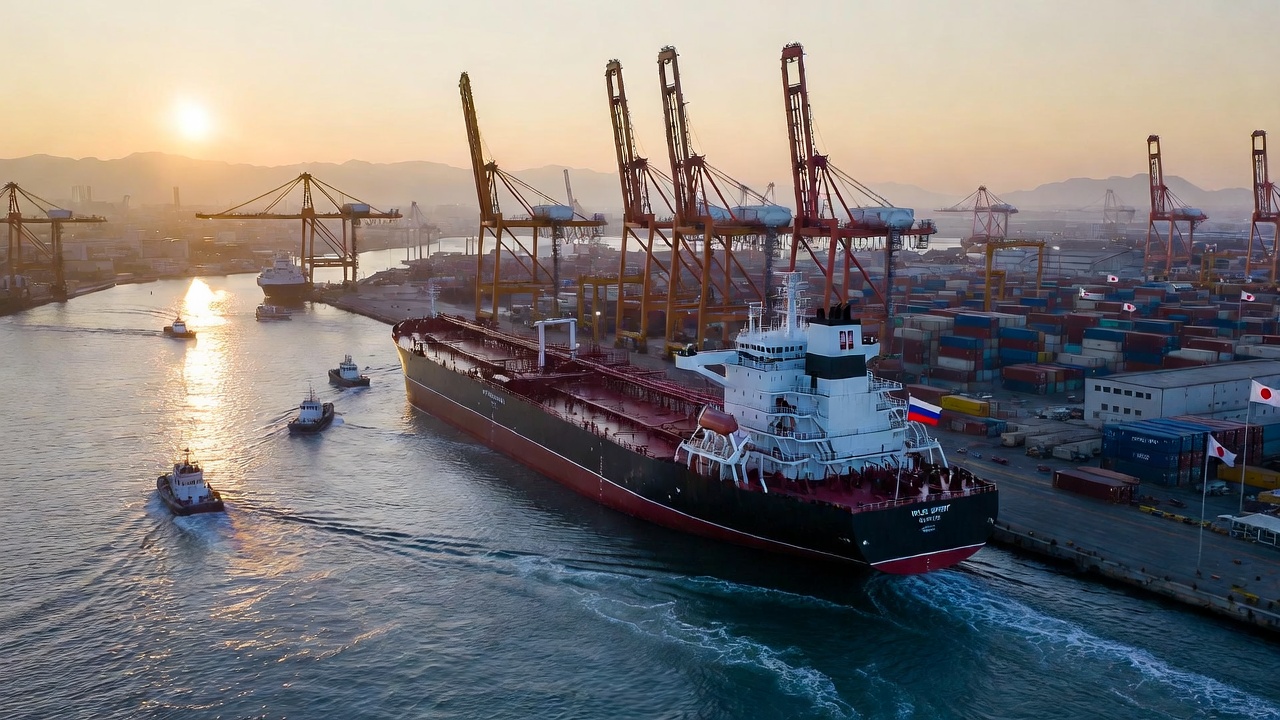
A Russian tanker carrying crude oil from the Sakhalin-2 project is set to arrive in Japan today, marking a notable development in the country’s efforts to secure energy supplies amid ongoing disruptions in the Middle East. The cargo is destined for Taiyo Oil’s refinery in Ehime Prefecture and represents the latest step by Japan to diversify its sources as it grapples with supply strains from traditional Middle Eastern providers.
Japan, one of the world’s largest energy importers with virtually no domestic production, relies heavily on foreign crude oil. In recent years, the country has imported approximately 2.3–2.4 million barrels per day of crude oil. For fiscal year 2024, total crude imports stood at around 136 million kiloliters, with the Middle East accounting for a record-high 95.9% dependency—the highest level in decades. Key suppliers include Saudi Arabia (typically 40–51% of imports), the United Arab Emirates (around 36–44%), Kuwait, and Qatar. Other sources, such as the United States, have seen modest increases as Japan seeks alternatives, but they remain a small fraction of the total.
This heavy reliance on Middle Eastern oil—much of it routed through the Strait of Hormuz—has left Japan vulnerable to geopolitical tensions in the region. Recent disruptions have prompted the Japanese government to take several measures: subsidizing domestic fuel prices, coordinating with the International Energy Agency (IEA) for a major release of strategic reserves (Japan contributing 80 million barrels, including 54 million barrels of crude), and actively seeking alternative supplies. Prime Minister Sanae Takaichi recently engaged Saudi Arabia to expand shipments via the Yanbu Port on the Red Sea, bypassing the strait.
The Sakhalin-2 project, located off Russia’s Far East coast and operated by Gazprom, has long been a strategic exception for Japan. Japanese companies Mitsui (12.5% stake) and Mitsubishi (10% stake) hold significant equity in the venture, which produces both crude oil and liquefied natural gas (LNG). The project has been exempted from Western sanctions on Russia precisely because of its importance to Japan’s energy security. Taiyo Oil’s purchase of this latest cargo follows a government request and comes after the company’s first Sakhalin crude import since 2023.
Japan’s Broader Oil Import Landscape
Japan’s oil import strategy has evolved amid global pressures. While Middle Eastern suppliers have dominated (reaching 95%+ dependency in FY2024), diversification efforts have included ramping up U.S. crude imports in certain periods. However, the current Middle East strains have accelerated the search for non-traditional sources. Japan maintains robust strategic stockpiles—government-held reserves reached 263 million barrels as of late 2025, supplemented by private-sector holdings—providing a buffer of over 250 days of consumption.
Japan’s LNG Imports: A Parallel Story of Diversification
Japan remains the world’s second-largest LNG importer, though volumes have seen slight declines. In 2025, LNG imports fell by about 1.4% from the previous year, reflecting efficiency gains and some fuel switching. Australia continues as the top supplier (roughly 35–40% share), followed by Malaysia, the United States, and others. Russia, primarily through the Sakhalin-2 project, accounts for around 9% of Japan’s LNG needs, with Japanese buyers taking approximately 58% of the project’s LNG output in recent years. This linkage makes Sakhalin-2 doubly important: it supplies both the arriving crude oil cargo and a reliable portion of Japan’s LNG, helping stabilize power generation and industrial demand.
Long-term contracts with Sakhalin-2 have been extended through waivers, underscoring Tokyo’s pragmatic approach to energy security over purely geopolitical considerations.
Implications for Energy Security
The arrival of Russian crude highlights Japan’s pragmatic energy diplomacy. While the country adheres to G7 sanctions broadly, exemptions for Sakhalin-2 allow continued access to a geographically closer and strategically vital resource. This move comes as Japan balances rising global oil prices, domestic fuel subsidies, and the need to maintain economic stability. Analysts note that such imports underscore how energy-strapped importers are prioritizing supply security amid volatility.As Japan continues releasing reserves and pursuing alternative routes (including more U.S. and non-Hormuz Middle Eastern shipments), the Sakhalin-2 cargo serves as a timely reminder of the country’s diversified yet interdependent energy portfolio.
Appendix: Links and Sources
- Original Article: “Russian Oil Cargo Set to Arrive in Japan Amid Supply Strains,” OilPrice.com (May 4, 2026) – https://oilprice.com/Latest-Energy-News/World-News/Russian-Oil-Cargo-Set-to-Arrive-in-Japan-Amid-Supply-Strains.html
- Japan Ministry of Economy, Trade and Industry (METI) – Crude Oil Import Statistics and Reports (various FY2024–2026 data) – https://www.meti.go.jp/english/statistics/
- Petroleum Association of Japan (PAJ) Oil Statistics – http://www.paj.gr.jp/english/statis
- IEA Country Profile: Japan Oil – https://www.iea.org/countries/japan/oil
- U.S. Energy Information Administration (EIA) on Strategic Reserves – https://www.eia.gov/todayinenergy/detail.php?id=67504
- LNG Prime: Japan’s LNG Imports Data (2025) – https://lngprime.com/asia/japans-lng-imports-down-1-4-percent-in-2025/176098/
- Additional reporting from Reuters, Nippon.com, and Japan Times (May 2–3, 2026) confirming tanker arrival and context.
- Trade Statistics of Japan, Ministry of Finance – https://www.customs.go.jp/toukei/info/index_e.htm
Energy News Beat Channel provides independent analysis based on public data and industry reports. All figures are approximate based on the latest available government and industry statistics as of May 2026.