


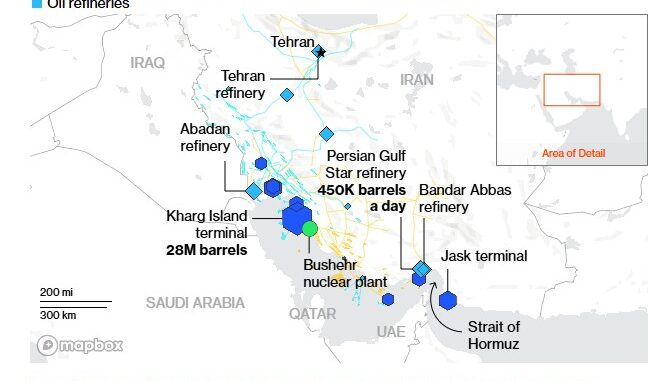
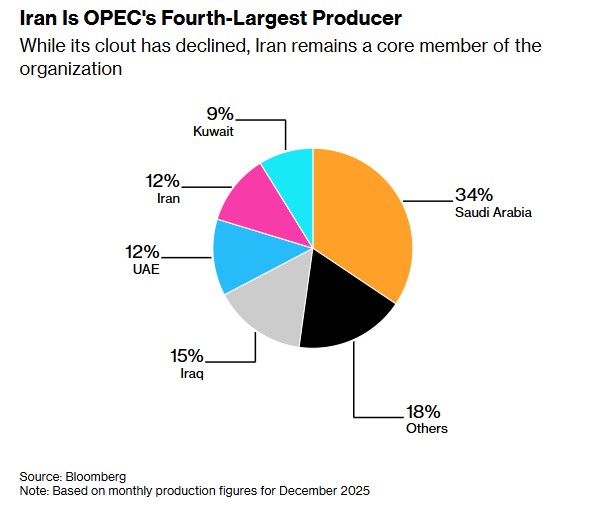
In a rapidly escalating geopolitical landscape, the recent U.S.-Israel strikes on Iraq have sent shockwaves through global energy markets. While the strikes appear targeted at specific military and infrastructure sites amid broader regional tensions—echoing concerns from similar actions in neighboring Iran—the implications for Iraq’s oil sector are profound. Iraq, OPEC’s second-largest producer, pumps around 4.5 million barrels per day (bpd) of crude, accounting for roughly 4-5% of global supply.
Any disruption here could ripple across the world, spiking prices and straining supplies for major importers. Drawing from historical precedents and current data, this analysis explores the potential oil at risk, downtime scenarios, effects on key markets like China, India, and California, the role of grid damage, and how a swift resolution might preserve Gulf shipping lanes, including the critical Strait of Hormuz.
Iraq’s Key Oil Fields: What’s at Stake?
Iraq’s oil wealth is concentrated in its southern fields, near Basra, which handle the bulk of production and exports. Strikes could target or collaterally damage these assets, given their proximity to strategic areas. Here’s a breakdown of major fields and their capacities, based on recent projections for 2026:
|
Oil Field
|
Operator/Partners
|
Current Production (bpd)
|
Planned Capacity (bpd)
|
Potential Impact
|
|---|---|---|---|---|
|
Rumaila
|
BP, CNPC
|
~1.5 million
|
Over 2 million (medium-term target)
|
Supergiant field; damage could sideline 1-1.5 million bpd, crippling 30-35% of national output.
oilprice.com
|
|
West Qurna 1
|
PetroChina, ExxonMobil
|
600,000
|
670,000 by end-2026
|
Key southern field; strikes could halt 500,000+ bpd.
|
|
West Qurna 2
|
Lukoil (transitioning to Chevron)
|
~400,000
|
750,000-800,000 by 2029
|
Output surge at risk; potential loss of 300,000-400,000 bpd.
|
|
Majnoon
|
Basra Oil Co., Shell
|
~250,000
|
450,000 expansion
|
Vulnerable to infrastructure hits; 200,000 bpd offline possible.
|
|
Kirkuk (Northern)
|
Iraqi North Oil Co.
|
~300,000
|
600,000 with upgrades
|
Northern fields more exposed to cross-border risks; 200,000-300,000 bpd impact.
eia.gov
|
In a worst-case scenario, if strikes damage pumping stations, pipelines, or export terminals like Basra, up to 2-3 million bpd could be disrupted—half of Iraq’s total output.
Historical analogies, such as the 2019 drone attacks on Saudi facilities that temporarily halted 5.7 million bpd (7% of global supply), suggest prices could surge 20-50% initially.
However, Iraq’s decentralized fields might limit total losses to 1-2 million bpd if only southern hubs are affected.
Downtime: How Long Could Fields Be Offline?
Recovery timelines depend on damage extent.
Minor strikes on above-ground infrastructure (e.g., pipelines or pumps) could see fields offline for days to weeks, with repairs drawing from Iraq’s $84 billion in 2025 oil revenues.
Severe hits to reservoirs or export terminals might extend downtime to months, as seen in past conflicts where Gulf War bombings destroyed 75% of Iraq’s power capacity, leading to years-long rebuilding.
OPEC+ allies like Saudi Arabia could ramp up output by 1-2 million bpd to offset, but prolonged disruptions (3+ months) might push global spare capacity to its limits, echoing the short-lived price spikes from Iran’s June war.
Ripple Effects on Major Importers: China, India, and California
Iraq’s exports, totaling ~4 million bpd, primarily flow to Asia via the Persian Gulf. A disruption would hit hardest here:China: As Iraq’s top buyer, absorbing 48% of its dirty crude exports (1.9 million bpd), Beijing faces immediate shortages.
With 90% of Iran’s exports also going to China, any regional spillover could compound losses.
China might pivot to Russian or African suppliers, but at higher costs, potentially inflating domestic energy prices by 10-20%.
India: Relying on Iraq for 38% of its imports (1.5 million bpd), India could see refinery disruptions at sites like Jamnagar and Paradip.
Fuel prices might rise 15-25%, exacerbating inflation in an economy already sensitive to oil shocks.
California: The U.S. state imports ~190,000 bpd from Iraq (21.7% of its foreign crude), making it a top supplier.
Nationwide, U.S. imports from Iraq averaged ~226,000 bpd in January 2026.
Disruptions could drive West Coast gasoline prices up $0.50-$1 per gallon, straining refineries and EV transition efforts.
Grid Damage: A Silent Killer for Iraq’s Exports
Iraq’s oil sector is electricity-dependent for pumping, processing, and exporting. The national grid, already plagued by 50-60% losses and frequent blackouts, generates only ~28,000 MW against a 55,000 MW summer peak.
Strikes damaging power plants or transmission lines—reminiscent of Gulf War devastation—could halt 1-2 million bpd in southern fields, where 90% of exports originate.
Basra’s terminals rely on stable power; outages force reliance on inefficient diesel generators, slashing efficiency and exports by 20-40%.
Full grid failure might reduce national output by 30%, equating to ~1.35 million bpd lost, with recovery taking weeks if spares are available.
Global Market Turbulence: Prices and Supply Chains
A 1-2 million bpd Iraqi shortfall could spike Brent crude by $10-30 per barrel initially (4% price rise per 1% supply cut, per historical data).
Global inflation might climb 0.5-1%, hitting transport and manufacturing. OPEC+ could hike output, but with spare capacity at ~5 million bpd, prolonged issues risk a 2027 supply crunch.
Freight rates would surge amid insurance hikes.
Quick Resolution: Keeping the Strait Open and Shipments Flowing
If the conflict ends swiftly—within days—without escalation, the Strait of Hormuz should remain open. This chokepoint handles 20 million bpd of Gulf oil, including Iraq’s ~4 million bpd exports.
Past flare-ups, like Iran’s June war, saw prices fade once infrastructure was spared.
Gulf producers, including Iraq, accelerated shipments in February 2026, with combined Iraq/Kuwait/UAE flows up ~600,000 bpd.
LNG from Qatar (third-largest exporter) would continue, averting a broader energy crisis.
However, any Iranian retaliation could close the strait, spiking prices 70% to $120-130 per barrel and disrupting 20-25% of global seaborne trade.
As tensions simmer, the energy world watches closely. Iraq’s oil resilience will be tested, but a de-escalation could limit fallout. For more insights, tune into the Energy News Beat podcast—where we break down the real stakes in global energy.
Sources: energyconnects.com, energyconnects.com, bloomberg.com, iraqinews.com
Get your CEO on the #1 Energy Podcast in the United States: https://sandstoneassetmgmt.com/media/
Is oil and gas right for your portfolio? https://sandstoneassetmgmt.com/invest-in-oil-and-gas/



Be the first to comment