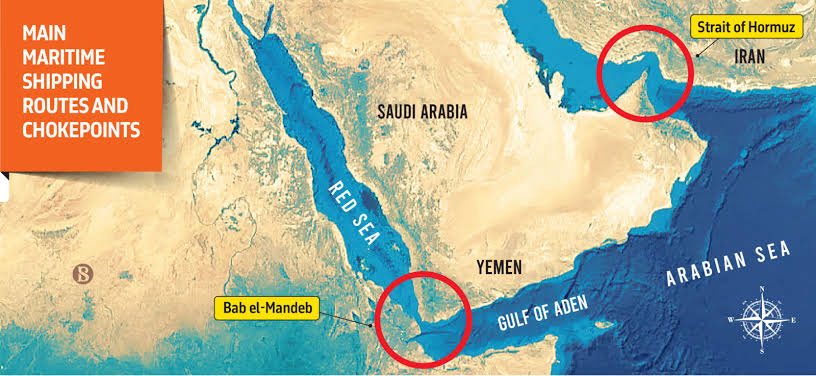
In a sharp escalation reported today, Iran has signaled its willingness to simultaneously blockade the Strait of Hormuz and the Bab el-Mandeb Strait. According to Iran’s state outlet Tasnim, Tehran is halting indirect talks with the United States amid tensions over Lebanon and is preparing to “completely block” the Strait of Hormuz while activating other fronts, including Bab el-Mandeb, in coordination with the “resistance front.”
The oil market reacted instantly. Brent crude surged more than 6% intraday, pushing prices from the low-to-mid $90s toward the high $90s, with $100 now a clear psychological threshold. This move is not idle rhetoric: Hormuz is already largely disrupted, and a second closure at Bab el-Mandeb would create a “dual chokepoint” nightmare with no easy bypass for much of the region’s energy exports.
What This Means for Global Oil Markets
The Strait of Hormuz has historically carried roughly 20% of global crude oil and LNG trade. Since the escalation of the Iran conflict earlier in 2026, it has seen traffic collapse by more than 90%, representing the largest supply disruption in the history of the global oil market, according to the International Energy Agency (IEA). Bab el-Mandeb, the narrow southern gateway to the Red Sea, handles an additional 5% of global oil flows (approximately 4.1 million barrels per day in recent years) and serves as a critical artery for East-West shipping.
A simultaneous closure of both straits would threaten up to 25% of the world’s oil and gas supply—and as much as 30% of global container shipping—placing an estimated $10 billion per day of trade at risk. Rerouting via the Cape of Good Hope would add 10–14 days and $1.2–1.8 million in extra fuel costs per round-trip voyage, while war-risk insurance premiums have already soared over 1,000% in the region.
Oil prices, already elevated by the initial Hormuz disruption, could spike further toward $150–$200 per barrel or higher in a sustained dual-blockade scenario, according to multiple analysts. This would exacerbate global inflation, strain supply chains for fertilizers (one-third of global seaborne fertilizer trade transits Hormuz), and hit food security in vulnerable regions. Asia, Europe, and the Horn of Africa would face the heaviest immediate blows, with knock-on effects rippling through manufacturing and consumer goods.
Direct Impact on VLCC Tankers Loading on Saudi Arabia’s West Coast
Saudi Arabia has already adapted to the Hormuz disruption by maximizing its East-West Pipeline, which runs 1,200 km from Abqaiq to the Red Sea port of Yanbu. The pipeline is operating at full capacity of 7 million barrels per day, allowing crude, condensate, and refined products to load onto Very Large Crude Carriers (VLCCs) at Yanbu for export.
Yanbu has surged in importance: it now accounts for roughly 11% of global seaborne crude loadings (up from 2% in 2025) and 30% of VLCC demand in recent weeks, with loading capacity around 4.5 million bpd. Dozens of VLCCs are routinely offshore or at berths there.
However, every VLCC departing Yanbu for Asia or Europe must transit Bab el-Mandeb to exit the Red Sea. A closure or major disruption there would directly strangle this critical bypass route. Tankers would face severe delays, forced rerouting around the Cape (adding thousands of nautical miles), or outright inability to sail. Even partial threats from Houthi forces—part of Iran’s Axis of Resistance—have already raised insurance and operational risks in the Red Sea.
While Houthis have stated “at present” there is no reason to block Yanbu VLCC traffic, analysts warn that any escalation involving Iranian proxies would create outsized fallout precisely because the global market is already short of crude from the Hormuz shutdown. Attacks on tankers in the Red Sea would amplify shortages, spike VLCC demand volatility, and further constrain Saudi export capacity.
In short, the Red Sea route that was meant to be Saudi Arabia’s lifeline around Hormuz would itself become a new bottleneck—leaving VLCC operators, charterers, and end buyers scrambling for alternative (and far more expensive) options.
Broader Strategic and Market Outlook
This threat lands harder than past Iranian rhetoric because the infrastructure for disruption is already in place, and the “resistance front” has demonstrated capability through prior attacks. Markets are now repricing not just today’s flows but the probability of a prolonged dual-chokepoint crisis with no third viable route for much of the Gulf’s output.
Energy traders, shipping firms, and policymakers are watching closely. For now, the immediate oil price jump reflects a heightened geopolitical risk premium. Should the threats materialize, the impact on global energy security, tanker logistics, and economic stability could be profound and long-lasting.
- Jack Prandelli (@jackprandelli) X post, June 1, 2026: https://x.com/jackprandelli/status/2061458382133801370
- ORF Middle East – “Double Chokepoint: Impact of a Hormuz and Bab al-Mandeb Closure” (Apr 23, 2026): https://orfme.org/expert-speak/double-chokepoint-impact-of-a-hormuz-and-bab-al-mandeb-closure/
- Al Jazeera – “Iran threatens Bab al-Mandeb closure: How would that affect world trade?” (Apr 6, 2026): https://www.aljazeera.com/news/2026/4/6/iran-threatens-bab-al-mandeb-closure-how-would-that-affect-world-trade
- Lloyd’s List – “Houthis see no reason to ‘prevent’ Yanbu VLCC trade ‘at present’”: https://www.lloydslist.com/LL1156734/Houthis-see-no-reason-to-prevent-Yanbu-VLCC-trade-at-present
- Additional context from Forbes, CBS News, Politico, and other reports on the ongoing 2026 Iran conflict and chokepoint threats (March–June 2026 coverage).
This article is prepared for the Energy News Beat Channel and reflects information available as of June 1, 2026.