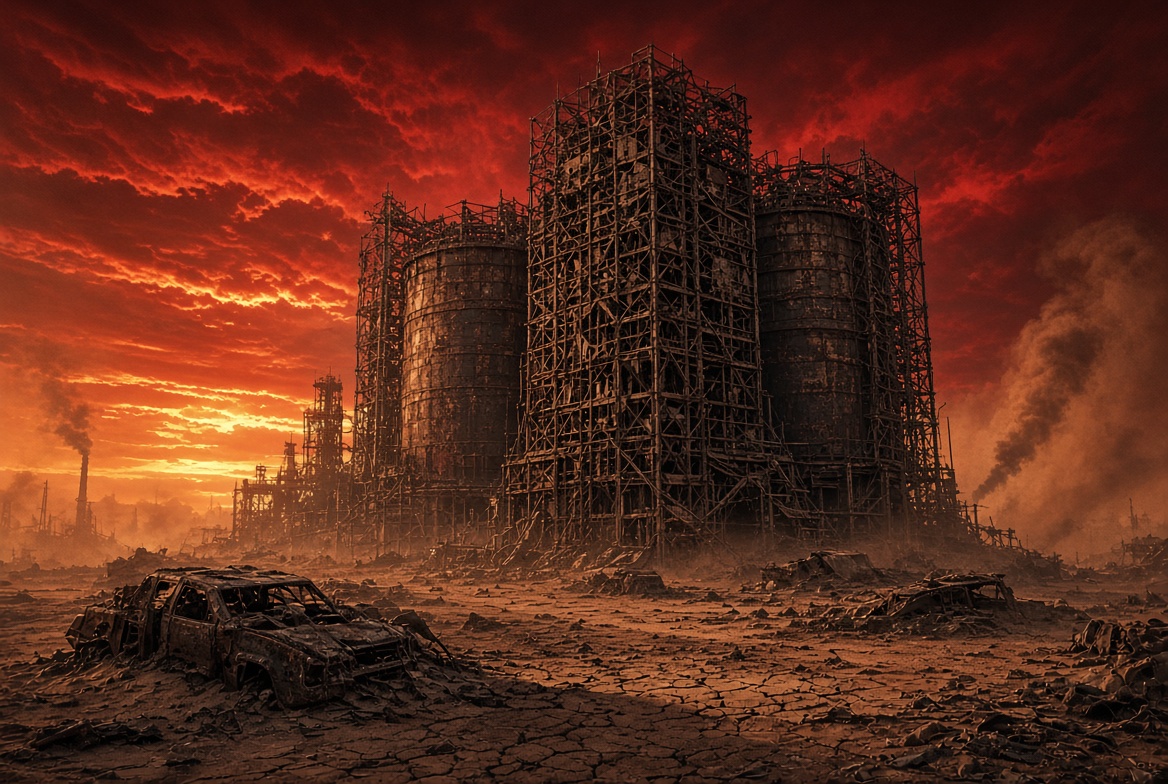
In a striking visual that feels pulled straight from a post-apocalyptic film set, the United Arab Emirates has completed the installation of massive metal “cope cages” over key oil and gas storage tanks in Abu Dhabi, with similar structures already in place or under construction near Dubai. These large steel mesh and framework enclosures are a low-tech, passive defense specifically designed to counter explosive one-way attack drones—particularly Iranian Shahed-type systems.
The cages, also known as “barbecue grills” in some military circles, work by creating a physical barrier that can catch, deflect, or force premature detonation of incoming drones before they strike the highly flammable tanks. Reports and imagery show the mesh positioned with standoff distance from the tanks themselves, so even a penetration slows or reduces the impact energy. They offer no meaningful protection against ballistic or cruise missiles, but they address the saturation threat of cheap, numerous drones that have overwhelmed traditional air defenses.
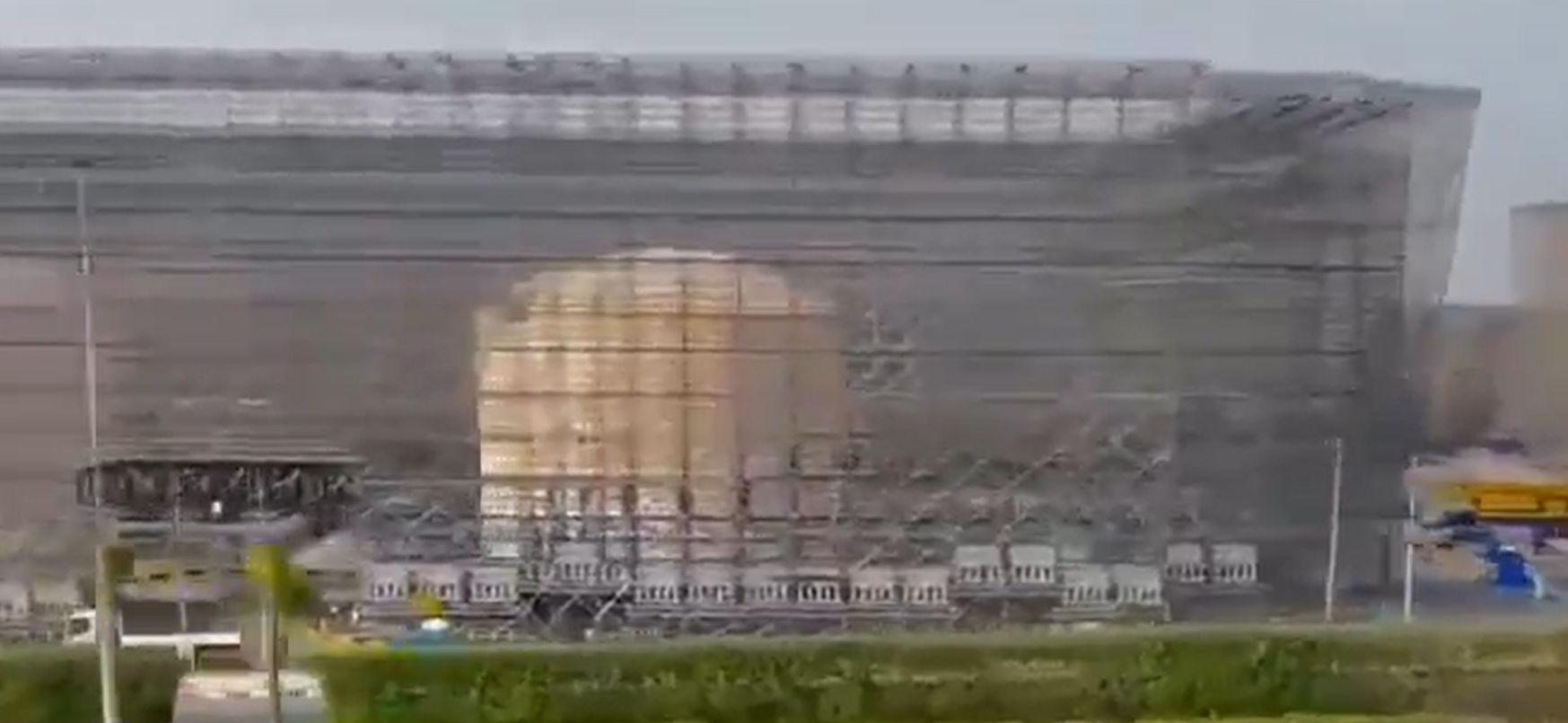
Scale of the Installations
Construction began around May 2026 in response to repeated Iranian drone and missile strikes that damaged UAE energy infrastructure, including the Port of Fujairah (a critical export hub that bypasses the Strait of Hormuz) and the Habshan natural gas processing facility. Recovery at Habshan is not expected until 2027 in some assessments.
As of late August 2026, installations are confirmed complete around fuel tanks in Abu Dhabi. Near Dubai International Airport, photos and video show multiple large cylindrical tanks enclosed or partially enclosed by the metal frameworks, with at least three defensive works visible in early imagery and construction ongoing on others. Similar measures are reported as planned or underway at Fujairah and extending toward Habshan.
Exact counts of tanks or total locations remain unreported by official sources. UAE commercial and strategic storage is extensive—Fujairah alone hosts more than 110 million barrels of capacity across numerous terminals with dozens of tanks each—so the cages target priority assets rather than every single tank. Video circulating on X shows large grid-like structures covering multiple tanks in an industrial area visible from major roadways, underscoring the industrial scale of the effort.
Cost to “Drone-Proof” Oil Assets
Precise UAE project costs have not been disclosed. Comparable Russian systems provide the best available benchmarks. Russian firms have quoted roughly 15–20 million rubles (approximately $160,000–$210,000 USD) to protect a single small tank and 50 million rubles (around $530,000) or more for several tanks, including design, materials, frames, and installation. Mesh materials themselves can be inexpensive (used fishing nets as low as $250 per metric ton, or specialized systems in the $55–$250 per square meter range), but the heavy structural steel cages, foundations, and labor drive the bulk of expenses.
One Russian company claimed roughly 150 such protective structures installed at oil facilities by late 2025. In the Gulf, commercial offerings for engineered tank protection (no hot work, rapid deployment of 4–6 weeks per tank) exist, with group deployments offering cost savings of around 25%. Overall, drone-proofing a major tank farm would likely run into the low millions of dollars—far cheaper than the cost of repeated interceptor missiles or the economic fallout from a successful hit on storage worth tens of billions.
Beyond Thunderdome Vibes?
The aesthetics are pure Mad Max: Beyond Thunderdome. Towering metal cages and mesh draped over industrial tanks evoke the improvised, scavenged fortifications of a dystopian wasteland. Russian commercial tankers and naval bases have already been fitted with similar nets and cages, prompting observers to note that “Mad Max movies have nothing that can top this.” The UAE’s cleaner, more engineered versions still project the same desperate ingenuity: when advanced air defenses face swarms of cheap drones, nations turn to steel and wire.
So will we see Beyond UAE Dome of Drones? Would that be an interesting cage match?
Global Adoption of Similar Technologies
Russia pioneered widespread use of these passive defenses on oil storage tanks, refineries, and depots starting around 2024–2025 to counter Ukrainian long-range drones. Nets and cages now appear at facilities hundreds of kilometers from the front, including in the Arctic and on sanctioned tankers.
Israel has distributed large quantities of anti-drone netting (over 158,000 square meters reported, with more on order) for bases and vehicles, and has fitted Merkava tanks with similar cages. Saudi Arabia has a growing commercial market for high-tensile steel mesh systems designed to stop drones at speeds up to 250 km/h; one infrastructure project exceeded SAR 9.1 million. Iraq has shown mesh fitted to tanks. Other Gulf states and energy exporters are watching closely, with interest noted in Kuwait and beyond as the drone threat to concentrated energy assets becomes a shared vulnerability.
The UAE’s move highlights a broader shift: in an era of inexpensive, attritable drones, passive physical barriers have become an essential layer of defense for critical energy infrastructure worldwide. Low-tech does not mean low-consequence—these cages may prove one of the more cost-effective ways to keep oil flowing under persistent aerial threat.
Appendix: Sources and Links
- Original X post by
@MorEdge_Insight
(22 Aug 2026): https://x.com/MorEdge_Insight/status/2091151017962319979
- The War Zone – UAE Building Massive ‘Cope Cages’… (13 May 2026): https://www.twz.com/news-features/uae-building-massive-cope-cages-to-protect-energy-facilities-from-iranian-drone-attacks
- The News (Pakistan) – New anti-drone cages installed around Abu Dhabi… (22 Aug 2026): https://www.thenews.com.pk/latest/1413220-new-anti-drone-cages-installed-around-abu-dhabi-fuel-tanks-heres-what-to-know
- Defense Express – UAE Copies Russia’s “Barbecue Grill” Tactic… (17 May 2026): https://en.defence-ua.com/news/uae_copies_russias_barbecue_grill_tactic_to_protect_oil_depots_from_shahed_drones-18517.html
- Defence Security Asia – UAE and Israel Turn to Ukraine-Style ‘Drone Cages’… (15 May 2026): https://defencesecurityasia.com/en/uae-israel-drone-cages-air-defense-crisis-2265-uav-attacks/
- Lovin Abu Dhabi – UAE Builds Metal Barriers… (16 May 2026): https://lovin.co/abudhabi/en/news/uae-builds-metal-barriers-to-protect-strategic-energy-sites/
- National Interest – The UAE Is Taking a Page from Russia’s Ukraine War Playbook (18 May 2026): https://nationalinterest.org/blog/buzz/uae-taking-page-from-russias-ukraine-war-playbook-sa-051826
- Business Insider – Ukraine Attacked Russian Oil Depot Protected by Anti-Drone Nets (19 Feb 2026) and related coverage of Russian nets/cages
- Wikipedia – Anti-drone mesh: https://en.wikipedia.org/wiki/Anti-drone_mesh
- MISDAD OSINT report – The Iron Cage Spreads Eastward (June 2026 PDF)
- United24 Media / Verstka investigation on Russian protective structure costs (2024)
- FuelTankProtect.com (UAE-focused commercial systems)
- Additional reporting from Hamer Intel, CGTN, NDTV, and various Russian/Ukrainian open-source imagery analyses of oil depot protections.
All links and details current as of 22 August 2026.