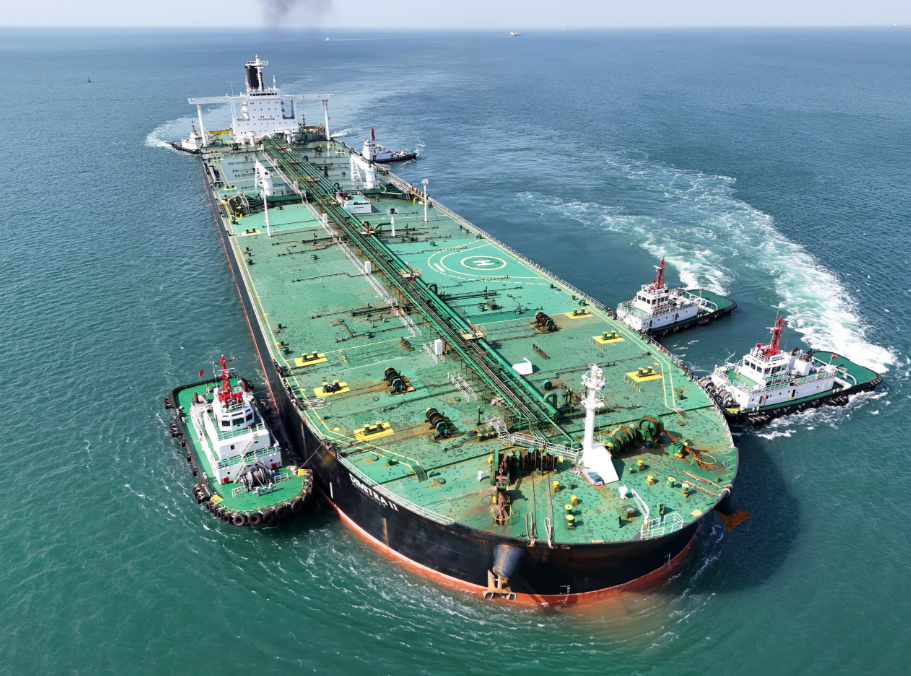
Chris Martenson asked who is buying all the tankers. Clarksons data show a prompt supertanker resale valued far above a new contract; Splash 247 notes a new ship would not arrive until 2029 or later. Secondhand sales have set a record, but not because 62 percent of the fleet has changed hands.
Chris Martenson asked on Wednesday, “Who’s buying all the tankers?” In a Nov. 18 post, the Peak Prosperity founder said used very large crude carriers are selling for $114 million more than new ones, and that a record 62 percent of tankers have changed hands in 10 months. He linked his Nov. 16 CRIB brief.
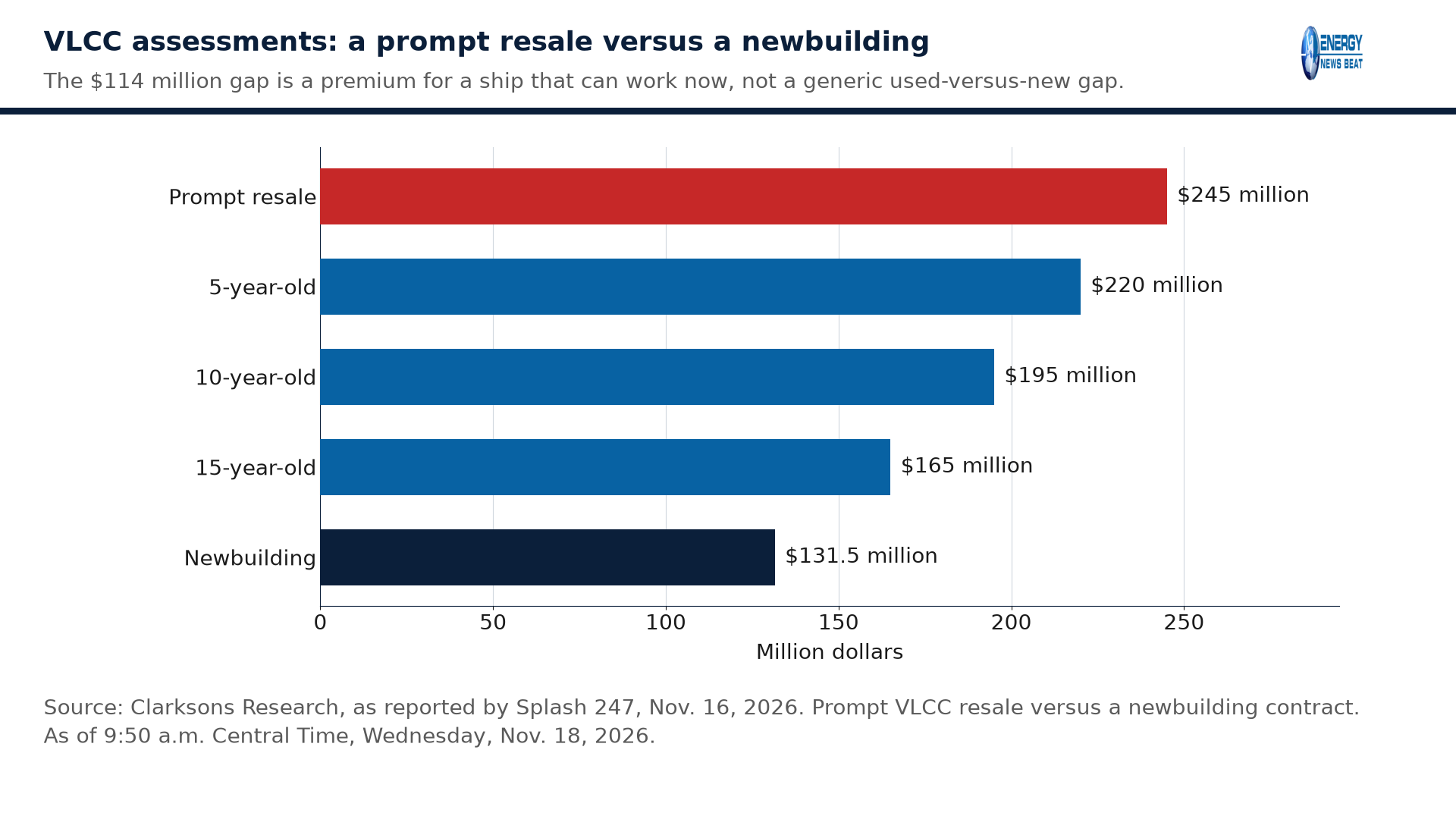
The first number is real, but it is not a comparison of ordinary used ships with new ones. Clarksons Research, as reported by Splash 247 on Nov. 16, assesses a prompt VLCC resale at $245 million, almost $114 million more than the $131.5 million benchmark cost of ordering a new vessel. Splash notes that a ship ordered today would not arrive until 2029 or later. Clarksons puts a five-year-old VLCC at $220 million, a 10-year-old at $195 million, and a 15-year-old at $165 million, all above that newbuilding price.
The second number needs a closer look. Clarksons counted 588 tankers, totaling 69.6 million deadweight tonnes, reported sold in the first 10 months of 2026, already 8 percent above the previous full-year record set in 2022, for $29.7 billion. A September fleet survey put the global tanker fleet at 5,957 ships; 588 sales are roughly 10 percent of that fleet. In the video attached to his post, after reading out the 588 figure, Martenson added that there are only about 950 of them; 588 divided by about 950 matches the 62 percent in his post. But 588 counts tankers of every size, while about 950 is roughly the VLCC fleet alone, which BRS puts at 941. By Clarksons’ own count, 124 VLCCs, about 13 percent of that fleet, have changed hands.
Clarksons figures reported by Splash put those 124 VLCC sales against 78 in all of 2025, with Sinokor the most active buyer. The premium is for a hull that can work now, while the oil market is still trying to rebalance around a damaged Strait of Hormuz.
Consumer and investor views
Households feel this first as a freight bill buried inside the price of a gallon. There is no clean, official figure for freight’s share of the U.S. retail pump price in this war, and inventing one would not help. The mechanism is simpler: when a VLCC can earn more than $1 million a day on the Baltic Exchange benchmark Middle East-to-China route (TD3C), and when war-risk cover is priced as a slice of the ship’s hull value, those costs travel with the barrel.
The Baltic Exchange tanker report for week 46, published Nov. 13, shows how wide the gap remains. The TD3C route, 270,000 tonnes from the Middle East Gulf to China, had fallen 188 points in a week to Worldscale 1,014.38, still a round-trip time-charter equivalent of $1,078,714 a day for a standard VLCC. The alternative TD34 route, from the Gulf of Oman to China, was Worldscale 310.71, or $307,160 a day. Clarksons, in the same Splash report, said average VLCC spot earnings had fallen 41 percent last week to $304,482 a day and were still historically elevated. Freight is easing from an extreme, not returning to the old baseline.
Public tanker stocks tell the same two-sided story. Yahoo Finance closing prices on Tuesday, Nov. 17, the last full session before this writing, put Frontline (FRO) at $45.32, DHT Holdings (DHT) at $21.47, International Seaways (INSW) at $99.37, Scorpio Tankers (STNG) at $80.69, Teekay Tankers (TNK) at $87.58, and CMB.Tech (CMBT), the Euronav successor, at $17.16. From the Jan. 2 close, those stocks were up about 120, 83, 111, 62, 70, and 81 percent, respectively. From Nov. 2, they were down about 13, 10, 6, 7, 8, and 1 percent.
China is buying again. China’s customs data, as reported in a Nov. 10 Reuters dispatch, showed October crude imports of 41.94 million tonnes, or 9.88 million barrels a day, up 9.4 percent from September and the most since March, though still 13.3 percent below a year earlier. Kpler put seaborne arrivals at about 9.2 million barrels a day. Clyde Russell, in a Nov. 17 Reuters column, calculated that refiners processed about 490,000 barrels a day less than imports plus domestic output in October, the first implied stock build since July. Satellite inventories from Kpler and Vortexa, cited in the Nov. 10 Reuters dispatch, still showed October draws, just much smaller than September’s. The official data do not split teapots out.
A recovery timeline
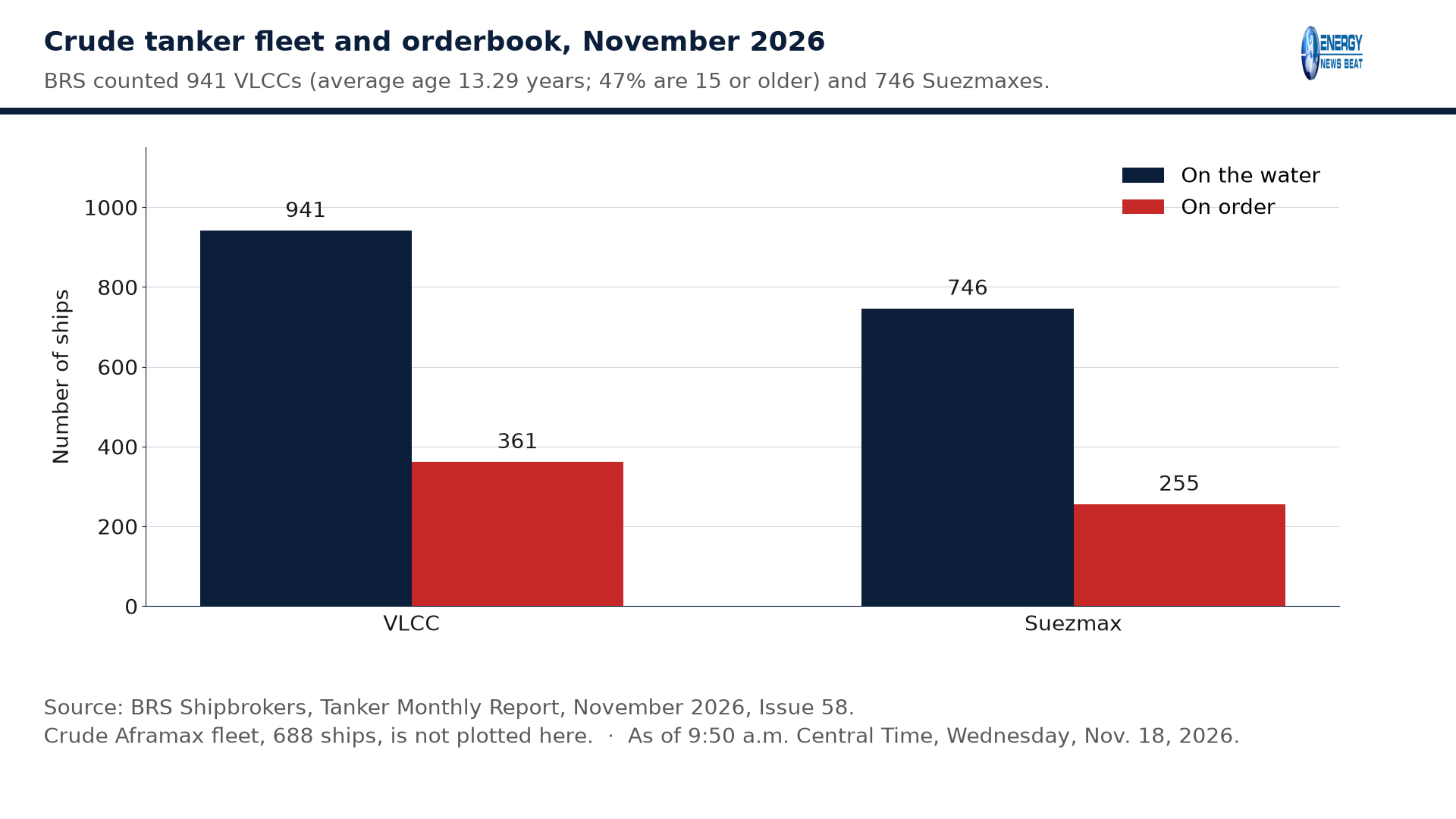
The ships that have to do this work are already old, and a large orderbook is coming. BRS Shipbrokers, in its November 2026 monthly tanker report, counted 941 VLCCs with an average age of 13.29 years, 746 Suezmaxes at 12.55 years, and 688 crude Aframaxes at 15.65 years. Of those VLCCs, 439, or 47 percent, are 15 years or older. The same report lists 361 VLCCs, 255 Suezmaxes, and a much smaller Aframax book on order, and 35 VLCC, 46 Suezmax, and 11 Aframax additions so far in 2026, with 221 VLCC orders placed this year. A new contract still does not give you a ship this winter.
The oil has to move while those new ships are being built. Analysts at ANZ, in a note quoted by Reuters on Nov. 17, said throughput in the Strait of Hormuz is only 49 percent of pre-war levels, and that more supply is being forced onto alternative routes exposed to attack or logistics constraints. That is a throughput measure, not a claim that the strait is shut.
Iraq is trying one of those alternatives. On Nov. 17, Oil Minister Bassem Khudair said Iraq had resumed pumping through the Kirkuk-Ceyhan pipeline to Turkey at an initial 120,000 barrels a day, to be raised gradually toward 500,000 after maintenance and tests, the state-owned Iraqi News Agency reported, according to The National. Iraqi exports had fallen from 3.36 million barrels a day in February to 131,000 in April after the Iran war began on Feb. 28.
The risk has not gone away with those workarounds. ADNOC Logistics & Services said one of its vessels was attacked while transiting the strait on the evening of Nov. 17, with one crew member unaccounted for, 11 injured, and the rest evacuated. Seatrade Maritime, citing the security firm Vanguard Tech, identified the ship as the Liberian-flagged product tanker Navig8 Messi; ADNOC’s statement did not name it. A day earlier, the Panama-flagged LPG carrier Tara Gas was struck about 7 nautical miles north of Khasab, Oman. India’s shipping minister, Sarbananda Sonowal, first said all 25 crew were safe. After a second strike, he posted that the crew had abandoned the vessel and “one Indian seafarer remains missing.” India’s foreign ministry said two injured Indian crew members were in hospital.
War-risk insurance is the other bill attached to a Hormuz voyage. Acting U.S. Navy Secretary Hung Cao told a Senate hearing that insurance for a single transit had risen to $64 million, Al Jazeera reported on Nov. 18; the outlet noted that the figure has not been independently verified. An S&P Global report in July had put war-risk premiums at 7.5 to 10 percent of hull value, or about $21 million on a standard VLCC cargo, and Reuters in September quoted an ENOC executive putting a Hormuz move at roughly $10 million to $20 million.
The case officials and skeptics make
The International Energy Agency, as cited in the same Reuters report, said the world oil market will return to a surplus in the fourth quarter as Middle East exports recover faster than demand, even with the attacks. That is the official case for easier prices, and it is already visible in the November fade in tanker shares and in the drop from record freight levels.
The other warning is the orderbook. At last month’s Maritime CEO Forum in Monaco, Splash reported, Arrow’s Burak Cetinok calculated that VLCC earnings were running at 14 times their 10-year average and warned that once orderbooks reach 25 percent of the existing fleet, earnings have historically declined within 24 to 36 months. The BRS November VLCC book, 361 ships against 941 on the water, is already above that 25 percent mark by ship count. Foreguard Shipping chief executive Alan Hatton cautioned against a “one-way directional bet” on continued strength. DHT’s Svein Moxnes Harfjeld was more constructive, noting that almost half the VLCC fleet would be over 15 years old by 2029. Those are named views, not a forecast.
The shadow fleet sits in the middle of that argument. Energy News Beat has already reported Treasury’s earlier tanker designations, Iran’s oil revenue, and the false rumor of a simple Hormuz bypass; this piece does not retell those stories. What is new is the policy turn. A U.S. official told Platts that Treasury may consider, case by case, proposals from legitimate owners to buy and restore shadow-fleet ships to licit trade. S&P Global Commodities at Sea counted 1,225 tankers sanctioned by the United States, the United Kingdom, or the European Union at the end of September, 560 of them by the United States, and said 41 shadow-fleet crude tankers had entered compliant trade through Oct. 20.
Stu’s Take
Martenson asked the right question and then overstated the math. A prompt VLCC resale is assessed at $245 million, about $114 million above a $131.5 million newbuild, because the new ship would not arrive until 2029 or later. That premium is real. The claim that 62 percent of tankers changed hands in 10 months compares different fleets; Clarksons counts 588 ships sold for $29.7 billion, roughly 10 percent of a fleet of about 6,000. Hormuz throughput is still only about half of pre-war levels, Iraq has just restarted Kirkuk-Ceyhan at 120,000 barrels a day, and an ADNOC ship was attacked on Nov. 17. China is importing again, and tanker stocks are up sharply this year, but they have already slipped in November as freight came off the highs. The oil market can look calmer in the price and still be one prompt hull, and one insurance quote, away from stress.
Sources
Primary and official sources opened for this article, with access on Wednesday, Nov. 18, 2026, unless a different date is noted. Direct quotation marks are used only where the named source set the words in quotes or an official English text was retrieved.
- Chris Martenson (@chrismartenson), X post 2122936091980214645, Nov. 18, 2026, 06:13 UTC (12:13 a.m. Central Time). “Who’s buying all the tankers?” with two claims: used VLCCs selling for $114 million more than new ones, and a record 62 percent of tankers changing hands in 10 months. The post links the Nov. 16 Peak Prosperity CRIB brief. A 131-second video is attached. Metrics at retrieval: 8,443 impressions, 163 likes, 33 reposts https://x.com/chrismartenson/status/2122936091980214645
- Peak Prosperity, “CRIB 11-16-26: Iran War Simmers Along, Russia’s Existential Moment, AI Hacks Continue & Grab Bag,” Nov. 16, 2026. The page is gated behind a newsletter signup. The unlocked teaser contained no tanker, VLCC, $114 million, or 62 percent text. The full member text was not retrieved https://peakprosperity.com/crib-11-16-26-iran-war-simmers-along-russias-existential-moment-ai-hacks-continue-grab-bag/
- Sam Chambers, Splash 247, “Tanker secondhand sales smash records with $30bn changing hands,” Nov. 16, 2026. Cites Clarksons Research for a prompt VLCC resale at $245 million, almost $114 million more than the $131.5 million newbuilding benchmark; five-, 10- and 15-year values of $220 million, $195 million and $165 million; 588 tankers / 69.6 million dwt sold in the first 10 months for $29.7 billion, 8 percent above the 2022 full-year record; 124 VLCC sales versus 78 in all of 2025; average VLCC spot earnings of $304,482 a day after a 41 percent weekly drop; and comments from Burak Cetinok, Alan Hatton and Svein Moxnes Harfjeld at the Maritime CEO Forum in Monaco https://splash247.com/tanker-secondhand-sales-smash-records-with-30bn-changing-hands/
- Georgios Georgiou, Riviera Maritime Media, “Greek owners cash in on tanker boom with US$5.1bn in sales amid Middle East turmoil,” Oct. 26, 2026, citing Xclusiv Shipbrokers’ Dimitris Roumeliotis. September and October, through late October, accounted for approximately 62 percent of total 2026 Greek tanker-sale transaction value (71 tankers sold March–October for $5.18 billion). This is a coincidental 62 percent, not a world-fleet turnover figure, and is not used in the body https://www.rivieramm.com/news-content-hub/greek-owners-cash-in-on-tanker-boom-with-us51bn-in-sales-amid-middle-east-turmoil-90370
- Allied Shipbroking, Monthly Secondhand Investment Trends, October 2026. January–October tanker sales 572, up 68 percent year over year; October tanker sales up 61 percent year over year. Allied’s counts and disclosed investment totals are not identical to Clarksons’ 588 ships / $29.7 billion https://maritimes.gr/wp-content/uploads/2026/11/Allied-Monthly-Secondhand-Investment-Trends-10-2026.pdf
- BRS Shipbrokers, Tanker Monthly Report, November 2026, Issue 58. Active crude fleet: VLCC 941 ships / 290 million dwt, average age 13.29 years; Suezmax 746 / 117 million dwt, 12.55 years; Aframax 688 / 76 million dwt, 15.65 years. VLCC age counts: under 5 years 107, 5–9 229, 10–14 166, 15–19 244, 20+ 195 (439 ships, or 47 percent, are 15 or older). Orderbook shown: VLCC 361, Suezmax 255. 2026 additions: VLCC 35, Suezmax 46, Aframax 11. 2026 new orders: VLCC 221, Suezmax 123, Aframax 19. Front-page market commentary and the page-18 price charts are image-based and were not used as a price source https://s3.pub2.infomaniak.cloud/v1/AUTH_7853eb88adcf4eaa95e9908062bcc0b7/brs-media/BRS_Tanker_Monthly_Report_11_26_b116a234e1.pdf
- NextBarrel / Shipping & Trade Research, “Tanker Fleet Overview,” Sept. 22, 2026. Global tanker fleet 5,957 ships / 694.1 million dwt; 1,260 on order (26.5 percent of live fleet by dwt); average age 13.7 years. VLCC 936 ships, orderbook 314 (33.6 percent); Suezmax 733, orderbook 227; Aframax/LR2 combined 1,267, orderbook 236. Used in the article as the September world-fleet headcount against which 588 sales are compared https://nextbarrel.io/files/Tanker-Fleet-Overview-Sep-2026.pdf
- Baltic Exchange, Tanker Report, Week 46, published Nov. 13, 2026. VLCC TD3C 270,000 mt Middle East Gulf/China Worldscale 1,014.38, time-charter equivalent $1,078,714/day; TD34 Gulf of Oman/China Worldscale 310.71, $307,160/day; other routes as listed in the weekly roundup https://www.balticexchange.com/en/data-services/WeeklyRoundup/tanker/news/2026/tanker-report-week-46.html
- Reuters, as carried by Arab News, “Oil slips as recovering Mideast exports blunt Gulf tensions,” Nov. 17, 2026, 9:54. ANZ analysts said Hormuz throughput is only 49 percent of pre-war levels, and that an increasing amount of supply must use alternative routes highly exposed to Iranian attacks or logistics constraints. The same dispatch cites the International Energy Agency saying the world oil market will return to a surplus in the fourth quarter of this year as Middle East exports recover faster than global oil demand despite attacks on shipping https://www.arabnews.com/energy/oil-slips-as-recovering-mideast-exports-blunt-gulf-tensions-3012412
- China customs data as reported by Reuters (Sam Li and Lewis Jackson), republished by World Ports, Nov. 10, 2026. October crude imports 41.94 million tonnes, or 9.88 million barrels a day, +9.4 percent from September, the most since March, −13.3 percent year over year. January–October 399.9 million tonnes, −15.1 percent year over year. Kpler seaborne arrivals about 9.2 million barrels a day in October. The same dispatch reports that Kpler’s and Vortexa’s onshore crude inventory data based on satellite images showed draws of seven million and 12 million barrels, respectively, in October, compared with larger draws of 47 million and 57 million barrels in September https://www.worldports.org/china-crude-oil-imports-hit-seven-month-high-in-october/
- Clyde Russell, Reuters column, republished by Hydrocarbon Processing, “China resumes storing crude oil, giving it fuel export options,” Nov. 17, 2026, 7:00 a.m. Residual calculation: October imports 9.88 plus domestic output 4.34 versus refinery runs 13.73 million barrels a day, an implied surplus of about 490,000 barrels a day, the first build since July. This column does not contain the Kpler or Vortexa inventory figures https://www.hydrocarbonprocessing.com/news/2026/11/china-resumes-storing-crude-oil-giving-it-fuel-export-options/
- The National, “Iraq resumes pumping crude oil for export through pipeline to Turkey,” Nov. 17, 2026, updated 4:38 p.m. Oil Minister Bassem Khudair, via the Iraqi News Agency, said Kirkuk–Ceyhan had restarted at an initial 120,000 barrels a day, to be raised gradually to 500,000 after maintenance and tests. Iraqi exports had fallen from 3.36 million barrels a day in February to 131,000 in April https://www.thenationalnews.com/business/energy/2026/11/17/iraq-resumes-pumping-crude-oil-for-export-through-pipeline-to-turkey/
- ADNOC Logistics & Services, official statement dated Nov. 18, 2026, on an attack on one of its vessels transiting the Strait of Hormuz on the evening of Nov. 17, 2026. One crew member unaccounted for, 11 injured, remaining crew evacuated. The company statement does not name the ship https://adnocls.ae/en/news-and-media/press-releases/2026/november-17-statement
- Marcus Hand, Seatrade Maritime, “One missing, 11 injured in attack on ADNOC tanker in Hormuz,” Nov. 18, 2026. Cites Vanguard Tech identifying the ship as the Liberian-flagged product tanker Navig8 Messi, hit about 13 nautical miles north of Khasab, Oman. Also reports that Tara Gas was attacked twice on Nov. 16, that the crew abandoned ship, and that one seafarer was missing and two were injured https://www.seatrade-maritime.com/security/one-missing-11-injured-in-attack-on-adnoc-tanker-in-hormuz
- Vessel Hunter, “Maritime Briefing of 17 November 2026.” Used for location details: Tara Gas struck on Nov. 16 about 7 nautical miles north of Khasab; On Phoenix hit about 3 nautical miles off the Omani coast; and a Nov. 15 incident involving the VLCC Al Dhannah, managed by ADNOC L&S, a separate case from the Nov. 17 evening attack. Crew-status reporting on Tara Gas is taken from Minister Sonowal’s posts and the MEA statement, not this briefing https://vesselhunter.io/news/hormuz-attacks-tara-gas-on-phoenix-al-dhannah-dar-salwa
- Usaid Siddiqui, Al Jazeera, “US official says Hormuz insurance hits $64m. Is the strait really open?” Nov. 18, 2026. Acting U.S. Navy Secretary Hung Cao, at a Senate Armed Services confirmation hearing, said insurance for a commercial crossing had gone from $54,000 before the war to $64 million. Al Jazeera states the claim has not been independently verified and cites an S&P Global July estimate of 7.5 to 10 percent of hull value, about $21 million on a 270,000-tonne tanker, and a September Reuters/ENOC range of $10 million to $20 million https://www.aljazeera.com/news/2026/11/18/us-official-says-hormuz-insurance-hits-64m-is-the-strait-really-open
- Kate Winston, S&P Global Commodity Insights, “US Treasury may allow purchase of sanctioned tankers on case basis,” Nov. 10, 2026. A U.S. official told Platts that Treasury may consider case-by-case proposals from legitimate shipping actors to purchase and restore shadow-fleet vessels. S&P Commodities at Sea: 1,225 tankers sanctioned by the United States, United Kingdom or European Union at end-September, 560 of them by the United States; 41 shadow-fleet crude tankers entered compliant trade in 2026 through Oct. 20 https://www.spglobal.com/energy/en/news-research/latest-news/crude-oil/111026-us-treasury-may-allow-purchase-of-sanctioned-tankers-on-case-basis
- Yahoo Finance historical daily bars (v8 chart API, exchange America/New_York) for Frontline (FRO), DHT Holdings (DHT), International Seaways (INSW), Scorpio Tankers (STNG), Teekay Tankers (TNK) and CMB.Tech (CMBT). Official closes used: Jan. 2, Feb. 27, Nov. 2 and Nov. 17, 2026. Mid-session Nov. 18 prints were not treated as official closes https://finance.yahoo.com/quote/FRO/history/
- Vesselhunter recap of the Clarksons/Splash secondhand figures, including a note that Volare Shipping bought the scrubber-fitted newbuilding Veni Vidi Vici for $210 million. Not used as a price source in the body https://vesselhunter.io/news/tanker-sale-purchase-record-29-7bn-vlcc-rates-fall
- Sarbananda Sonowal (@sarbanandsonwal), X post 2122640902569279893, Nov. 17, 2026, 10:40 UTC. After a subsequent attack on Tara Gas, the minister said the crew abandoned ship and “one Indian seafarer remains missing,” with 24 of the 25 crew accounted for. An earlier post the same day, 05:17 UTC, had said all 25 crew were completely safe after the first strike https://x.com/sarbanandsonwal/status/2122640902569279893
- Indian Express, “MEA condemns Hormuz attack on ship with 24 Indians onboard,” reporting India’s Ministry of External Affairs. Verbatim: “two injured Indian crew members have been admitted to hospital, while one Indian national remains missing.” https://indianexpress.com/article/india/mea-condemns-hormuz-attack-on-ship-with-24-indians-onboard-10967422/
Key primary excerpts
Chris Martenson, X post, Nov. 18, 2026, 12:13 a.m. Central Time. Who’s buying all the tankers? Used VLCCs are selling for $114M more than new ones. A record 62% of tankers have changed hands in 10 months.
Clarksons Research, as reported by Sam Chambers, Splash 247, Nov. 16, 2026. A prompt VLCC resale is valued at an astonishing $245m, almost $114m more than the $131.5m benchmark cost of ordering a new vessel.
Same Splash / Clarksons report, Nov. 16, 2026, on secondhand volume. New figures from Clarksons Research show that 588 tankers totalling 69.6m dwt have been reported sold so far this year, already 8% above the previous annual record set in 2022. The combined value of transactions has reached $29.7bn, almost double the $16.2bn recorded throughout 2025.
Baltic Exchange, Tanker Report, Week 46, Nov. 13, 2026. The TD3C route (270,000 mt Middle East Gulf/China) has fallen 188 points since last Friday to WS1014.38, producing a daily round-trip TCE of $1,078,714 for the standard Baltic VLCC. TD34 (Gulf of Oman/China) fell more sharply, losing 234 points to WS310.71, giving a round-trip TCE of $307,160/day.
ANZ, as quoted by Reuters, Nov. 17, 2026. The supply flows are also unsustainable over the longer term. An increasing amount must find its way via alternative routes that are highly exposed to disruptions from attacks from Iran or constraints on logistics, they said, adding that throughput in the Strait of Hormuz is only 49 percent of pre-war levels.
ADNOC Logistics & Services, official statement dated Nov. 18, 2026. ADNOC L&S can confirm that one of its vessels was attacked while transiting the Strait of Hormuz on the evening of 17 November 2026. One crew member remains unaccounted for, with search and rescue operations ongoing in coordination with the relevant authorities. All other crew members have been safely evacuated from the vessel. Eleven sustained injuries and where required are receiving medical care.
Bassem Khudair, as reported by The National via the Iraqi News Agency, Nov. 17, 2026. This achievement represents an important strategic step in enhancing Iraq’s export capacity and diversifying crude oil export outlets.
U.S. official, as reported by Kate Winston, S&P Global / Platts, Nov. 10, 2026. Treasury may consider proposals from legitimate shipping actors to purchase and restore shadow fleet vessels to the licit shipping industry on a case-by-case basis.
Burak Cetinok, Arrow, at the Maritime CEO Forum, as reported by Splash, Nov. 16, 2026. Burak Cetinok, head of research at Arrow, calculated that VLCC earnings were running at 14 times their 10-year average, warning that once orderbooks reach 25% of the existing fleet, earnings have historically declined within 24 to 36 months.
Alan Hatton, Foreguard Shipping, as reported by Splash, Nov. 16, 2026. Alan Hatton, chief executive of Foreguard Shipping, cautioned against making a “one-way directional bet” on continued market strength, particularly with expensive newbuildings delivering in 2030 or later.