Energy consultant Kathryn Porter, founder of Watt-Logic, has issued one of the clearest practical warnings yet about the United Kingdom’s electricity system. In her recent Daily Mail piece, she describes a nightmare scenario in which the National Grid collapses under the weight of Net Zero policies: supply-demand imbalance triggers cascading failures, plunging homes, businesses, hospitals, airports, and emergency services into darkness. Communications fail, fires rise from improvised lighting and cooking, traffic systems seize, fuel stops flowing, and restoration stretches for days—or longer in some areas.
This is not abstract fearmongering. It is grounded in physics, recent near-misses, and the deliberate displacement of the very resources that keep a grid stable. We will be getting Kathryn on the Energy News Beat podcast soon.
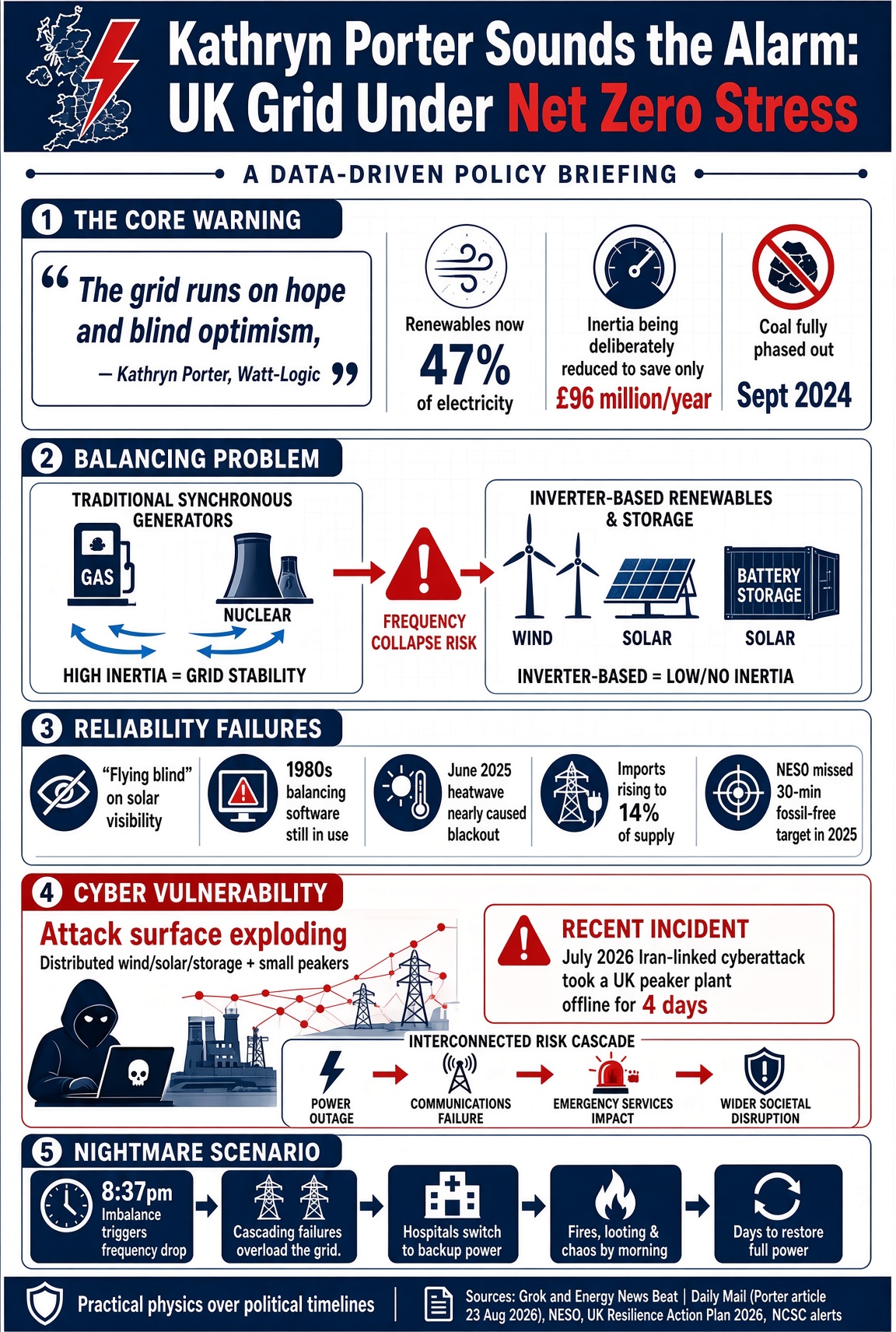
Porter’s core argument is straightforward. Conventional generators—natural gas, coal (now fully phased out in the UK as of September 2024), and nuclear—provide synchronous inertia: the kinetic energy stored in their spinning masses that resists rapid changes in frequency and buys operators precious seconds to rebalance the system. Wind and solar are inverter-based resources. They produce power without that physical mass. Batteries and other storage can deliver ultra-fast frequency response, but they do not replicate traditional inertia at scale and introduce their own operational and security constraints. NESO (the National Energy System Operator) has pushed to lower minimum inertia requirements to save roughly £96 million a year and advance Net Zero targets. Porter has formally objected to Ofgem, calling the move “very dangerous” because it increases the risk of blackouts.
The practical results are already visible. Renewables now supply around 47 percent of UK electricity, yet NESO missed its 2025 goal of running the system for even 30 continuous minutes without fossil fuels. Solar output is hard to see in real time because much of it injects at low-voltage household level; operators are effectively “flying blind,” relying on estimates and aging 1980s software that has already forced engineers onto spreadsheets and phones. Wind can drop to near zero. Imports (now about 14 percent of supply, up sharply from 2008) come from neighbors facing similar weather and nuclear aging issues. A June 2025 heatwave near-miss, confirmed by whistleblowers and raised in Parliament by shadow energy secretary Claire Coutinho, showed how quickly margins evaporate when solar fades, and gas plants are offline. Hundreds of meters installed backward went undetected. The grid is being run on “hope and blind optimism.”
Storage is often presented as the solution. Grid-scale batteries can smooth short-term fluctuations and provide synthetic inertia-like services. But duration is limited, costs remain high, and large fleets of distributed batteries and inverters expand the number of digital control points. The same transition that reduces physical inertia multiplies the cyber attack surface. Thousands of small generators, remote inverters (many Chinese-made, with documented undocumented communication modules in some cases), and battery systems sit outside the tightest regulatory thresholds that apply to large conventional plants. A successful intrusion need not take down a major nuclear station; coordinated disruption of many smaller assets, or manipulation of frequency response services, can cascade under low-inertia conditions.
That risk is no longer theoretical. In July 2026, Iran-linked hackers forced a small UK peaker electricity generator offline for approximately four days. Officials stated there was no threat to the wider system, yet the National Cyber Security Center and the Department for Energy Security and Net Zero issued alerts and briefings to energy CEOs. The incident sits alongside government documents that openly acknowledge a more dangerous environment: sub-threshold attacks, major cyber incidents, severe weather, and interconnected risks in which energy disruption hits supply chains, communications, and emergency services. Jim Ferguson’s recent analysis of the UK Government Resilience Action Plan: 2026 Implementation Report and related National Risk Register materials captures this clearly—the government itself describes risks as volatile, diverse, and interconnected, and is preparing both national exercises and public advice on household resilience for multi-day disruptions that include cyber and power failures.
The balancing problem is therefore dual. On one side sits physical security of supply: enough dispatchable, high-inertia capacity (gas, remaining nuclear, and any new firm low-carbon sources) to ride through dunkelflaute periods and sudden losses. On the other side sits the digital and distributed nature of the new system, which is more open to cyber exploitation precisely because it is more complex and less centralized. Reducing inertia while expanding the attack surface is not a free lunch. Porter’s point is that the costs of a major failure—economic, social, and human—dwarf the modest operational savings claimed for lower inertia thresholds.
The United States faces parallel pressures, concentrated in blue states that have adopted aggressive Net Zero or 100 percent clean-electricity mandates modeled on the same philosophy.
California’s SB 100 targets 100 percent renewable and zero-carbon retail electricity by 2045. The state leads in solar and battery deployment yet posts some of the highest residential rates in the continental U.S. (often roughly double the Texas average) and has a long record of major outages, Public Safety Power Shutoffs, and reliance on imports. NERC assessments have flagged elevated risks in the California-Mexico area from demand growth, planned retirements of dispatchable plants, and constrained imports during wide-area heat events. New York’s Climate Leadership and Community Protection Act requires 70 percent renewable electricity by 2030 and 100 percent zero-emission by 2040. The state closed the Indian Point nuclear plant, restricted gas infrastructure, and faces warnings from NYISO and NYSERDA studies of capacity shortfalls (around 25 GW of clean firm capacity needed by 2040) and emerging stability risks from inverter-based resources as early as 2030, particularly in high-load zones.
Across the broader U.S., NERC’s long-term assessments show resource adequacy challenges in multiple regions as coal and gas retire faster than firm replacements arrive, while new capacity is dominated by solar, wind, and batteries. Blue-state policies accelerate the displacement of synchronous generation; the physics of inertia and the expanded cyber surface do not change with political borders. Texas (ERCOT), by contrast, has added large volumes of wind, solar, and storage while retaining significant gas and maintaining a competitive market structure; it has weathered recent extreme weather with improved reserves, though it remains isolated and faces its own load-growth pressures from data centers. The pattern is clear: jurisdictions that retire dispatchable capacity most aggressively while relying on intermittent resources plus short-duration storage confront higher costs and tighter reliability margins first.
Porter’s alarm is practical, not ideological. Electricity underpins modern civilization—hospitals, water systems, communications, food supply, and order. A grid that prioritizes political timelines over inertia, visibility, and cyber-hardened design invites exactly the cascading failures she describes. The UK experience, reinforced by government resilience documents and a real cyber incident on generation assets, is a live demonstration. Blue states pursuing similar Net Zero pathways are already exhibiting the cost and near-miss symptoms.
The solution is not to abandon emissions reductions; it is to restore the engineering discipline that treats reliability and security as non-negotiable constraints rather than secondary afterthoughts. When the lights go out, hope and optimism are poor substitutes for spinning mass and defended control systems.
Dr. Gene Nelson, a guest on the Energy News Beat Channel, stated that any grid with wind and solar has cost more and emitted more CO2 than traditional grids using clean technology updates. Like nuclear, clean coal, or natural gas. We have not been told the real numbers on wind and solar, and the ratepayers and consumers are waking up. In the United States, people are waking up.
- Kathryn Porter, “The National Grid collapses, Britain goes dark… chaos is unleashed,” Daily Mail, 23–24 August 2026: https://www.dailymail.com/news/article-16069801/National-Grid-collapses-Britain-dark-chaos-Net-Zero-energy-expert-KATHRYN-PORTER.html
- Jim Ferguson, X post on UK Government Resilience Action Plan and interconnected risks, 24 August 2026: https://x.com/JimFergusonUK/status/2091835043530375660
- Energy News Beat coverage of Porter on NESO inertia reduction and blue-state parallels: https://energynewsbeat.co/net-zero/the-national-grid-is-becoming-ever-more-fragile-and-net-zero-is-to-blame-kathryn-porter/
- Watt-Logic analyses and reports by Kathryn Porter (inertia, Iberian blackout, electrification risks, affordability of Net Zero): https://watt-logic.com/
- UK Government Energy Sector Cyber Security Strategy (May 2026): https://www.gov.uk/government/publications/energy-sector-cyber-security-strategy/energy-sector-cyber-security-strategy
- Reporting on July 2026 Iran-linked cyberattack on small UK power generator (Telegraph, BBC, Guardian, Computer Weekly, Cybernews): multiple contemporaneous accounts confirming four-day outage of a peaker plant with no wider grid impact but subsequent NCSC/DESNZ alerts.
- UK Government Resilience Action Plan: 2026 Implementation Report and National Risk Register updates (referenced in parliamentary statements and Ferguson analysis).
- NERC Long-Term Reliability Assessment and Summer Reliability materials on U.S. resource adequacy and inverter-based resource challenges.
- California and New York policy frameworks (SB 100; Climate Leadership and Community Protection Act) and related ISO/NYSERDA reliability studies on capacity gaps and stability risks under high renewable penetration.
- Comparative electricity rate and outage data (EIA, historical CAISO/ERCOT performance) illustrating cost and reliability differences between high-mandate blue states and other markets.