Europe’s natural gas market is once again on the brink of turmoil as traders place aggressive bets that benchmark prices could more than double ahead of the 2026/2027 winter. Options contracts for the October–March delivery period have traded as high as €100 per megawatt-hour (MWh), compared to the current front-month TTF price hovering around €45/MWh.
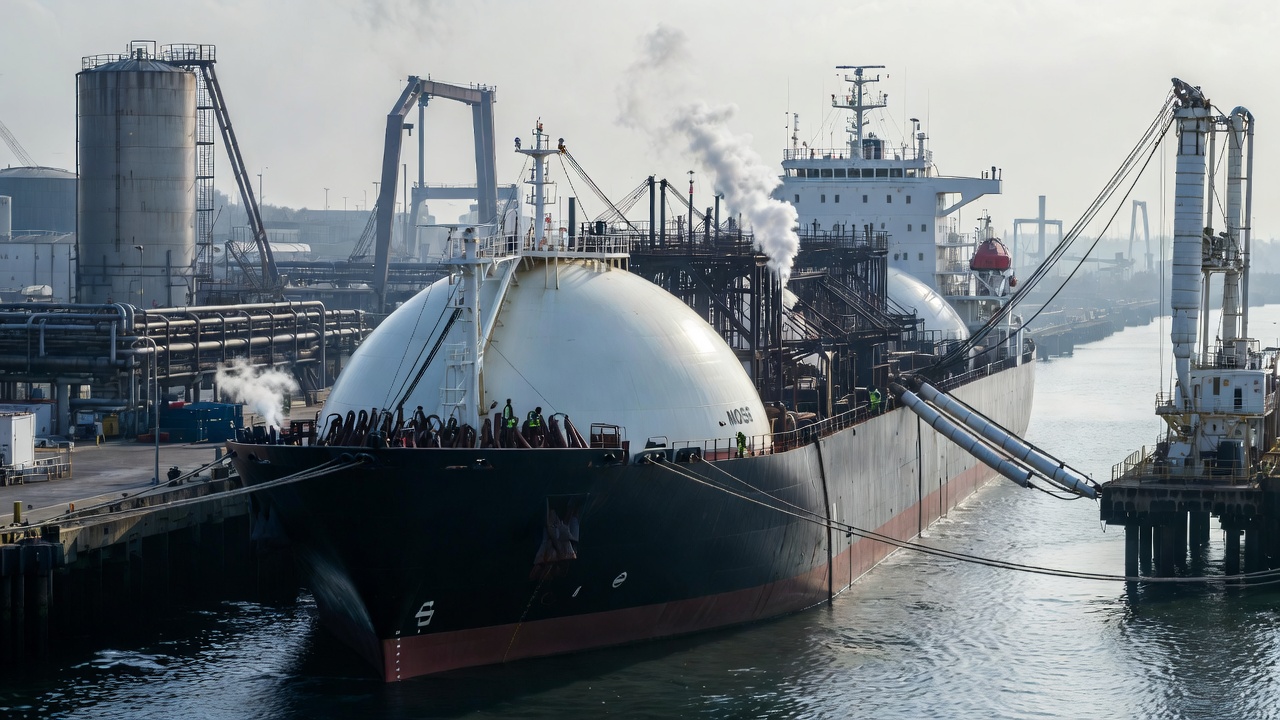
The catalyst? Geopolitical shocks in the Middle East that have slashed LNG supply from Qatar and redirected cargoes toward Asia, exposing the EU’s fragile post-Russia energy architecture.
The timing could not be worse. Europe emerged from the 2025/2026 winter with storage levels at a four-year low—around 28–31% full by early April 2026—after unusually rapid withdrawals driven by colder weather and tight supply. Refilling those storage facilities for next winter will require record LNG imports at a time when global supply is constrained, and competition from Asia is fierce.
A New Import Map: Diversified, But Expensive and Vulnerable
The EU has successfully slashed direct dependence on Russian pipeline gas since 2022, but the replacement mix is proving costly and geopolitically exposed.
According to 2025 full-year data from the European Council and Eurostat:
Norway remained the largest single supplier at ~30.9% (89.3 bcm), primarily via reliable pipelines.
United States LNG surged to 26.2% (75.6 bcm) of total imports and ~57% of all LNG volumes—up nearly fourfold since 2021.
North Africa (mainly Algeria) contributed 12.7% (36.7 bcm).
Russia still accounted for 12.5% (36 bcm) through a mix of LNG and residual pipeline flows (TurkStream), despite EU plans to fully phase out Russian LNG by end-2026 and pipeline gas thereafter.
Smaller volumes arrived from the UK, Azerbaijan (via TAP expansion starting 2026), Qatar, and Nigeria.
Total EU LNG imports hit record levels in 2025 and are forecast to climb again in 2026 to as high as 185 bcm according to the IEA.
Yet the shift from cheap, long-term Russian pipeline contracts to spot-market US and global LNG has left Europe paying a structural premium—often 2–4 times higher than pre-2022 levels—and exposed to every tanker diversion or chokepoint crisis.
Energy Policies Driving the Pain: Green Deal, ETS, and the Cost of Ideology
EU policymakers celebrate “energy sovereignty” after weaning off Russian gas, but the numbers tell a different story. The REPowerEU plan, the European Green Deal, and the Emissions Trading System (ETS) have combined to inflate energy costs across the board:
Carbon pricing via ETS now adds significant levies to power and industrial gas use, with carbon prices stabilizing at €60–90/tCO₂ and rising. These costs are frequently passed directly to industrial consumers.
Renewables subsidies and grid intermittency have driven some of the highest electricity prices in the world—often $0.18–$0.25/kWh for industry, double or triple U.S. and Chinese levels.
CBAM (Carbon Border Adjustment Mechanism), now fully phased in during 2026, aims to protect EU industry from “carbon leakage” but further raises input costs and complicates global supply chains.
The result: Europe replaced one form of dependence with another—expensive, price-volatile U.S. LNG—while layering on regulatory costs that make domestic manufacturing uncompetitive. Critics argue the rushed transition ignored basic energy reality: intermittent renewables still require gas backup, and the EU’s own demand destruction (down ~90 bcm since 2021) came largely from industrial shutdowns rather than efficiency miracles.
Deindustrialization Accelerates: Businesses Closing, Jobs Vanishing
High energy prices are no longer a theoretical risk—they are actively hollowing out Europe’s industrial base, particularly in Germany, once the EU’s manufacturing powerhouse.
Chemical sector — Europe’s third-largest industry—has seen production fall ~21% since 2021. In Germany alone, chemical output dropped another 3.3% in 2025. Plants representing 9% of European chemical capacity have closed since 2022, with 25% of those closures in Germany.
BASF, the continent’s largest chemical producer, reported over €1 billion in losses at its flagship Ludwigshafen site in 2025. The company has already cut ~4,800 jobs, announced further site downsizing and closures through 2026, and is shifting production to lower-cost regions in North America and Asia.
Broader surveys show 37–45% of energy-intensive firms actively considering relocation, production cuts, or insolvency. Germany lost an estimated 160,000 industrial jobs in 2025 alone.
Steel, fertilizers, glass, and refining sectors face similar pressures. The Draghi report and multiple industry analyses have flagged EU electricity and gas prices as 2–5 times higher than in the U.S., directly threatening competitiveness and driving capital flight.
This is not a temporary disruption—it is structural deindustrialization. Every factory closure means lost tax revenue, higher welfare costs, and weaker fiscal balances at a time when EU member states are already struggling with debt and green-transition spending.
Outlook: Winter Shock 2.0 and Fiscal Strain Ahead
With Qatar’s Ras Laffan LNG facilities potentially offline for up to five years and the Strait of Hormuz no longer a reliable artery (previously ~20% of global LNG flows), Europe faces a brutal refill season. Reaching even the EU’s flexible 80% storage target by winter 2026/2027 will be expensive and logistically challenging.
Traders are not betting on a mild winter—they are pricing in violent price spikes. If TTF winter strips hit €100/MWh, the knock-on effects on electricity bills, heating costs, and industrial viability will be severe. Governments will once again face pressure for subsidies, price caps, and emergency measures—further straining public finances already burdened by the first energy crisis.
The Bigger Picture for the EU
Europe’s energy policies—well-intentioned on paper—have delivered higher costs, greater global-market exposure, and accelerating deindustrialization. Replacing Russian pipeline gas with U.S. LNG bought short-term political points but locked in structural price premiums and renewed geopolitical risk. Layering the Green Deal’s carbon taxes and renewable mandates on top has turned energy into a luxury good for European industry.
Unless Brussels and national capitals fundamentally rethink the pace and cost of the transition—prioritizing affordable baseload power, grid modernization, and realistic demand management—the fiscal decline and industrial hollowing-out will continue. Winter 2026/2027 may prove the next painful reminder that energy security is not a slogan; it is the foundation of economic sovereignty.
Appendix: Sources and Links
- OilPrice.com (May 6, 2026): “Europe’s Gas Market Braces for Winter Shock as Traders Bet Prices Could Double” – https://oilprice.com/Latest-Energy-News/World-News/Europes-Gas-Market-Braces-for-Winter-Shock-as-Traders-Bet-Prices-Could-Double.html
- European Council / Consilium: “Where does the EU’s gas come from?” (2025 data) – https://www.consilium.europa.eu/en/infographics/where-does-the-eu-s-gas-come-from/
- IEEFA / DW: US LNG dependence analysis – https://www.dw.com/en/weaned-off-putins-gas-europe-now-addicted-to-us-lng/a-75911713
- Forbes: EU plans to phase out Russian LNG by end-2026 – https://www.forbes.com/sites/marktemnycky/2026/01/07/europe-moves-to-phase-out-russian-lng-by-the-end-of-2026/
- IEA / Reuters: Record LNG imports forecast 2026 – https://www.reuters.com/business/energy/europe-set-record-lng-imports-2026-iea-says-2026-01-23/
- Argus Media / Cefic / VCI: German chemical industry closures and production data – https://www.argusmedia.com/en/news-and-insights/latest-market-news/2821168-german-chemical-industry-power-demand-could-resume-fall
- BASF financial statements and media reports on Ludwigshafen losses and restructuring (2025–2026).
- Additional context from ACER Gas Winter Outlook, Kpler, Bruegel, and Oxford Energy Forum reports on storage, prices, and policy impacts.
Energy News Beat Channel – Unfiltered energy intelligence for the real world.