ENB Pubnote: This article was run on David Blackmon’s Energy Additions Substack, and we highly recommend subscribing. This morning on Mornings with Maria, Secretary Chris Wright hit it out of the park, and we will have that information out later. California is a self-imposed energy island with a crisis brewing, and Secretary Wright is spot on when he said that California can be part of the Golden Age if they get new leaders who don’t hinder homegrown energy. This article mentions David Blackmon, Secretary Chris Wright, Steve Hilton, and Professor Mische, and all of them have been on the Energy News Beat podcast. – Just saying.
Republican gubernatorial candidate Steve Hilton delivered a blistering takedown of California’s Democratic leadership during last night’s CNN California gubernatorial primary debate. Responding to attempts to blame President Trump for the state’s woes, Hilton cut through the noise with refreshing clarity:
“It’s not Donald Trump who has given us gas prices $2 higher than the rest of the country. It is Democrat policies which all Democrats here support… It is not Donald Trump that gives us highest housing cost in this country. It’s Democrat policy that all these Democrats support… Obviously it is way past time for change in California. And endlessly going on about Donald Trump doesn’t serve the needs of struggling families and small businesses.”
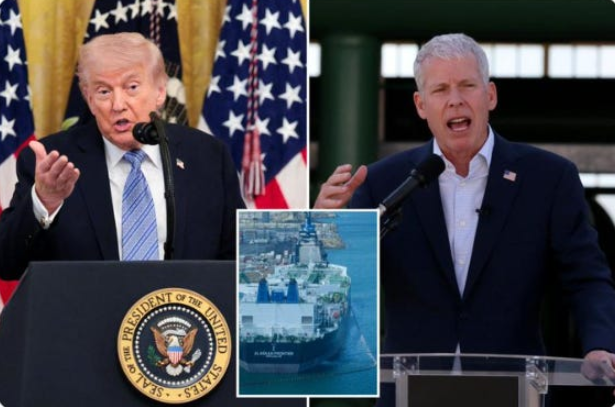
Hilton is exactly right. Just one month after I warned at Forbes that a self-imposed energy crisis was looming in California, the Golden State’s chickens have come home to roost in dramatic fashion. As the final Middle East oil tanker docked in Long Beach this week amid ongoing global supply disruptions, average gasoline prices in the state surged past $6 per gallon — more than two dollars above the national average.
For a jurisdiction that sits atop the fifth-largest oil reserves in the United States and underpins more than $4.1 trillion of American GDP, this is not merely an inconvenience. It is a self-inflicted wound that now poses a genuine threat to national security.
Energy Secretary Chris Wright also took the state’s leadership to task on Tuesday. In pointed remarks relayed through his office, Wright highlighted the absurdity of the situation: “This is an untenable threat to our national security, especially in a time of military conflict.” He went further, noting that despite hosting more than 30 military installations, California’s policies have left U.S. forces and a massive chunk of the national economy “dependent on imported oil.”
This dependence did not happen by accident. It is the direct result of years of deliberate policy choices by Governor Gavin Newsom, the California Air Resources Board (CARB), and a Democratic supermajority in Sacramento that has waged an unrelenting war on the state’s domestic oil and gas sector. In my April 23 Forbes piece, “A Self-Imposed Energy Crisis Looms in California,” USC Prof. Michael Mische detailed how aggressive regulations, Low Carbon Fuel Standards, EV mandates, and permitting denials and delays had turned the state into an energy island, vulnerable to exactly the sort of global shocks now materializing.
The numbers tell a damning story. California’s in-state oil production has plummeted by roughly 75 percent since its peak in the 1980s. Today, the state imports more than 60 percent of its crude from foreign sources, making it an isolated “oil island” with no pipelines linking it to the broader U.S. supply network. Two major refineries, Phillips 66’s Carson/Wilmington facility and Valero’s Benicia operation, shuttered in the past year alone, slashing refining capacity by 17-18 percent. All the while, Californians labor under the nation’s highest state gas tax at 61.2 cents per gallon, layering additional pain onto already elevated pump prices.
A recent paper from Prof. Mische and fellow researchers at USC and UC Berkeley, cited in my earlier column, underscored the fragility: California maintains only about a 10-day fuel inventory and relies on CARB-compliant gasoline from Asian refiners for roughly 20 percent of its supply. With tanker transit times across the Pacific stretching 25 to 45 days, the state is now feeling the full brunt of disrupted imports from the Middle East.
Rather than confront these realities, Sacramento has doubled down on its energy policy insanity. When the Trump administration moved to restart the Santa Ynez pipeline system off Santa Barbara County – invoking the Defense Production Act to boost in-state production by approximately 15 percent and displace nearly 1.5 million barrels of foreign crude per month – California’s response was predictable: a lawsuit to block the project and an $18 million fine slapped on the operator.
Secretary Wright’s office delivered a blunt rejoinder: “Instead of correcting these self-inflicted vulnerabilities, California leaders are attempting to block the Secretary’s efforts to restart critical infrastructure and strengthen domestic energy production.” The kicker came in a direct challenge to Sacramento’s priorities: “California leaders should stop prioritizing political agendas over America’s energy security.”
Hilton’s debate performance underscores a deeper truth about energy policy in America’s most populous state. For years, California has pursued an aggressive decarbonization agenda through government fiat, forcing refinery closures, restricting drilling, and mandating costly blends of fuel that isolate it from national markets. The result is precisely what critics warned against: higher costs, reduced reliability, and dangerous foreign dependence. It is a cautionary tale that mirrors Europe’s energy struggles, where similar ideological pursuits left nations exposed when global markets tightened.
The economic stakes could not be higher. California’s economy is a powerhouse, but its energy policies are undermining the very foundations of that strength. Many businesses facing exorbitant energy costs have fled the state in recent years, and others are looking elsewhere. Military readiness is compromised by reliance on vulnerable tanker routes. And everyday Californians bear the heaviest burden through inflated prices at the pump and outrageous utility bills.
The Trump administration’s intervention via the Santa Ynez project represents a pragmatic effort to restore balance. Restarting this critical infrastructure would not solve every problem overnight, but it would meaningfully increase domestic supply, reduce import dependence, and send a signal that ideology must yield to reality when national security is on the line.
Governor Newsom and his allies have spent years blaming external factors – oil companies, federal policies, even climate change itself – for problems of their own making. The arrival of that final Middle East tanker should serve as a wake-up call. California possesses abundant resources and technical expertise. What it lacks is the political will to develop them responsibly.
As I noted last month, energy security equals national security. The rest of America, enjoying robust domestic production and export capacity under more rational federal policies, should not be forced to subsidize or endure the consequences of California’s experiment in energy isolationism. Reality is asserting itself.
Sacramento can either adapt or continue down a path that leaves its citizens and the nation more vulnerable. The choice, for now, remains theirs. But the costs of continued denial are mounting by the day — at the gas pump, in the economy, and potentially on the global stage. As Steve Hilton rightly insists, it is way past time for change in California.