

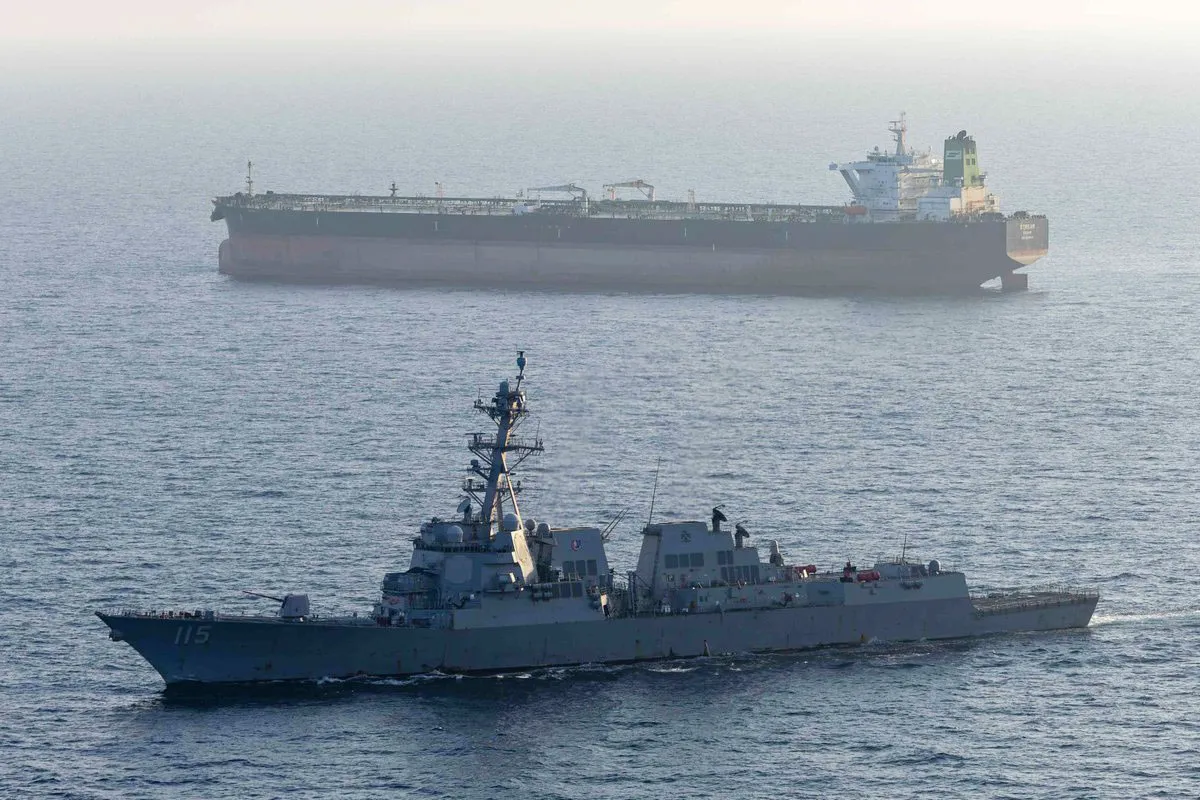
The U.S. naval blockade of Iran, enforced since mid-April 2026, is delivering a measurable blow to Tehran’s oil-dependent economy. Iranian crude and condensate exports have plummeted from nearly 2 million barrels per day (bpd) earlier this year to below 300,000 bpd in May, according to trade intelligence firm Kpler. At conservative Brent prices around $90 per barrel, that collapse has slashed daily oil revenue from roughly $165 million in March to about $27 million in May—an 84% drop that has cost Iran an estimated $5.8 billion in potential earnings over April and May alone.
Oil remains the lifeblood of Iran’s economy, accounting for the bulk of its foreign currency earnings and a significant share of GDP. With roughly 90% of seaborne exports historically routing through Kharg Island in the Persian Gulf, the blockade’s chokehold on tanker traffic out of the Strait of Hormuz has forced Tehran into desperate measures: massive floating storage (147 million barrels currently held offshore, including 67 million in the Gulf and Gulf of Oman) and shadow shipping tactics.
As energy markets analyst JH (@CRUDEOIL231) detailed in a widely discussed June 6, 2026, post on X, Iran’s export system operates as a sophisticated “money-and-logistics laundering matrix.” Tankers disable AIS signals, mask hull numbers, and perform ship-to-ship (STS) transfers in the East of the Persian Gulf or off the UAE to blend Iranian crude into “Malaysian Blend” or other sanitized grades destined for Chinese teapots. Payments bypass SWIFT via RMB/AED shadow banking networks, shell companies in Dubai, Hong Kong, and Turkey, and even barter deals for Chinese goods. The entire cycle—from loading at Kharg to cash hitting Iranian accounts—takes 3–6 months.
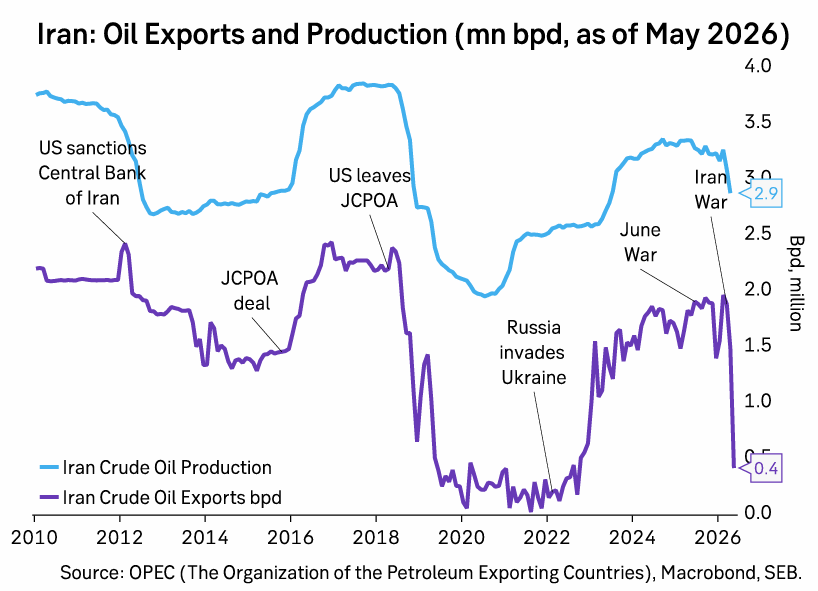
That lag has cushioned the immediate liquidity crunch. Revenue flowing into Tehran today reflects oil sold months ago, before the blockade fully bit. However, the structural discount on Iranian barrels, combined with U.S. pressure on dark-fleet operators and financial nodes, is now accelerating the pain. Storage at Kharg Island—the crown jewel handling the vast majority of exports—is nearing dangerous levels, raising risks of forced production shut-ins that could permanently damage wells.
Strikes in the Gulf: Escalation and Retaliation
The blockade did not occur in isolation. It is intertwined with a broader 2026 Iran conflict that began with joint U.S.-Israeli strikes on February 28 and has repeatedly targeted Kharg Island’s military infrastructure while sparing its oil terminals—at least so far.
March 13, 2026: The U.S. Air Force conducted a large-scale precision raid on Kharg Island, hitting more than 90 military targets, including naval mine storage, missile bunkers, air defenses, a naval base, and helicopter facilities. Oil infrastructure was deliberately left intact. President Trump described it as one of the most powerful raids in Middle East history and warned Iran that strikes on oil facilities remained an option if the Hormuz closure continued.
April 7, 2026: U.S. forces carried out “restrikes” on more than 50–90 additional military targets on the island (bunkers, radar, ammunition storage). Again, oil terminals and export facilities were untouched. These actions came amid Trump’s deadline for Iran to reopen the Strait of Hormuz.
Iran has responded aggressively in the Gulf. In recent weeks (late May–early June 2026), Tehran launched missile and drone barrages targeting U.S. facilities and allies:
Iranian forces claimed strikes on U.S. bases in Kuwait and Bahrain, including the 5th Fleet headquarters. Several missiles were intercepted by U.S. and Bahraini defenses; others failed in flight. One incident damaged Kuwait’s main airport.
The U.S. responded with strikes on Iranian military assets, including a ground control station on Qeshm Island in the Strait of Hormuz and radar sites.
Ceasefire talks remain fragile. A brief April truce collapsed, and as of June 6, 2026, sporadic interdictions and seizures continue despite reports that the formal blockade may have eased after May negotiations. Iran has seized foreign vessels in retaliation and continues to threaten wider disruption across the Indian Ocean, Red Sea, and beyond if pressure mounts.
Broader Economic Toll and Market Implications
Analysts estimate the blockade has cost Iran $400–500 million per day in economic activity at peak enforcement. Beyond oil, seaborne trade (over 90% of Iran’s total) has been throttled, driving up domestic inflation, food prices, and unemployment while straining the rial. Iran’s wartime economy—already stretched by months of regional conflict—is now confronting storage overflows that could force production cuts of hundreds of thousands of barrels per day, with permanent reservoir damage possible if wells are shut in too long.
For global energy markets, the situation is double-edged. While Iranian barrels have largely vanished from the market, the resulting price spikes earlier in the conflict helped Iran temporarily offset some losses before the blockade fully took hold. China, Iran’s primary customer, has absorbed some diverted volumes via dark-fleet routes, but overall flows remain sharply curtailed. Gulf producers have also faced export disruptions from Hormuz volatility, underscoring the strait’s role as a 20% global oil chokepoint.
The central question, as @CRUDEOIL231framed it: Who blinks first under the weight of time—Tehran’s endurance or Washington’s willingness to sustain pressure amid global economic ripple effects?
Iran has survived zero-export periods before (notably during COVID). Yet sustained blockade enforcement, combined with military strikes on supporting infrastructure, is testing that resilience in real time. Energy traders, policymakers, and market participants will be watching Kharg Island loadings, floating storage levels, and any signs of renewed Hormuz incidents closely in the weeks ahead.
All information drawn from publicly available reporting and analysis as of June 6, 2026.
- X post by@CRUDEOIL231(June 6, 2026): https://x.com/CRUDEOIL231/status/2063201575565488637
- Al Jazeera: “How the US naval blockade has bled Iran of nearly $6bn in oil revenues” (June 5, 2026) – https://www.aljazeera.com/news/2026/6/5/how-the-us-naval-blockade-has-bled-iran-of-nearly-6bn-in-oil-revenues
- Wikipedia: 2026 Kharg Island attack – https://en.wikipedia.org/wiki/2026_Kharg_Island_attack
- Wikipedia: 2026 United States naval blockade of Iran – https://en.wikipedia.org/wiki/2026_United_States_naval_blockade_of_Iran
- Additional context from Kpler data, U.S. Department of Defense estimates, and reporting by Reuters, NYT, AP, and FDD (April–June 2026 coverage of strikes and economic impacts).
Energy News Beat will continue monitoring developments at Kharg Island and the Strait of Hormuz. Stay tuned for updates.
