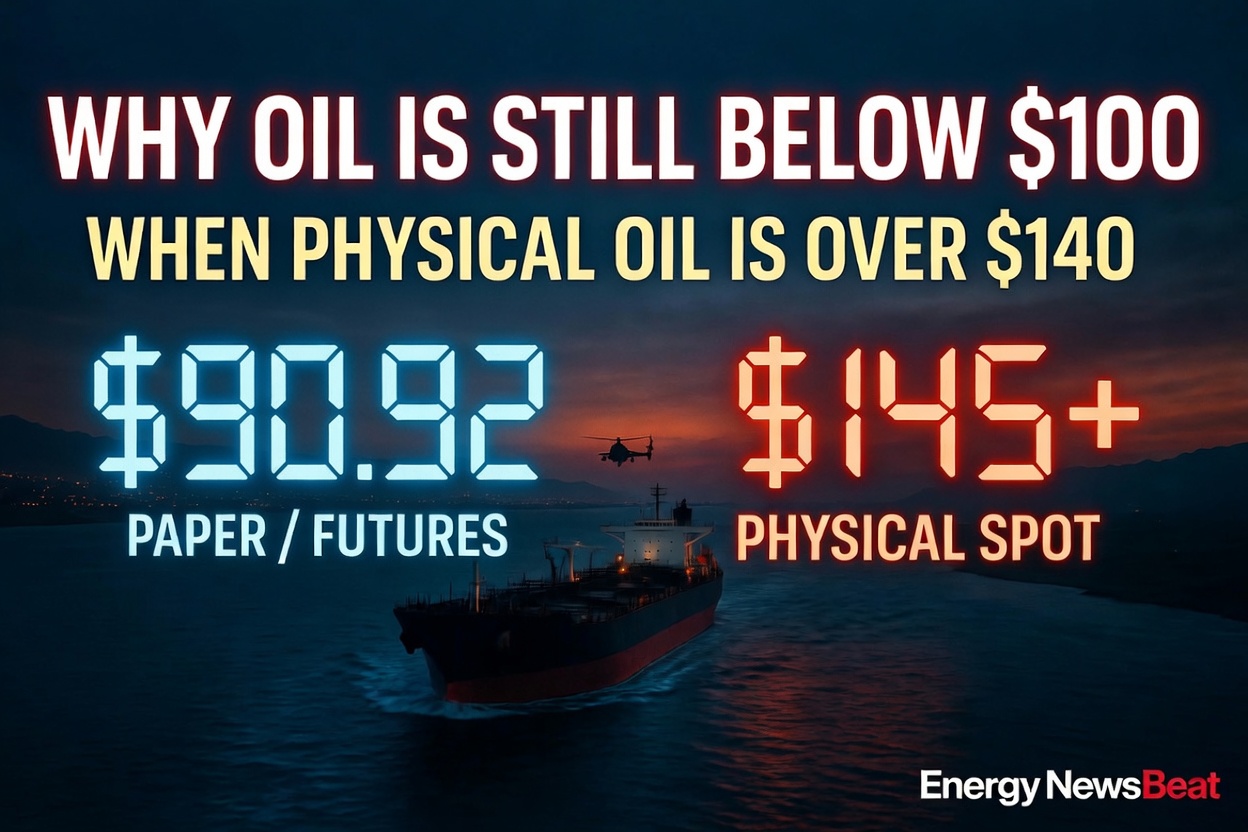
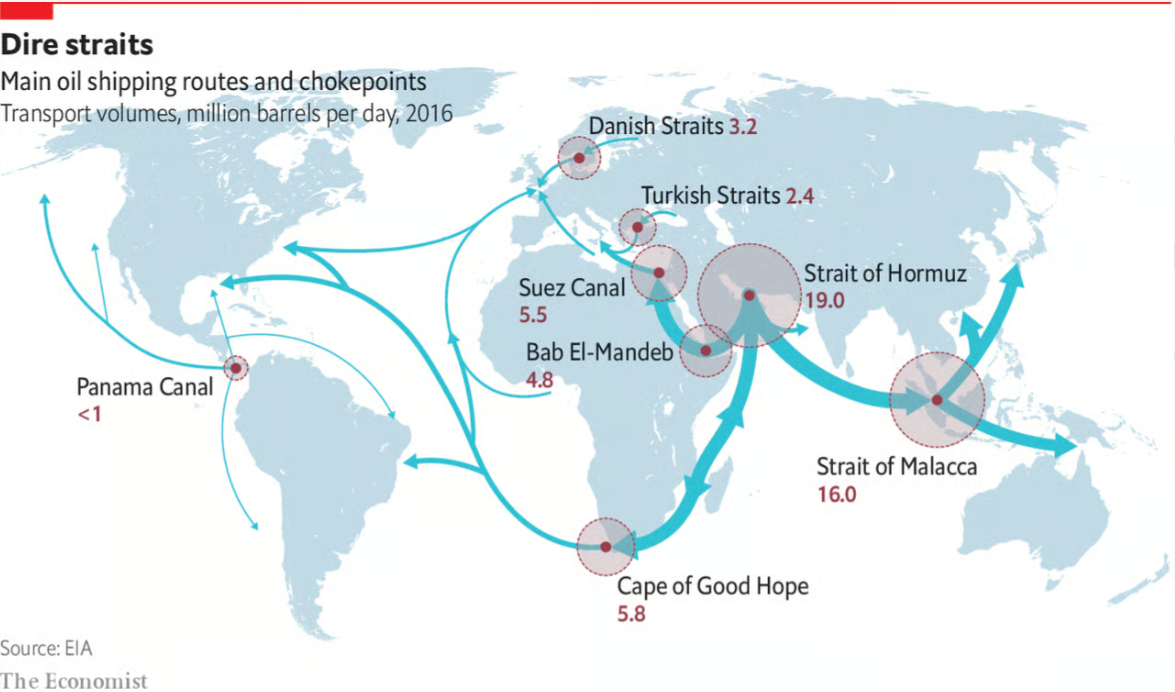
The paradox gripping global energy markets in mid-June 2026 is stark. Brent crude futures — the benchmark “paper” oil traded on exchanges — have hovered around $90–$98 per barrel despite more than 100 days of war involving Iran that has severely disrupted flows through the Strait of Hormuz, a chokepoint for roughly 20% of the world’s seaborne oil.
Yet in the physical market — where actual barrels change hands for immediate delivery to refineries — prices have traded at significant premiums. Earlier in the conflict, key grades like Forties surged toward $147 per barrel, with physical spot prices running $25–$50 above futures in recent weeks.
This disconnect between paper and physical markets is not accidental. It reflects a combination of structural buffers, demand responses, improved information flows, and deliberate U.S. strategic actions under the Trump administration.
Bloomberg’s 10 Reasons Oil Futures Stay Below $100
Bloomberg Opinion columnist Javier Blas outlined ten key factors explaining why prices have defied expectations of $150–$200 oil in a major supply shock:
China, China, and China — Beijing slashed seaborne crude imports by nearly 40% (a drop of ~4 million barrels per day), acting as a massive relief valve.
Demand destruction — Global refinery throughput fell ~5 million bpd as consumers and petrochemical sectors adjusted rapidly.
Oil is still leaving Hormuz — Roughly 7 million bpd continue to flow via Saudi/UAE bypass pipelines plus limited tanker movements hugging the Omani coast.
Original oversupply — The market entered the crisis with a 3–4 million bpd surplus from U.S. shale and OPEC+ decisions.
Strategic releases — The IEA coordinated the release of 400 million barrels (largest in history), adding ~2.5 million bpd at peak.
Refinery flexibility — Modern facilities easily switch crude slates and product yields (e.g., more jet fuel output).
Trump’s jawboning — Repeated public statements that a deal was “imminent” (nearly 40 times) repeatedly capped speculative buying.
Options market hedging — Traders buy call options for protection instead of aggressively going long futures.
Thinning fog of war — Real-time satellite imagery and tanker tracking reduce uncertainty and speculation.
Non-Middle East production gains — U.S., Brazilian, Guyanese, Canadian, and Venezuelan output has offset some losses.
These factors have kept futures calm while physical markets remain tight.
U.S. Operations Steady the Physical Flow: The Apache Incident and the 22 VLCCs
Recent developments reported by Energy News Beat provide critical context for the stabilization. On or around June 8–9, 2026, a U.S. Army AH-64 Apache helicopter on patrol near the Strait of Hormuz (as part of tanker escort operations) collided with an Iranian Shahed drone. The drone’s warhead lodged in the canopy but failed to detonate. The crew ditched the ~$50 million aircraft into the sea and was rescued safely by U.S. forces.
This incident occurred amid a broader, low-profile U.S. military operation to protect commercial shipping. The effort has enabled over 200 commercial ships — including very large crude carriers (VLCCs) — to transit the strait safely, moving more than 100 million barrels of oil.
In one notable night operation, 22 ships (including VLCCs) were escorted through the strait traveling dark (no lights), after U.S. strikes degraded Iranian radar and air defense capabilities near the waterway. President Trump highlighted the success:“We took out the other night 22 ships late at night with no lights, because they don’t have any radar, because we blasted the crap out of it.”
“This wildly successful effort is because the UNITED STATES of AMERICA CONTROLS the Strait of Hormuz — NOT Iran.”
These operations have demonstrably helped steady global oil markets by preventing a total cutoff and maintaining some physical supply, even as Iran has threatened closure.Lt. Col. Anthony Aguilar’s Analysis: Operation Sledgehammer Phases
Retired U.S. Army Lt. Col. Anthony Aguilar (former Green Beret with 25 years of service), appearing on Mario Nawfal’s show, framed the developments within “Operation Sledgehammer,” which he described as having three distinct phases.
Phase 1 (completed/successful): Quietly getting enough ships through the Strait of Hormuz to stabilize oil prices. This aligns directly with the successful escort of the 22 VLCCs/tankers and the movement of over 100 million barrels.
Phase 2 (current): Degrading Iran’s military capabilities under the cover of retaliation (including strikes following the Apache incident and other exchanges).
Phase 3 (pending): Direct action on objectives inside Iran.
Aguilar noted that nothing so far has fundamentally changed either side’s negotiating position, signaling that more significant developments are likely ahead.
Path Forward: Physical Control and Leverage
With the demonstrated ability to move substantial volumes of oil through the strait and assert effective control, the Trump administration is now positioned to shift focus toward higher-leverage objectives. Reports and commentary around the operation point to potential next steps involving physical pressure on key Iranian infrastructure, such as Kharg Island (Iran’s primary oil export terminal handling the vast majority of its crude exports) and broader Iranian oil and gas assets. Such moves would provide additional leverage in negotiations while the market-stabilizing effects of Phase 1 continue to buy time.
The Bottom Line
The gap between paper oil below $100 and physical oil significantly higher reveals a sophisticated market that has absorbed a major shock better than many anticipated — thanks to China’s demand cuts, global buffers, refinery adaptability, better information, and proactive U.S. naval and diplomatic efforts. The successful stealth escort of the 22 VLCCs and over 100 million barrels, coupled with the safe resolution of the Apache incident, has helped prevent the worst-case price spike.
Yet the persistent physical premium serves as a warning: real barrels remain constrained. As Lt. Col. Aguilar’s phased analysis suggests, the situation remains dynamic. With U.S. control of the strait now publicly asserted, attention turns to whether Phase 3 objectives — potentially including greater physical influence over Iranian export infrastructure — will further reshape the energy landscape.
Markets have been steadied for now. The next moves will determine whether that stability holds or gives way to renewed volatility.
- Bloomberg Opinion: “Ten Reasons Oil Is Still Below $100 a Barrel” by Javier Blas (June 10/11, 2026) — https://www.bloomberg.com/opinion/articles/2026-06-11/oil-prices-10-reasons-why-oil-is-still-below-100-a-barrel
(Summary/reprint via Economic Times: https://energy.economictimes.indiatimes.com/news/oil-and-gas/ten-reasons-oil-is-still-below-100-a-barrel/131654034) - Energy News Beat: “Full Story on the Downed Apache – Part of Getting 22 Tankers Through the Gulf” (June 11, 2026) — https://energynewsbeat.co/crude-oil/full-story-on-the-downed-apache-part-of-getting-22-tankers-through-the-gulf/
- Energy News Beat: “The Strait of Hormuz Standoff Why Paper Oil Prices Don’t Match Reality” — https://energynewsbeat.co/crude-oil/the-strait-of-hormuz-standoff-why-paper-oil-prices-dont-match-reality/
- X Post by Mario Nawfal featuring Lt. Col. Anthony Aguilar on Operation Sledgehammer (June 11, 2026) — https://x.com/MarioNawfal/status/2065075329421680752
- Additional context from contemporaneous reporting on tanker movements, Apache incident, and Trump statements (June 2026).
This article is written for the Energy News Beat Channel.