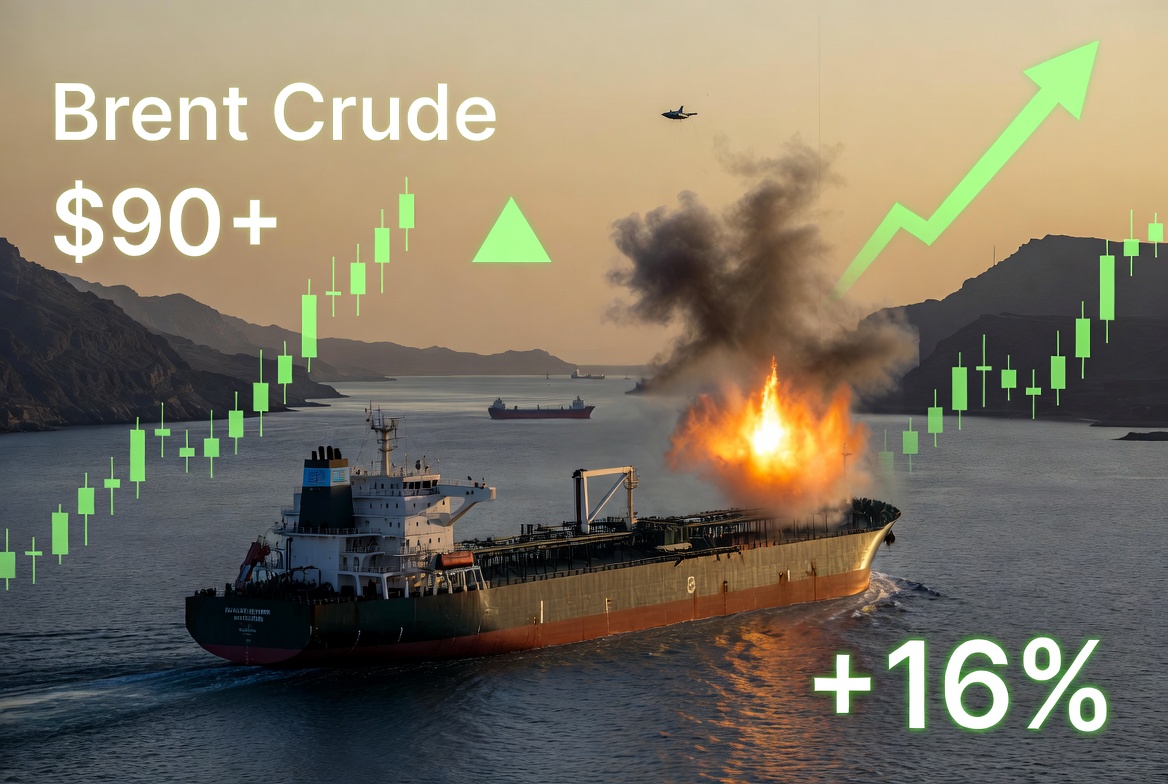
Oil markets are back on edge. Brent crude has surged above $90 per barrel for the first time in weeks, driven by a fresh attack on a Kuwaiti tanker in the Strait of Hormuz and renewed fighting between the United States and Iran.
Early Tuesday (July 21, 2026), the UK Maritime Trade Operations (UKMTO) reported that a Kuwait-owned oil products tanker — the Kaifan, operated by Kuwait Oil Tanker Co. — was struck by an unknown projectile approximately 8 nautical miles northeast of Limah, Oman, in the southern Strait of Hormuz. The crew abandoned the vessel and took to lifeboats. No environmental impact or casualties were reported in initial statements.
This incident is part of a broader wave of attacks. Iran’s Islamic Revolutionary Guard Corps (IRGC) has claimed responsibility for striking multiple vessels in recent days, stating that ships using what Tehran calls an “unsafe southern route” were targeted after ignoring warnings. Reports indicate at least three tankers were hit in the corridor within 24 hours, with traffic through the Strait grinding to a near-halt — dropping to a two-month low.
Price Surge and Immediate Market Reaction
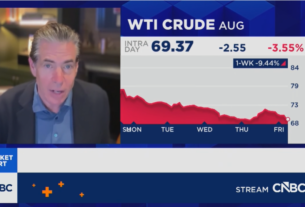
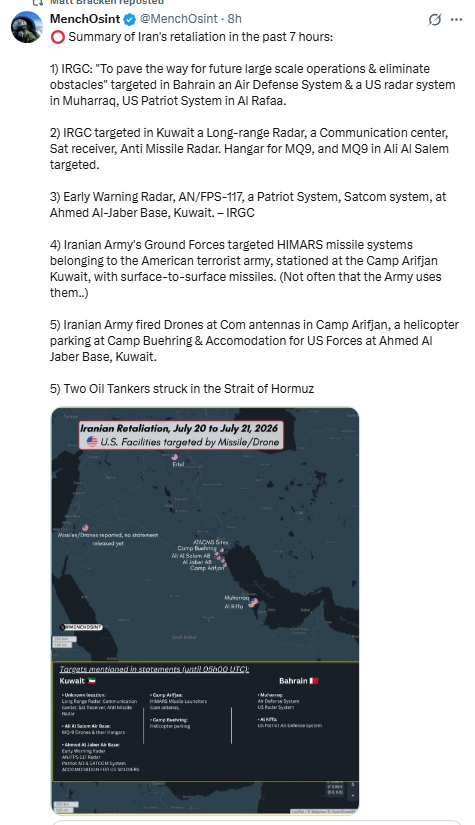
Brent crude futures rose sharply, breaking above the psychologically important $90/bbl level and touching intraday highs around $91.42 before settling lower. WTI crude also climbed, reaching above $84/bbl.
The spike reflects both immediate supply fears and a re-pricing of geopolitical risk. The Strait of Hormuz handles roughly one-fifth of global seaborne oil trade. With tanker transits collapsing and multiple vessels now damaged or abandoned, refiners face tighter supplies of key crudes just as summer demand peaks.
Visual: Brent Crude Oil Prices (June 19 – July 19, 2026)
Geopolitical Backdrop
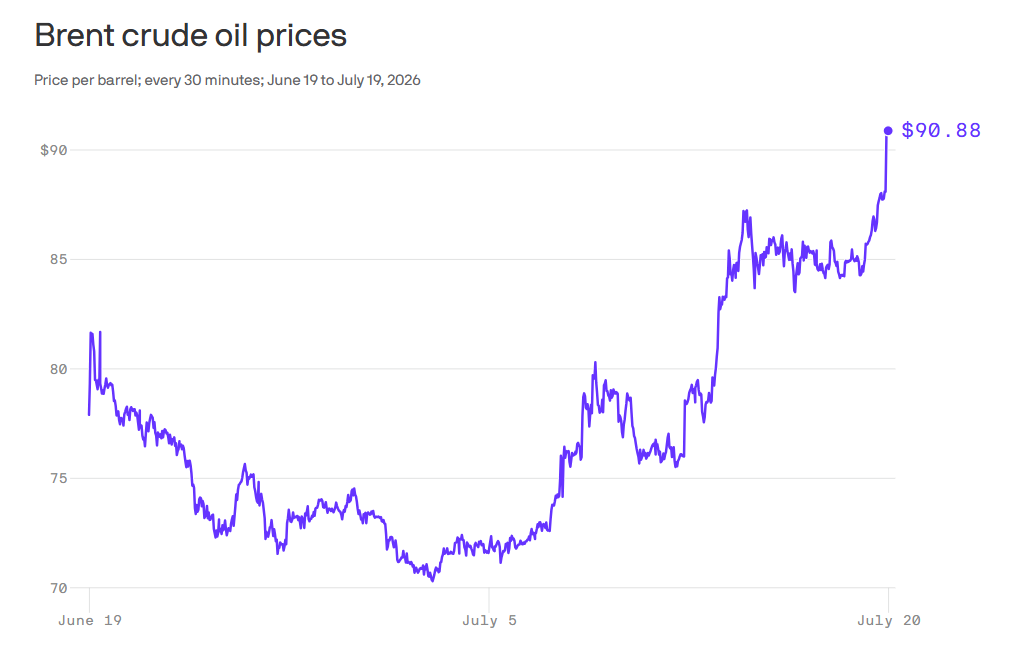
The tanker attack comes amid a sharp escalation in the US-Iran conflict. The US has conducted repeated strikes on Iranian targets, while Iran has retaliated with missile and drone attacks on US-linked assets in Kuwait, Bahrain, and elsewhere. Kuwait has reported damage to oil facilities and infrastructure.
Houthis in Yemen (aligned with Iran) have also threatened further disruptions. The result is a high-risk environment where even sporadic attacks can paralyze one of the world’s most critical energy chokepoints.
Analyst Views: “Higher for Longer” Scenario Gains Traction
The second key development is the strengthening narrative around “higher for longer” oil prices. A recent OilPrice.com analysis highlights that, despite earlier expectations of a post-ceasefire glut, structural tightness persists.
Key reasons cited:
- Shrinking inventories — OECD crude stocks have fallen sharply (e.g., ~62 million barrels in June). US storage at Cushing is near minimum operational levels.
- Tight fuel (product) markets — Refinery damage in the Middle East (~20% less crude processed in Q2 2026 vs. 2025) and Russia (Ukrainian drone attacks disabling significant capacity) have created bottlenecks. Diesel export bans from Russia further tighten global supply.
- Resilient demand — Global economies remain heavily dependent on fuels; governments are reluctant to allow demand destruction.
- Ongoing geopolitical risk — Renewed Hormuz disruptions and the breakdown of earlier US-Iran understandings keep a risk premium embedded in prices.
Andy Lipow, president of Lipow Oil Associates, warned: “The worst fears of the oil market could still be realized later this year as we get to the minimum operating levels. The only way to get prices back in balance is to have prices go up, such that you would have demand destruction. Once the shelf is bare, there’s nowhere to turn.”
Cross-Check with Other Publications and Analysts
Other sources largely align with the near-term bullish pressure while showing divergence on duration:
- ING noted Brent breaking above $90 with vessel flows grinding to a halt and warned of potential wide-scale Gulf attacks if escalation continues.
- TD Securities has emphasized structural deficits and inventory drawdowns supporting prices toward $90–$100/bbl in a tight scenario.
- Kpler highlighted the risk of $100+ oil if both Hormuz and Bab el-Mandeb face prolonged closures, citing global refining constraints.
Earlier forecasts from JPMorgan, Goldman Sachs, and UBS (pre-escalation) projected a return toward $70–$80 later in 2026/2027 assuming de-escalation and supply recovery. However, the latest attacks have forced markets to re-price upside risks.
EIA and Capital Economics still lean toward eventual lower prices if hostilities ease and inventories rebuild, but current events have clearly delayed that outlook.
How Should Investors React?
Short-term opportunities:
- Energy producers, upstream operators, and integrated majors are likely beneficiaries of sustained higher prices and a stronger risk premium.
- Energy-focused ETFs and select midstream/refining plays (where margins expand on tight product markets) could outperform.
- Volatility is elevated — consider hedging or using options for protection.
- Invest in tax advant
Longer-term considerations:
- Monitor de-escalation signals closely. A quick resolution could trigger a sharp pullback.
- Watch inventory data, refinery runs, and SPR releases. Persistent low stocks favor “higher for longer.”
- Diversify: Geopolitical shocks can also pressure equities and raise recession risks if prices spike too far.
Risk management: Position sizing is critical. The market has already shown it can swing dramatically on headlines.
How Should Consumers React?
Higher oil prices flow through to gasoline, diesel, jet fuel, and broader costs:At the pump: Expect gasoline prices to rise further in coming weeks. Some relief may come from government interventions or SPR draws, but product tightness limits downside.
Budgeting: Factor in higher energy and transportation costs. Review commuting, consider carpooling/public transit, or accelerate efficiency measures (e.g., tire pressure, maintenance).
Broader economy: Elevated energy costs can feed into inflation, potentially delaying interest rate cuts and pressuring household budgets.
Governments in import-dependent regions may implement subsidies or price caps, but these are often temporary.
Bottom Line and Outlook
The combination of the latest tanker attack and structural tightness has revived the “higher for longer” narrative in the near term. Brent above $90 reflects real supply anxiety and a re-embedding of geopolitical risk.
However, history shows these spikes can reverse quickly if diplomacy gains traction. The key variables to watch: US-Iran talks, tanker traffic recovery in the Strait, and global inventory trends.
For now, energy markets are pricing in caution — and investors and consumers alike should prepare for continued volatility.
Appendix: Sources and Links
- OilPrice.com: “Oil Prices Top $90 as Kuwaiti Tanker Hit in Strait of Hormuz” (Jul 21, 2026) — https://oilprice.com/Latest-Energy-News/World-News/Oil-Prices-Top-90-as-Kuwaiti-Tanker-Hit-in-Strait-of-Hormuz.html
- OilPrice.com: “Higher-For-Longer Oil Scenario Is Here To Stay” (Jul 20, 2026) — https://oilprice.com/Energy/Crude-Oil/Higher-For-Longer-Oil-Scenario-Is-Here-To-Stay.html
- Windward Daily Intelligence / Maritime reports on tanker incidents (Jul 21, 2026)
- Reuters / Korea Times coverage of Hormuz attacks and US-Iran strikes
- ING, TD Securities, Kpler, JPMorgan, Goldman Sachs, UBS analyst notes (various July 2026 reports)
- Energy Network Media Group / Al-Monitor / Axios on Brent topping $90–$91
- UKMTO incident reports (via multiple outlets)
All information cross-checked against multiple independent publications as of July 21, 2026. Markets move fast — always verify latest data.