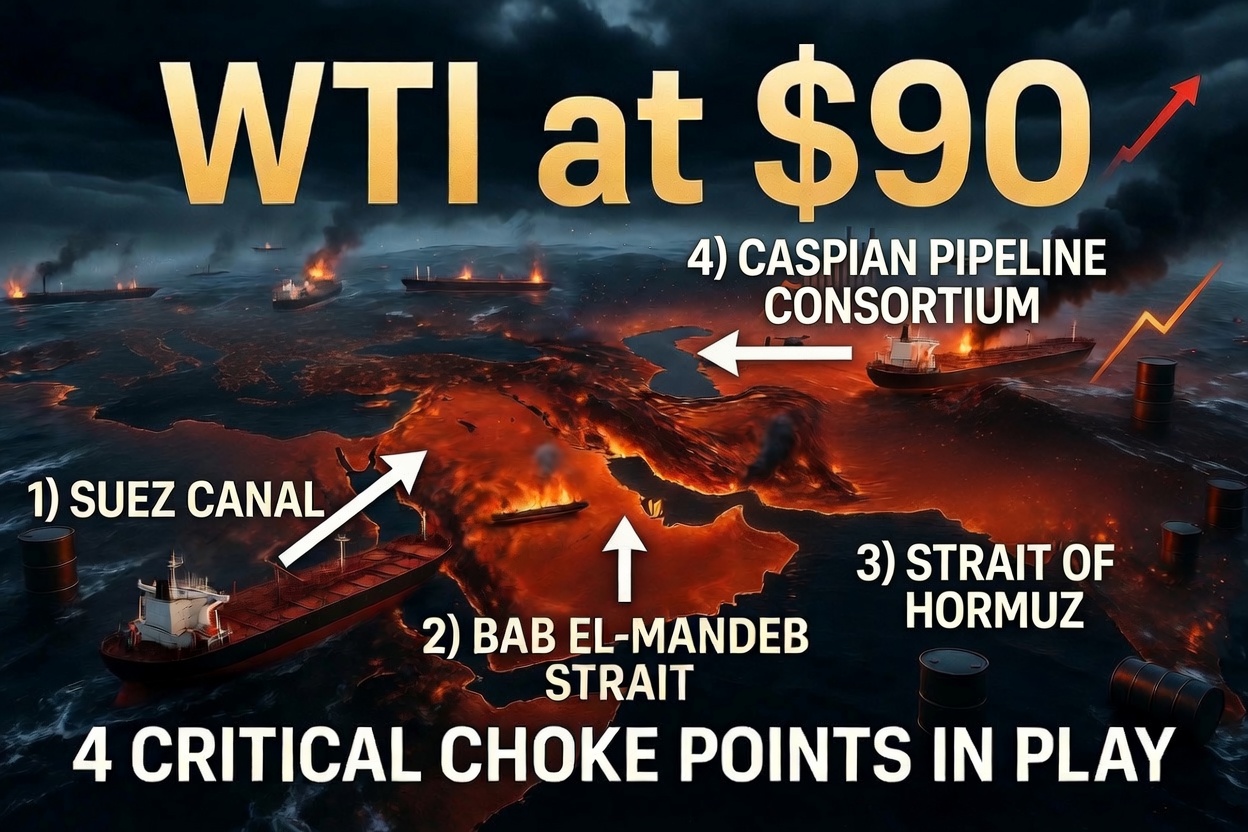
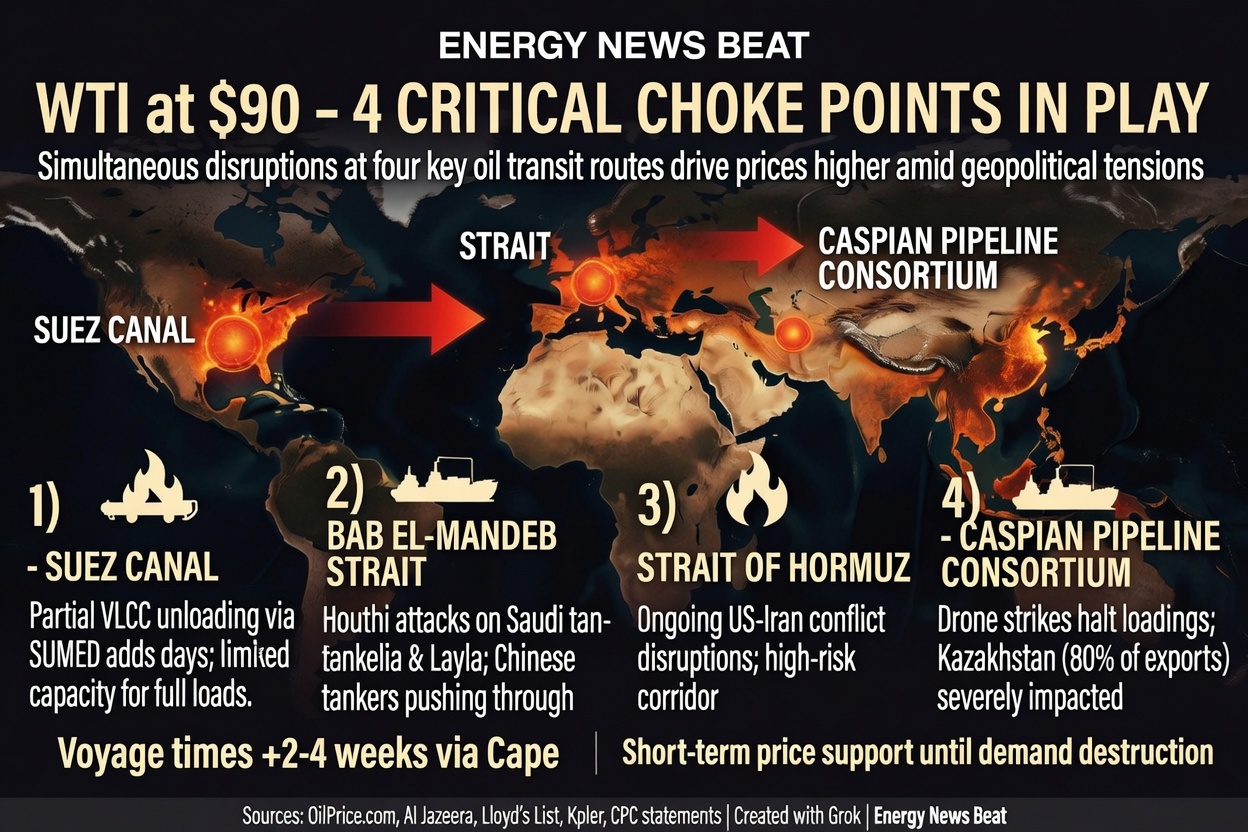
West Texas Intermediate crude hovered near $90 per barrel on July 23, 2026, with Brent trading higher in the mid-to-high $90s amid escalating disruptions across multiple global oil transit routes. Markets are reacting to simultaneous pressures on four critical choke points: the Bab el-Mandeb Strait, the Strait of Hormuz, the Suez Canal corridor, and the Caspian Pipeline Consortium (CPC) export pathway from the Caspian region. These bottlenecks are tightening supply just as geopolitical tensions—U.S. strikes on Iran, Houthi actions, and Black Sea drone attacks—compound risks.
Bab el-Mandeb: Houthi strikes on Saudi tankers and selective Chinese passage
Overnight into Thursday (Wednesday night local time), Yemen’s Iran-backed Houthis claimed responsibility for missile and drone attacks on two Saudi-flagged oil tankers, the Encelia and Layla, in the Red Sea. The Encelia was struck by an unknown projectile about 70 nautical miles southwest of Al Shuqaiq, Saudi Arabia, sparking a fire that the crew extinguished with no reported casualties or environmental damage. The Houthis said the vessels violated their newly announced naval blockade of Saudi Arabia and claimed they forced multiple other ships to turn back. Maritime security reports from UKMTO and others corroborated at least one confirmed strike.
This escalates the Houthis’ campaign, which targets Saudi oil shipments redirected via the Red Sea port of Yanbu to bypass Hormuz risks. Saudi Arabia has been routing a large share of its crude this way. Several tankers loaded with Saudi crude for Asia reversed course earlier in the week.
In contrast, two China-owned and operated Cosco Shipping tankers—the Xin Long Yang and Cosnew Lake—loaded with Saudi crude at Yanbu continued toward the Bab el-Mandeb Strait on Thursday, openly broadcasting their Chinese destinations. Ship-tracking data showed them progressing despite the threats. One report noted a Chinese VLCC securing Houthi clearance for transit on a case-by-case basis.
A post by commodity analyst Jack Prandelli highlighted China’s permanent military base in Djibouti, positioned directly on the Bab el-Mandeb. The People’s Liberation Army Support Base, operational since 2017 near the Port of Doraleh, supports Chinese naval operations in the region. Historical patterns show Houthis have often avoided Chinese-linked vessels, reportedly due to diplomatic arrangements involving Iran and China. While not officially confirmed as the sole reason for current passage, the base’s strategic location and China’s regional presence provide context for why Chinese tankers appear to face lower risk than Saudi-flagged ones.
Strait of Hormuz: Persistent high-risk corridor
The Strait of Hormuz remains under severe pressure from the ongoing U.S.-Iran conflict, with traffic far below normal levels at times and vessels operating with heightened caution or “dark” (AIS off). Saudi Arabia and others have already shifted significant volumes away from it via pipelines to Yanbu, but residual risks and intermittent incidents continue to support elevated risk premiums in oil prices.
Suez Canal: Limited relief for VLCCs
Asian buyers are exploring the Suez Canal as a northern alternative from Yanbu, routing into the Mediterranean and then around Africa via the Cape of Good Hope. However, fully laden Very Large Crude Carriers (VLCCs)—the workhorses of long-haul Saudi exports—cannot transit the Suez due to draft restrictions. Ships must partially unload (lighter) cargo via Egypt’s SUMED pipeline on the Red Sea side, transit in a lighter state (often as Suezmax-equivalent), and reload on the Mediterranean side. This process adds days of delay, complexity, cost, and reduced effective capacity.
A full Cape of Good Hope diversion for Asia-bound cargoes from Yanbu roughly doubles voyage times—for example, from about 21–24 days to 49–54 days to destinations like China or South Korea—adding up to roughly a month in extreme cases when including operational delays. Extra bunker fuel, higher freight rates, and tighter tanker availability further inflate costs.Caspian/CPC pathway: Loadings disrupted for landlocked producers
The fourth pressure point involves the Caspian Pipeline Consortium terminal near Novorossiysk on Russia’s Black Sea coast. CPC carries oil from Kazakhstan’s major Caspian fields (Tengiz, Kashagan, Karachaganak) and accounts for roughly 80% (or more than two-thirds) of Kazakhstan’s oil exports—volumes of around 1.6–1.7 million barrels per day in recent periods. Multiple drone attacks in mid-to-late July struck tankers loading at the terminal (including Asia, Nissos Ios, and later Nelsa), causing fires that were extinguished with no casualties or spills. Loadings were suspended, briefly resumed, then halted again.
Kazakhstan, as a landlocked Caspian producer heavily reliant on this route, faces the most direct constraints on shipping out crude. Alternative routes (via Azerbaijan/Georgia or other corridors) have far lower capacity. Russia also uses the system for some volumes, but CPC oil is largely non-sanctioned Kazakh crude. Repeated attacks have prompted strong protests from Astana demanding protection of the infrastructure.
Short-term price outlook and demand destruction
Analysts see near-term support for elevated prices from the multi-choke-point risks, with potential for further spikes if disruptions intensify or persist (some scenarios flag upside toward $100+ or higher in extreme cases). Goldman Sachs and others have noted risks of Brent moving significantly higher if Hormuz or Red Sea flows deteriorate further.
However, most forecasts emphasize that sustained high prices will trigger demand destruction—reduced consumption from higher fuel costs, conservation, and economic slowdown—which is already visible in revised demand growth numbers (IEA and EIA projecting declines of around 1.1 million b/d for 2026 in some updates). Banks such as JPMorgan, Goldman Sachs, and Morgan Stanley have lowered second-half 2026 averages, with Q3/Q4 Brent projections often in the $80s or lower once flows partially recover and demand softens. The consensus is that current levels near $90 WTI reflect a temporary risk premium that should ease as demand responds, barring further major escalation.
The simultaneous strain on these four routes underscores the fragility of global oil logistics. Markets will watch whether Chinese tankers complete their Bab el-Mandeb transit cleanly, the status of CPC loadings, Hormuz traffic recovery, and any expansion of Houthi targeting in the coming days.
- OilPrice.com: Chinese Tankers Push Through Bab el-Mandeb Despite Houthi Blockade Threats (Jul 23, 2026) – https://oilprice.com/Latest-Energy-News/World-News/Chinese-Tankers-Push-Through-Bab-el-Mandeb-Despite-Houthi-Blockade-Threats.html
- Al Jazeera: Can the Suez save Asian oil consumers after Houthis shut Bab al-Mandeb? (Jul 22, 2026) – https://www.aljazeera.com/news/2026/7/22/can-the-suez-save-asian-oil-consumers-after-houthis-shut-bab-al-mandeb
- X post by@jackprandelli (Jul 23, 2026) – https://x.com/jackprandelli/status/2080219108335853579
- Ship & Bunker / UKMTO / various maritime reports on Encelia and Layla attacks (Jul 23, 2026)
- Bloomberg / Reuters / CPC statements on drone attacks and loadings suspensions at Novorossiysk terminal (Jul 19–21, 2026)
- Kpler data and analysis on transit times, VLCC/Suez limitations, and Asian exposure (cited across Al Jazeera, Splash247, Korea Herald)
- Lloyd’s List: Chinese VLCC granted Houthi passage (Jul 23, 2026)
- Wikipedia / public records on PLA Support Base in Djibouti
- Analyst notes from JPMorgan, Goldman Sachs, Morgan Stanley, IEA, EIA on prices and demand destruction (June–July 2026 reports)
- Additional maritime tracking and security reports from UKMTO, Vanguard, and ship-tracking platforms.