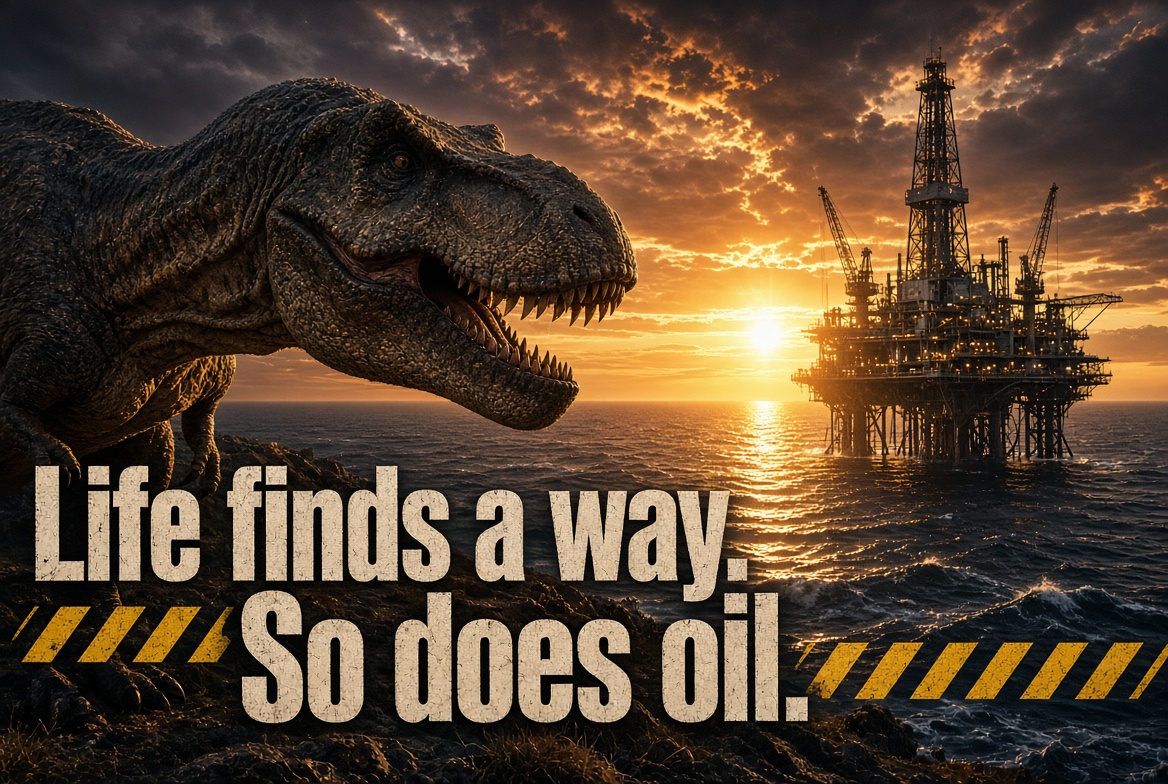
In Jurassic Park, Dr. Ian Malcolm delivers one of cinema’s most memorable lines: “Life finds a way.” Nature adapts, persists, and routes around obstacles no matter how carefully the fences are built. In the summer of 2026, crude oil is doing the same thing.
Blockades and attacks have choked the Strait of Hormuz and the Bab el-Mandeb. Tanker rates from the Middle East to China have exploded to more than $600,000 a day. Iranian barrels that once flowed freely to Chinese teapots have been slashed. Yet the barrels keep moving. Saudi Aramco is loading inside the Gulf, crossing the strait with trackers switched off, then transferring cargoes ship-to-ship off Oman. At the same time, an east-west pipeline shuttle is pushing oil to Yanbu on the Red Sea, then north to Egypt’s SUMED system so tankers can load on the Mediterranean and steam all the way around Africa to China. Oil, like life, finds a way.
Tanker Trackers posted that about 15 simultaneous Ship-to-Ship oil transfers were underway, and none of them were Iranian.

The Hormuz Workaround and the Yanbu Shuttle
Saudi Aramco has already sold at least 4 million barrels to China this month using a relay that would have seemed exotic a year ago. Two VLCCs, Singapore Prosperity and Algeria Prosperity, loaded inside the Gulf, transited Hormuz, and transferred their cargoes off Sohar, Oman, to Xin Hui Yang and Xin Han Yang. Those vessels are now bound for Ningbo and Zhanjiang for Sinopec. Last week Aramco sold another 4 million barrels of heavier grades to PetroChina and Sinochem after restarting Ras Tanura loadings. September offers are again structured around ship-to-ship transfers off Fujairah or Sohar rather than a straight-through delivery.
The same ingenuity is visible on Saudi Arabia’s west coast. The East-West pipeline feeds Yanbu. When Houthis threatened the southern Red Sea, Aramco began shuttling cargoes north from Yanbu to Ain Sukhna. There, the oil is discharged into the SUMED pipeline and reloaded at Sidi Kerir on the Mediterranean. From the Med, the tankers must sail west through Gibraltar and then all the way around the Cape of Good Hope—more than doubling the voyage to Asia. The route is longer and more expensive, but it keeps the barrels moving when both Hormuz and Bab el-Mandeb are too dangerous. Several Asian refiners have even asked to collect cargoes at Sidi Kerir rather than risk Yanbu.
Tanker rates tell the story of how expensive these workarounds have become. The Middle East-to-China VLCC benchmark sat near $100,000–$200,000 a day before the escalation. By late August it had reached $603,447 a day, a five- to six-fold jump that prices in a prolonged Hormuz crisis rather than a temporary spike.

Iran’s Lost Barrels and China’s Shrinking Appetite
Iran once supplied China with roughly 1.4 million barrels a day. Those volumes covered 45 percent of the Iranian government’s budget last year. China still takes about 90 percent of Iran’s sanctioned crude, but the physical route has become far harder. Imports of Iranian oil have nearly halved to around 530,000 barrels a day since the war began. No laden Iranian supertankers have visibly crossed Hormuz since the U.S. blockade resumed in mid-July. Floating storage outside the blockade zone has dropped from 105 million barrels to about 80 million. What remains is being offered at a premium instead of the usual discount.
Beijing has not walked away. State-backed banks still finance teapot refiners, tanker ownership records are rewritten, and part of the payment arrives as infrastructure projects inside Iran rather than dollars that could be seized. New U.S. sanctions hit 60 entities but left the major Chinese banks untouched. Until that changes, the financial plumbing remains intact even as the physical barrels dwindle.
China’s overall crude imports have collapsed far more than just the Iranian slice. Seaborne arrivals fell to eight-year lows earlier this year as prices spiked and domestic demand weakened. Refiners cut runs, drew on inventories estimated at 1–1.4 billion barrels, and Beijing restricted product exports to protect the home market. That decision tightened diesel and gasoline supplies across the rest of Asia.

Are Chinese Refineries Reopening to Exploit the Shortage?
Not in any meaningful way. Global diesel cracks have soared because Russian refining capacity is offline from Ukrainian strikes, Middle Eastern plants have been hit, and China itself slashed exports. Yet Chinese refiners are not racing to fill the gap. Utilization rates dropped to multi-year lows. Independent “teapot” plants in Shandong ran at just 50.5 percent earlier this summer—the weakest since 2017. State refiners faced even worse margins, some as low as minus $18 a barrel after domestic price caps.
Beijing has quietly allowed runs to fall to about 80 percent of year-ago levels. Inventories of gasoline and diesel inside China remain ample; some terminals are approaching ullage constraints. A second tranche of export quotas was issued, but analysts expect little extra product to leave the country. The priority remains domestic security, not capturing record export margins. A few plants, such as a 200,000-barrel-a-day unit at PetroChina’s Dalian complex, have been discussed for restart, but those plans have been delayed to year-end or indefinitely. New projects have also slipped.
China is buying additional Saudi barrels via new workarounds and replacing lost Iranian supply with Russian, Iraqi, and Brazilian grades. Imports may recover modestly in the fourth quarter. But the world’s largest refiner is not throwing open the gates to flood the market with diesel. It is managing the shock on its own terms.
Oil is stubborn, and fungible. It moves through pipelines that were built for emergencies, transfers from one darkened tanker to another in the Gulf of Oman, and takes the long way around Africa when the short way is closed. The volumes are smaller, the freight bills are enormous, and the Iranian share has been cut in half. Yet the molecules still reach Chinese ports.
Life finds a way. So does oil.
Appendix: Sources and LinksX Posts Referenced
- Jack Prandelli, tanker rates chart: https://x.com/jackprandelli/status/2092558374437020009
- Jack Prandelli, Saudi STS sales to China: https://x.com/jackprandelli/status/2092644513915293912
- Jack Prandelli, Iran-China oil and budget share: https://x.com/jackprandelli/status/2092640959318082039
Key News and Data Reports
- Reuters, “Aramco offers more oil outside Hormuz with some cargoes heading to China,” Aug. 26, 2026: https://www.reuters.com/business/energy/aramco-offers-more-oil-outside-hormuz-with-some-cargoes-heading-china-2026-08-26/
- Reuters, “Saudi Aramco sells at least 4 million barrels of crude loading outside Hormuz to China,” Aug. 20, 2026: https://www.reuters.com/business/energy/saudi-aramco-sells-least-4-million-barrels-crude-loading-outside-hormuz-china-2026-08-20/
- Bloomberg / gCaptain, Saudi ramping exports and Yanbu loadings: https://gcaptain.com/saudi-arabia-is-ramping-up-oil-exports-as-gulf-ports-restart/
- Bloomberg, Saudi shuttle north to avoid Houthis and Mediterranean loadings: https://www.energyconnects.com/news/oil/2026/august/saudi-oil-logistics-roiled-again-by-houthis-red-sea-threat/
- Kpler, Red Sea flows, Bab el-Mandeb, and alternative routes: https://www.kpler.com/blog/factbox-red-sea-crude-flows-bab-el-mandeb-and-alternative-routes
- The National, “China’s Iranian oil imports nearly halve since war”: https://www.thenationalnews.com/business/energy/2026/08/26/chart-of-the-week-chinas-iranian-oil-imports-nearly-halve-since-war/
- Reuters / US News, Iranian offers to China falling under blockade: https://www.usnews.com/news/world/articles/2026-08-21/iranian-oil-offers-to-chinese-buyers-fall-as-us-blockade-bites-sources-say
- Kpler, second tranche of Chinese export quotas and run cuts: https://www.kpler.com/blog/second-tranche-of-chinese-export-quotas-to-offer-little-relief-to-asian-product-markets
- OilPrice, China’s teapot refiners at lowest runs since 2017: https://oilprice.com/Latest-Energy-News/World-News/Chinas-Teapot-Refineries-Cut-Operations-to-Their-Lowest-Level-Since-2017.html
- Columbia SIPA CGEP, “How China Is Managing Lower Oil Imports”: https://www.energypolicy.columbia.edu/how-china-is-managing-lower-oil-imports/
- Reuters, Chinese refiners delaying projects: https://www.reuters.com/business/energy/chinese-refiners-delay-projects-with-middle-east-oil-supply-disrupted-2026-06-08/
- Energy News Beat (related coverage): https://energynewsbeat.co/crude-oil/china-tells-refiners-to-keep-fuel-output-high-as-the-iran-and-ukraine-wars-drag-on/
Additional supporting data drawn from Vortexa, Kpler, LSEG, Mysteel OilChem, and official Chinese customs and statistics releases cited in the above reports.