

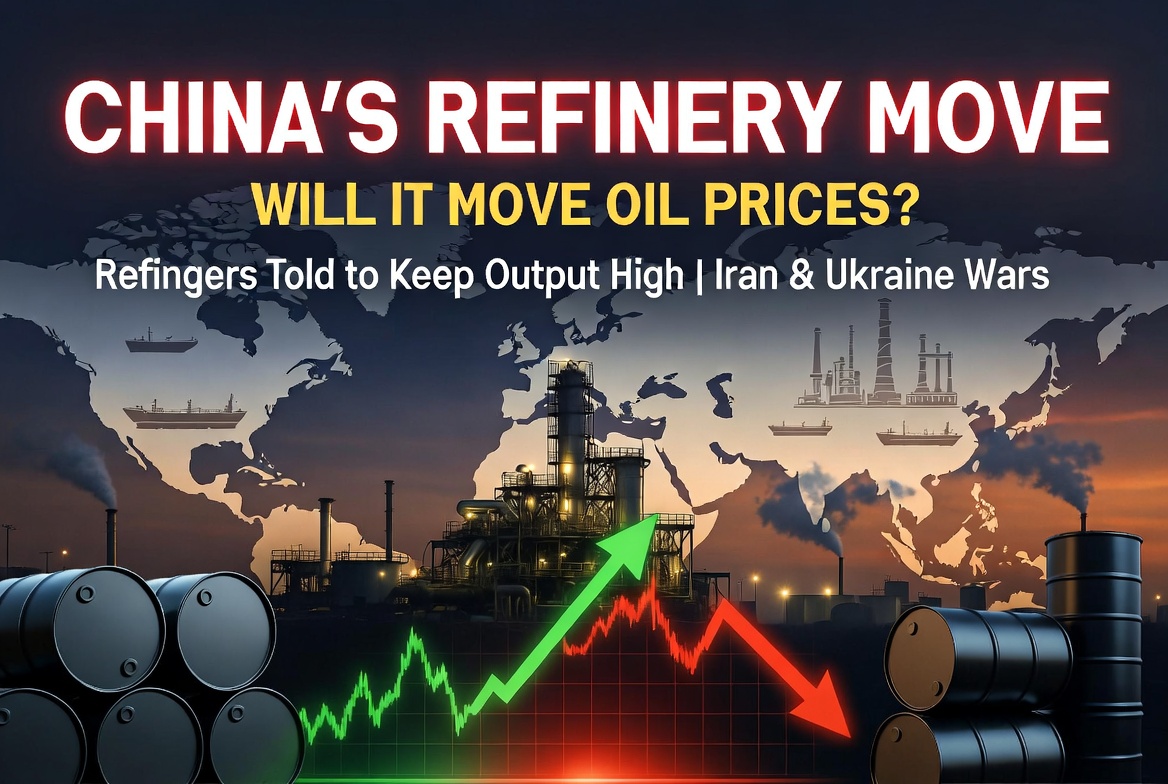
Beijing has directed at least two major Chinese refineries to maintain or even increase processing rates to ensure adequate domestic supplies of gasoline, diesel, and other fuels. This comes amid renewed threats to crude shipments through the Persian Gulf tied to the ongoing Iran conflict, according to people familiar with the matter cited by Bloomberg on July 11, 2026.
Iran Conflict: Supply and Shipping Risks Persist
The Iran war, which escalated with U.S.-Israeli strikes earlier in 2026, has repeatedly threatened oil flows from the Persian Gulf. Early in the conflict, China imposed curbs on exports of gasoline, diesel, and jet fuel to protect local supplies. These restrictions were later eased, with authorities issuing more export permits for diesel and gasoline in July.
China, Asia’s largest crude consumer, had sharply reduced imports earlier in the crisis to around 7.8 million barrels per day (bpd) in May 2026 (an eight-year low) from over 11 million bpd previously—by drawing on strategic reserves, slowing refinery runs, and shifting toward alternatives like EVs and coal-to-liquids.
Ukraine War: Major Blow to Russian Refining and Global Diesel Supply
Parallel to the Iran situation, Ukraine’s long-range drone strikes have significantly degraded Russia’s oil refining capacity. Ukrainian claims and assessments indicate that around 40% or more of Russia’s refining capacity was disabled by early July 2026, with some reports citing peaks exceeding 40-60% offline at times due to repeated hits on facilities like those in Omsk, Saratov, Nizhny Novgorod, and Moscow regions.
Global Diesel Demand Context
Global oil demand forecasts for 2026 have been repeatedly revised lower due to the wars’ impacts. The IEA projects a contraction of around 420,000 bpd year-on-year for the full year (to about 104 million bpd), significantly weaker than pre-conflict expectations.
Is This the Key to China Reopening Crude Purchases and Boosting Oil Demand?
Analysts note that Chinese oil imports may not fully recover to pre-war levels soon. The conflict accelerated shifts away from certain transport fuels, with permanent demand losses estimated in the hundreds of thousands of bpd for transportation fuels.
Analyst Views on Oil Prices
Oil prices have eased from earlier 2026 peaks amid partial supply recoveries but remain sensitive to geopolitics. As of mid-July 2026, WTI traded around $71–72 per barrel and Brent near $76 per barrel.
- The U.S. EIA’s latest Short-Term Energy Outlook sees Brent averaging around $74/bbl in Q3 2026 before falling further toward $65/bbl in 2027, citing building inventories and moderating draws.
- Earlier Reuters polls (May 2026) showed analysts raising 2026 Brent forecasts to an average of ~$90/bbl amid slow supply normalization expectations.
- Major banks have mixed outlooks: some (e.g., J.P. Morgan) are bearish around $60/bbl for 2026 on soft fundamentals and potential surpluses; others maintain higher targets if disruptions persist.
- Renewed July clashes have added a risk premium, with prices sensitive to Hormuz flows and Russian product availability.
Overall, analysts see downside risks if tensions ease and supply normalizes, but significant upside if either conflict escalates further.
Implications for Energy Markets
Appendix: Sources and Links
- Bloomberg (July 11, 2026): “China Tells Refiners to Keep Fuel Output High as Iran War Drags” — https://www.bloomberg.com/news/articles/2026-07-11/china-tells-refiners-to-keep-fuel-output-high-as-iran-war-drags
- The Edge Singapore / Bloomberg repost (July 11, 2026) — https://www.theedgesingapore.com/news/oil-gas/china-tells-refiners-keep-fuel-output-high-iran-war-drags–bloomberg
- Investing.com (July 11, 2026) — https://www.investing.com/news/commodities-news/china-tells-refiners-to-keep-fuel-output-high-as-iran-conflict-threatens-supply-4787257
- Reuters (June 25, 2026): China state refiners considering resuming Iran oil imports — https://www.reuters.com/business/energy/china-state-refiners-considering-resuming-iran-oil-imports-sources-say-2026-06-25/
- Bloomberg (June 9/22, 2026 articles on China imports and potential permanent demand loss) — referenced via multiple reports
- IEA Oil Market Report (May/July 2026) — https://www.iea.org/reports/oil-market-report-may-2026 and July update
- EIA Short-Term Energy Outlook (July 2026) — https://www.eia.gov/outlooks/steo/
- Institute for the Study of War / Reuters reports on Russian refining (July 2026) — https://understandingwar.org/research/russia-ukraine/russian-offensive-campaign-assessment-july-10-2026
- Carnegie Endowment (June 2026) on Russian oil sector — https://carnegieendowment.org/russia-eurasia/politika/2026/06/russia-new-refinery-strike
- Kpler oil products demand outlook — referenced in industry analyses
- Reuters poll on analyst forecasts (May 2026) and various bank outlooks (J.P. Morgan, Goldman Sachs, etc.)
- Additional context from FT, NYT, and market reports on China imports and Hormuz impacts (June–July 2026)
All information is current as of July 12, 2026. Markets and geopolitical situations evolve rapidly; readers should consult primary sources for the latest developments.