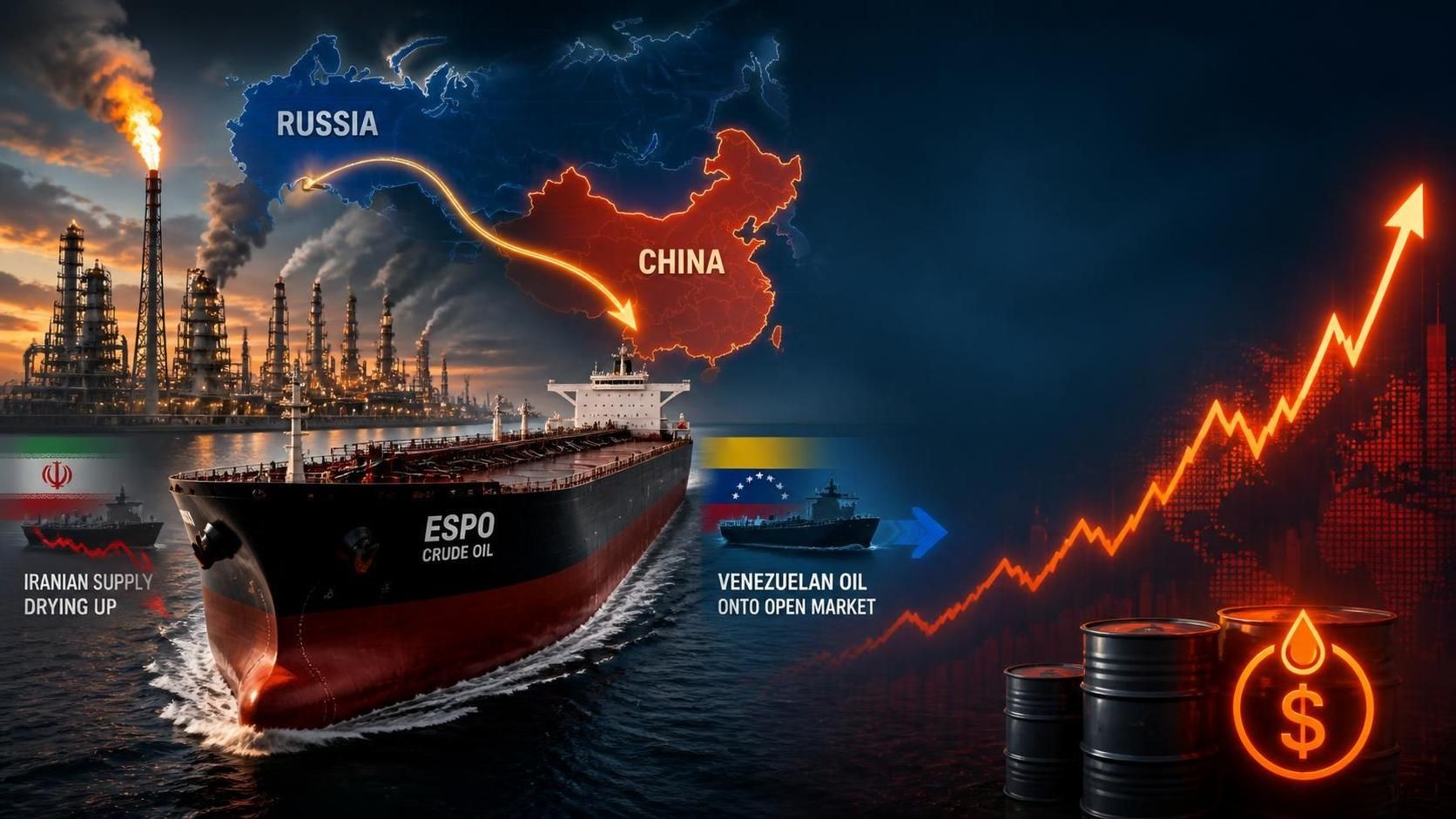
November-loading ESPO from Kozmino is trading at more than $7 per barrel over Brent, with some offers to independent refiners reaching $10, according to traders cited by Bloomberg and OilPrice.com. That is a sharp reversal from the deep discounts China extracted for years.
ESPO loads on Russia’s Pacific coast and reaches Chinese ports in less than a week. China still takes the bulk of it—83% in the first seven months of 2026, down from 88% a year earlier—while India’s share rose from 12% to 16%. Kozmino loadings were up 6% over the same period. Sinopec has been locking in large volumes to offset lost Middle East term cargoes, squeezing Shandong “teapot” refiners that previously relied on cheap Iranian grades.
The premium is the market’s verdict on reliability. Iranian barrels that independent refiners favored have been hit by a U.S. naval blockade. Middle East shipments remain disrupted. ESPO is the closest, lightest, and now most contested alternative.
China’s decade of supplier shifts
China’s crude imports rose from roughly 381 million metric tons in 2016 to a record 578 million tons in 2025 (about 11.6 million bpd). Official customs data and tanker-tracking estimates show a clear pattern: Russia became the top supplier, Saudi volumes stayed large but lost share, and “Malaysian” barrels exploded as a label for rebranded Iranian and Venezuelan crude.
Russia’s official volumes climbed from about 52.5 million tons in 2016 to a peak of 108.5 million tons in 2024 before easing to 100.7 million tons in 2025. Saudi Arabia peaked near 87–88 million tons in 2020–2022 and slipped to about 81 million tons in 2025. Malaysia (the main proxy for disguised sanctioned oil) jumped from a few million tons to more than 70 million tons in 2024. Iraq and Brazil also gained. Official Iran and Venezuela numbers collapsed after sanctions, even as Kpler and others tracked 1.38 million bpd of Iranian crude and 389,000 bpd of Venezuelan crude into China in 2025. Sanctioned barrels from Russia, Iran, and Venezuela together accounted for more than 22% of China’s imports that year.
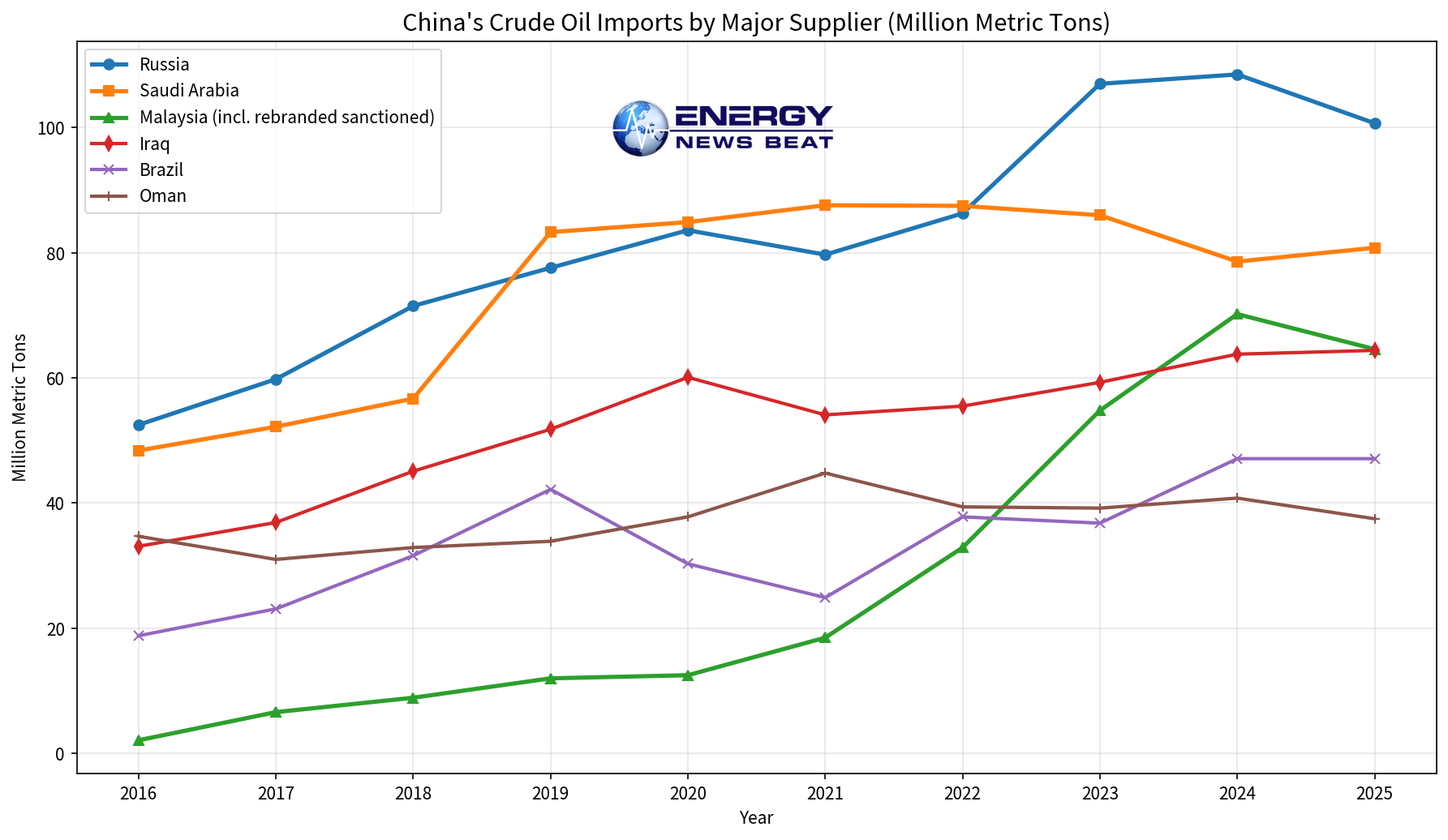
Note: Malaysia volumes include substantial rebranded Iranian and Venezuelan crude via ship-to-ship transfers. Official customs figures understate Iran and Venezuela after 2022. Sources compiled from China General Administration of Customs / CNPC energy data handbook, World Bank WITS, Kpler estimates via Columbia CGEP, and Reuters.
From double-digit discou nts to premiums
For most of the past decade, China used its buying power to extract large discounts from sanctioned producers.
Russia: After 2022, Urals and ESPO often traded $8–$20 below Brent into Asia. Discounts narrowed when Middle East risk rose, then widened again under tighter sanctions. By late 2025, ESPO was offered at record discounts of $7–$8. In 2026, the grade flipped to a premium as Chinese state refiners and teapots competed for scarce prompt barrels.
Iran: Typical discounts ran $5–$10, widening to $8–$10 in late 2025 when supply was plentiful. Teapots preferred Iranian Light and similar grades. Those barrels are now scarce.
Venezuela: Merey heavy crude delivered the steepest concessions—often $14–$21 below Brent. China took the majority of Venezuelan exports for years, including oil-for-debt flows. Those discounts have collapsed.
China saved billions. One Russian estimate put discounts on Russian crude alone at $2.2 billion in 2025 and nearly $12 billion over four years. That era is ending for two of the three sources.
Venezuela on the open market, Iran constrained
Venezuelan crude is no longer a shadow-fleet special for Chinese teapots. After the change of government in Caracas, the United States asserted control over sales. U.S. buyers became the top destination (about 786,000 bpd in July 2026). Trading houses and refiners now bid in a more transparent market. Discounts to China narrowed sharply—from the mid-teens to roughly $5–$7—and some Chinese state companies stepped back. Heavy Merey still has buyers, but they pay closer to market prices and the barrels increasingly go to U.S. Gulf Coast and other licensed refiners.
Iranian oil faces the opposite problem: a U.S. naval blockade and war-related disruption have sharply reduced what independent Chinese refiners can obtain. The cheap, prompt barrels that kept teapot margins alive are gone. That is the immediate reason ESPO premiums exploded.
The open market therefore looks different. Discounted “pariah” barrels that previously stayed inside a closed China-India-Russia-Iran-Venezuela circuit are either disappearing (Iran) or being repriced and redirected (Venezuela). Reliable, short-haul grades such as ESPO command scarcity premiums. Other Middle East grades still carry geopolitical risk. Incremental Venezuelan supply that reaches the Atlantic Basin and licensed Asian buyers adds barrels to the visible market rather than the shadow market.Net effect: China is paying more for the oil it can actually get, teapots are squeezed, and global benchmarks reflect a mix of lingering disruption risk and new supply from the Americas.
Where analysts see prices settling
Brent has been trading in a wide $70–$96 range in recent sessions after earlier spikes above $120 during the height of Middle East disruption. The consensus for the next 12–18 months is lower, not higher, provided Hormuz flows continue to recover and Venezuelan output keeps rising.
- Goldman Sachs: 2027 Brent average cut to about $80 (some notes $75), with Q4 2026 still seen near $80–$90 depending on the update.
- UBS: 2026 average roughly $84, 2027 $75; range $70–$100 depending on the U.S.-Iran memorandum and Hormuz normalization.
- EIA (July/August STEO vintage): 2026 average around $82, 2027 $65 as inventories rebuild and shut-in production returns.
- World Bank (earlier 2026 outlook): $86 in 2026, $70 in 2027.
- Other banks (Morgan Stanley, JPMorgan in mid-year notes): 2027 averages clustered in the mid-$60s to $80.
The common thread is a 2026 market that is still tight or balanced because of war-related losses, followed by a 2027 surplus as Venezuelan, Brazilian, Guyanese, UAE, and recovering Gulf barrels arrive faster than demand grows. A security premium is expected to keep a floor under prices; a renewed Hormuz closure or Iranian export collapse would push them higher again.
For Chinese refiners, the implication is straightforward. The decade of $10–$20 discounts on sanctioned crude is over for Iran and Venezuela. Russia can still sell, but ESPO is no longer cheap. China will keep buying large volumes from Russia, Saudi Arabia, Iraq, and Brazil. It will pay closer to the global price to do so.
At Energy News Beat, we Make Appendices Great Again.
- OilPrice.com – Chinese Refiners Pay Record Premiums for Russian ESPO Crude (Sept. 3, 2026): https://oilprice.com/Latest-Energy-News/World-News/Chinese-Refiners-Pay-Record-Premiums-for-Russian-ESPO-Crude.html
- Bloomberg – Chinese Refiners Pay Double Premiums for a Key Russian Oil Grade: https://www.bloomberg.com/news/articles/2026-09-03/chinese-refiners-pay-double-premiums-for-a-key-russian-oil-grade
- Reuters – Sinopec extends bumper Russian oil buys, squeezing teapots: https://www.reuters.com/business/energy/sinopec-extends-bumper-russian-oil-buys-squeezing-teapots-traders-say-2026-09-02/
- Reuters – EXCLUSIVE: Sinopec steps up Russian oil imports to offset Mideast supply cuts: https://www.reuters.com/business/energy/sinopec-steps-up-russian-oil-imports-offset-mideast-supply-cuts-traders-tracker-2026-08-06/
- Columbia SIPA Center on Global Energy Policy – Where China Gets Its Oil (2025 imports): https://www.energypolicy.columbia.edu/where-china-gets-its-oil-crude-imports-in-2025-reveal-stockpiling-and-changing-fortunes-of-certain-suppliers-including-those-sanctioned/
- CNPC Economics & Technology Research Institute energy data handbook (China customs series, 2000–2025)
- World Bank WITS / Comtrade – China crude imports by partner, 2016–2018 and later years
- Reuters – China’s crude oil imports from top supplier Russia reach new high in 2024: https://www.reuters.com/markets/commodities/chinas-crude-oil-imports-top-supplier-russia-reach-new-high-2024-2025-01-20/
- Statista / ITC – China’s top crude oil suppliers 2025
- The Diplomat – China’s Cheap Oil Strategy Is Becoming a Geopolitical Liability: https://thediplomat.com/2026/02/chinas-cheap-oil-strategy-is-becoming-a-geopolitical-liability/
- Reuters / S&P Global – Venezuelan crude prices to Chinese independent refineries; U.S. control of sales
- Asia Times – US-Venezuela oil deal deepens China’s energy security squeeze: https://asiatimes.com/2026/09/us-venezuela-oil-deal-deepens-chinas-energy-security-squeeze/
- The Rio Times – The US Is Now the Top Buyer of Venezuela’s Oil
- Goldman Sachs / OPIS – 2027 Brent forecast cuts
- UBS via Reuters / Oil & Gas 360 – 2026–27 oil price forecast cuts
- EIA Short-Term Energy Outlook (July/August 2026 vintages)
- World Bank Commodity Markets Outlook
- Kpler, Vortexa, Argus, and trader comments cited across Reuters and S&P Global reports on ESPO, Urals, Iranian, and Merey differentials
- Energy Institute / BP Statistical Review series and EIA China country analysis for longer-term import context
Data on official versus tracked volumes differ because of rebranding and ship-to-ship transfers. Price differentials vary by delivery basis (FOB vs. DES Shandong) and loading month. Forecasts are subject to rapid revision if Hormuz flows or Venezuelan output change.