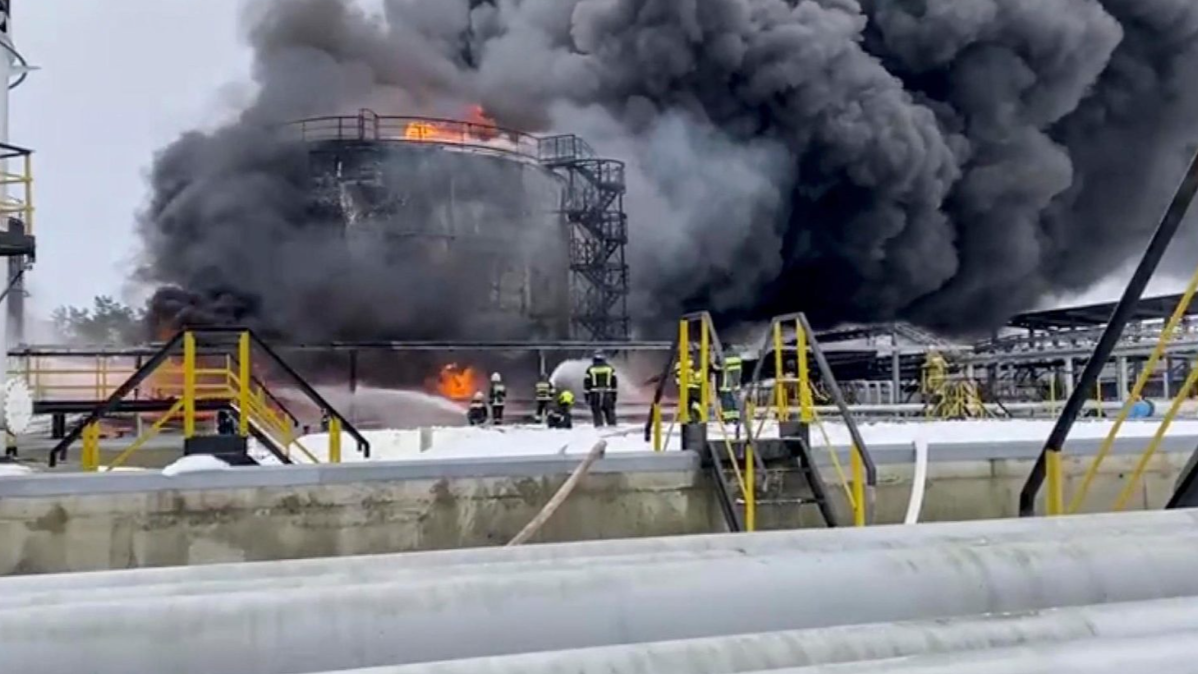
A pivotal shift occurred overnight on July 14–15, 2026. Ukraine struck the Gazprom Neftekhim Salavat refinery in Bashkortostan — previously Russia’s last major untouched gasoline production facility — along with the Afipsky refinery in Krasnodar Krai. Drones traveled over 1,500 km to hit primary processing units at Salavat, igniting fires and knocking out its full 10 million tons per year capacity. The same night, the Afipsky facility (6.25 million tons/year) and an oil transshipment hub at Gelendzhik were also hit.understandingwar.org
Commodity trader and analyst Jack Prandelli summarized the development bluntly on X: “Russia lost its LAST untouched refinery… The message: there’s NO REFINERY LEFT in Russia that’s actually out of reach anymore.”
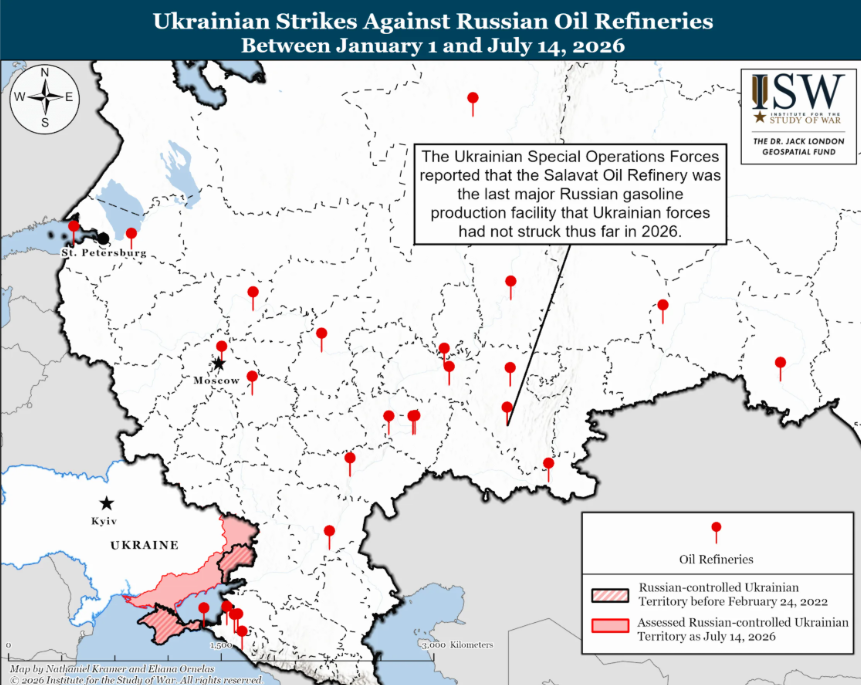
Cumulative Impact: 24 of 34 Major Refineries Hit
These latest strikes build on a sustained Ukrainian long-range drone campaign. As of mid-July 2026, Ukrainian forces have struck at least 24 of Russia’s 34 major refineries, damaging capacity equivalent to roughly 5.1 million barrels per day (around 81% of Russia’s total refining capacity, though not all plants were offline simultaneously).
National refining throughput has fallen to approximately 3.9 million barrels per day — the lowest level in more than 21 years.
Gasoline production has dropped to about 65% of peak summer demand, creating daily shortfalls of 40,000–45,000 metric tons.
Key recent hits (July 2026) include:
- Ilsky refinery (Krasnodar Krai, up to 6.6 million tons/year capacity)
- Saratov refinery (primary distillation unit damaged)
- TAIF-NK in Nizhnekamsk (Tatarstan)
- Oil terminals and depots in Taganrog, Azov, and Ust-Luga
Earlier waves damaged major facilities supplying Moscow and central Russia (Yaroslavl, Ryazan, Kstovo, NORSI, Omsk). Many plants have suffered repeated strikes, with repairs often only partial.
Domestic consequences are severe: widespread gasoline and diesel shortages, rationing (odd-even license plate systems, QR-code limits on refills in some regions), price spikes, queues at pumps, and calls for remote work to reduce travel. Russia has banned or restricted diesel and gasoline exports to prioritize domestic supply. Federal stockpiles are being drawn down, and farmers are warning of harvest disruptions.
How Russia Is Managing the Crisis
Russia is deploying a multi-pronged strategy to mitigate the refining shortfall while protecting war funding from crude oil revenues:
Shadow (“Dark”) Fleet Crude Exports to India and China
Russia continues routing large volumes of crude oil through its shadow fleet of older tankers (often using flag-hopping, ship-to-ship transfers, and opaque ownership to evade sanctions and the G7 price cap). In June 2026, India’s imports of Russian crude hit a record high — rising 34% month-on-month to EUR 4.5 billion. China remains the top buyer. Roughly 54% of Russia’s seaborne oil exports in June moved via sanctioned shadow tankers.
Trading Crude for Refined Products
Russia has begun seaborne imports of gasoline from India to fill domestic gaps. At least 60,000 metric tons have already been dispatched in two tankers (parcels of 30,000–40,000 tons each). This represents a pragmatic swap: Russia exports discounted crude to Indian refiners via the shadow fleet; India processes it and sells gasoline back to Russia.
Allied Imports and Stockpiles
Russia is receiving ~6,000 metric tons per day of gasoline from Belarus and tapping strategic reserves. Kazakhstan has tightened border controls to stop illegal fuel smuggling into Russia.
Domestic Measures:
- Patchwork repairs at damaged refineries (capacity has partially recovered after previous dips).
- Export bans/restrictions on refined products.
- Regional rationing and consumption-reduction campaigns.
- Deputy Prime Minister Alexander Novak publicly acknowledged the issue and pledged additional supplies.
Strategic Implications
While Russia’s crude export machine (via shadow fleet) remains largely intact and continues generating revenue for the war effort, the loss of refining capacity creates a structural vulnerability. Domestic fuel shortages risk economic friction, agricultural disruption, and public discontent. The ability to import products from India (which benefits from cheap Russian crude) provides a temporary buffer, but sustained Ukrainian strikes could force deeper production cuts or heavier reliance on expensive imports.
Ukraine’s new “long-range impact” command signals intent to intensify pressure on Russia’s energy backbone.
The Salavat strike — hitting a facility deep in Bashkortostan that had survived every previous wave — demonstrates that distance is no longer protection. Every major Russian refinery is now effectively in range.
- X post by@jackprandelli(July 15, 2026): Thread and photo of the Salavat strike.
- Institute for the Study of War (ISW) – Russian Offensive Campaign Assessment, July 10, 2026.
- Ukrainska Pravda / various reports on refining throughput (July 2026).
- Reuters reporting on gasoline imports from India (July 1, 2026) and diesel export bans.
- Centre for Research on Energy and Clean Air (CREA) – June 2026 monthly analysis of Russian fossil fuel exports.
- Oxford Institute for Energy Studies (via secondary reporting) on 24 refineries attacked.
- Carnegie Endowment and other analyses on cumulative damage.
- Multiple ISW and Reuters updates on specific strikes (Ilsky, Saratov, etc.).
Visual: ISW map of Ukrainian strikes on Russian oil refineries (Jan 1 – July 14, 2026), highlighting Salavat as the last major untouched gasoline facility prior to the latest strike.This situation is fluid. Energy News Beat will continue monitoring developments, repair timelines, import volumes, and any shifts in shadow fleet activity or India-Russia energy trade.