Oil markets remain highly volatile in August 2026, shaped by the ongoing geopolitical tensions in the Middle East, disruptions around the Strait of Hormuz, and structural shifts among major producers. One of the clearest signals of adaptation by a key player is Abu Dhabi’s aggressive move to control more of its own logistics chain.
ADNOC Logistics & Services (ADNOC L&S), the shipping arm of the UAE’s national oil company, has acquired 11 vessels—six Very Large Crude Carriers (VLCCs) and five Very Large Gas Carriers (VLGCs)—for approximately $1.3 billion (AED 4.8 billion).
This nearly doubles ADNOC L&S’s VLCC fleet from eight to 14 vessels (each capable of carrying roughly two million barrels of crude) and expands its VLGC fleet to 12. Nine of the ships (six VLCCs and three VLGCs) were purchased on the secondary market for delivery in the third quarter of 2026 and immediate entry into service. The remaining two VLGCs are newbuilds acquired via resale from a Chinese shipyard, scheduled for the fourth quarter. The deal follows a recent order for four next-generation LNG carriers worth about $900 million.
The timing is strategic. The UAE exited OPEC and OPEC+ effective May 1, 2026, citing national interests, long-term energy strategy, and a desire to expand production beyond previous quota constraints. Combined with pipeline options that partially bypass Hormuz and aggressive use of its own and chartered tonnage (sometimes under cover of darkness with military escorts), ADNOC has moved substantial volumes even as the strait faced severe constraints. Owning more tankers gives the company greater control from wellhead to customer delivery, reducing reliance on the spot charter market at a moment when availability and costs are under pressure.
Tanker Insurance Rates Through the Roof
War-risk insurance has become one of the most acute constraints on oil movements. Pre-conflict rates for Hormuz transits sat around 0.25% (or lower) of hull value. At peaks during the 2026 crisis, rates reached 5–10% of vessel value—translating into single-voyage premiums of several million dollars for a VLCC or Suezmax (reports cited figures up to $7.5–10 million in extreme cases). Even after partial de-escalations and temporary ceasefires, rates have remained elevated in the 2–6% range or higher depending on conditions, with cover often available only on short notice, subject to strict underwriting, and sometimes withdrawn entirely by some providers.
Lloyd’s of London and the broader London market, along with other major underwriters, have expanded high-risk designations, introduced restrictive clauses, and selectively limited capacity. New or expanded facilities involving U.S. insurers and government-linked reinsurance (including efforts around the Development Finance Corporation) have sought to fill gaps, but coverage is not universal, excludes certain liabilities in some cases, and remains conditional. The result is that commercial insurance for war clearance is expensive, uncertain, or unavailable for many operators.
Impact on Countries Without Government Self-Insurance
National oil companies and governments that can self-insure or backstop their fleets hold a decisive advantage. ADNOC’s fleet expansion is a textbook example of vertical integration that mitigates exactly this risk: more owned tonnage means greater ability to move product even when commercial insurers pull back.
Saudi Arabia’s Bahri fleet has long provided a similar buffer. Countries or producers that lack comparable state-owned fleets, sovereign insurance capacity, or the political/financial ability to self-insure face higher costs, delayed cargoes, reduced market access, or forced reliance on less reliable “shadow” or sanctioned fleets.
If Lloyd’s, other traditional markets, or the newer U.S.-linked facilities refuse or severely restrict war-risk cover, producers without self-insurance options will struggle to get oil to buyers on commercial terms. This can widen price differentials, favor integrated national champions, and further fragment the global tanker market into “insured” and “high-risk/self-insured” segments. Smaller exporters or those in geopolitically exposed regions without government backing are the most vulnerable.
Global Tanker Orders: Who Is Buying and the 20-Year Picture
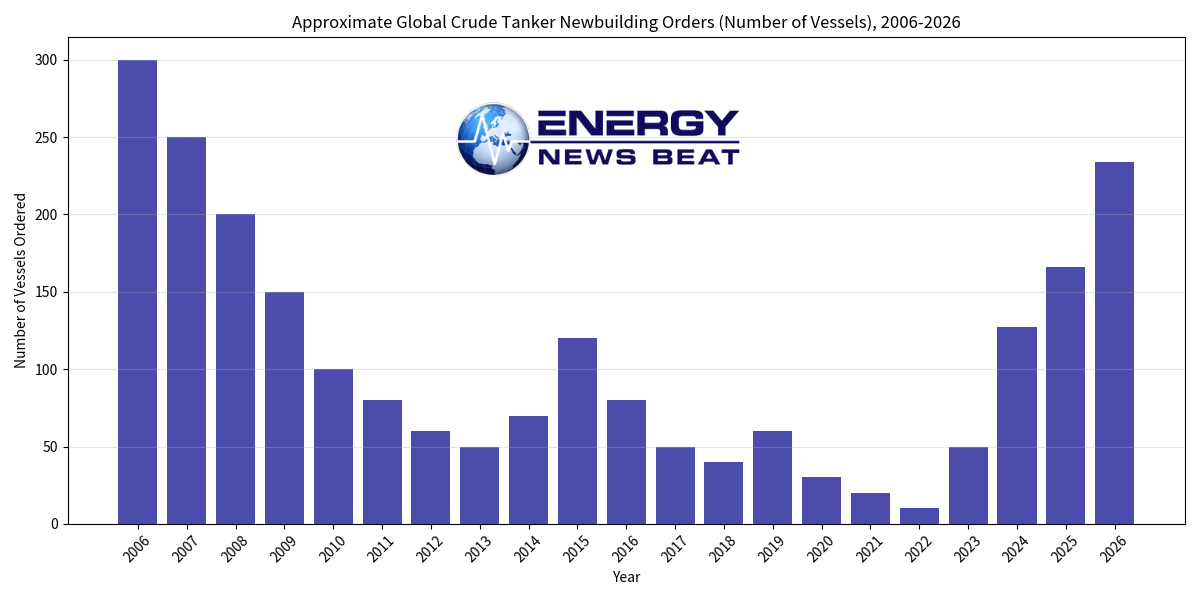
The ADNOC purchase fits into a broader surge in tanker ordering. Crude tanker contracting in 2026 has already set records. By mid-year, BIMCO and other trackers reported roughly 234 crude tankers ordered (around 60 million dwt), with VLCCs dominating (over 150 units in some counts for the first half alone—more than double the full-year 2025 total in that segment). The crude tanker orderbook has swollen to record or near-record levels (reports cited over 130 million dwt or more than 600 vessels in some tallies), equivalent to roughly 27% of the existing fleet in places, far above the trough near 3% seen in 2022–2023.
Chinese yards have captured the large majority of new contracts; Greek owners have been the most active commercial buyers, followed by other Asian and international players. National entities such as ADNOC and Saudi Arabia’s Bahri continue to expand controlled fleets.
Ordering has been cyclical. The mid-2000s boom (peaking around 2006–2008 with hundreds of vessels ordered and orderbook-to-fleet ratios that later caused oversupply) gave way to leaner years, especially after 2015–2016 and the very low activity of 2021–2022. Activity recovered gradually from 2023, accelerated in 2024–2025, and exploded in 2026 amid high freight rates, an aging fleet (significant share of VLCCs and other crude tankers over 20 years old), and geopolitical premiums on owned capacity.
Taking Control From Well to Delivery
ADNOC’s $1.3 billion investment is more than a fleet expansion; it is a deliberate step to internalize shipping risk at a time when commercial insurance and charter markets are strained. In an environment of flux—UAE outside OPEC, Hormuz contested, insurance rates elevated, and orderbooks swelling—the ability to move one’s own barrels on owned ships provides resilience that pure producers without logistics assets lack. Countries unable to self-insure or secure government-backed cover will find themselves at a competitive disadvantage when traditional providers such as Lloyd’s or emerging U.S. facilities tighten terms.
One thing to watch on the UAE’s forward progress is the IRGC’s consistent claims to exit the port outside the Strait of Hormuz. After the UAE left OPEC and OPEC+, it is clear they are pursuing a UAE-first strategy as well, as they should.
Oil markets will continue to reward vertical integration and balance-sheet strength. ADNOC’s move is a clear illustration of that reality.
You have also heard Stu Turley on the Energy News Beat Podcast say, “Energy Security Starts at Home, and your Energy Dominance is displayed through your exports.” This is a true example of how this plays out.
Make no mistake, this should wake up the administration to the fact that we need our own tanker fleet. Buy them now, flag them, and at the same time start getting our shipping yards moving again. As the US is the global financial center of the US Dollar, we face the potential of becoming the British Pound Sterling. A thing of the past like the British fleet.
Appendix: Sources and Links
- Bloomberg: “UAE’s Adnoc Buys Tankers for $1.3 Billion as Crude Exports Boom” (August 7, 2026) – https://www.bloomberg.com/news/articles/2026-08-07/uae-s-adnoc-buys-tankers-for-1-3-billion-as-crude-exports-boom
- Reuters: “ADNOC L&S expands fleet with $1.3 billion acquisition of 11 vessels” (August 7, 2026) – https://www.reuters.com/business/energy/adnoc-ls-expands-fleet-with-13-billion-acquisition-11-vessels-2026-08-07/
- The National: “Adnoc L&S buys 11 new vessels for $1.3bn to boost oil and gas exports” – https://www.thenationalnews.com/business/energy/2026/08/07/adnoc-ls-buys-11-new-vessels-for-13bn-to-boost-oil-and-gas-exports/
- Offshore Technology / company statements and related coverage of the $1.3 billion deal.
- Emirates News Agency (WAM): UAE decision to exit OPEC & OPEC+ – https://www.wam.ae/en/article/bzxzuh7-uae-announces-decision-exit-opec-opec%2B
- BIMCO analyses on crude tanker contracting records in 2026 (via MarineLink, Splash247, PortNews, and related reports).
- Clarksons Research data referenced in SEC filings and industry reports on orderbooks and fleet statistics (March 2026 and related).
- Veson Nautical / VesselsValue data on 2026 ordering surges and ownership.
- Insurance Business, Marsh, Lloyd’s List, S&P Global, and related reporting on Hormuz war-risk premiums (multiple articles, June–August 2026).
- Additional context from Seatrade Maritime, Lloyd’s List, BRS Shipbrokers, and company disclosures on fleet ownership (Greece, China, Bahri, Frontline, etc.).
All figures and developments are current as of early August 2026 reporting. Market conditions, especially insurance rates and orderbook tallies, can shift rapidly with geopolitics.