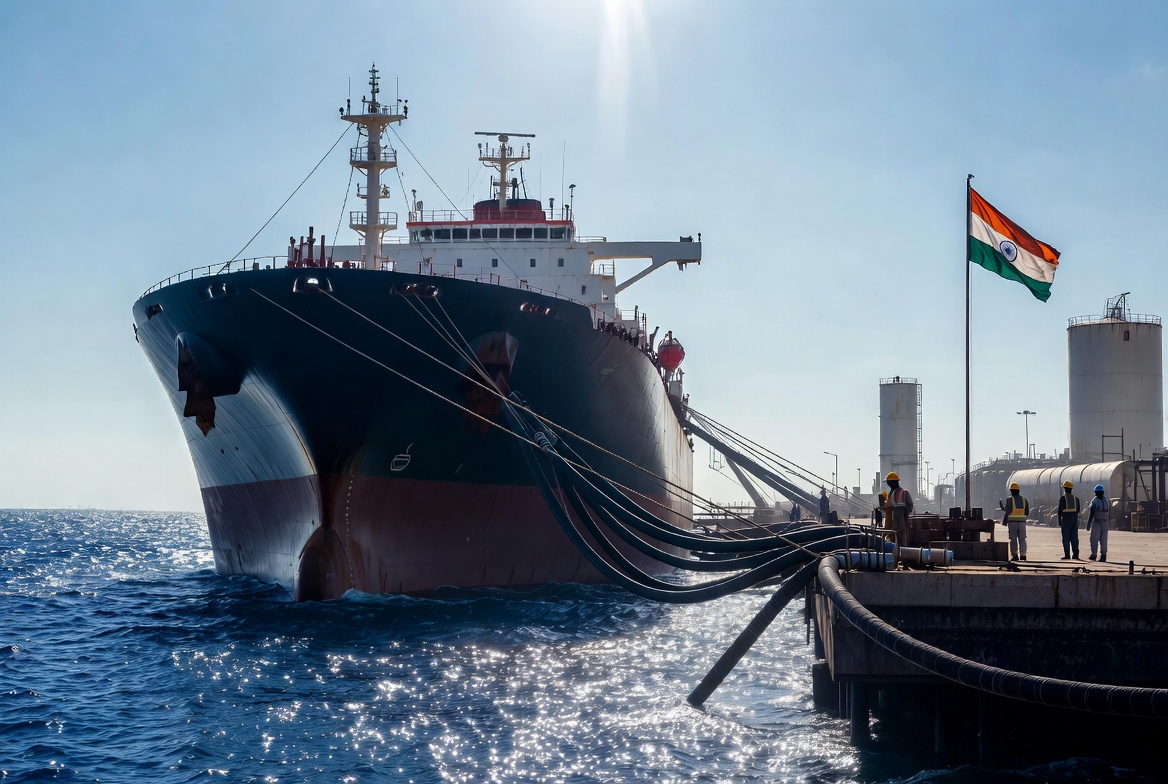
Russia is capitalizing on elevated global oil prices triggered by the ongoing Middle East conflict, pushing crude export volumes near 2026 highs while redirecting flows to key Asian buyers—most notably India.
According to tanker-tracking data compiled by Bloomberg, Russia’s four-week average crude shipments reached 3.66 million barrels per day (bpd) in the period ending May 24, 2026—essentially flat from the prior week’s 3.65 million bpd but about 100,000 bpd higher than the 2025 average for the same period. Export volumes this year have already surpassed the full-year averages recorded in every year since Moscow’s full-scale invasion of Ukraine in 2022.
A standout driver of the surge has been India. Indian imports of Russian crude have jumped 70% since February, helping Moscow offset any Western pressure and fill the gap left by disrupted Middle Eastern supplies amid the Iran-related conflict.
Independent data from Kpler and other trackers corroborate the rebound: Russian volumes to India hit record highs in March (around 2.14–2.25 million bpd, nearly doubling February levels) and have remained elevated into April–May, with some weeks approaching 2.1–2.3 million bpd. This shift occurred after a temporary dip in early 2026 linked to U.S. sanctions concerns, followed by a U.S. waiver for already-loaded cargoes and the Strait of Hormuz disruptions that curtailed Middle East flows to India.
The Kremlin is clearly banking on these higher prices and redirected volumes. Russia’s Urals crude has benefited from the global rally, providing a timely revenue boost even as longer-term production and export forecasts have been revised downward due to sanctions and infrastructure challenges.
Russia’s 2026 Economy and Energy Revenues: Headwinds Persist, But Oil Provides a Lift
While crude flows are strengthening in the short term, Russia’s broader economy has shown clear signs of strain in 2026. Preliminary data indicate GDP contracted by approximately 0.3% year-over-year in the first quarter—the first quarterly decline since early 2023—driven by high interest rates, wartime spending, sanctions, and softening domestic demand.
The Russian government sharply downgraded its 2026 GDP growth forecast in mid-May from 1.3% to just 0.4%, citing weaker oil revenues (earlier in the year), a stronger ruble, and mounting fiscal pressures. Independent forecasts vary: Wikipedia/IMF projections hover around 1.1% for the full year, while some think tanks and banks (including Sberbank) now see 0.5–1%. Nominal GDP is estimated at roughly $2.66 trillion.
Energy sales—still the backbone of the federal budget—have been volatile but received a significant tailwind from the Middle East conflict. After a weak start to the year:
February 2026 fossil fuel export revenues rose modestly to around €492 million per day.
March saw a dramatic surge: oil export earnings nearly doubled to approximately $19 billion (from ~$9.7 billion in February), with daily earnings jumping over 140%.
April revenues climbed further to roughly €734 million per day (highest in 2.5 years), despite slightly lower volumes, driven by higher prices.
May projections show oil-and-gas budget revenues at around 700 billion rubles (~$9.8 billion), up 39% year-over-year.
The Ministry of Economy has nonetheless revised downward its 2026–2029 forecasts for crude and gas production and exports, reflecting ongoing sanctions, drone attacks on infrastructure, and structural constraints. Oil exports under the base-case scenario were cut by millions of tons for both 2026 and 2027.
Analysts note that while the Iran war and Hormuz disruptions have delivered a short-term “dividend” for Russian energy revenues, the budget remains under pressure from high military spending and falling non-energy revenues. The government has already signaled it will direct any extra oil income into the National Wealth Fund rather than expand spending aggressively.
Bottom line: Russia’s crude export machine continues to adapt and find willing buyers in Asia—India in particular—while global prices remain supportive. Yet the 2026 economic picture is one of slowing growth, fiscal tightness, and reliance on volatile energy windfalls. The Kremlin is cashing in where it can, but longer-term challenges from sanctions and over-dependence on oil remain firmly in place.
- Bloomberg: “Russia Boosts Crude Flows as Kremlin Banks Gains From Iran War” (May 27, 2026) – https://www.bloomberg.com/news/articles/2026-05-27/russia-boosts-crude-oil-exports-to-cash-in-on-middle-east-war?srnd=phx-industries-energy
- Reuters: “Russia revises down oil and gas production and exports forecasts 2026-2029” (May 12, 2026) – https://www.reuters.com/business/energy/russia-revises-down-oil-gas-production-exports-forecasts-2026-2029-document-2026-05-12/
- The Moscow Times: “Russia Cuts 2026 Growth Forecast as Oil Revenues and Wartime Pressures Weigh on Economy” (May 12, 2026) – https://www.themoscowtimes.com/2026/05/12/russia-cuts-2026-growth-forecast-as-oil-revenues-and-wartime-pressures-weigh-on-economy-a92733
- Wikipedia: Economy of Russia (2026 data) – https://en.wikipedia.org/wiki/Economy_of_Russia
- Reuters: “Russia’s economy shows first quarterly contraction in three years” (Apr 29, 2026) – https://www.reuters.com/business/russias-economy-shows-first-quarterly-contraction-three-years-2026-04-29/
- Centre for Research on Energy and Clean Air (CREA) monthly analyses (Feb–Apr 2026) – https://energyandcleanair.org/
- Reuters: “Russia’s oil and gas revenue seen up 39% y/y in May thanks to Iran war” (May 20, 2026) – https://www.reuters.com/business/energy/russias-oil-gas-revenue-seen-up-39-yy-may-thanks-iran-war-2026-05-20/
- Additional supporting data from Kpler, Vortexa, Times of India, and OilPrice.com reports on India-Russia crude flows (March–May 2026).
All data current as of May 27, 2026. Energy News Beat will continue monitoring developments in Russian exports and global energy markets.