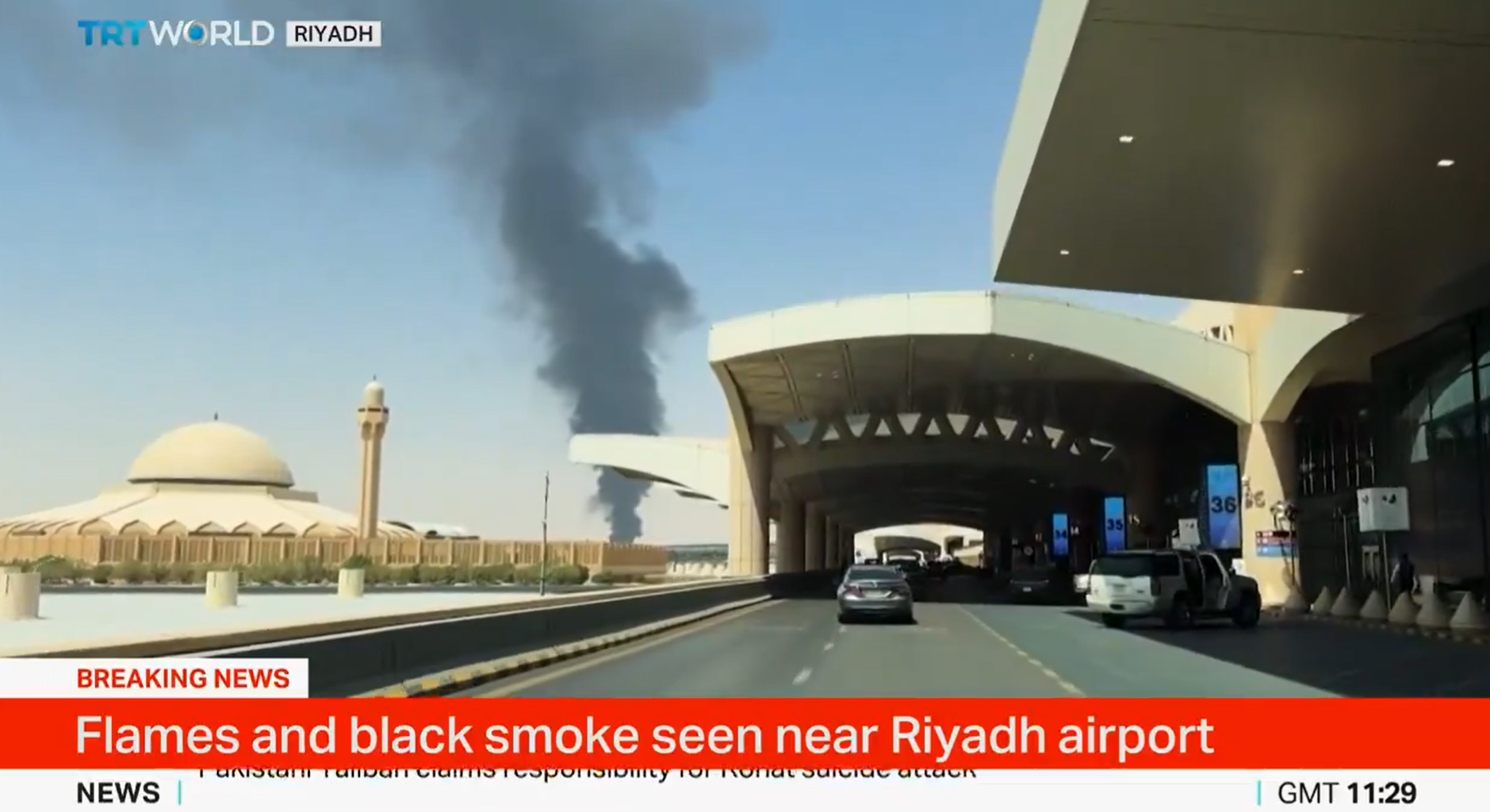
Saudi Arabia’s capital came under direct threat early Saturday as air-raid alerts sounded over Riyadh and explosions were heard, followed by a large plume of black smoke rising from a fuel storage depot at King Khalid International Airport. The incident marks the first time Houthi attacks have visibly affected the Saudi capital since fighting with the Iran-backed group intensified in July.
Reuters video and photographs showed a towering column of black smoke with flames visible behind fuel tanks near the airport highway and main terminal. Flight-tracking data from FlightRadar24 placed the airport at its maximum disruption index of 5.0, with cancellations and lengthy delays. Saudi Civil Defense issued overnight “hostile aerial threat” alerts for Riyadh and nearby Al-Kharj before sending an all-clear Saturday morning. Officials have not publicly identified the source of the threat or confirmed a direct hit.
TRT World posted video of the smoke rising from the fuel storage depot, drawing widespread attention. Some Saudi accounts, including journalist Hussein al-Gawi, later described the fire as originating at a residential property rather than the airport itself, highlighting the difficulty of verifying damage in real time.
The Houthis separately claimed two drone attacks targeting Najran Airport and an Aramco facility in southern Saudi Arabia. These claims have not been independently confirmed by Riyadh.
Last 24 Hours: Strikes, Alerts, and Limited Damage Assessment
In the period from Friday afternoon through Saturday midday (UTC), the main confirmed activity inside Saudi territory centered on Riyadh:
Overnight air-raid alerts and at least two explosions heard in the capital.
Fire and heavy smoke at the King Khalid International Airport fuel storage area, identified in multiple reports as an Aramco tank or depot.
Major flight disruptions at Riyadh’s main airport.
No detailed official bomb damage assessment (BDA) has been released for the Riyadh incident. Saudi authorities have historically been tight-lipped on specific infrastructure impacts, typically stating that fires were contained and operations resumed after temporary interruptions. Earlier satellite imagery from previous weeks showed damage to pumping stations on the East-West pipeline and possible effects at King Khalid Air Base in Khamis Mushait, but no equivalent public imagery or official BDA has appeared yet for Saturday’s events.
Oil Assets Hit Again?
Yes. The Riyadh airport fuel depot is an Aramco-linked asset. This follows a pattern of repeated Houthi targeting of energy infrastructure:
- Aramco facilities and the Jizan industrial/refinery complex (400,000 bpd capacity) in the south.
- Aramco sites in Abha and Najran.
- The East-West pipeline (critical for moving crude to Red Sea export terminals after the Strait of Hormuz disruption), which suffered damage to pumping stations in mid-September.
- Claimed strikes on Yanbu, Saudi Arabia’s main Red Sea oil port.
Saudi Energy Ministry statements after earlier waves described fires at multiple southern energy and utility sites, temporary operational halts, and ongoing assessments. Aramco has previously said interruptions had no material impact on overall production or finances, citing spare capacity. The latest Riyadh fire adds another data point but does not yet indicate a large-scale production outage.
Full List of Recently Hit or Claimed Targets (September Escalation)September 19 (last 24 hours):
King Khalid International Airport, Riyadh — fuel storage depot/Aramco tank (fire, smoke, flight disruptions).
Claimed: Najran Airport and Aramco facility, Najran.
Prior days/weeks (key confirmed or claimed hits):
- East-West oil pipeline pumping stations.
- Aramco facilities and Jizan City for Primary and Downstream Industries / Jizan refinery area.
- Aramco sites in Abha and Najran.
- King Khalid Air Base, Khamis Mushait (hangars, runways, depots claimed).
- Abha International Airport (earlier strikes).
- Civilian and economic sites in Abha, Khamis Mushait, Jazan, and Najran (73 wounded on Sept. 8).
- Taif — intercepted drone debris killed one person and injured two.
- Claimed: Yanbu oil facilities and additional air bases.
Damage has generally consisted of fires that were extinguished, temporary shutdowns, and some structural effects visible in satellite photos. No repeat of the 2019 Abqaiq-scale outage has been reported.
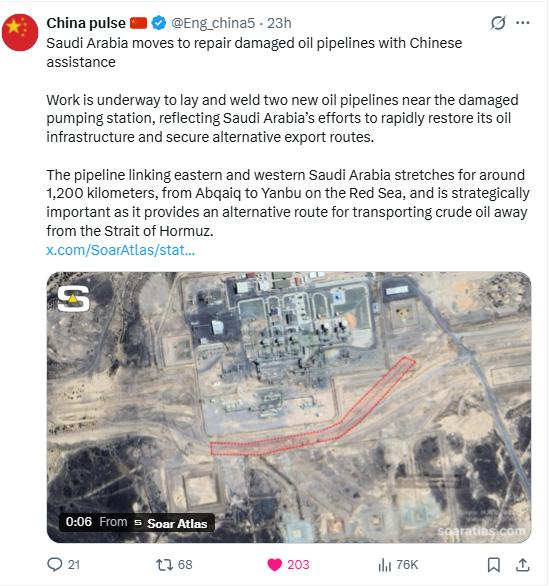
China helping repair problems – Brings up other questions we will report on later. We do not know the details and are following up with the sources on this X post.
What Analysts Are Saying About Oil Prices
Brent crude closed Friday around $104 per barrel after falling for a third consecutive session. Markets had already priced in a substantial risk premium from the effective closure of the Strait of Hormuz, Houthi attacks on Red Sea shipping, and earlier Saudi energy-site strikes. Reports that Saudi Arabia was arranging ship-to-ship transfers off Oman and working to restore partial East-West pipeline capacity helped ease some supply-disruption fears.
Analysts note that Saturday’s strike on a Riyadh airport fuel asset is symbolically significant because it reaches the capital, but the immediate physical impact on crude production or exports appears limited so far. Much of the geopolitical risk was already embedded in prices above $100. Monday trading will reveal whether the latest incident adds a fresh layer of premium or is absorbed as another contained event. Longer-term concerns remain around Red Sea/Bab el-Mandeb access and any further degradation of Saudi export resilience.
The UN Security Council condemned continued Houthi attacks on Saudi civilian and energy infrastructure. Riyadh has vowed to respond firmly while the Houthis frame their operations as retaliation for Saudi airstrikes in Yemen.
The situation remains fluid. Saudi officials have not yet issued statements on the exact nature and extent of Saturday’s damage.
Making Appendices Great Again
Check out the World’s Greatest Podcast Show Notes at EnergyNewsBeat.co or EnergyNewsBeat.com.
Subscribe to the Energy News Beat Substack: https://theenergynewsbeat.substack.com/
______________________________________________________________
Appendix: Sources and Links
- TRT World post and video: https://x.com/TRTWorldNow/status/2101274148169244790
- Dawn / Reuters: Smoke visible near Riyadh airport — https://www.dawn.com/news/2031137
- Times of Israel liveblog, Sept. 19: https://www.timesofisrael.com/liveblog-september-19-2026/
- Al-Monitor / Reuters: Smoke near Riyadh airport — https://www.al-monitor.com/originals/2026/09/smoke-visible-near-riyadh-airport-after-saudi-arabia-issues-all-clear
- The Week: Did Houthi missiles strike Riyadh airport? — https://www.theweek.in/news/middle-east/2026/09/19/did-houthi-missiles-strike-riyadh-airport-saudi-silent-after-viral-videos.html
- Telangana Today: Houthis claim Najran airport and Aramco — https://telanganatoday.com/tag/houthis-saudi-arabia-drone-attacks
- NYT, Sept. 8 and 15 reports on earlier waves: https://www.nytimes.com/2026/09/08/world/middleeast/saudi-arabia-yemen-energy-attack.html and https://www.nytimes.com/2026/09/15/world/middleeast/yemen-saudi-arabia-houthis-attacks.html
- Al Jazeera, Sept. 8 and 17: https://www.aljazeera.com/news/2026/9/8/saudi-houthi-fighting-in-yemen-escalates-what-happened-and-whats-next and https://www.aljazeera.com/news/2026/9/17/five-killed-as-saudi-arabia-and-yemens-houthis-trade-attacks
- NPR, Sept. 8: https://www.npr.org/2026/09/08/g-s1-142296/houthi-attacks-saudi-arabia
- Reuters photos of earlier damage: https://www.reuters.com/pictures/photos-show-damage-saudi-infrastructure-after-houthi-strikes-2026-09-14/
- Oil price context: Reuters / Tribune, Sept. 18 — https://tribune.com.pk/story/2629997/oil-prices-fall-for-third-day-on-hopes-of-limited-saudi-supply-disruptions
- FlightRadar24 disruptions referenced across Reuters, Dawn, and Malay Mail reports.