Geopolitical risks are colliding across multiple theaters in early August 2026, creating a perfect storm for energy markets.
The Strait of Hormuz is flaring again, with Iranian loadings collapsing toward zero. Saudi Arabia’s Jazan refinery has been hit by Houthi drones for the second time in weeks. Ukraine continues deep strikes on Russian refining infrastructure, including a major facility far from the front lines.
And Turkey is emerging as a new pressure point in the Black Sea, with attacks on commercial vessels and Ankara restricting traffic while reducing reliance on Russian crude. Against this backdrop, analysts are once more asking whether Brent can reclaim $100 per barrel.
The short answer is that crude may struggle to get there—or stay there—while the real pain shows up in refined products. Diesel, gasoline, jet fuel, and crack spreads are the more likely candidates to break higher as lost refining capacity, not just crude supply, becomes the binding constraint.
Hormuz Tensions Return and Iranian Exports Stall
According to OilPrice.com reporting on August 11, ICE Brent has rebounded to around $87 per barrel as Hormuz transits slow sharply. No VLCCs loaded Iranian crude in the first ten days of August, and Iranian floating storage sits near 40 million barrels—double July levels when navigation was freer. The risk of Tehran fully halting transits is rising amid stalled Iran-Oman talks, escalatory U.S. rhetoric, and Houthi activity in the Red Sea and Gulf of Oman.
This is not the peak-war disruption of earlier 2026, when Hormuz flows collapsed, and Brent briefly exceeded $120. But the renewed squeeze, combined with U.S. naval pressure on Iranian terminals, removes a meaningful volume of crude just as other risks compound. OPEC output has recovered somewhat to 19.9 million b/d, yet the market remains sensitive to any further choke-point interruption.
Saudi Arabia Under Fire Again
Yemen’s Houthis struck Aramco’s 400,000 b/d Jazan refinery days after Riyadh signed a collective-defense agreement with Turkey and Pakistan. This marks the second successful attack in less than a month. The facility remains offline, with restart now pushed toward late August or early September. Saudi crude production and exports have largely held up, but every lost refining barrel tightens the product market further.
Ukraine’s Drone Campaign Deep Inside Russia
On the same day as the latest Hormuz analysis, Ukraine hit the Orsknefteorgsintez refinery in Russia’s Orenburg region—roughly 1,500 km from the front lines. The plant processes about 6 million tons of crude per year (roughly 120,000 b/d) into gasoline, diesel, aviation fuel, and other products. Fire was reported, and damage is still being assessed. This follows a deadly strike days earlier on Tatneft’s Taneco complex in Tatarstan and a sustained campaign that has already forced many large Russian plants offline for months.
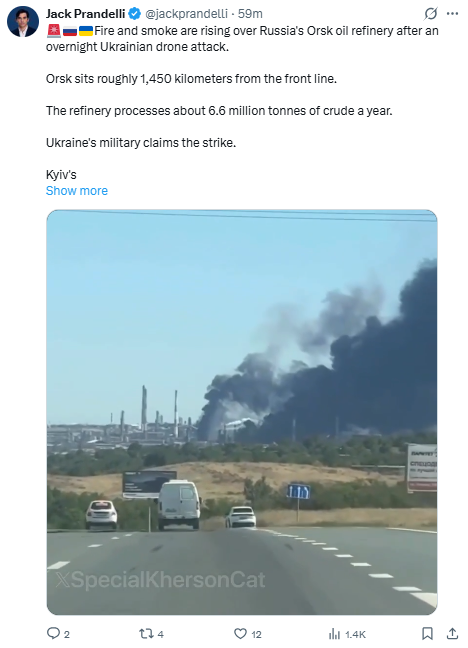
Russian refining runs have fallen to multi-decade lows—estimates range from 3.6–4.0 million b/d at troughs, with 20–40% of capacity affected at peaks. Gasoline and diesel shortages have persisted for over three months inside Russia during peak demand season. Moscow has responded with temporary diesel export bans, removing a traditional source of seaborne middle distillates from the global market.
Turkey Becomes a Black Sea Flashpoint
Turkey is no longer a quiet transit player. Drone attacks have hit Turkish-linked commercial vessels in the Black Sea, prompting Foreign Minister Hakan Fidan to call for a moratorium on strikes against civilian shipping. Ankara has restricted or slowed transit permits for vessels heading to Novorossiysk (a key Russian oil and grain port) via the Dardanelles.
At the same time, Turkish refiners have cut Urals imports and shifted toward Kazakh CPC Blend and Iraqi grades amid tightening sanctions and the EU’s looming ban on fuels derived from Russian oil. These moves reduce one outlet for Russian crude and products while raising the risk of further disruptions to Black Sea flows. Turkey’s dual role as importer, refiner, and potential energy hub makes any escalation here particularly relevant for European and Mediterranean product balances.
Production vs. Demand—and the Real Bottleneck: Lost Refining Capacity
Global oil balances remain tight. Supply has been reduced by Gulf disruptions, Iranian constraints, and lower Russian product availability, while demand has shown some price-driven weakness (especially in China and non-OECD markets). Forecasts from the IEA, EIA, and others still show deficits through much of 2026 before a potential surplus emerges later or in 2027 if flows fully normalize. Yet the more acute shortage is downstream. Years of Western refinery closures left limited spare capacity.
The Iran-related conflict damaged or idled several million barrels per day of Middle East refining capacity at peaks. Ukrainian strikes have taken a large share of Russia’s primary distillation offline for extended periods. Combined with Chinese product-export restrictions and high utilization rates elsewhere (U.S. plants near 97%+), global refinery runs have been millions of barrels per day below pre-conflict levels. Crude can still find homes—via alternative routes, floating storage, or strategic releases—but products cannot be conjured from thin air when distillation units are damaged or offline for safety and repair reasons. This is why the market’s stress is migrating from the crude price to the crack.
Why Brent May Not Sustain $100—While Products and Cracks Could Soar
The OilPrice.com analysis correctly flags the path back toward $100 if Hormuz risks intensify further. Historical elasticities and inventory draws support that possibility in a severe escalation scenario. However, several offsets limit the upside for crude itself: Non-OPEC supply (Americas, Brazil, etc.) continues to grow.
Demand destruction from elevated prices and product shortages is already visible.
Inventories, while drawn, have been buffered by earlier releases and rerouting.
Markets have repeatedly priced in and then partially unwound Hormuz risk premiums throughout 2026.
In contrast, diesel, gasoline, and jet fuel face structural tightness. Russian middle-distillate exports are curtailed. Gulf product exports remain impaired. U.S. and European refiners are running hard but have little spare capacity left. Crack spreads—the difference between crude and refined product prices—have already reached or approached record territory in 2026.
The 3-2-1 crack has traded well above $60/bbl at peaks; diesel and jet cracks have regularly exceeded $60–80/bbl in key hubs. Further outages at Jazan, additional Russian hits, or any new Hormuz-related product flow interruption would push these spreads higher still.
In short, the geopolitical “all under fire” environment raises the probability of another crude spike, but the more durable and economically painful outcome is likely a product-driven squeeze. Consumers and industries that burn diesel, gasoline, and jet fuel will feel it first and hardest—even if Brent stalls short of a sustained $100 print.
Energy markets are rarely about a single chokepoint. Right now they are about simultaneous pressure on crude logistics and the refining system that turns that crude into usable fuel. That dual constraint is what makes the current moment especially dangerous for product prices and refining margins.
Stu Turley on the Energy News Beat Channel actually sees oil prices higher for longer, but in the $75 to $85 range until balance is restored. We may hit spikes, but they won’t last long due to the global bottleneck on refining.
Appendix: Sources and Links
- Tom Kool, “Brent Could Hit $100 as Hormuz Crisis Flares Again,” OilPrice.com, August 11, 2026.
https://oilprice.com/Energy/Energy-General/Brent-Could-Hit-100-as-Hormuz-Crisis-Flares-Again.html - Charles Kennedy, “Ukraine Drone Attack Hits Major Oil Refinery Deep Inside Russia,” OilPrice.com, August 11, 2026.
https://oilprice.com/Latest-Energy-News/World-News/Ukraine-Drone-Attack-Hits-Major-Oil-Refinery-Deep-Inside-Russia.html - Reuters / related coverage of Orsk and Taneco / Nizhnekamsk strikes (August 2026).
Multiple reports including New York Times, The Guardian, and Ukrainian military statements. - Reports on Houthi attacks on Aramco Jazan refinery (July–August 2026) and delayed restart.
Reuters, Bloomberg via Energy Connects, Saudi Energy Ministry statements. - Black Sea / Turkey developments: Turkish Foreign Ministry calls for moratorium, transit restrictions, reduced Urals imports.
Türkiye Today, Kyiv Post, Energy Intelligence, Kpler shipping data summaries (August 2026). - IEA Oil Market Report (June 2026 and subsequent updates) – global supply, demand, and stock balances.
https://www.iea.org/reports/oil-market-report-june-2026 - EIA Short-Term Energy Outlook (July 2026).
https://www.eia.gov/outlooks/steo/ - Analyses of Russian refining losses (Kpler, Energy Intelligence, Oxford Institute for Energy Studies, JPMorgan commentary summarized in secondary reporting).
- Crack spread and product market data (Argus, LSEG, MacroMicro, various market reports on 3-2-1, diesel, and jet cracks in 2026).
- Additional context on global refining utilization and capacity constraints from Wall Street Journal / Mint, Reuters, and industry trackers (August 2026).