Worldwide economies run on continuous and uninterruptible electricity and transportation fuels like the following:
Jet fuel for the military and international airports, diesel fuel for trucks and construction equipment, different grades of gasoline for vehicles, and bunker fuel for all the ships arriving and departing from Ports.
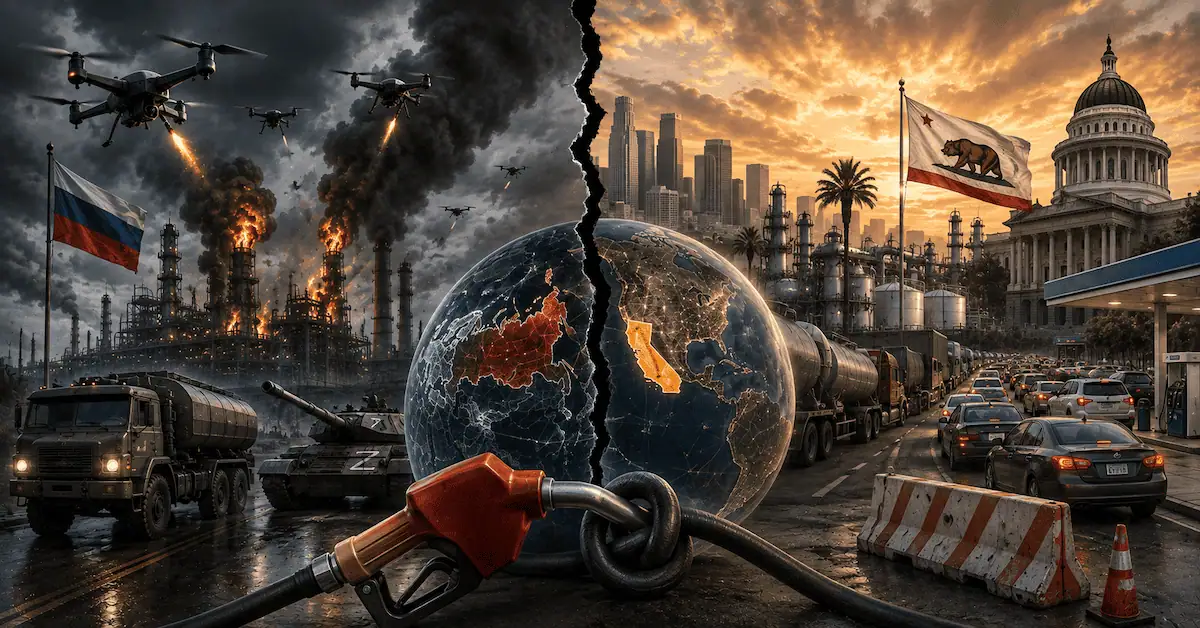
Ukraine and California are using proven ways to reduce the supply chain of those vital fuels.
Ukraine uses military drones to reduce the manufacturing capabilities of its enemy, Russia. California uses political overregulations to effectively establish an unfriendly business environment for refineries to remain within the State to manufacture the transportation fuels demanded by the 4th largest economy in the world.
Ukraine is using drone attacks on Russian refineries to reduce the supply chain of transportation fuels demanded by the Russian military and its economy.
Starting in August 2025, increased Ukrainian drone attacks on Russian oil refineries during the Russo-Ukrainian War caused widespread damage and a significant decrease in production of refined products across the Russian oil industry, leading to a fuel crisis in the country.
According to a June 25, 2026, analysis by CNN, Ukraine had struck Russian oil facilities over 300 times since the start of Russia’s full-scale invasion on 24 February 2022.
Russia is facing severe nationwide fuel shortages caused by Ukrainian drone and missile strikes on its major oil refineries.
- Drivers across multiple regions, especially in Siberia and remote areas, have faced lines at gas stations lasting hours or even days.
- Local authorities have introduced purchase limits, such as capping vehicles at a single fill-per-day in regions like Altai and banning filling portable gas canisters in others.
- National average gasoline prices climbed over 18% since the beginning of the year,
California had more than 40 operating oil refineries in the early 1980s, but that number has dropped significantly due to industry consolidation and environmental transitions. The number of active refineries has fallen to 7, as the state overregulates its supply chain of transportation fuels demanded within the state.
- Recent closures of major in-state refineries, including facilities operated by Phillips 66 and Valero, have slashed local gasoline production and forced a heavier reliance on foreign imports
- California uses a unique specialized environmental gasoline blend and lacks pipeline connections to the rest of the U.S., making it difficult to quickly backfill supply from domestic out-of-state sources.
- Ongoing conflict in the Middle East and restrictions tied to the Strait of Hormuz have constrained international crude shipments, raising replacement costs for refiners who import a significant portion of their crude oil feedstock.
- While overall inventory numbers sit near multi-year lows, analysts emphasize that extreme price spikes tend to induce “demand destruction” where high costs naturally curb consumption at local stations.
While California Governor Newsom and policymakers remain oblivious that economies around the world run on transportation fuels for planes, ships, trucks, construction equipment, and vehicles, and the infrastructure that is supported by the products made from oil derivatives extracted from raw crude oil, the State’s political policies are effectively supporting an impending collapse of California’s transportation fuel infrastructure.
Driven by adversarial state policies and aggressive litigation from activist groups, California’s domestic refining capacity has already been crippled, and has led to the most expensive transportation fuel in the nation for its California residents.
Jet fuel for the State’s 40 military and 9 international airports, bunker fuel for all the ships arriving and departing from 3 of the busiest Ports in America at Long Beach, Los Angeles, and Oakland, diesel fuel for trucks and construction equipment, and different grades of gasoline for vehicles.
The more than 6,000 products in our daily materialistic lives that did not exist before the 1800s are meeting the supply chain demands of today’s hospitals, airports, telecommunications, appliances, electronics, sanitation systems, and heating and ventilating systems to support current lifestyles.
California policymakers are unaware that crude oil by itself is useless black tar unless entrepreneurial companies build a multi-billion-dollar refinery to break it down to produce various types of transportation fuels like jet, diesel, gasoline, and bunker fuel for ships, and oil derivatives that are the basis of more than 6,000 products in our materialistic world.
The global population has surged from 1 to over 8 billion in less than 200 years. This growth has been supported by the dramatic increase in the number of products and transportation fuels made from oil, and food production made possible by synthetic fertilizers, all of which did not exist before the 1800’s, just a few hundred years ago.
California Governor Gavin Newsom has yet to share his Energy Wisdom, IF ANY, publicly about all the money spent on wind turbines, solar panels, and battery storage, as the “renewable industry” CANNOT support the transportation fuels demands of various infrastructures of military airports, commercial airports, merchant ships moving products through various shipping ports, truck and construction equipment fuel demands, nor meet the demands for more than 6,000 products used by hospitals, airports, telecommunications, appliances, electronics, sanitation systems, heating and ventilating systems to support current lifestyles.
The impacts on military readiness, the local economies, and lifestyles are very similar to the different approaches taken by Ukraine and California to reduce transportation fuel availability.
Please share this information with teachers, students, and friends to encourage Energy Literacy conversations at the family dinner table.
Click this Link to Sign up for Energy Literacy from Ronald Stein.